

Business Studies Concept Notes for Class 12: Chapter 10 Financial Markets
Access comprehensive revision notes for Chapter 10 Financial Markets using the CBSE Class 12 Business Studies Financial Markets Notes Set 01. Designed to align with the 2026-27 academic syllabus for Class 12 Business Studies, these concept summaries help students streamline their exam preparation and review complex topics efficiently.
Download Chapter 10 Financial Markets Revision Notes PDF
Access the complete concept summary PDF for Chapter 10 Financial Markets below. Regular review of these targeted notes builds familiarity with complex Class 12 Business Studies themes and helps secure higher marks in final school evaluations.
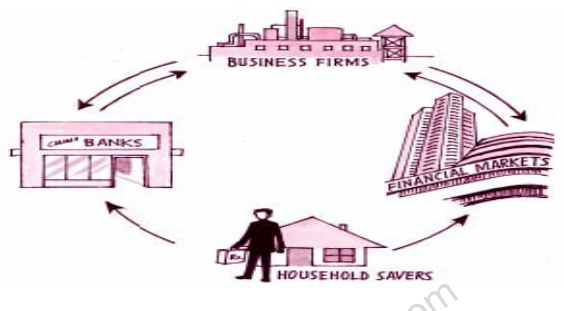
Introduction : Financial Market is a market for creation and exchange of financial assets like share, bonds etc. It helps in mobilising savings and channelising them into the most productive uses. It helps to link the savers and the investors by mobilizing funds between them. The person / Institution by which allocation of funds is done is called financial intermediaries.
Functions of Financial Market.
1. Mobilisatin of Savings and channeling them into the most productive uses : Financial market facilitates the transfer of savings from savers to investors and thus helps to channelise surplus funds into the most productive use.
2. Help in Price Determination : Financial Market helps in interaction of savers and investors which in turn helps in the determination of prices of the financial assets such as shares, debentures etc.
3. Provide Liquidity to Financial Assets : Financial market ficilitate easy purchase and sale of financial assets. Thus, it provide liquidity to them so that they can be easily converted into cash whenever required.
4. Reduce cost of transations : Financial market provide valuable information about securities which helps in saving time, efforts and money and thus it reduces cost of transactions.
the determination of prices of the financial assets such as shares, debentures etc.
3. Provide Liquidity to Financial Assets : Financial market ficilitate easy purchase and sale of financial assets. Thus, it provide liquidity to them so that they can be easily converted into cash whenever required.
4. Reduce cost of transations : Financial market provide valuable information about securities which helps in saving time,efforts and money and thus it reduces cost of transactions.
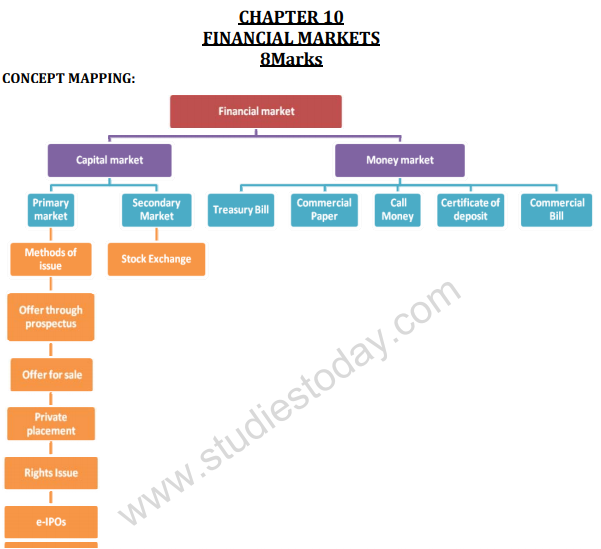
Money Market :- It is a market for short term funds / securities whose period of maturity is upto one year. The major participants in the money market are RBI, Commercial Banks, Non-Banking Finance Companies, State Government, Large Corporate Houses and Mutual Funds. The main insruments of money market are as follows.
1. Treasury Bills : They are issued by the RBI on behalf of the Cenral Government to meet its short-term requirement of funds. They are issued at a price which is lower than their face value and repaid at par. They are available for a minimum amount of Rs. 25,000 and in multiples thereof. They are also known as Zero Coupon Bonds.
2. Commercial Paper : It is a short term unsecured promissory note issued by large and credit worthy companies to vaise short term funds at lower rates of interest than market rates.
They are negotiable instrument transferable by endorsement and delivery with a fixed maturity period of 15 days to one year.
3. Call Money : It is short term finance repayable on demand, with a maturity period of one day to 15 days, used for interbank trasactions. Call Money is a method by which banks borrow from each other to be able to maintain the cash reserve ratio as per RBI. The interest rate paid on call money loans is known as the call rate.
4. Certificate of Deposit : It is an unsecured instrument issued in bearer form by Commercial Banks & Fiancial institutions. They can be issued to individuals, Corportations and companies for raising money for a short period ranging from 91 days to one year.
5. Commercial Bill : It is a bill of exchange used to finance the working capital requirements of business firms. A seller of the goods draws the bill on the buyer when goods are sold on credit. When the bill is accepted by the buyers it becomes a marketable instrument and is called a trade bill. These bills can be discounted with a bank if the seller needs funds before the bill maturity.
Capital Market : It is a market for long term funds where debt and equity are traded. It consists of development banks, commercial banks and stock exchanges. The capital market can be divided into two part.
1. Primary Market.
2. Secondary Market
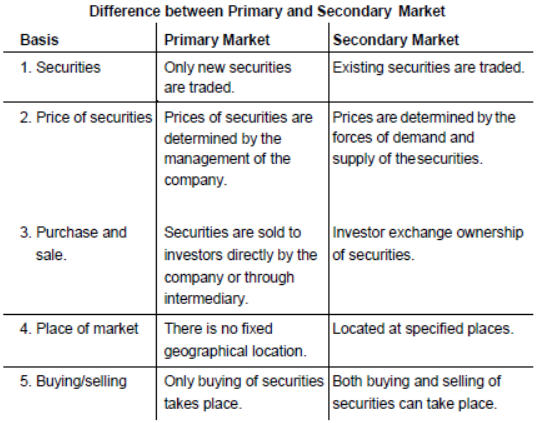
Primary Market : It deals wth the new securities which re issued for the first time. It is also known as the new issues market. The investros in this market are banks, financial institutions, insurance companies, mutual funds and individuals. It has no fixed geographical location and only buying of securities take place in the primary market.
Secondary Market : It is also known as the stock market or stock exchange where purchase and sale of existing securities take place. They are located at specified places and both the buying as well as selling of securities take place.
Methods of Floatation of New Issues in the Primary Market
1. Offer through Prospectus : It involves inviting subscription from the public through issue of prospectus. A prospectus makes a direct appeal to investors to raise capital throughan advertisement in newspapers and magazines.
2. Offer for sale : Under this method securities are offerecd for sale through intermediaries like issuing houses or stock brokers. The company sells securities to intermediary / broker at an agreed price and the broker resell them to investors at a higher price.
3. Private Placements : It refers to the process in which securities are allotted to institutional investor and some selected individuals.
4. Rights Issue : It refers to the issue in which new shares are offered to the existing shareholders in proportion to the number of shares they already possess.
5. e-IPOs :- It is a method of issuing securities through on-line system of stock exchange. A company proposing to issue capital to the public through the on-line system of the stock exchange has to enter into an agreement with the stock exchange. This is called an e-intial public offer. SEBI registered brokers have to be appointed for the purpose of

Key Concepts in nutshell:
CONCEPT OF FINANCIAL MARKET:
It refers to the market which creates and exchanges financial assets.
FUNCTIONS OF FINANICIAL MARKET
1. Mobilization of savings and channeling them into the most productive uses: A financial market facilitates the transfer of savings from savers to investors (industries)
2.Facilitates price discovery: In the financial market, the households are suppliers of funds and business firms represent the demand. The interaction between them helps to establish a price for the financial asset which is beingtraded in that particular market.
3. Provide liquidity to financial assets: Financial markets facilitate easy purchase and sale of financial assets. In doing so they provide liquidity to financial assets, so that they can be easily converted into cash whenever required.
4. Reduce the cost of transactions: Financial markets provide valuable information about securities being traded in the market. It helps to save time, effort and money.
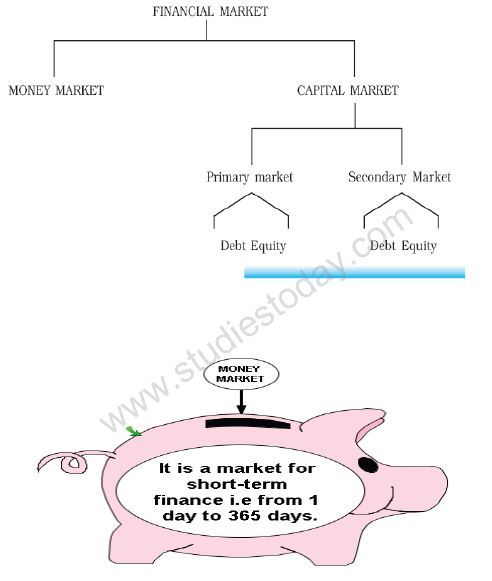
1. Treasury Bill (Tbills): It is basically an instrument of short‐term borrowing by the Government of India maturing in less than one year. They are also known as Zero Coupon Bonds.
2. Commercial Paper: It is a short‐term unsecured promissory note, negotiable and transferable by endorsement and delivery with a fixed maturity period. It is issued by large and creditworthy companies to raise sort‐term funds at lower rates of interest than market rates. It usually has a maturity period of 15 days to one year.
3. Call Money: It is a short‐term finance repayable on demand, with a maturity period of one day to fifteen days, used for inter‐bank transactions. It is a method by which banks borrow from each other to be able to maintain the cash reserve ratio.
4. Certificate of Deposit (CD): It is a unsecured, negotiable short‐term instruments in bearer form, issued by commercial banks and development financial institutions. It can be issued to individuals, corporations and companies.
5. Commercial Bill (Trade Bill): It is a short‐term , negotiable, self‐liquidating instrument which is used to finance the credit sales of firms. The bill can be discounted with a bank if the eller (drawer) needs funds before the bill maturit

TYPES OF CAPITAL MARKET:
Primary Market: It is also known as the new issues market. It deals with new securities being issued for the first time. A company can raise capital through the primary market in the form of equity shares, preference shares, debentures, loans and deposits.
Secondary Market: It is also known as stock market or stock exchange or second‐hand market. It is a market for the purchase and sale of existing securities.
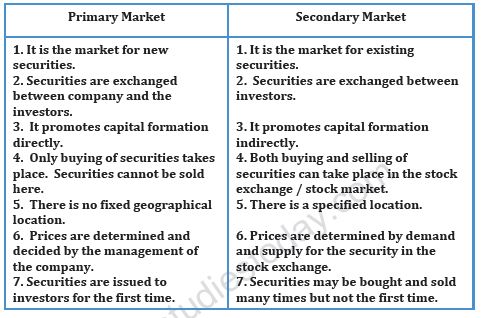
Difference between Primary Market and Secondary Market
Following are the methods of raising capital from the primary market :
• 1. Public issue through prospectus: under this method the company wanting to raise capital issues a prospectus to inform and attract the investing public. It invites prospective investors to apply for the securities.
• 2.Offer for sale: under this method the sale of securities takes place in two steps. In the first step the company sells the entire lot of shares to the intermediary firms of stock brokers at an agreed price .In the second step, the intermediary resells these shares to investors at a higher price.
• 3. Private placement: In private placement the entire lot of new securities is purchased by an intermediary at a fixed price and sold not to the public but to selected clients at a higher price.
• 4 .Rights issue (for existing companies: This is the offer of new shares (additional shares) by an existing company to the existing shareholders. The shareholder may either accept the offer for himself or assign to another. A rights issue to the existing shareholders is a mandatory requirement.
Please click the link below to download pdf file for CBSE Class 12 Business Studies Financial Markets Notes
Free study material for Business Studies
Chapter 10 Financial Markets Concepts and Summary for Class 12 Business Studies
Quick Revision Notes: Chapter 10 Financial Markets (CBSE)
Explore reliable chapter overviews for Chapter 10 Financial Markets tailored for Class 12 learners. Use these structured points to grasp difficult themes and ensure solid preparation for upcoming assessments.
Expert Study Material for Class 12 Business Studies
Cross-reference your comprehension with comprehensive NCERT solutions for Class 12 to ensure absolute clarity across all sub-topics in this chapter.
Complete Your Chapter Revision
Wrap up your chapter revision by testing your knowledge against standard question formats. Everything on our platform is provided free of charge.
FAQs
You can download the teacher prepared revision notes for CBSE Class 12 Business Studies Financial Markets Notes Set 01 from StudiesToday.com. These notes are designed as per 2026-27 academic session to help Class 12 students get the best study material for Business Studies.
Yes, our CBSE Class 12 Business Studies Financial Markets Notes Set 01 include 50% competency-based questions with focus on core logic, keyword definitions, and the practical application of Business Studies principles which is important for getting more marks in 2026 CBSE exams.
Yes, our CBSE Class 12 Business Studies Financial Markets Notes Set 01 provide a detailed, topic wise breakdown of the chapter. Fundamental definitions, complex numerical formulas and all topics of CBSE syllabus in Class 12 is covered.
These notes for Business Studies are organized into bullet points and easy-to-read charts. By using CBSE Class 12 Business Studies Financial Markets Notes Set 01, Class 12 students fast revise formulas, key definitions before the exams.
No, all study resources on StudiesToday, including CBSE Class 12 Business Studies Financial Markets Notes Set 01, are available for immediate free download. Class 12 Business Studies study material is available in PDF and can be downloaded on mobile.