

Revision Notes for Class 12 Business Studies: Chapter 01 Nature and Significance of Management
Review targeted revision notes for Class 12 Business Studies with the CBSE Class 12 Business Studies Nature And Significance Of Management Notes Set 01. Built according to official educational guidelines for the 2026-27 academic year, these downloadable summaries for Chapter 01 Nature and Significance of Management support daily study and last-minute exam readiness.
Review Chapter 01 Nature and Significance of Management for Class 12 Business Studies
Navigate directly to the revision notes for Chapter 01 Nature and Significance of Management using the digital viewer below. Each summary is structured to highlight high-weightage sections, allowing students to instantly access critical definitions and focus on core exam topics.
Linking of Class XI syllabus:
1. In sole proprietorship business, the owner him‐self manages his business.
2. In Partnership business all partners or any one partner on behalf of other partners can manage the business.
3.In HUF ‘Karta’ manages the business.
4. But in a Joint Stock Company, it is managed by professionally qualified managers. So in this context, the need for management arises.
CONCEPT MAPPING
Concept: Management is the process of planning, organising, staffing, directing and controlling the resources efficiently and effectively for achieving the organisational goals.
Characteristics: (a) goal oriented process, (b) pervasive, (c) multidimensional (d) group activity, (e) continuous process, (vi) dynamic function, (vii) intangible force
Objectives : (a) organisational (b) social, and (c) personal objectives
Importance: (a) achieves group goals (b) increases efficiency (c) creates dynamic organization (d) helps
achieve personal goals (e) development of society
Management as Art: Theoretical knowledge, personal application, based on practice, creativity
Management as a Science : (a) Systematic body of knowledge (b) principles dpplication,
base on a(c) universal validity Management as a Profession: (a) well defined body of knowledge (b). restricted entry (c) professional association (d) ethical code of conduct Management fulfills
some but not all of these requirements
Levels of management: (a) Top Level management (b) Middle Level management (c) Supervisory or operational or lower level management
Functions of Maniagement: Planning, organising, staffng, directing and controlling
Coordination : The process of achieving unity of action among interdependent activities and departments of an organisation. It is the essence of management as it is required in all managerial functions.
KEY CONCEPTS IN NUTSHELL
1.MEANING/CONCEPT OF MANAGEMENT: Management is the process of getting things done with the aim of achieving goals effectively and efficiently.
• Process: refers to the primary function like planning, organising, staffing, directing and c.
ontrolling performed by the management to get things done
• Effectiveness: means completing the right task to achieve the deputed goal within the time frame.
• Efficiency: means completion of task using minimum resources
2.DEFINITION OF MANAGEMENT: “Management is the process of working with and through others to effectively achieve the organisational objectives by efficiently using limited resources in the changing environment.”
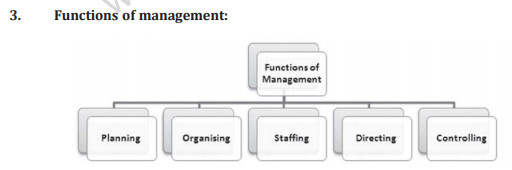
3. Staffing Finding and placing the right person at the right job at the right
4. Directing Leading, influencing, motivating the staff chosen to perform the assigned task efficiently and effectively.
5. Controlling ‐ Ensuring/Monitoring the activities in an organisation are performed as per the plan.
4. Nature of Management: As an art, As a science and As a professio
5. MANAGEMENT OBJECTIVES Organisational Objectives:
Survival: Ensure that the organisation survives and exists in the future. Profitability: Earning adequate profit in order to survive and grow Growth: Growth indicates how well it exploits the potential opportunities.
SocialObjectives:
• Producing quality products at reasonable rates,
• generating employment opportunities,
• Community progress and development by providing schools and crèches to employees In fact most of the firms have taken upon themselves the concept of social responsibility as one of the basic element of business objectives .
• Environmental friendly method of production.
PersonalObjectives:
• Meeting the Financial needs like competitive salaries and perks
• Social and safety needs of the employee like peer recognition, self respect and respect for colleagues
• Higher level needs like implementation and monitoring of policies for personal growth and survival
• Reconcile personal goals with organisational objectives for harmony in the organisation.
6. IMPORTANCE OF MANAGEMENT
• Aids in achievement of individual and organisational goals
• Increases efficiency
• Enhances optimum utilisation of resources
• Creates a dynamic organisation
• Promotes development of society
7. LEVELS OF MANAGEMENT
Top level: Designations and Functions
• Comprises of CEO, Board of Directors, MD, GM, VP
• Conceptualising of organisational goal, policy and strategy formulation
• Organising , Controlling and Monitoring activities and resources
• Controlling the work performance
• Approving Budgets
MiddleLevel: Designations and Functions
• Comprises of Departmental, Sub‐Departmental and Divisional heads.
• Execution of plans, policies framed by the top level management
• Preparing organisational set up & appointing employees
• Issuing instructions and motivating employees
• Ensuring interdepartmental cooperation
LowerLevel: Designations and Functions
• Forwarding suggestions and feedback to the top level
• Comprise of Supervisors, Foremen and inspectors
• Maintain Morale, safety and discipline amongst the work force
• Oversee the work of the workers
• Assist the management in selection, training, placement & promotion of workers
8. NATURE OF MANAGEMENT As an art:
• Existence of theoretical knowledge.
• Developed through Practical and creative process.
• Personalised application and skill
Asa Profession:
• Well defined body of knowledge.
• Existence of code of conduct
• Professional association (AIMA)
• Restricted entry
• Fees as remuneration for their services
Asa Science:
• Arranged, organised systematic body of knowledge
• Universal validity
• Principles arrived at after experimentation
9. COORDINATION
It is the synchronisation of various activities and efforts in an organisation providing the required amount of quality, timing and sequence; thus ensuring the achievement of the planned goal with minimum content.
10. FEATURES OF COORDINATION:
• Integrates Group Effort: It is an orderly arrangement of group effort and not individual effort
• Ensures unity of action: It is a binding force between departments and ensures that all efforts are focussed towards achieving the organisational goal
• It is a Continuous Process never ending process as its needs are felt at all levels and steps in the organisations. It begins at the planning stage and continues till controlling
• It remains the function and responsibility of every manager: the top level coordinates the overall plan, middle level coordinates the efforts of the different sections and subsections and lower level management coordinates the activities of the workers.
Q14. Amit and Kavya, complete their school education together. After that Amit appears and qualifies MBBS entrance examinations and joins a reputed Medical college to pursue a degree in medicine. After 4 years, he will get a degree from Medical council of India and start practicing as a doctor. Kavya had to take over her mother’s business as she passes away in a tragic accident. She assumes the post of Managing Director’ in the company. Kavya also joins National Open School to complete her graduation along side.
On the basis of above para identify and explain the main features of a profession. Also, share your views on whether management is a profession or not.
Q15. Prime Minister of India, launched the Swaach Bharat Abhiyan and urged all the citizens and business organizations to actively support it. Keeping this in mind, Armour Helments Pvt. Ltd. decided to contribute by installing 500 dustbins in and around major markets of the city.
Which objective of management is the company trying to fulfill by this act?
ANSWERS
Answer 1: The company is lacking an important aspect of management that is Coordination. Here production department, marketing department and finance department are not working in unity for achieving the goals of the organization due to which return on investment and market share is declining.
To bring company back on track proper coordination should be ensured. Coordination will help in integrating activities of separate units of an organization to accomplish the goals efficiently.
Favourable environment should be created where departments instead of blaming each other can work in harmony with each other for improving the current situation of the company.
Answer 4: Top level management
Answer 6: a. Social Objectives have been discussed in the given situation. The social objectives of an organisation basically involves the creation of benefit and development of the society. The
following are some of the social objectives of management that are being indicated in the given situation.
i. Producing environment friendly products such as solar lanterns.
ii. Setting-up a factory of solar lanterns in order to provide electricity in rural areas.
iii. Providing employment opportunities to the needy.
Answer 10: He is effective but not efficient
Please click the link below to download pdf file for CBSE Class XII Business Studies - Nature and Significance of Management Notes.
Definition Of Management
Question 1. Who defined management as "the process by which a co-operative group directs actions of others toward common goals"?
Answer: According to Marrie and Douglas, management is the process by which a co-operative group directs actions of others toward common goals. Management is understood as the process of planning, organising and controlling an organization's operations in order to reach the target efficiently and effectively. It is essential for all organisations.
In simple words: Marrie and Douglas say that management is how a group works together to guide others toward shared goals. It uses planning, organising, and control to reach targets both well and on budget.
Exam Tip: Always mention both the authors' names (Marrie and Douglas) when answering definition-based questions, and include key terms like "planning," "organising," and "controlling."
Question 2. What is the concept of management?
Answer: Management is a process that aims to bring the efforts of the people working in the organization to reach a common objective effectively and efficiently.
The concept includes:
(a) Process - The term process refers to the primary activities performed in an organization by the management to reach the objective. It includes planning, organizing, staffing, directing and controlling.
(b) Effectively - The term effectively refers to completion of the given task in the allotted time frame.
(c) Efficient - The term efficient means completing the task within minimum cost as well as optimum utilization of resources.
In simple words: Management is a way to combine all workers' efforts toward one shared goal. It does this through planning, organizing, staffing, directing, and controlling. It means finishing work on time (effectively) and spending less money (efficiently).
Exam Tip: Remember the three key concepts - Process (the activities), Effectively (finishing on time), and Efficiently (using minimum resources) - as these form the foundation of the management definition.
Question 3. What is the difference between effectiveness and efficiency?
Answer:
| Basis | Effectiveness | Efficiency |
|---|---|---|
| Meaning | It refers to the process of completing the assigned task within the given time frame. | It refers to the process of completing the assigned task with minimum wastage and at minimum cost. |
| Objectives | To reach the targets on time. | Optimum use of resources and at minimum cost. |
| Main Element | Time. | Cost. |
In simple words: Effectiveness means doing the job within the set time. Efficiency means doing the job with the least spending and waste. The first one focuses on time; the second one focuses on cost.
Exam Tip: Remember the key distinction - Effectiveness is about TIME, while Efficiency is about COST. This will help you quickly answer questions comparing the two.
Question 4. What are the characteristics of management?
Answer: The characteristics of management are:
(i) Management is a Goal Oriented Process - Organization's existence is based on objectives and management is the process which unites the efforts of every individual to reach the goal.
(ii) Management is All Pervasive - The use of management is not limited; it applies in all organisations whether big or small, profit or non-profit making.
(iii) Management is Multidimensional - It does not contain one activity; it is a complex activity including three main activities:
(a) Management of house
(b) Management of people
(c) Management of operations
(iv) Management is a Continuous Process - It is a never ending process. It consists of series of interrelated functions which perform continuously.
(v) Management is a Group Activity - Organisation is a collection of many individuals; every individual contributes towards reaching the goal.
(vi) Management is an Intangible Force - It cannot be seen or touched; only it can be felt in the way the organisation functions.
In simple words: Management works toward goals by uniting all workers. It happens in all types of organizations. It involves managing homes, people, and tasks. It never stops and everyone participates. You cannot see management, but you can see its effects on how the organization works.
Exam Tip: When listing characteristics, remember the six key points and ensure you explain what each characteristic means rather than just stating it as a label.
Question 5. What are the objectives of management?
Answer: There are three objectives of management:
1. Organizational Objectives - Organizational Objectives are those objectives that are set by the management of an organization within a predetermined time period. An organization has different types of objectives to be achieved; these objectives are determined in consideration to the different interests of the stakeholders. The main objective of an organization is optimum utilisation of resources in the most effective and efficient manner. It is further divided into three parts - survival, profit and growth.
- Survival - Ensuring survival in the market in the long run by taking positive decisions in respect of business activities is the primary objective of management.
- Profitability - Any person or individual who runs a business has the ultimate objective of earning profit. Management ensures to earn sufficient profit to meet its various needs.
- Growth - Management should aim towards continuously improving the performance of the organization. It is the general objective of management to secure maximum results through minimum resources to increase prosperity and growth.
2. Social Objectives - Any organization that operates doesn't solely have an objective of profit making. It also has some social obligations or social objectives to fulfill towards the society. This may differ from organization to organization. For example: Some aim at providing basic infrastructure to the people living around, some aim at providing maximum employment and some aim at producing products that are environment friendly.
3. Personal Objectives - Each and every individual joins an organization for pursuing their personal objectives. Some join for a good package of salary, some join for greater recognition, some just for survival. So, this depends upon individual to individual. It is important for an organization to identify the personal objectives to integrate it with the organizational objectives to bring harmony in the organization.
In simple words: Management has three main goals. First, organizational goals focus on staying in business (survival), making money (profit), and getting better (growth). Second, social goals mean helping the community through jobs, services, or safe products. Third, personal goals are what each worker wants, like good pay or respect. Organizations need to balance all three types of goals together.
Exam Tip: When discussing objectives, clearly distinguish between organizational, social, and personal objectives. Use examples to make each type concrete and memorable.
Question 6. What is the importance of management?
Answer: The importance of management is:
(i) Management Helps Achieving Group Goals - It integrates the objective of individual along with organisational goals.
(ii) Management Increases Efficiency - It increases productivity through better planning, organising, directing the activities of the organisation.
(iii) Management Creates a Dynamic Organisation - Organisation has to survive in dynamic environment thus managers keep changes in the organisation to match environmental changes.
(iv) Management Helps in Achieving Personal Objectives - Through motivation and leadership, management helps in achieving the personal objectives.
(v) Management Helps in the Development of Society - It provides good quality products and services, creates employment, generates new technology in that sense it helps in the development of the society.
In simple words: Management brings together individual and company goals. It makes work faster and better through smart planning and organizing. It helps organizations stay fresh and ready for change. It gives workers the motivation to reach their own dreams. Finally, management benefits society by making good products, creating jobs, and building new technology.
Exam Tip: Focus on the five key importance points and provide brief explanations for each. Connect how management benefits individuals, organizations, and society as a whole.
Question 7. What is the nature of management?
Answer: Management has evolved over time; it has become very dynamic in modern times. Earlier it was based on a set of rules and regulations or we may state them as conventions that evolve slowly and gradually as per the ever changing needs.
Management can be an art, science or a profession.
In simple words: Management changes with time and has become more flexible today. In the past, it followed fixed rules that changed very slowly. Now management can be seen as an art (using skills), a science (using facts and tests), or a profession (using training and standards).
Exam Tip: Remember that the nature of management is not just one thing - it can be viewed as an art, a science, and a profession simultaneously. Be ready to explain each perspective.
Question 8. Explain management as an art.
Answer: Art refers to putting the knowledge and capabilities into practice so as to reach the desired results. It can be acquired through various methods like observation, study and experience.
The basic features are as follows:
- Existence of theoretical Knowledge - Art involves the application of theoretical knowledge. Management is an art of getting things done through individuals for accomplishment of desired results by putting the available knowledge into practice.
- Personalized application - The use of knowledge varies from person to person and hence management is basically an individual skill. Two different people can perform the same type of work but will always differ in the way they perform. For example: two singers will always perform differently.
- Based on practice and creativity - Management is goal-oriented and result-oriented. As for art, management also requires practice; continuous practice hones the skills and creativity of an individual. Hence, management can be considered as an art, as both require skills, practice and creativity.
In simple words: Management as an art means using your skills and knowledge to get work done through people. Different managers do this differently, just like two artists create different paintings. The more you practice management, the better you get at it, and you build your own creative way of leading.
Exam Tip: Highlight the three key features of management as art - theoretical knowledge, personalized application, and practice - and use the example of singers to show how two people can perform the same task differently.
Question 9. Explain management as a science.
Answer: It is a systematised body of knowledge. Its principles are based on experimentation. It is made of universally acknowledged concepts that define the relationships between causes and effects.
The following are the essential characteristics of science:
- A well-organized body of knowledge - Management is a systematised body of knowledge with its own set of ideas and concepts based on cause-and-effect relationships.
- Principle based on experiments and observation - Fundamental principles of management are developed through experiments and observations. Their results can be tested and verified.
- Universal Validity - The principles of management have no universal validity and application like that of science. The basics of management is imparted to the managers, rest has to be tailored as per the requirement of the organization and environment.
In simple words: Management as a science means it has organized knowledge with clear ideas and concepts. These ideas come from tests and watching real situations. Scientists can check if these ideas work. But unlike natural science, management rules do not work the same way everywhere - they must be adjusted based on what each organization needs.
Exam Tip: When explaining management as a science, stress that it has systematic knowledge and is based on experiments, but clarify that its principles are NOT universally applicable like natural science principles are.
Question 10. Explain management as a profession.
Answer: A vocation that requires specific knowledge, practical training, a service motivation, and a code of conduct is referred to as a profession.
The following are the essential characteristics of a profession:
- Specialized Knowledge - Management has its own set of principles, concepts and is a well defined body of knowledge.
- Restricted Entry - Every profession has restricted entry through examination or through educational degree. Though, to build a career in management, it is not necessary to have an educational degree etc.
- Statutory Body - Every profession is regulated by a legally recognized body like ICAI for a chartered accountant. Management also has their association like All India Management Association but management associations are not statutory bodies.
- Code of Conduct - Like every profession, managers also have a code of conduct, but it does not legally bind a manager as compared to the professional code of conduct.
- Service Motive - Managers aim to serve the society similarly like other professions.
In simple words: Management as a profession means managers have specialized learning and skills. While some professions need a degree to join, management does not always require this. Managers follow a code of behavior but it is not legally required like it is for lawyers or doctors. Like all professions, managers want to help society.
Exam Tip: When discussing management as a profession, note the key difference from other professions - while most require a degree for entry, management does not always demand one. Also mention that the All India Management Association exists but is not a statutory body.
Question 11. What are the levels of management?
Answer: The levels of management are:
- Top Management - It consists of senior most executives who are usually referred to as the Chairman, Chief Executive Officer, President and Vice President.
- Middle Management - They are usually division heads who are the link between top and lower level of management.
- Operational Management - They are usually the foremen and supervisors who actually carry on the work or perform the activities.
In simple words: Management has three levels. Top level includes the main bosses like the Chairman. Middle level includes department heads who connect the top bosses to the workers. The bottom level includes supervisors and foremen who oversee the actual work being done.
Exam Tip: Remember the three levels from top to bottom - Top (executives), Middle (division heads), and Operational (foremen/supervisors) - and briefly describe the role of each level in the organizational structure.
Question 12. What are the functions of management?
Answer: The functions of management are:
- Planning - It refers to deciding in advance what to do, how to do and developing a plan of achieving a goal efficiently and effectively.
- Organising - It refers to the assigning of duties, grouping tasks, establishing authority and allocating of resources required to carry out a specific plan.
- Staffing - It implies the right people for the right job.
- Directing - It involves leading, influencing, motivating employees to perform the task assigned to them.
- Controlling - It refers to the performance measurement and follow up actions that keep the actual performance on the path of plan.
In simple words: Management has five main functions. Planning means deciding what and how to do things. Organizing means giving out jobs and resources. Staffing means picking the right worker for each job. Directing means guiding and motivating workers. Controlling means checking that work meets the plan.
Exam Tip: Remember the five functions using the acronym POSDC - Planning, Organizing, Staffing, Directing, and Controlling. These are the core activities that every manager must perform.
Question 13. What is coordination and why is it called the essence of management?
Answer: Coordination is a force which synchronizes all the five functions and levels of management in order to reach the goal of the organization. Coordination is implicit and inherent in all the functions of an organization.
Without coordination there are chances of overlapping, duplication, delays and chaos in the work. The function of coordination starts from the planning function itself. Coordination thus synchronises the different efforts and actions of various units of the organization.
In simple words: Coordination is the glue that holds all management functions and levels together. It ensures that planning, organizing, staffing, directing, and controlling all work as one. Without coordination, teams could do the same work twice, miss deadlines, or create confusion. Coordination starts early in planning and continues throughout.
Exam Tip: Explain that coordination prevents overlapping, duplication, delays, and chaos. Emphasize that coordination is not just one more function - it is the force that binds all five functions together.
Question 14. What are the characteristics of coordination?
Answer: The characteristics of coordination are:
- It integrates group efforts.
- It ensures units of action.
- It is a continuous process.
- It is an all pervasive function.
- It is the responsibility of all managers.
In simple words: Coordination brings together all team efforts into one direction. It makes sure everyone takes action as one unit. It keeps working all the time, never stopping. It spreads throughout the entire organization. Every manager, not just one person, is responsible for making it happen.
Exam Tip: List all five characteristics clearly and remember that coordination is the shared responsibility of all managers, not just top management.
Question 15. What is the importance of coordination?
Answer: The importance of coordination is:
- Growth in Size - Coordination harmonizes individual goals with the organizational goals. This results in the growth of the organization which results in an increase in the number of people employed with it.
- Functional Differentiation - The various departments of the organization have their own objectives, policies and their own style of working. But to reach organizational objective coordination is important so as to link the activities of all departments.
- Specialization - Coordination integrates all the specialists' activities into a collective effort.
In simple words: Coordination helps the organization grow by aligning what each worker wants with what the company wants. Different departments have different jobs and ways of working, but coordination ties them all together. Coordination also brings specialists from different areas into one united team effort.
Exam Tip: Connect the three importance points - growth, functional differentiation, and specialization - and show how coordination solves the challenges in each area.
Question 16. What does management in the twenty-first century mean?
Answer: Management in the 21st century means the new ways, trends, ideas, and techniques of doing business and makes it possible to think of the organisation as a 'Global Organisation.'
In simple words: Modern management in the twenty-first century uses fresh methods and new thinking about business. It lets organizations work across the world and think of themselves as truly global companies, not just local ones.
Exam Tip: When discussing 21st century management, emphasize the concepts of modern approaches and global organization thinking. Be ready to discuss how technology and globalization have changed management practices.
Free study material for Business Studies
Study Material and Revision Notes for Class 12 Business Studies Chapter 01 Nature and Significance of Management
Quick Revision Notes: Chapter 01 Nature and Significance of Management (CBSE)
Explore reliable chapter overviews for Chapter 01 Nature and Significance of Management tailored for Class 12 learners. Use these structured points to grasp difficult themes and ensure solid preparation for upcoming assessments.
Expert Study Material for Class 12 Business Studies
Each chapter summary is structured around standard CBSE textbooks, allowing students to check their understanding and clarify complex ideas early in their revision.
Complete Your Chapter Revision
Wrap up your chapter revision by testing your knowledge against standard question formats. Everything on our platform is provided free of charge.
FAQs
You can download the teacher prepared revision notes for CBSE Class 12 Business Studies Nature And Significance Of Management Notes Set 01 from StudiesToday.com. These notes are designed as per 2026-27 academic session to help Class 12 students get the best study material for Business Studies.
Yes, our CBSE Class 12 Business Studies Nature And Significance Of Management Notes Set 01 include 50% competency-based questions with focus on core logic, keyword definitions, and the practical application of Business Studies principles which is important for getting more marks in 2026 CBSE exams.
Yes, our CBSE Class 12 Business Studies Nature And Significance Of Management Notes Set 01 provide a detailed, topic wise breakdown of the chapter. Fundamental definitions, complex numerical formulas and all topics of CBSE syllabus in Class 12 is covered.
These notes for Business Studies are organized into bullet points and easy-to-read charts. By using CBSE Class 12 Business Studies Nature And Significance Of Management Notes Set 01, Class 12 students fast revise formulas, key definitions before the exams.
No, all study resources on StudiesToday, including CBSE Class 12 Business Studies Nature And Significance Of Management Notes Set 01, are available for immediate free download. Class 12 Business Studies study material is available in PDF and can be downloaded on mobile.