

Revision Notes for Class 12 Business Studies: All topics
Access comprehensive revision notes for All topics using the Supplementary Study Material For New Syllabus For Business Studies. Designed to align with the 2026-27 academic syllabus for Class 12 Business Studies, these concept summaries help students streamline their exam preparation and review complex topics efficiently.
Review All topics for Class 12 Business Studies
Access the complete concept summary PDF for All topics below. Regular review of these targeted notes builds familiarity with complex Class 12 Business Studies themes and helps secure higher marks in final school evaluations.
UNIT–4: PLANNING
Sub Topic: Single Use and Standing Plans
PLAN
A plan is a specific action proposed to help the organization achieve its objectives. It is a document that outlines how goals are going to be met. The importance of developing Plans is evident from the fact that there may be more than one means of reaching a particular goal. So with the help of logical plans, objectives of an organization could be achieved easily.
SINGLE USE PLAN
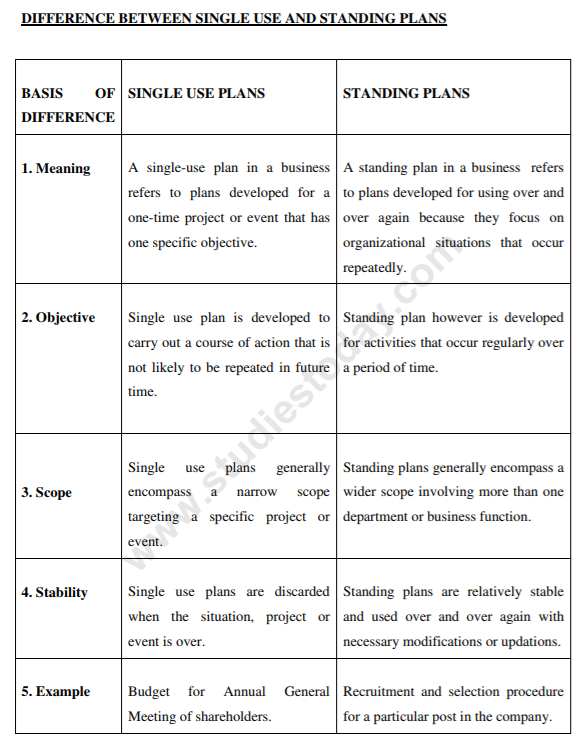
A Single use plan in a business refers to plan developed for a one-time project or event that has one specific objective. It applies to activities that do not recur or repeat. It is specifically designed to achieve a particular goal.. Such Plan is developed to meet the needs of a unique situation. The length of a single-use plan differs greatly depending on the project in question, as a single event plan may only last one day while a single project may last weeks or months.
For example, an outline for an advertising campaign. After the campaign runs its course, the short term plan will lose its relevance except as a guide for creating future plans.
STANDING PLANS
Standing plans are used over and over again because they focus on organizational situations that occur repeatedly. They are usually made once and retain their value over a period of years while undergoing revisions and updates. That is why they are also called repeated use plans. For example, Business plan to establish a new business. Entrepreneurs draft business plan before opening the doors to their business, and they can use their plan to guide their efforts for years into the future.
Questions:-
1. What do you understand by single use plans?
2. What do you understand by standing plans?
3. XYZ Limited follows a standard procedure for recruiting Production Manager for its company. Which type of plan is it? Justify your answer.
4. ABC Limited prepares budget for its Annual General Meeting for Financial Year 2011-12. What kind of plan is it? Justify your answer.
5. Explain the objectives of single use plans and Standing plans with suitable examples.
6. Differentiate between Single use plans and Standing plans?
UNIT–6: STAFFING
Sub Topic: Induction Training
Induction training is a type of training given to help a new employee in settling down quickly into the job by becoming familiar with the people, the surroundings, the job and the business. The duration of such type of training may be from a few hours to a few days. The induction provides really a good opportunity to socialize and brief the newcomer with the company’s overall strategy, performance standards etc. If carefully done, it saves time and cost (in terms of effectiveness or efficiency etc.).
Questions:-
1. Define Induction training?
2. What is the main objective of Induction training?
3. How does Induction training help in reducing cost and saves time?
4. Write a short note on Induction training?
UNIT 7: DIRECTING
Sub Topic: Styles of Leadership
Leadership styles refer to a leader’s behaviour. Behavioural pattern which the leader reflects in his role as a leader is often described as the style of leadership.
A Leadership style is the result of the leader’s philosophy, personality, and experience and value system. It also depends upon the type of followers and the atmosphere prevailing in the organization.
Different types of leadership style are:
1. Autocratic leadership
2. Participative leadership – Democratic
3. Free rein leadership – Laissez Faire
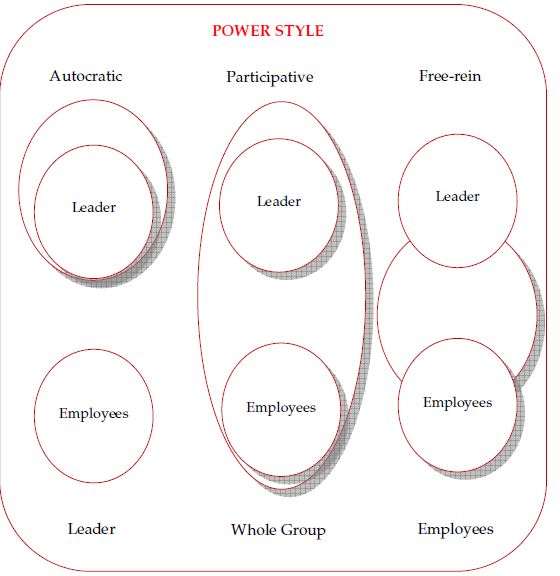
A leader may use all styles over a period of time but one style tends to predominate as his normal way of using power.
1.Autocratic or Authoritarian Leader
An autocratic leader gives orders and insists that they are obeyed. He determines the policies for the group without consulting them.
He does not give information about future plans but simply tells the group what immediate steps they must take.
Under this style, all decision making power is centralized in the leader as shown in the diagram. He does not give the subordinates any freedom to influence his decision.
It is like “bossing people around.” This style should normally be used on rare occasions.

When should authoritarian leadership be applied?
- It is best applied to situations where there is little time for group decision-making
- or where the leader is the most knowledgeable member of the group.
2. Democratic or Participative Leader
A democratic leader gives order only after consulting the group and works out the policies with the acceptance of the group.
He never asks people to do things without working out the long term plans on which they are working. He favours decision making by the group as shown in the diagram. This improves
the attitude of the employees towards their jobs and the organization thereby increasing their morale.
Using this style is of mutual benefit – it allows them (subordinates) to become part of the team and helps leaders (seniors) to make better decisions.
When should Participative/democratic leadership be applied?
- It works best in situations where group members are skilled and eager to share their knowledge.
- It is also important to have plenty of time to allow people to contribute, develop a plan and then vote on the best course of action This style should NOT be used when:
- In situations where roles are unclear or time is of the essence, democratic leadership can lead to communication failures and uncompleted projects.
-
3. Laissez Faire or Free Rein Leader
A free rein leader gives complete freedom to the subordinates. Such a leader avoids use of power. He depends largely upon the group to establish its own goals and work out its own
problems. Group members work themselves as per their own choice and competence. The leader exists as a contact man with the outsiders to bring information and the resources the
group requires for accomplishing the job.
NOTE: This is also known as laissez faire which means no interference in the affairs of others. [French: laissesz means to let / allow and faire means to do.
Please click the link below to download pdf file for CBSE Class 10 Supplementary Study Material for new Syllabus for Business Studies.
Free study material for Business Studies
All topics Concepts and Summary for Class 12 Business Studies
About All topics Revision Notes
Explore reliable chapter overviews for All topics tailored for Class 12 learners. Use these structured points to grasp difficult themes and ensure solid preparation for upcoming assessments.
How to Use These Revision Notes
Built using the official NCERT book for Class 12 Business Studies, these notes provide reliable academic guidance. Pair your summary review with our recommended NCERT solutions to master optimal problem-solving approaches.
Enhance Practice with MCQs and Worksheets
Wrap up your chapter revision by testing your knowledge against standard question formats. Everything on our platform is provided free of charge.
FAQs
You can download the teacher prepared revision notes for Supplementary Study Material For New Syllabus For Business Studies from StudiesToday.com. These notes are designed as per 2026-27 academic session to help Class 12 students get the best study material for Business Studies.
Yes, our Supplementary Study Material For New Syllabus For Business Studies include 50% competency-based questions with focus on core logic, keyword definitions, and the practical application of Business Studies principles which is important for getting more marks in 2026 CBSE exams.
Yes, our Supplementary Study Material For New Syllabus For Business Studies provide a detailed, topic wise breakdown of the chapter. Fundamental definitions, complex numerical formulas and all topics of CBSE syllabus in Class 12 is covered.
These notes for Business Studies are organized into bullet points and easy-to-read charts. By using Supplementary Study Material For New Syllabus For Business Studies, Class 12 students fast revise formulas, key definitions before the exams.
No, all study resources on StudiesToday, including Supplementary Study Material For New Syllabus For Business Studies, are available for immediate free download. Class 12 Business Studies study material is available in PDF and can be downloaded on mobile.