

Class 12 Economics Competency-Based Questions: CBSE Class 12 Economics The Theory of the Firm under Perfect Competition VBQs
Explore authentic value-based practice materials through the CBSE Class 12 Economics The Theory of the Firm under Perfect Competition VBQs. Tailored for Class 12 learners, utilizing these Economics VBQs ensures thorough preparation and strengthens moral reasoning skills before final CBSE evaluations.
Download Part A Microeconomics Chapter 04 The Theory of the Firm under Perfect Competition VBQ PDF with Solutions
Navigate directly to the solved Economics Value Based Questions using the digital viewer below. Each practice set includes detailed solutions, allowing students to instantly cross-check their work and understand the ethical dimensions of the topic.
Producer behaviour & Supply
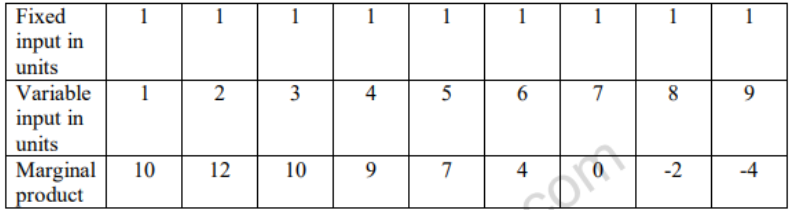
1) Identify and define the stages underlying the schedule given below. Also, identify the value based on the behaviour of marginal product: (4)
Answer:
The underlying law is the Law of Diminishing Returns. As more and more units of variable input are combined with fixed quantities of fixed inputs beyond a certain point the marginal product falls with further employment of it.
Stage 1: MP increases and is the stage of increasing returns to a factor
Stage 2: It is stage of diminishing returns to a factor. In this stage MP decreases i.e. MP falls but remains positive and MP falls and becomes negative.
Analysis-> whatever is the industry diminishing returns will set in sooner or later and all economies face the same.
VALUE: Analytical Thinking
2. In the second stage of the operation of law of variable proportion both TP and AP increase. State true or false and identify the value and the significance of this stage. (3)
Answer: False, in the ii stage TP increases at a diminishing rate, but AP increases till it equals MP then it falls.
VALUE: Efficient utilisation of resources.
.
3.Why is short run MC curve ‘U” shaped? How does it affect the behaviour of TVC? Also identify the value. (3)
Answer:
i) Due to the operation of the Law of Variable Proportions.
ii) When MC decreases, TVC increases at a diminishing rate and when MC increases, TVC increases at an increasing rate
VALUE: Analytical thinking.
4.The difference between AC and AVC decreases with the increase in the output. Explain why and state the value. (4)
Answer: Due to the presence of AFC which is not only ever diminishing but never become zero as AFC= TFC/ Q.
VALUE: Analytical thinking.
5.With the increase in the provision of telephonic services by the private sector the services provided by the Government sector has come down.(1)
i) What is the nature of relationship that exists between these services? Identify the value.
Answer:i) These services are substitute to each other
Value: consumer awareness.
6. With the increase in the use of mobile phones, the use of landlines has come down.(1)
i) What is the nature of relationship exists between these services? Identify the value.
Answer:
i) These services are substitute to each other
ii) Value: consumer awareness/environmental degradation
7. With the increase in the use of mobile phones, the use of landlines particularly provided by the government sector has come down” (3)
i) How does this change affect revenue of the government and why?
ii) Highlight the value.
Answer:
i) As the supply of quality services by the government decreases revenue also fall as we can carry mobile anywhere and it is cost efficient and convenient.
ii) Value: Empathy.
8.How can a firm under perfect competition earn only normal profit in the long run, when a monopolist can earn abnormal profit both in the short run and long run as the condition of producer’s equilibrium(MR=MC) is the same for both the markets.
Highlight the value which is emphasised and affected.(3)
Answer: Under PC there are large number of buyers and sellers, selling homogeneous products and free entry and exit whereas under monopoly he is the only seller, restricted entry and no close substitutes.
Value : care & concern/consumer exploitation affects welfare
9. Is MR=MC a necessary condition for a firm to be in equilibrium?(1) Identify the value.
Answer: Yes necessary, but not sufficient because MC must be rising.
Value: Critical thinking.
10.How does the shortage of LPG affect its equilibrium price and quantity? Identify the value.(3)
Answer: Supply decreases. Now at a given price less is supplied which increases the price and decreases the quantity(leftward shift)
Value: Social Responsibility/conservation of energy. (As DD is more than the SS households must economies the usage of resources like LPG, ELECTRICITY and other ENERGY resources. )
11.Due to enormous increase in the price of land , the farmers prefer to sell the land to the real estate promoters instead of taking chances in the agricultural earning. Is it a healthy trend for a country like india?
Ans: It is not an encouraging practice, though, the farmers are benefitted temporarily. It will lead to severe shortage of food grains and import from other countries. The Govt. has to amend strict legislation to stop the conversion of agri .lands for profit sake.
Value: social responsibility.
Question. The condition for producer equilibrium is
1. TR=TVC
2. MC=MR
3. TC=TSC
4. None of this above
Answer : MC=MR
Question. Globalization has made the Indian market as?
1. Buyer Market
2. Seller Market
3. Monopoly Market
4. All of the above
Answer : Buyer Market
Question. When AR=Rs.10 and AC=Rs. 8, the firm makes?
1. Gross Profit
2. Normal Profit
3. Net Profit
4. Supernormal Profit
Answer : Supernormal Profit
Question. Define perfect competition.
Answer : Perfect competition is a market where a large number of buyers and sellers, sells a similar product in the same price
Question. Which is an ideal market?
1. Monopolistic Competition
2. Oligopoly
3. Monopoly
4. Perfect Competition
Answer : Perfect Competition
Question. What is Oligopoly?
Answer : Oligopoly refers to a market structure where a few large sellers sell the same or different product.
Question. Explain the implication of free entry and free exit of a firm in the perfect competition market.
Answer : The implication of free entry and free exit of a firm in the perfect competition market is that in this market structure no company earn an unusual profit. Each company just earns a normal profit.
Question. Under perfect competition, the cost lies below the average cost curve, the company would
1. Incur losses
2. Make an unusual profit
3. Make normal profits
4. Profit cannot be determined
Answer : Incur losses
Question. How can the productivity of Human resources be increased?
Answer : The productivity of human resource can be increased with the help of human capital formation by providing training and skill to available labour force.
Value: Creative thinking
Question. What efforts should be made in an economy to reduce the continuous use of exhaustible natural resources in production?
Answer : There are various efforts namely,
1. To increase the use of renewable resources
2. To explore the substitutes of resources
3. To reduce the wastage of resources
4. To spread awareness about the effectively and optimum use of natural resources
Value: Environmental conservation
Question. Availability of agricultural land (fixed cost) is limited in the world, but demand of food grains is continuously increasing. Is it possible to increase the supply of food grains by continuously increasing variable factors like seeds, fertilizer, etc?
Answer : Availability of agricultural land is limited in the world, production of food grains may be increased by continuous increase in variable factors only up to a optimum combination with fixed factors.
After that law of negative returns is applied.
Value: Critical thinking
Question. Imagine yourself as a producer (in a perfectly competitive market structure), focusing on profit maximization. Will you prefer striking an equilibrium in a state of increasing returns?
Answer : Striking an equilibrium in a state of increasing returns to a factor (when MP is rising or MC is falling) is absolutely ruled out. Because it is a situation when every addition unit of output adds more and more to total profits.
Reason: while MR is constant (under perfect competition) MC is falling (owing to increasing returns), so that the difference between MR and MC tends to rise. It is only when the differential (MR – MC) starts shrinking, and is finally eliminated, that the profits are maximized. This happens only in a state of diminishing returns when MP is falling or MC is rising.
COST
1) In a situation of fall in the sale of ice cream, the ice cream producer would like to reduce the production. What factors of production fixed or variable will be reduced by him? Explain with reasons.
Answer : When sale of ice cream decreases, profit of producer will fall by which he will try to control his cost of production but in short run he cannot change the cost of fixed factors therefore he will reduce the cost of variable factors.
REVENUE
Question. A manager of zoo wants to increase the revenue, which measure is more appropriate:
i) Increase the entry fee
ii) Decrease the entry fee. Explain?
Answer : By reducing the entry fee the number of visitors will increase and total revenue will increase, but if the entry fee is increased, number of visitors will decrease and total revenue will fall.
Value: Problem solving
SUPPLY
Question. How can tax policy of government be effective in controlling the supply of Liquor like harmful product?
Answer : The production of liquor like harmful products will be less profitable to the producer due to increasing tax rates because the difference between revenue and cost decreases and hence producer’s profit will decrease, and the supply of liquor will be decreased.
Value: Social health consciousness
Free study material for Economics
VBQs with Answers for Class 12 Economics Part A Microeconomics Chapter 04 The Theory of the Firm under Perfect Competition
About Part A Microeconomics Chapter 04 The Theory of the Firm under Perfect Competition Value-Based Questions
Review important VBQs for Part A Microeconomics Chapter 04 The Theory of the Firm under Perfect Competition tailored for Class 12 learners. These structured exercises highlight core values and practical concepts essential for high-scoring exam performance.
How to Use These Value-Based Questions
Pair your practice with our comprehensive NCERT solutions for Class 12 Economics to review detailed responses and master the underlying themes of this chapter.
Real-Life Applications in Economics
Explore our wider library of free chapter notes, worksheets, and online mock tests to support your ongoing revision and secure top-tier academic results.
FAQs
The latest collection of Value Based Questions for Class 12 Economics Part A Microeconomics Chapter 04 The Theory of the Firm under Perfect Competition is available for free on StudiesToday.com. These questions are as per 2026 academic session to help students develop analytical and ethical reasoning skills.
Yes, all our Economics VBQs for Part A Microeconomics Chapter 04 The Theory of the Firm under Perfect Competition come with detailed model answers which help students to integrate factual knowledge with value-based insights to get high marks.
VBQs are important as they test student's ability to relate Economics concepts to real-life situations. For Part A Microeconomics Chapter 04 The Theory of the Firm under Perfect Competition these questions are as per the latest competency-based education goals.
In the current CBSE pattern for Class 12 Economics, Part A Microeconomics Chapter 04 The Theory of the Firm under Perfect Competition Value Based or Case-Based questions typically carry 3 to 5 marks.
Yes, you can download Class 12 Economics Part A Microeconomics Chapter 04 The Theory of the Firm under Perfect Competition VBQs in a mobile-friendly PDF format for free.