

Sample Question Papers for Class 7 Social Science
Access comprehensive sample question papers for Class 7 Social Science using the CBSE Class 7 Social Science Sample Paper Set 18. Designed to align with the 2026-27 CBSE academic guidelines, these model papers help students assess their exam readiness and understand current marking schemes.
Practice Class 7 Social Science Exam Papers
View or download the dedicated CBSE Class 7 Social Science Sample Paper Set 18 resource below. Engaging with these sample papers under timed conditions ensures continuous academic progress and mastery of the 2026-27 exam format.
CBSE Class 7 Social Science Sample Paper Set R. It’s always recommended to practice as many sample papers as possible before the examinations. Students can download the sample papers and also question papers of previous years to practice and score better marks in examinations. Refer to other links too for more sample papers.
SECTION – A
Q.1 Fill in the blanks. (1×6=6)
i) _______ waves help to determine the structure of the Earth.
ii) _______ protects us from the harmful ultraviolet rays of the sun.
iii) Waves are caused by the action of _______.
iv) Balban introduced the Persian custom of _______ in his court.
v) _______ was Akbar’s regent.
vi) The three organs of government are -legislature, executive and _______.
Q.2 Choose the correct option. (1×6=6)
i) Most of the early medieval temples of south India are built in the
a) Nagara style b) Dravidian style c) Indo-saracenic style d) None of these
ii) The union territory that has a legislature of its own
a) Lakshadweep b) Pondicherry c) Daman d) None of these
iii) The Governor of a state is appointed by the
a) Chief Minister b) Prime Minister c) President d) None of these
iv) The token coins introduced by Muhammad-bin-Tughluq were made of
a) Iron b) Bronze c) Copper d) None of these
v) Lingraj Temple is located at
a) Bhubaneswar b) Rameshwaram c) Tirunelveli d) All of these
vi) The art of inlaying marble with pieces of stone is called
a) inscriptions b) motifs c) pietradura d) none of these
Q.3 Match the column A with B. (1×6=6)
A B
i) Monsoon Din Ilahi
ii) Trade winds Selected by a Public Service Commission
iii) Abul Fazl Seasonal winds
iv) Akbar Elected by the people
v) Civil Servants Akbarnama
vi) MLA Permanent winds
Q.4 Give appropriate term for the following. (1×6=6)
i) The upper most layer of the earth.
ii) The amount of water vapour present in the atmosphere.
iii) A proposal to pass a new law or to change an existing one.
iv) Each independent department of government in charge of a cabinet minister.
v) A network of spies maintained by the Sultans of Delhi.
vi) A musician who was among the ‘nine gems’ of Akbar’s court.
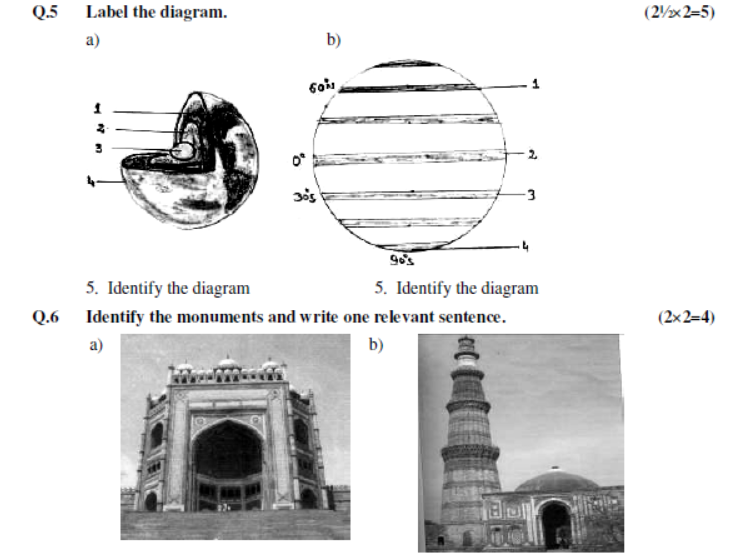
Q.5 Label the diagram.
Q.7 a) Locate the following in the given outline map of India. (3)
i) Panipat ii) Kannauj iii) Pala Kingdom
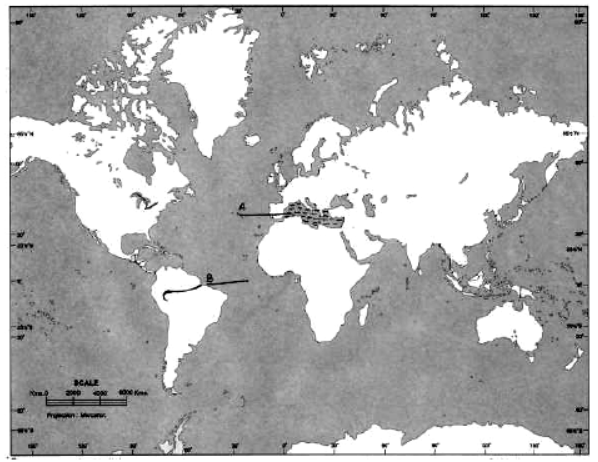
b) Identify the following in the given outline map of the world.
Q.8 Look at the diagrams and answer the following questions.
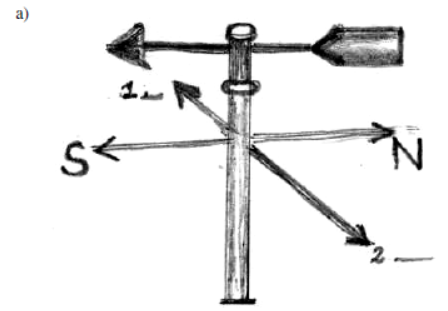
i) Identify the Instrument.
ii) Name the other two directions.
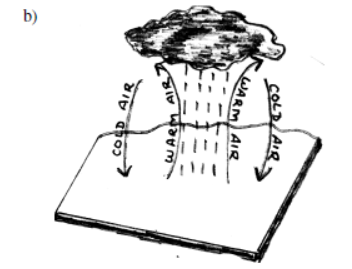
i) Identify the type of rainfall.
ii) Where do this type of rainfall occur throughout the year?
SECTION – B
Q.9 Distinguish between the following. (Any three) (2×3=6)
i) Sedimentary rocks and Metamorphic rocks
ii) Weather and climate
iii) Saline water and fresh water
iv) Waves and tides
Q.10 Give reasons for the following. (Any three) (2×3=6)
i) The Harbour of London does not freeze during winter.
ii) Desert has a higher range of temperature.
iii) Loss of Qandahar was a setback for the Mughal empire.
iv) Muhammad-bin-Tughluq shifted his capital to Devagiri.
Q.11 Answer the following in not more than 20 words each. (Any three) (2×3=6)
i) Why did Ala-ud-din Khalji start the practice of branding horses?
ii) How did Akbar win over Rajput chiefs? Name one ruler who resisted Akbar.
iii) To which place did Shah Jahan shift his capital after Mumtaz Mahal’s death? What did he name the place?
iv) What were the two main styles of temple architecture in medieval India?
Q.12 Answer the following in not more than 40 words each. (Any four) (3×4=12)
i) Explain the green house effect.
ii) What are plates? What causes them to move?
iii) What was Minhaj-us-Siraj’s attitude towards Raziyya?
iv) Write briefly how Sher Shah tried to improve the economy of his empire.
v) How is the Chief Minister of a state chosen and appointed?
SECTION - C
Q.13 Answer the following in not more than 100 words.
i) What are sedimentary rocks? Explain how they are formed. (5)
ii) Write briefly about Akbar’s mansabdari system. (5)
iii) What are the main functions of the chief minister?
OR
Write briefly about governor’s powers.
iv) How does the atmosphere receive nitrogen, oxygen and carbondioxide?
OR
Describe the layer of the atmosphere nearest to the earth’s surface.
v) Mughal architecture reached the peak of its glory under Shah Jahan.
Justify this statement.
OR
Mention the important architectural features of the Taj Mahal.
vi) Once the polling is over, all the electronic voting machines are sealed and taken to a secured place. After few days, on the predecided date, all the EVMs from the constituencies are opened and the candidate securing the highest number of votes from a constituency is declared elected. Within a few hours of counting, all the results are declared and it becomes clear as to who will form the government.
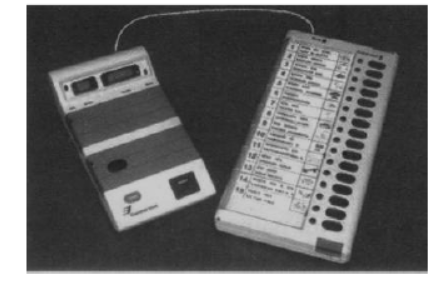
a) Identify the picture.
b) Which category of people are not allowed to vote in India?
c) Should educational qualifications be made a criteria for enjoying the voting rights? Justify.
Please click the link below to download CBSE Class 7 Social Science Sample Paper Set R.
Free study material for Social Science
Model Practice Papers & Solutions for Class 7 Social Science
Get Started with CBSE Class 7 Social Science Sample Paper Set 18 (CBSE)
Review model practice papers for Class 7 Social Science. Working through the CBSE Class 7 Social Science Sample Paper Set 18 under simulated test conditions at home ensures complete familiarity with upcoming school evaluations.
Key Advantages of Solving CBSE Class 7 Social Science Sample Paper Set 18
- Exam Blueprint: Understand mark allocations and structural guidelines relevant to Class 7 evaluations.
- Targeted Improvement: Identify weak areas in Class 7 Social Science requiring focused revision.
- Pacing & Precision: Practice mixed question formats to build execution speed and ensure timely paper completion.
Post-Practice Strategy for Class 7 Social Science
- Self-Evaluation: Score your answers using official guidance to track your academic progress.
- Mistake Correction: Class 7 pupils must re-solve questions answered incorrectly to master the correct method.
- Continuous Practice: Take additional Social Science sample modules online to maximize preparedness for CBSE evaluations.
FAQs
You can download the complete PDF for CBSE Class 7 Social Science Sample Paper Set 18 for free from StudiesToday.com. Our resources for Class 7 Social Science are updated for the latest academic session and follow the official exam pattern.
Yes, CBSE Class 7 Social Science Sample Paper Set 18 comes with detailed, teacher-verified solutions. We have provided step-by-step answers for Social Science to help students of Class 7 understand correct methodology and marking scheme.
Practicing this Social Science paper helps in time management and identifying important topics. For Class 7, solving mock papers is the best way to gain confidence and reduce exam-day anxiety.
Yes, all our study materials for Class 7 Social Science are provided in a mobile-friendly PDF format. You can easily download CBSE Class 7 Social Science Sample Paper Set 18 on your mobile device.