

Class 7 Social Science Solved Model Papers: CBSE Class 7 Social Science Sample Paper Set 31
Access comprehensive sample question papers for Class 7 Social Science using the CBSE Class 7 Social Science Sample Paper Set 31. Designed to align with the 2026-27 CBSE academic guidelines, these model papers help students assess their exam readiness and understand current marking schemes.
Download Class 7 Social Science Sample Paper PDF
View or download the dedicated CBSE Class 7 Social Science Sample Paper Set 31 resource below. Engaging with these sample papers under timed conditions ensures continuous academic progress and mastery of the 2026-27 exam format.
CBSE Class 7 Social Science Sample Paper Set E. It’s always recommended to practice as many CBSE sample papers as possible before the examinations. The latest sample papers have been designed as per the latest blue prints, syllabus and examination trends. Sample papers should be practiced in examination condition at home or school and also show it to your teachers for checking or compare with the answers provided. Students can download the sample papers in pdf format free and score better marks in examinations. Refer to other links too for latest sample papers.
1 Where is the worlds deepest mine situated?
Ans: South Africa
2 State any one of the common earthquake prediction methods.
Ans: animal behavior, fish in ponds get agitated, snakes come to surface.
3 Name the gas which is responsible for global warming.
Ans: carbon dioxide.
4 State the specialisation of ENT doctors.
Ans: Ear, Nose and Throat.
5 What is the full form of W.H.O.?
Ans: World Health Organization.
6 Define the term equality.
Ans: Every person is equal before the law irrespective age, caste, religion, sex or position
7 What enabled samantas todeclare themselves independent?
Ans: as they gained power and wealth, they declared themselves independent.
8 Under whose rule did Delhi become an important commercial centre?
Ans: Tomar Rajputs
9 Who was Abul Fazl?
Ans: Abul Fazl was one of Akbar’s close friends and courtiers wrote a three volume
history of Akbar’s reign titled, Akbar Nama.
10 Distinguish between continental crust and oceanic crust giving three points each.
Ans: (Any3)
Continental Oceanic
Main composition is silica and
aluminum
Main composition is silica and magnesia
Also called as sial Also called as sima
Its density is 0nly 2.7gm/cm Its density is 3.1gm/cm approx
Forms the upper part of the crust Forms the lower part of the crust
11 Identify the feature in the given diagram and explain its formation.
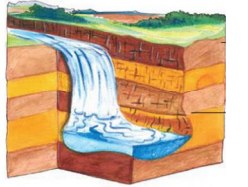
Ans: a. Waterfall
b. The running water in the river erodes the landscape. When the river tumbles at steep angle over very hard rocks or down a steep valley side it forms a waterfall
12 Explain the three different types of winds
Ans: Permanent or Planetary Winds: These winds blow constantly throughout the year in a particular direction. These winds are broadly classified as: -
(a) Trade Winds
(b) Westerlies
(c) Polar Easterlies
2. Seasonal or Periodic Winds: These winds change their direction in different seasons.
The best example is "Monsoon Winds".
3. Local Winds: These winds blow only during a particular period of the day or year. For example, land and sea breeze. These winds bring short time changes in the weather conditions over a smaller area. Some of the examples are: -
(a) Chinook: Chinook means 'snow eater'. These winds are strong, warm and dry. They blow in North America.
(b) Loo: These are hot and dry winds which, blow during the summer season in the northern part of India.
13 What kind of Public health services are available at the village level, district level and in cities?
Ans: 1. At the village level there are health centres where there is usually a nurse and a village health worker. They are trained in dealing with common illnesses and work under the supervision of doctors at the Primary Health Centre (PHC). Such a centre covers many villages in a rural area.
2. At the district level is the District Hospital that also supervises all the health centres.
3. Large cities have many government hospitals.
14 Evaluate the objective of Wall paper project and also state its advantages.
Ans: Objective: it is an interesting activity to display one’s thought for a particular topic of interest.
Advantage: a. it helps in building up a strong team work
b. also help in encouraging the participant to express their view point on a particular issue
15 With examples state how people in India live highly unequal lives.
Ans: Even though there is equality among people in India yet poverty and the lack of resources continue to be a key reason why so many people’s lives in India are highly unequal.
For example— · The increasing privatization of health services and the neglect of government hospitals have made it difficult for most poor people to get good quality health care. These people do not have the resources to afford expensive private health services.
· The man who sells juice does not have the resources to compete with all of the major companies who sell branded drinks through expensive advertising.
Discrimination on the basis of a person’s religion, caste and sex is another significant factor for why people are treated unequally in India.
16 Give some reasons for the displacement of people from one place to another.
Ans: 1. When dams are built or forest areas declared sanctuaries for animals, thousands of people are displaced. Whole villages are uprooted and people are forced to go and build new homes, start new lives elsewhere. Most of these people are poor.
2. In urban areas too, bastis in which poor people live are often uprooted. Some of them are relocated to areas outside the city.
3. Their work as well as their children’s schooling is severely disrupted because of the distance from the outskirts of the city to these locations. This displacement of people and communities is a problem that has become quite widespread in our country.
17 Explain the administrative divisions of the Chola Empire.
Ans: 1. Settlements of peasants, known as ur, became prosperous with the spread of irrigation agriculture.
2. Groups of such villages formed larger units called nadu.
3. The village council and the nadu had several administrative functions including dispensing justice and collecting taxes.
4. Rich peasants of the Vellala caste exercised considerable control over the affairs of the nadu under the supervision of the central Chola government.
5. Associations of traders known as nagarams also occasionally performed administrative functions in towns.
18 Briefly discuss how people participated in Sabha.
Ans: (any3)
1. All those who wish to become members of the Sabha should be owners of land from which land revenue is collected.
2. They should have their own homes.
3. They should be between 35 and 70 years of age.
4. They should have knowledge of the Vedas.
5. They should be well-versed in administrative matters and honest.
6. If anyone has been a member of any committee in the last three years, he cannot become a member of another committee.
19 What kind of irrigation works were developed in Tamil region under the reign Chola ruler?
Ans: (any3)
(i) the river Kaveri deposits fertile soil on the banks. Water from the channels also provides
Please click the link below to download the full pdf file for CBSE Class 7 Social Science Sample Paper Set E.
Free study material for Social Science
CBSE Class 7 Social Science Sample Paper Set 31 & Sample Question Papers for Class 7 Social Science
Class 7 Social Science CBSE Class 7 Social Science Sample Paper Set 31 PDF Download Guide
Access structured sample papers for Class 7 Social Science. Solving the CBSE Class 7 Social Science Sample Paper Set 31 provided above helps students understand official exam blueprints and tackle anticipated question formats with confidence.
Key Advantages of Solving CBSE Class 7 Social Science Sample Paper Set 31
- Exam Blueprint: Understand mark allocations and structural guidelines relevant to Class 7 evaluations.
- Targeted Improvement: Identify weak areas in Class 7 Social Science requiring focused revision.
- Pacing & Precision: Practice mixed question formats to build execution speed and ensure timely paper completion.
Post-Practice Strategy for Class 7 Social Science
- Verify Answers: Compare your responses against professional teacher solutions provided in the sample paper keys.
- Error Analysis: Class 7 learners must review incorrect answers carefully to understand underlying mistakes.
- Concept Reinforcement: Consult the official NCERT book for Class 7 Social Science when stuck before re-attempting problems.
FAQs
You can download the complete PDF for CBSE Class 7 Social Science Sample Paper Set 31 for free from StudiesToday.com. Our resources for Class 7 Social Science are updated for the latest academic session and follow the official exam pattern.
Yes, CBSE Class 7 Social Science Sample Paper Set 31 comes with detailed, teacher-verified solutions. We have provided step-by-step answers for Social Science to help students of Class 7 understand correct methodology and marking scheme.
Practicing this Social Science paper helps in time management and identifying important topics. For Class 7, solving mock papers is the best way to gain confidence and reduce exam-day anxiety.
Yes, all our study materials for Class 7 Social Science are provided in a mobile-friendly PDF format. You can easily download CBSE Class 7 Social Science Sample Paper Set 31 on your mobile device.