

Official Class 11 Painting And Sculpture Worksheets: Buddhist Jain And Hindu Art
Review targeted practice sets for Class 11 Painting And Sculpture Buddhist Jain And Hindu Art. Built according to official educational guidelines for the 2026-27 academic year, these downloadable worksheets support daily revision and core concept reinforcement.
Chapter-wise Practice Material: Buddhist Jain And Hindu Art
Navigate directly to the printable exercises for Buddhist Jain And Hindu Art using the digital viewer below. Each practice set allows students to isolate specific topics for thorough review and uninterrupted practice alongside standard textbooks.
Buddhist, Jain and Hindu Art/Study of Sculptures
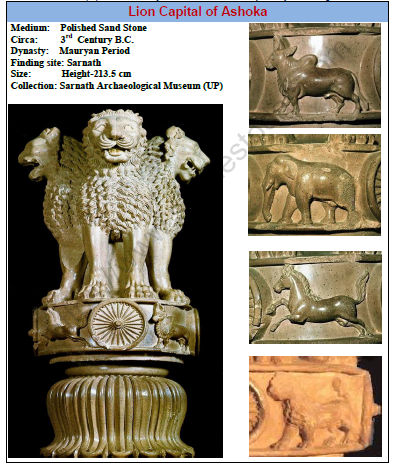
Description: The Lion Capital of Ashoka is a sculpture of four ‘Indian Lions’ standing back to back. It was originally placed atop of the Ashoka pillar at Sarnath, in the state of Uttar Pradesh, by Emperor Ashoka, circa 250 B.C. The pillar, sometimes called the Ashoka Column, is still in its original location, but the Lion Capital is now in the Sarnath Museum.
This Lion capital of Ashoka from Saranath has been adopted as the National Emblem of India and the wheel ‘Ashoka Chakra’ from its base was placed onto the centre of the National Flag of India.
The lion capital carved out of a single block of polished sandstone is more than two meters (7ft) in height. It comprises of four Indian/Asiatic Lions, placed back to back on a round slab called abacus. The abacus is supported by a bell shapedinverted- lotus base. On the side of the abacus are carved high relief sculptures of four animals - an elephant, a galloping horse, a bull, and a lion moving in a clockwise manner. These animals carved with great skill alternate with four smaller 24 spokes dharma chakras or wheels of law.
The capital was believed to be crowned by a 'Wheel of Dharma’ (Dharma Chakra) popularly known in India as the ‘Ashoka chakra’, which has now been lost. The figures of four majestic lions which are sticking their backs and facing four different directions - East, West, North and South - have been shown as the guard of the country, standing ever in alert position on their front legs. The four lions on top are highly symbolic and stylized with a very little hint of naturalness. This is clear in the hair carved along with neck as little flame-shaped bunches and the upper lip of the lions shown by three slit/cut lines. The magnificent modelling gives them great power and dignity. Surprisingly, compared to the majesty of the lions, the animals on the abacus are done with great naturalistic energy and are defined carefully. Petals of the lotus have rhythmically cut/slit curves and contours. The surface of these pillars has a mirror-like finish. It also reveals the aristocratic and international nature of the Mauryan Art.
The great symbolism of the greatest Buddhist virtues along with the great masterly skill of sculpting of this piece of art deserved to be a national identity of the great nation.
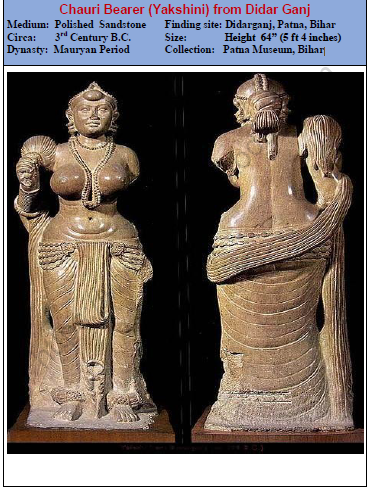
Description: The statues of Yakshas and Yakshis, the deities of fertility and abundance are excellent speciments of the Mauryan craftsman ship in fashioning the human figure. The Yakshi from Patna Museum is a striking example of 3rd century B.C. created by a gifted sculptor.
The life-size standing woman known as Yakshini holding a Chauri (flywhisk) in her right hand is another good example of the sculptural tradition of the Mauryan period. The characteristics of this statue are as follows:
a) It is tall, well-proportional, free standing sculpture of a chatty young woman.
b) She is adorned with jewels on the forehead, ear-ring, necklaces, bangles, girdle over loin cloth and laces.
c) Features of the face are sharp and smooth with proper roundness of different organs of the body are praiseworthy.
d) Her left hand is broken.
e) The sophistication of the image is shown very beautifully.
f) The most remarkable feature of the sculpture apart from the shiny polish is the peaceful and calm expression on her face. Her composure creates a powerful impact of rare and royal dignity. This beautiful Didarganj Chauri Bearer is proud symbol of Indian artistic genius.
Please click on below link to download CBSE Class 11 Painting And Sculpture Buddhist Jain And Hindu Art Worksheet Set B
Free study material for Other Subjects
Buddhist Jain And Hindu Art Practice Sheet and Solutions for Class 11 Painting And Sculpture
Chapter Practice Questions for Class 11 Painting And Sculpture
Review targeted practice exercises for Class 11 Painting And Sculpture Buddhist Jain And Hindu Art. Curated to match official CBSE guidelines, these downloadable PDF sheets support daily revision and core concept reinforcement.
Expert Practice Material for Class 11 Painting And Sculpture
Each worksheet is structured around standard CBSE textbooks, allowing students to check their working steps and correct mistakes early in their revision.
Complete Your Chapter Revision
Explore our broader library of printable assignments, chapter notes, and mock tests designed to support continuous revision and secure higher marks in CBSE assessments.
FAQs
You can download the teacher-verified PDF for CBSE Class 11 Painting And Sculpture Buddhist Jain And Hindu Art Worksheet Set 02 from StudiesToday.com. These practice sheets for Class 11 Painting And Sculpture are designed as per the latest CBSE academic session.
Yes, our CBSE Class 11 Painting And Sculpture Buddhist Jain And Hindu Art Worksheet Set 02 includes a variety of questions like Case-based studies, Assertion-Reasoning, and MCQs as per the 50% competency-based weightage in the latest curriculum for Class 11.
Yes, we have provided detailed solutions for CBSE Class 11 Painting And Sculpture Buddhist Jain And Hindu Art Worksheet Set 02 to help Class 11 and follow the official CBSE marking scheme.
Daily practice with these Painting And Sculpture worksheets helps in identifying understanding gaps. It also improves question solving speed and ensures that Class 11 students get more marks in CBSE exams.
All our Class 11 Painting And Sculpture practice test papers and worksheets are available for free download in mobile-friendly PDF format. You can access CBSE Class 11 Painting And Sculpture Buddhist Jain And Hindu Art Worksheet Set 02 without any registration.