

Official Class 11 Painting And Sculpture Worksheets: The Art Of Ajanta Caves
Access printable practice worksheets for The Art Of Ajanta Caves designed to align with the 2026-27 academic syllabus for Class 11 Painting And Sculpture . These structured exercises help students evaluate their conceptual understanding and improve exam readiness.
Chapter-wise Practice Material: The Art Of Ajanta Caves
Navigate directly to the printable exercises for The Art Of Ajanta Caves using the digital viewer below. Each practice set allows students to isolate specific topics for thorough review and uninterrupted practice alongside standard textbooks.
The Art of Ajanta Caves
Inroduction
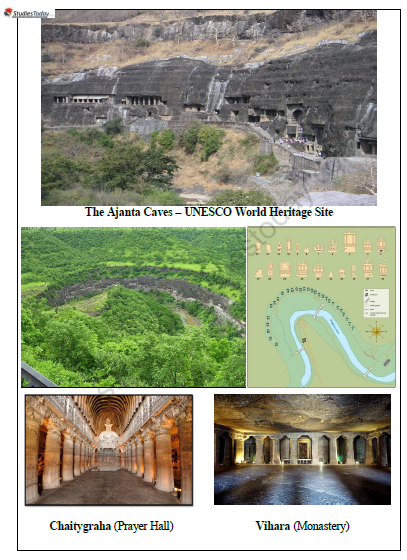
Related to Buddhism, Ajanta is the most famous UNESCO world heritage site and protected by Archaeological Survey of India. It is an ancient rock-cut caves site which is located in Aurangabad district of Maharashtra state. Ajanta is a great treasure. Its caves are fine example of rock-cut architecture. There is a U-shaped cliff of a gorge of small river Waghora where 29 caves have been carved. Lord Buddha, Bodhisattvas and Jatak tales have been engraved and painted on the walls, pillars and ceiling of the caves. These caves have been constructed during 2nd century B.C. to 5th century A.D. The scholars believe, nowhere in the world such beautiful paintings were done during that period. That is why it is known as the golden period of Indian Art.
The Buddhist site has been discovered in 1819 A.D. by a hunting group of British officers. This holy pilgrimage of Indian Paintings set like a huge amphitheatre is situated in Aurangabad district of Maharashtra state. There is a small hill of about 300 feet high in a crescent moon formation or in a horseshoe formation with a stream flowing nearby. Ajanta is the only surviving example of painting in 2nd century B.C. and 5th century A.D. Ajanta is a complex of 29 chaitya and vihara caves that were chiseled into live rock and are host to some of the best preserved painting and sculptures. Cave No. 1 (21 ft long) is the biggest cave which is home to the figure painting of Padmapani. Cave No. 29 is the best stupa cave. Cave No. 17 has the highest number of paintings.
The walls, ceilings and columns of the caves were covered with complex compositions of the Jataka stories (the stories of the Buddha's former existences as Boddhisattva), and ornate floral and animal decorations. The excitement and richness of the painting suggests that the artists were accustomed to painting secular as well as religious works.
Category of the Caves
1. Chaitygraha (Chaityas): These were the places of worship and religious discussion.
2. Viharas (Monastery): These were the living places for Buddha Bhikshus.
Main Painting and Sculptures:
1. Mahaparinirvana (High relief sculpture): Cave no. 26 is very big and carved with a variety of Buddha images. The biggest and more remarkable one is the Mahaparinirvana image. Size is 23 feet long.
2. Padmapani Bodhisattva (Fresco painting): This painting has been painted on the back wall of the interior hall of cave no.1
3. Mara Vijay (High relief sculpture): This sculpture is based on Jatak Tales. It engraved on the wall of cave no. 26
CHARACTERISTICS OF AJANTHA PAINTINGS:
• These paintings have a lot of Typological variation such as outward projections.
• Body colour gets merged with the outline which creates the effect of volume.
• Colours are limited. No over stylization.
• Figures are broad with heavy proportion.
• Rhythmicity in clearly defined lines.
• Skin colours are used in the paintings-brown, yellowish-brown, greenish, yellow ochre etc. Which represent a multi-coloured population.
• Events are grouped together according to space and location.
• Paintings are very orderly and naturalistic, well-integrated with the sculptures in the caves.
• The important and famous paintings are Padmapani and Vajrapani in Cave No.1
What is Fresco technique?
The painting techniques at Ajanta are similar to European fresco technique. First, a rough plaster of clay, cow dung, and rice husks were pressed on to the rough cave walls. This was then coated with lime paste in order to create a smooth working surface. The dark outlines of the figures were then added followed by a palette of only 6 colours. The pigments the artists used came from natural resources.
What is Mural?
A mural is any piece of artwork painted or applied directly on a wall, ceiling or other large permanent surface. A particularly distinguished characteristic of mural painting is that the architectural elements of the given space are harmoniously incorporated into the picture.
Please click on below link to download CBSE Class 11 Painting And Sculpture The Art Of Ajanta Caves Worksheet
The Art Of Ajanta Caves Practice Sheet and Solutions for Class 11 Painting And Sculpture
CBSE Practice Material: Class 11 Painting And Sculpture The Art Of Ajanta Caves
Review targeted practice exercises for Class 11 Painting And Sculpture The Art Of Ajanta Caves. Curated to match official CBSE guidelines, these downloadable PDF sheets support daily revision and core concept reinforcement.
NCERT-Aligned Questions and Solutions
Each worksheet is structured around standard CBSE textbooks, allowing students to check their working steps and correct mistakes early in their revision.
Next Steps in Your Exam Preparation
Explore our broader library of printable assignments, chapter notes, and mock tests designed to support continuous revision and secure higher marks in CBSE assessments.
FAQs
You can download the teacher-verified PDF for CBSE Class 11 Painting And Sculpture The Art Of Ajanta Caves Worksheet from StudiesToday.com. These practice sheets for Class 11 Painting And Sculpture are designed as per the latest CBSE academic session.
Yes, our CBSE Class 11 Painting And Sculpture The Art Of Ajanta Caves Worksheet includes a variety of questions like Case-based studies, Assertion-Reasoning, and MCQs as per the 50% competency-based weightage in the latest curriculum for Class 11.
Yes, we have provided detailed solutions for CBSE Class 11 Painting And Sculpture The Art Of Ajanta Caves Worksheet to help Class 11 and follow the official CBSE marking scheme.
Daily practice with these Painting And Sculpture worksheets helps in identifying understanding gaps. It also improves question solving speed and ensures that Class 11 students get more marks in CBSE exams.
All our Class 11 Painting And Sculpture practice test papers and worksheets are available for free download in mobile-friendly PDF format. You can access CBSE Class 11 Painting And Sculpture The Art Of Ajanta Caves Worksheet without any registration.