

Official NCERT Solutions for Class 12 Physics: Chapter 08 Electromagnetic Waves
Explore reliable textbook solutions for Chapter 08 Electromagnetic Waves tailored for Class 12 learners. Utilizing these Physics answers ensures thorough preparation and strengthens foundational knowledge before final NCERT evaluations.
Chapter-wise Solutions for Physics: Chapter 08 Electromagnetic Waves
Access the complete solution PDF for Class 12 Physics below. Regular practice with these targeted textbook answers builds familiarity with standard question patterns and helps secure higher marks in final school evaluations.
Question. Two circular plates having radius of 12 cm each and separated by 5 cm are used to make a capacitor as shown in the Figure 8.6. An external source charges this capacitor. 0.15 A is the charging current which remains constant.
(a) Determine the capacitance and the rate of charge of potential difference between the two capacitiveplates.
(b) Calculate the displacement current across the capacitive plates.
(c) Kirchhoff’s first rule (junction rule) is applicable to each plate of the capacitor. Yes or No. Give Reasons.
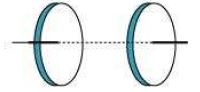
Answer : Radius of each circular plate, r = 12 cm = 0.12 m
Distance between the plates, d = 5 cm = 0.05 m
Charging current, I = 0.15 A
Permittivity of free space, ∈0 = 8.85 × 10⁻¹² C2 N−1 m−2
(a) Capacitance between the two plates is given by the relation,
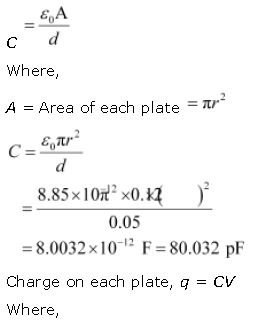
V = Potential difference across the plates
Differentiation on both sides with respect to time (t) gives
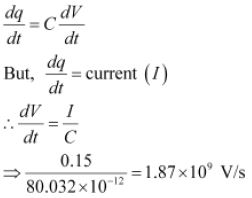
Therefore, the change in potential difference between the plates is 1.87 × 10⁹ V/s.
(b) The displacement current across the plates is the same as the conduction current. Hence, the displacement current, id is 0.15 A.
(c) Yes Kirchhoff’s first rule is valid at each plate of the capacitor provided that we take the sum of conduction and displacement for current.
Question. A parallel plate capacitor (Fig. 8.7) made of circular plates each of radius R = 6.0 cm has a capacitance C = 100 pF. The capacitor is connected to a 230 V ac supply with a (angular) frequency of 300 rad s−1.
(a) What is the rms value of the conduction current?
(b) Is the conduction current equal to the displacement current?
(c) Determine the amplitude of B at a point 3.0 cm from the axis between the plates.
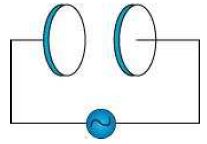
Answer : Radius of each circular plate, R = 6.0 cm = 0.06 m
Capacitance of a parallel plate capacitor, C = 100 pF = 100 × 10−12 F
Supply voltage, V = 230 V
Angular frequency, ω = 300 rad s−1
(a) Rms value of conduction current, I = = V/XC
Where,
XC = Capacitive reactance
= 1/ωC
∴ I = V × ωC
= 230 × 300 × 100 × 10−12
= 6.9 × 10⁻⁶ A
= 6.9 μA
Hence, the rms value of conduction current is 6.9 μA.
(b) Yes, conduction current is equal to displacement current.
(c) Magnetic field is given as:
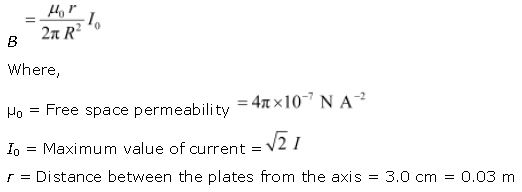
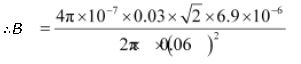
= 1.63 × 10⁻¹¹ T
Hence, the magnetic field at that point is 1.63 × 10⁻¹¹ T.
Question. What physical quantity is the same for X-rays of wavelength 10−10 m, red light of wavelength 6800 Å and radiowaves of wavelength 500 m?
Answer : The speed of light (3 × 10⁸ m/s) in a vacuum is the same for all wavelengths. It is independent of the wavelength in the vacuum.
Question4. A plane electromagnetic wave travels in vacuum along z-direction. What can you say about the directions of its electric and magnetic field vectors? If the frequency of the wave is 30 MHz, what is its wavelength?
Answer : The electromagnetic wave travels in a vacuum along the z-direction. The electric field (E) and the magnetic field (H) are in the x-y plane. They are mutually perpendicular.
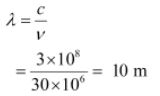
Frequency of the wave, ν = 30 MHz = 30 × 106 s−1
Speed of light in a vacuum, c = 3 × 10⁸ m/s
Wavelength of a wave is given as:
Question. A radio can tune in to any station in the 7.5 MHz to 12 MHz band. What is the corresponding wavelength band?
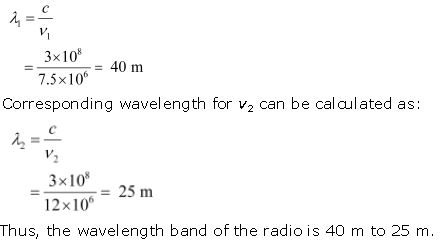
Answer : A radio can tune to minimum frequency, ν1 = 7.5 MHz= 7.5 × 10⁶ Hz
Maximum frequency, ν2 = 12 MHz = 12 × 106 Hz
Speed of light, c = 3 × 10⁸ m/s
Corresponding wavelength for ν1 can be calculated as:
Question. A charged particle oscillates about its mean equilibrium position with a frequency of 109 Hz. What is the frequency of the electromagnetic waves produced by the oscillator?
Answer : The frequency of an electromagnetic wave produced by the oscillator is the same as that of a charged particle oscillating about its mean position i.e., 109 Hz.
Question. The amplitude of the magnetic field part of a harmonic electromagnetic wave in vacuum is B0 = 510 nT. What is the amplitude of the electric field part of the wave?
Answer : Amplitude of magnetic field of an electromagnetic wave in a vacuum,
B0=510nT=510×10−9T
Speed of light in vacuum, c = 3×10⁸m/s
Amplitude of electric field of an electromagnetic wave is given by the relation,
E=cB0=3×108×510×10−9=153N/C
Therefore, the electric field part of the wave is 153 N/C.
Question. Suppose that the electric field amplitude of an electromagnetic wave is E0 = 120 N/C and that its frequency is ν = 50.0 MHz. (a) Determine, B0, ω, k, and λ. (b) Find expressions for E and B.
Answer : Electric field amplitude, E0 = 120 N/C
Frequency of source, ν = 50.0 MHz = 50 × 106 Hz
Speed of light, c = 3 × 10⁸ m/s
(a) Magnitude of magnetic field strength is given as:
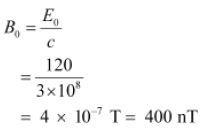
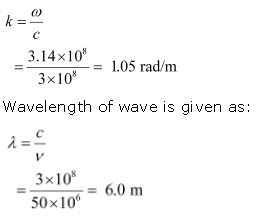
Angular frequency of source is given as:
ω = 2πν
= 2π × 50 × 106
= 3.14 × 10⁸ rad/s
Propagation constant is given as:
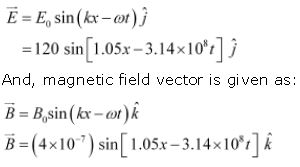
(b) Suppose the wave is propagating in the positive x direction. Then, the electric field vector will be in the positive y direction and the magnetic field vector will be in the positive z direction. This is because all three vectors are mutually perpendicular.
Equation of electric field vector is given as:
Question. The terminology of different parts of the electromagnetic spectrum is given in the text. Use the formula E = hν (for energy of a quantum of radiation: photon) and obtain the photon energy in units of eV for different parts of the electromagnetic spectrum. In what way are the different scales of photon energies that you obtain related to the sources of electromagnetic radiation?
Answer : Energy of a photon is given as:
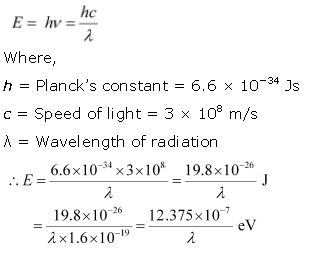
The given table lists the photon energies for different parts of an electromagnetic spectrum for different λ.
| λ (m) | 103 | 1 | 10−3 | 10−6 | 10−8 | 10−10 | 10−12 |
| E (eV) | 12.375 × 10⁻¹⁰ |
12.375 × 10⁻⁷ |
12.375 × 10⁻⁴ |
12.375 × 10⁻¹ |
12.375 × 101 |
12.375 × 10³ |
12.375 × 10⁵ |
The photon energies for the different parts of the spectrum of a source indicate the spacing of the relevant energy levels of the source.
Question. In a plane electromagnetic wave, the electric field oscillates sinusoidally at a frequency of 2.0 × 10¹⁰ Hz and amplitude 48 V m−1.
(a) What is the wavelength of the wave?
(b) What is the amplitude of the oscillating magnetic field?
(c) Show that the average energy density of the E field equals the average energy density of the B field. [c = 3 × 10⁸ m s−1.]
Answer : Frequency of the electromagnetic wave, ν = 2.0 × 10¹⁰ Hz
Electric field amplitude, E0 = 48 V m−1
Speed of light, c = 3 × 10⁸ m/s
(a) Wavelength of a wave is given as:
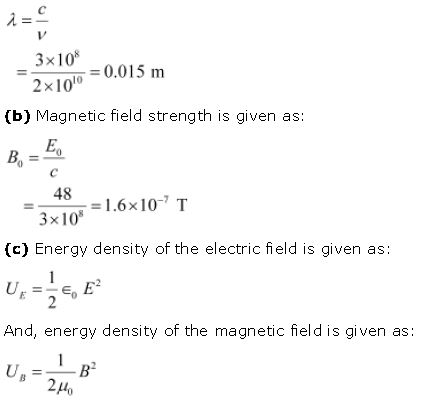
Where,
∈0 = Permittivity of free space
μ0 = Permeability of free space
We have the relation connecting E and B as:
E = cB … (1)
Where,

Question. Suppose that the electric field part of an electromagnetic wave in vacuum is E = {(3.1 N/C) cos [(1.8 rad/m) y + (5.4 × 10⁶ rad/s)t]}i.
(a) What is the direction of propagation?
(b) What is the wavelength λ?
(c) What is the frequency ν?
(d) What is the amplitude of the magnetic field part of the wave?
(e) Write an expression for the magnetic field part of the wave.
Answer : (a) From the given electric field vector, it can be inferred that the electric field is directed along the negative x direction. Hence, the direction of motion is along the negative y direction i.e.,-j
(b) It is given that,

On comparing equations (1) and (2), we get
Electric field amplitude, E0 = 3.1 N/C
Angular frequency, ω = 5.4 × 10⁸ rad/s
Wave number, k = 1.8 rad/m
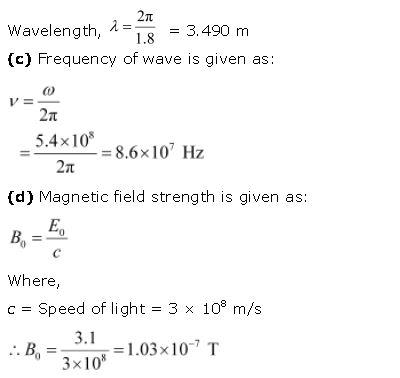
(e) On observing the given vector field, it can be observed that the magnetic field vector is directed along the negative z direction. Hence, the general equation for the magnetic field vector is written as:

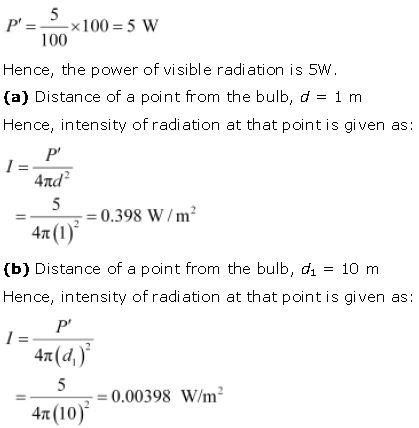
Question. About 5% of the power of a 100 W light bulb is converted to visible radiation. What is the average intensity of visible radiation
(a) at a distance of 1 m from the bulb?
(b) at a distance of 10 m?
Assume that the radiation is emitted isotropically and neglect reflection.
Answer : Power rating of bulb, P = 100 W
It is given that about 5% of its power is converted into visible radiation.
∴ Power of visible radiation,
Question. Use the formula λm T= 0.29 cm K to obtain the characteristic temperature ranges for different parts of the electromagnetic spectrum. What do the numbers that you obtain tell you?
Answer : A body at a particular temperature produces a continous spectrum of wavelengths. In case of a black body, the wavelength corresponding to maximum intensity of radiation is given according to Planck’s law. It can be given by the relation,
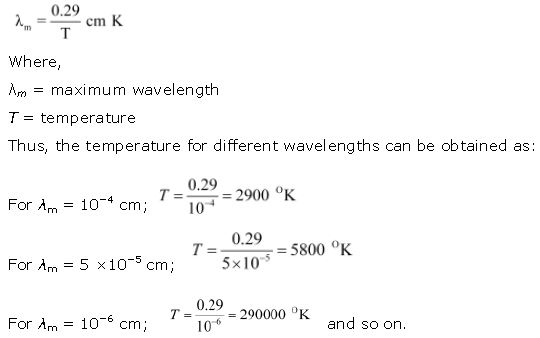
The numbers obtained tell us that temperature ranges are required for obtaining radiations in different parts of an electromagnetic spectrum. As the wavelength decreases, the corresponding temperature increases
Question. Given below are some famous numbers associated with electromagnetic radiations in different contexts in physics. State the part of the electromagnetic spectrum to which each belongs.
(a) 21 cm (wavelength emitted by atomic hydrogen in interstellar space).
(b) 1057 MHz (frequency of radiation arising from two close energy levels in hydrogen; known as Lamb shift).
(c) 2.7 K [temperature associated with the isotropic radiation filling all space-thought to be a relic of the ‘big-bang’ origin of the universe].
(d) 5890 Å - 5896 Å [double lines of sodium]
(e) 14.4 keV [energy of a particular transition in 57Fe nucleus associated with a famous high resolution spectroscopic method
Answer : (a) Radio waves; it belongs to the short wavelength end of the electromagnetic spectrum.
(b) Radio waves; it belongs to the short wavelength end.
(c) Temperature, T = 2.7 °K
λm is given by Planck’s law as:
λm = 0.29 / 2.7 = 0.11 cm
This wavelength corresponds to microwaves.
(d) This is the yellow light of the visible spectrum.
(e) Transition energy is given by the relation,
E = hν
Where,
h = Planck’s constant = 6.6 × 10⁻³⁴ Js
ν = Frequency of radiation
Energy, E = 14.4 K eV
∴ V = E/h
= 14.4 x 103 x 1.6 x 10-19 / 6.6 x 10-34
= 3.4 x 10¹⁸ Hz
This corresponds to X-rays.
Question. Answer the following questions:
(a) Long distance radio broadcasts use short-wave bands. Why?
(b) It is necessary to use satellites for long distance TV transmission. Why?
(c) Optical and radio telescopes are built on the ground but X-ray astronomy is possible only from satellites orbiting the earth. Why?
(d) The small ozone layer on top of the stratosphere is crucial for human survival. Why?
(e) If the earth did not have an atmosphere, would its average surface temperature be higher or lower than what it is now?
(f) Some scientists have predicted that a global nuclear war on the earth would be followed by a severe ‘nuclear winter’ with a devastating effect on life on earth. What might be the basis of this prediction?
Answer : (a) Long distance radio broadcasts use shortwave bands because only these bands can be refracted by the ionosphere.
(b) It is necessary to use satellites for long distance TV transmissions because television signals are of high frequencies and high energies. Thus, these signals are not reflected by the ionosphere. Hence, satellites are helpful in reflecting TV signals. Also, they help in long distance TV transmissions.
(c) With reference to X-ray astronomy, X-rays are absorbed by the atmosphere. However, visible and radio waves can penetrate it. Hence, optical and radio telescopes are built on the ground, while X-ray astronomy is possible only with the help of satellites orbiting the Earth.
(d) The small ozone layer on the top of the atmosphere is crucial for human survival because it absorbs harmful ultraviolet radiations present in sunlight and prevents it from reaching the Earth’s surface.
(e) In theabsenceof an atmosphere, there would be no greenhouse effect on the surface of the Earth. As a result, the temperature of the Earth would decrease rapidly, making it chilly and difficult for human survival.
(f) A global nuclear war on the surface of the Earth would have disastrous consequences. Post-nuclear war, the Earth will experience severe winter as the war will produce clouds of smoke that would cover maximum parts of the sky, thereby preventing solar light form reaching the atmosphere. Also, it will lead to the depletion of the ozone layer.
Free study material for Physics
Physics Class 12 Curriculum Solutions: Chapter 08 Electromagnetic Waves
Official NCERT Solutions for Chapter 08 Electromagnetic Waves
Review comprehensive exercise answers for Class 12 Physics Chapter 08 Electromagnetic Waves. Fully updated to match current NCERT syllabus guidelines, these textbook solutions help students verify their work and maintain accurate study notes.
Step-by-Step Explanations for Chapter 08 Electromagnetic Waves
Clear, methodical explanations accompany every challenging problem within the Class 12 Physics text. Engaging with these detailed answers lays a solid foundation for advanced learning and improves foundational clarity for upcoming assessments.
Next Steps in Your Physics Revision
These resources act as an effective roadmap for daily homework tasks and independent study. Supplement your review of Chapter 08 Electromagnetic Waves with official sample papers and interactive practice tests available on our platform free of charge.
FAQs
The complete and updated NCERT Solutions Class 12 Physics Chapter 8 Electromagnetic Waves is available for free on StudiesToday.com. These solutions for Class 12 Physics are as per latest NCERT curriculum.
Yes, our experts have revised the NCERT Solutions Class 12 Physics Chapter 8 Electromagnetic Waves as per 2026 exam pattern. All textbook exercises have been solved and have added explanation about how the Physics concepts are applied in case-study and assertion-reasoning questions.
Toppers recommend using NCERT language because NCERT marking schemes are strictly based on textbook definitions. Our NCERT Solutions Class 12 Physics Chapter 8 Electromagnetic Waves will help students to get full marks in the theory paper.
Yes, we provide bilingual support for Class 12 Physics. You can access NCERT Solutions Class 12 Physics Chapter 8 Electromagnetic Waves in both English and Hindi medium.
Yes, you can download the entire NCERT Solutions Class 12 Physics Chapter 8 Electromagnetic Waves in printable PDF format for offline study on any device.