

NCERT Solutions for Class 12 Physics: Chapter 15 Communication Systems
Explore reliable textbook solutions for Chapter 15 Communication Systems tailored for Class 12 learners. Utilizing these Physics answers ensures thorough preparation and strengthens foundational knowledge before final NCERT evaluations.
Practice Class 12 Physics Solutions: Chapter 15 Communication Systems
View or download the dedicated Chapter 15 Communication Systems solution resource below. Engaging with these textbook answers under focused study conditions ensures continuous academic progress and mastery of the 2026-27 curriculum for Physics.
Question. Which of the following frequencies will be suitable for beyond-the-horizon communication using sky waves?
(a) 10 kHz
(b) 10 MHz
(c) 1 GHz
(d) 1000 GHz
Answer : B
For beyond-the-horizon communication, it is necessary for the signal waves to travel a large distance. 10 KHz signals cannot be radiated efficiently because of the antenna size. The high energy signal waves (1GHz − 1000 GHz) penetrate the ionosphere. 10 MHz frequencies get reflected easily from the ionosphere. Hence, signal waves of such frequencies are suitable for beyond-the-horizon communication.
Question. Frequencies in the UHF range normally propagate by means of:
(a) Ground waves.
(b) Sky waves.
(c) Surface waves.
(d) Space waves.
Answer : D
Owing to its high frequency, an ultra high frequency (UHF) wave can neither travel along the trajectory of the ground nor can it get reflected by the ionosphere. The signals having UHF are propagated through line-of-sight communication, which is nothing but space wave propagation.
Question. Digital signals
(i) Do not provide a continuous set of values,
(ii) Represent values as discrete steps,
(iii) Can utilize binary system, and
(iv) Can utilize decimal as well as binary systems.
Which of the above statements are true?
(a) (i) and (ii) only
(b) (ii) and (iii) only
(c) (i), (ii) and (iii) but not (iv)
(d) All of (i), (ii), (iii) and (iv).
Answer : C
A digital signal uses the binary (0 and 1) system for transferring message signals. Such a system cannot utilise the decimal system (which corresponds to analogue signals). Digital signals represent discontinuous values.
Question. Is it necessary for a transmitting antenna to be at the same height as that of the receiving antenna for line-of-sight communication? A TV transmitting antenna is 81m tall. How much service area can it cover if the receiving antenna is at the ground level?
Answer : Line-of-sight communication means that there is no physical obstruction between the transmitter and the receiver. In such communications it is not necessary for the transmitting and receiving antennas to be at the same height.
Height of the given antenna, h = 81 m
Radius of earth, R = 6.4 × 10⁶ m
For range, d = (2Rh)½, the service area of the antenna is given by the relation:
A = πd2
= π (2Rh)
= 3.14 × 2 × 6.4 × 106 × 81
= 3255.55 × 106 m2
= 3255.55
∼ 3256 km2
Question. A carrier wave of peak voltage 12 V is used to transmit a message signal. What should be the peak voltage of the modulating signal in order to have a modulation index of 75%?
Answer : Amplitude of the carrier wave, Ac = 12 V
Modulation index, m = 75% = 0.75
Amplitude of the modulating wave = Am
Using the relation for modulation index:
m = Am/Ac
∴Am = mAc
= 0.75 x 12 = gV
Question. A modulating signal is a square wave, as shown in Fig. 15.14.
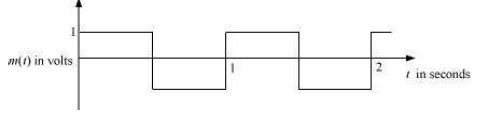
The carrier wave is given by: c(t) = 2 sin (8πt) volts.
(i) Sketch the amplitude modulated waveform
(ii) What is the modulation index?
Answer : It can be observed from the given modulating signal that the amplitude of the modulating signal, Am = 1 V
It is given that the carrier wave c (t) = 2 sin (8πt)
∴Amplitude of the carrier wave, Ac = 2 V
Time period of the modulating signal Tm = 1 s
The angular frequency of the modulating signal is calculated as:
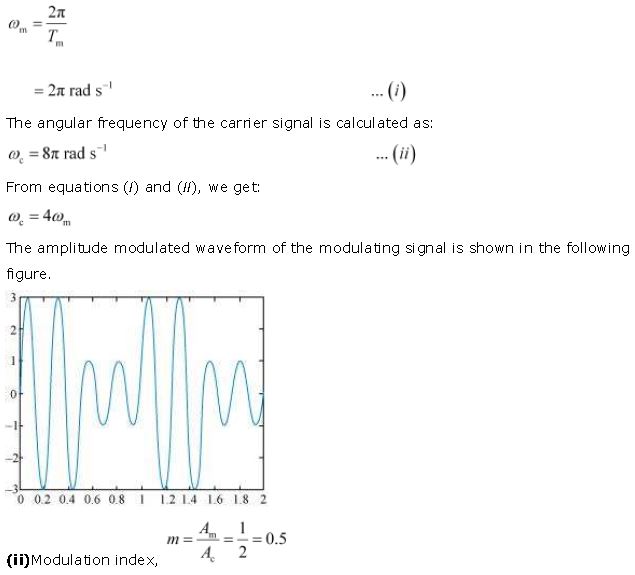
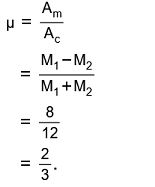
Question. For an amplitude modulated wave, the maximum amplitude is found to be 10 V while the minimum amplitude is found to be 2 V. Determine the modulation index μ. What would be the value of μ if the minimum amplitude is zero volt?
Answer : Maximum amplitude, Amax = 10 V
Minimum amplitude, Amin = 2 V
Modulation index μ, is given by the relation:
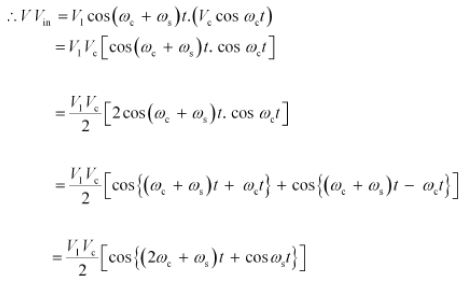
Question. Due to economic reasons, only the upper sideband of an AM wave is transmitted, but at the receiving station, there is a facility for generating the carrier. Show that if a device is available which can multiply two signals, then it is possible to recover the modulating signal at the receiver station.
Answer : Let ωc and ωs be the respective frequencies of the carrier and signal waves.
Signal received at the receiving station, V = V1 cos (ωc + ωs)t
Instantaneous voltage of the carrier wave, Vin = Vc cos ωct
Free study material for Physics
Free NCERT Textbook Explanations: Class 12 Physics Chapter 15 Communication Systems
Accessing Chapter 15 Communication Systems Solutions
Explore reliable textbook solutions for Chapter 15 Communication Systems tailored for Class 12 learners. Utilizing these complete exercise answers ensures your preparation aligns exactly with official NCERT standards for Physics.
Concept-Driven Answers for Class 12 Physics
Each solution includes detailed reasoning to foster genuine comprehension of Chapter 15 Communication Systems concepts. Reviewing these step-by-step breakdowns allows learners to master both analytical and descriptive questions expected in school evaluations.
Maximizing Study Efficiency
Frequent review of these structured answers builds strong analytical capabilities and response efficiency. Maximize your academic readiness by combining these textbook solutions with our curated study materials and mock evaluations for Class 12 Physics.
FAQs
The complete and updated NCERT Solutions Class 12 Physics Chapter 15 Communication Systems is available for free on StudiesToday.com. These solutions for Class 12 Physics are as per latest NCERT curriculum.
Yes, our experts have revised the NCERT Solutions Class 12 Physics Chapter 15 Communication Systems as per 2026 exam pattern. All textbook exercises have been solved and have added explanation about how the Physics concepts are applied in case-study and assertion-reasoning questions.
Toppers recommend using NCERT language because NCERT marking schemes are strictly based on textbook definitions. Our NCERT Solutions Class 12 Physics Chapter 15 Communication Systems will help students to get full marks in the theory paper.
Yes, we provide bilingual support for Class 12 Physics. You can access NCERT Solutions Class 12 Physics Chapter 15 Communication Systems in both English and Hindi medium.
Yes, you can download the entire NCERT Solutions Class 12 Physics Chapter 15 Communication Systems in printable PDF format for offline study on any device.