

Find CBSE Class 12 Economics HOTs Introduction right below. We offer complete High Order Thinking Skills (HOTS) questions and answers for Class 12 Economics Part A Microeconomics Chapter 01 Introduction to Micro Economics. Designed to support your 2026-27 exam session goals, these expert questions match standard curriculum patterns from CBSE, NCERT, and KVS.
Download Class 12 Economics Part A Microeconomics Chapter 01 Introduction to Micro Economics HOTS Practice
Every Class 12 Economics student should practice these HOTS Questions to tackle difficult exam problems. Use the provided solutions to improve your critical thinking and boost your overall performance in Class 12.
HOTS Questions and Answers for Class 12 Economics Part A Microeconomics Chapter 01 Introduction to Micro Economics
UNIT - I
INTRODUCTION
QUESTIONS BASED ON HOTS WITH MODEL ANSWERS
VERY SHORT ANSWER TYPE QUESTIONS: - (1 Mark Each)
Q.1. Why is there a need for economizing of resources?
Ans. Because resources are limited.
Q.2. Why does economic problem arise?
Ans. It arises mainly because of scarcity of resources.
Q.3. Why is PPC downward sloping from left to right?
Ans. Because in situation of full employment of resources, production of one good can be increased only with less of other good.
Q.4. What does a rightward shift of PPC indicate?
Ans. The rightward shift of PPC indicates growth of resources or technological progress.
Q.5. Why does the problem of choice arise?
Ans. Relative scarcity of resources having alternative uses in relation to unlimited wants, gives rise to an economic problem.
Q.6. Why does PPC look concave to the origin?
Ans. PPC is concave to the origin because of increasing marginal rate of transformation (or increasing marginal opportunity cost).
Q.7. Which factor lead to a shift of PPC towards right hand side?
Ans. Growth of resources or technological progress leads to a shift of PPC towards right-hand side.
Q.8. What does a point below PPC indicate?
Ans. It shows inefficient/under utilization of resources.
Q.9. What does slope of PPC show?
Ans. Negative slope of PPC shows that in order to produce more units of one good, some units of the other good must be sacrificed.
Q.10. When allocation of resources is considered as inefficient?
Ans.Allocation of resources is considered as inefficient when economy performs below the PPC curve.

Question. With the help of an example, define micro economics.
Ans. Micro Economics is that branch of economics in which economic problems are studied at individual level e.g. the behaviour of consumer, firms, etc.
Question. Define macro economics with the help of an example.
Ans. Macro economics is that branch of economics which studies the economy as a whole and its aggregates e.g. National income, the level of employment.
Question. Define opportunity cost.
Ans. For the selection of an opportunity, the sacrifice of next best alternative use is called opportunity cost.
Question. Why does an economic problem arise?
Ans. An economic problem arises due to scarcity of resources having alternative uses in relation to unlimited wants.
Question. Write two characteristics of resources.
Ans. Resources are scarce (limited) and they have alternative uses.
Question. What do you mean by scarcity?
Ans. Scarcity refers to a situation in which demand is more than supply
1. Why is a production possibilities curve concave? Explain.
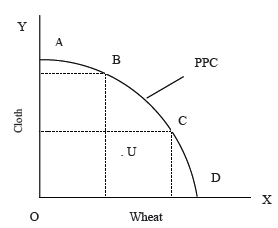
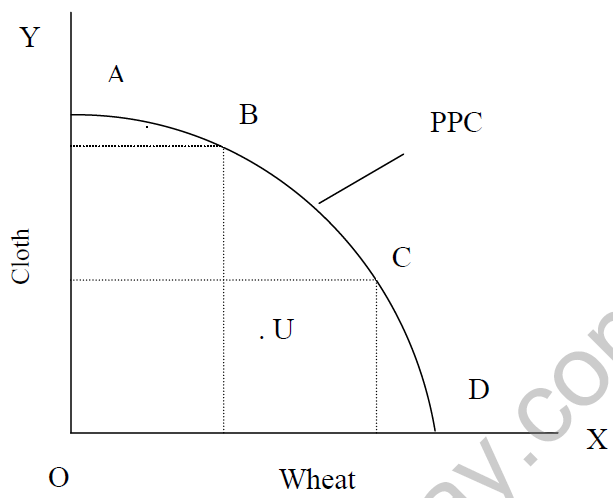
Ans. The production possibility curve being concave means that MRT increases as we move downward along the curve. MRT increases because it is assumed that no resource is equally efficient in production of all goods. As resources are transferred from one good to another, less & less efficient resources have to be employed. This raises cost and raises MRT
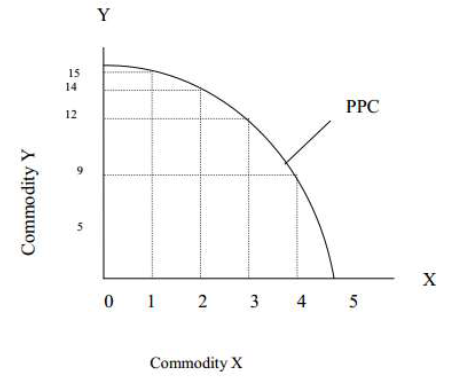
3. Draw PPC and show the followings:-
a. Full employment of resources,
b. Underutilisation of resources, and
c. Growth of resources.
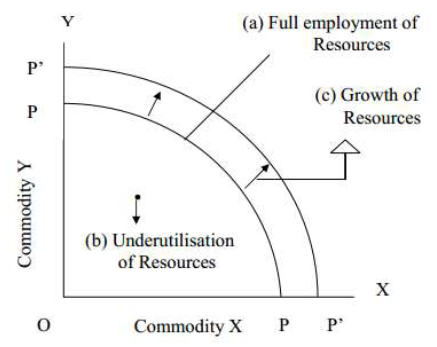
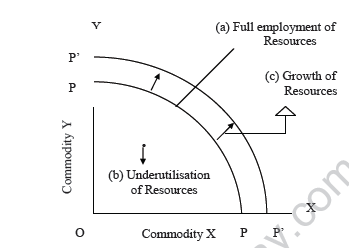
Ans. a. Full employment of resources - A point anywhere on the PPC, shows the efficient use or full employment of resources.
b. Underutilisation of resources - A point anywhere inside of the curve, shows inefficient/under utilisation of resources.
c. Growth of resources – It refers to the shift in PPC. If more resources are generated, the level of production will increase. In the figure it is represented by a shift in PPC from PP to P’P’.
Q.1 Why is a production possibilities curve concave? Explain.
Question. What are the three central problems of Economy?
Answer : The three central problems of Economy are.
• What to Produce
• How to Produce
• For whom to Produce
Question. Define Scarcity.
Answer : Scarcity refers to the deficit of resources as compared to the demand.
Question. What is another name for opportunity cost in economics?
1. Economic problem
2. Marginal Cost
3. Total Cost
4. Economic Cost
Answer : Economic problem
Question. Is the subject of the Jute industry studied in a macroeconomy?
1. True
2. False
3. Maybe
4. Can’t say
Answer : False
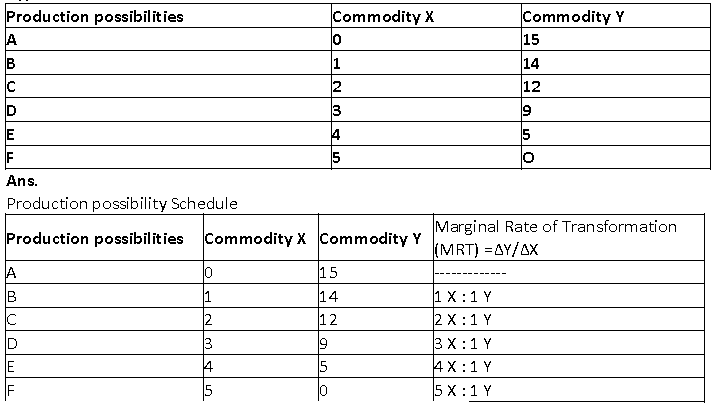
Question. Define marginal rate of transformation.
Answer : Marginal Rate of Production MRT is the ratio of a particular product sacrificed to manufacture another product.
MRT= ▲y / ▲x
Question. The primary assumption about resources while drawing a PPC is
1. Resources are limited
2. Resources depend on the kind of products produced
3. Resources can be put to a particular use
4. Resources are constant and given
Answer : Resources are constant and given
Question. What are the three central problems of an economy?
Answer : The three central problems of an economy are
(a) What to produce?
(b) How to produce
(c) For whom to produce?
Question. What do you mean by economizing of resources?
Answer : Economizing means making the best of the available resources.
Question. What does the problem for whom to produce refer to?
Answer : The problem for whom to produce refers to a particular section of people who will consume the end product. Here, the problem of choices arises because the manufacturers are unable to produce each product in huge quantity to satisfy everybody’s need. So, the consumers’ have to make choices between which product is more important to them, so the limited resources can be distributed rationally.
Question. What is the difference between the planned economy and market economy?
Answer : Planned Economy – A planned economy has one person or a group who takes a decision on production, investment, pricing, and distribution, etc, and produces products and services that are pre-planned. The planned economy is a centrally planned economy and the decisions are basically taken by the government. In another term, the planned economy is also known as a command economy because everybody has to follow one person, his command and guidelines. The aim of the planned economy is to increase production by making sure that everything required is manufactured and that everyone’s requirements are fulfilled. Most assets are controlled and owned by the state. Market Economy- A market economy is controlled by external authority and may have one individual who might decide what to produce, whom to produce, and how to get the things done. This type of economy keeps changing according to the demand and supply and taste of a consumer. The main issue in the economy is that a company might refuse to manufacture goods if it’s unprofitable for them. Most assets are controlled and owned privately. Few differences between the planned economy and market economy are as follows.
• The planned economy operates according to the structure planned by the government. Whereas, the market economy operates based on market demand.
• A decision on production, investment, pricing, and distribution, etc are taken by the government whereas in the market economy it in the free market.
• A planned economy doesn’t identify consumer needs, supply, and shortages. Whereas, in a market economy, demand and supply are based on those factors.
Free study material for Economics
Download Class 12 Economics Part A Microeconomics Chapter 01 Introduction to Micro Economics HOTS Practice Questions
Preparing with Part A Microeconomics Chapter 01 Introduction to Micro Economics HOTS Exercises
Explore rigorous problem-solving exercises for Class 12 Economics Part A Microeconomics Chapter 01 Introduction to Micro Economics. These questions focus on advanced applications of core formulas, ensuring complete readiness for school tests and academic evaluations.
How to Use These Class 12 Economics HOTS
Each question in this set is mapped directly to the official NCERT book for Class 12. Review the detailed answer keys provided below each problem to verify your solution steps and correct mistakes early.
More Study Resources for Class 12 Economics
Wrap up your chapter revision by testing your speed with our interactive Economics quizzes. Access all curriculum-aligned study resources online without any restrictions.
FAQs
You can download the teacher-verified PDF for CBSE Class 12 Economics HOTs Introduction from StudiesToday.com. These questions have been prepared for Class 12 Economics to help students learn high-level application and analytical skills required for the 2026-27 exams.
In the 2026 pattern, 50% of the marks are for competency-based questions. Our CBSE Class 12 Economics HOTs Introduction are to apply basic theory to real-world to help Class 12 students to solve case studies and assertion-reasoning questions in Economics.
Unlike direct questions that test memory, CBSE Class 12 Economics HOTs Introduction require out-of-the-box thinking as Class 12 Economics HOTS questions focus on understanding data and identifying logical errors.
After reading all conceots in Economics, practice CBSE Class 12 Economics HOTs Introduction by breaking down the problem into smaller logical steps.
Yes, we provide detailed, step-by-step solutions for CBSE Class 12 Economics HOTs Introduction. These solutions highlight the analytical reasoning and logical steps to help students prepare as per CBSE marking scheme.