CBSE Class 12 Economics HOTs Consumer Behaviour And Demand Set A

Refer to CBSE Class 12 Economics HOTs Consumer Behaviour And Demand Set A. We have provided exhaustive High Order Thinking Skills (HOTS) questions and answers for Class 12 Economics Part A Microeconomics Chapter 2 Theory of Consumer Behaviour. Designed for the 2025-26 exam session, these expert-curated analytical questions help students master important concepts and stay aligned with the latest CBSE, NCERT, and KVS curriculum.

Part A Microeconomics Chapter 2 Theory of Consumer Behaviour Class 12 Economics HOTS with Solutions

Practicing Class 12 Economics HOTS Questions is important for scoring high in Economics. Use the detailed answers provided below to improve your problem-solving speed and Class 12 exam readiness.

HOTS Questions and Answers for Class 12 Economics Part A Microeconomics Chapter 2 Theory of Consumer Behaviour

 
3 - 4 MARKS QUESTIONS
 
Q.1 Distinguish between ‘increase in demand’ and ‘increase in quantity demanded’ of a commodity.
 
Ans. When demand increases at given price then it is called ‘increase in demand’. On the other hand, when demand increases by decrease in the price of a commodity then it is called increase in quantity demand.
 
Q.2 Given price of a good, how does a consumer decide as to how much of that good to buy?
 
Ans. Consumer purchases upto the point where marginal utility is equal to the price (MU=P). So long as marginal utility is greater than price, he keeps on purchasing. As he makes purchases MU falls and at a particular quantity of the good MU becomes equal to price. Consumer purchases upto this point.
 
Q.3 A consumer consumers only two goods X and Y. State & explain the conditions of consumer’s equilibrium with the help of utility analysis.
 
Ans. There are two conditions of consumer equilibrium :
MUX/PX = MUY/PY 
Explanation : 
If, the consumer is not in equilibrium because he  
Similarly if    MUX/PX           MUY/PY   the consumer is not in equilibrium as he can raise his total utility by buying less of X and more of Y.
 
(ii) MU falls as consumption increases : If MU does not fall as consumption increases the consumer will end up buying only good which is unrealistic or consumer will never reach the equilibrium position.
 
Q.4 Explain how the demand for a good is affected by the price of its related goods. Give examples.
 
Ans. Related goods are either substitutes or complementary
Substitutes Goods : When price of a substitude falls, it becomes cheaper than the given good. So the consumer substitutes it for given good will decrease. Similarly, a rise in the price of substitute will result in increase in the demand for given good. For example Tea and Coffee.
 
Complementary Goods : When the price of a complementary good falls its demand rises and the demand for the given good will increase.
Similarly when price of complementary good increases, then demand for given good decreases. For example : – Car & Petrol.
 
Q.5 Distinguish between normal goods and inferior goods. Give example also.
 
Ans. Normal Goods : These are the goods the demand for which increases as income of the buyer rises. There is a positive relationship between income and demand or income effect is positive. Example ; Rice, Wheat 
 
Inferior Goods : These are the goods the demand for which decreases as income of buyer rises. Thus, there is negative relationship between income and demand or income effect is negative.Example : coarse grain, coarse cloth. 
 
Q.6 Explain any four factors that affect price elasticity of demand.
 
Ans. 1. Nature of Commodity : Necessories like Salt, Kerosene oil etc. have inelastic demand and luxuries have elastic demand.
 
2. Availability of substitutes : Demand for goods which have close substitudes is relatively more elastic and goods without close substitutes have less elastic demand.
 
3. Different uses : Commodities that can be put to different uses have elastic demand for instance electricity has different uses.
 
4. Habit of the consumer : Goods to which consumers become habitual will have inelastic demand. Examples – Liquor and Cigarette.
 
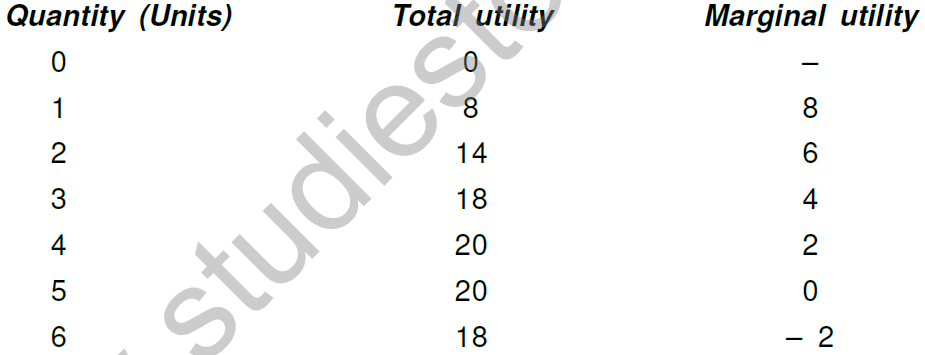
Q.7 Explain relationship between total utility and marginal utility with the help of a schedule.
 Ans.
 CBSE_Class_12_Economics_Behaviour_Set_A_1
 
(1) As long as 18 MU is positive, TU increases. – 2
(2)When marginal utility is equal to zero then total utility is maximum. (3)     When marginal util[ity is negative; Total utility starts diminishing.
 
Q.8 Define marginal utility. State the law of diminishing merginal utility.
 
Ans. Marginal Utility : It is addition more to the total utility as consumption is increased by one more unit of the commodity.
 
Law of Diminishing Merginal utility : It states that as consumer consumes more and more units of a commodity, the utility derived from each successive unit goes on decreasing. According to this law TU increases at decreasing rate and MU decreases.
 
6 MARKS QUESTIONS

Q.1 Explain the three properties of indifference curves.
 
Ans. Three properties of indifference curves are as follow.
 
1. Slopes downward from left to right : To consume more of one good the consumer must give up some quantity of the other good so that total utility remains the same.
 
2. Convex towards the origin : MRS declines continuously due to the operation of the law of diminishing marginal utility.
 
3. Higher indifference curves represents higher utility : Higher indifference curve represent large bundle of goods. Which means more utility because of monotoric preference.
 
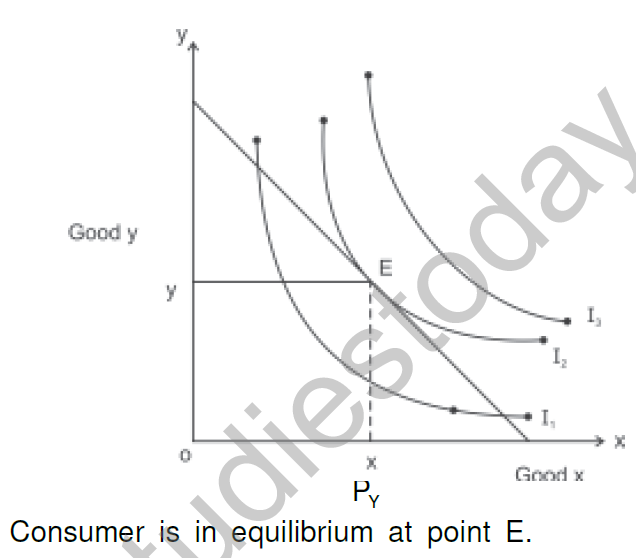
Q.2 Explain the conditions of consumer’s equilibrium using indifference curve analysis. Use diagram.
 
Ans. There are two conditions for consumer’s equilibrium.
(i) MRS =PX/PY
(ii) MRS is continuously falling.
Explanation
Suppose there are two goods X and Y. the first condition of consumer’s equilibrium is MRS =
 
If MRS    . It means consumer values X more than what market values & willing to give more price than market price he will purchase more of X this cause fall in MRS and it will continue upto that when MRS = PX/PY
If MRS     . It means consumer values X less than what market values. Consumer is willing to give less price as market price & he will purchase less of X, by this MRS will increase and it will continue till MRS = PX/PY
 
(ii) Unless the MRS is continuously falling the equality between the MRS and will not be achieved.
CBSE_Class_12_Economics_Behaviour_Set_A_2
Part A Microeconomics Chapter 01 Introduction to Micro Economics
CBSE Class 12 Economics HOTs Introduction
Part A Microeconomics Chapter 03 Production and Costs
CBSE Class 12 Economics HOTs Production and Costs
Part A Microeconomics Chapter 05 Market Equilibrium
CBSE Class 12 Economics HOTs Market Equilibrium
Part A Microeconomics Chapter 06 Non Competitive Markets
CBSE Class 12 Economics HOTs Non Competitive Markets
Part B Macroeconomics Chapter 02 National Income Accounting
CBSE Class 12 Economics HOTs Economics Forms of Market and Price Determination
Part B Macroeconomics Chapter 06 Open Economy Macroeconomics
CBSE Class 12 Economics HOTs for Balance of Payment

HOTS for Part A Microeconomics Chapter 2 Theory of Consumer Behaviour Economics Class 12

Students can now practice Higher Order Thinking Skills (HOTS) questions for Part A Microeconomics Chapter 2 Theory of Consumer Behaviour to prepare for their upcoming school exams. This study material follows the latest syllabus for Class 12 Economics released by CBSE. These solved questions will help you to understand about each topic and also answer difficult questions in your Economics test.

NCERT Based Analytical Questions for Part A Microeconomics Chapter 2 Theory of Consumer Behaviour

Our expert teachers have created these Economics HOTS by referring to the official NCERT book for Class 12. These solved exercises are great for students who want to become experts in all important topics of the chapter. After attempting these challenging questions should also check their work with our teacher prepared solutions. For a complete understanding, you can also refer to our NCERT solutions for Class 12 Economics available on our website.

Master Economics for Better Marks

Regular practice of Class 12 HOTS will give you a stronger understanding of all concepts and also help you get more marks in your exams. We have also provided a variety of MCQ questions within these sets to help you easily cover all parts of the chapter. After solving these you should try our online Economics MCQ Test to check your speed. All the study resources on studiestoday.com are free and updated for the current academic year.

Where can I download the latest PDF for CBSE Class 12 Economics HOTs Consumer Behaviour And Demand Set A?

You can download the teacher-verified PDF for CBSE Class 12 Economics HOTs Consumer Behaviour And Demand Set A from StudiesToday.com. These questions have been prepared for Class 12 Economics to help students learn high-level application and analytical skills required for the 2025-26 exams.

Why are HOTS questions important for the 2026 CBSE exam pattern?

In the 2026 pattern, 50% of the marks are for competency-based questions. Our CBSE Class 12 Economics HOTs Consumer Behaviour And Demand Set A are to apply basic theory to real-world to help Class 12 students to solve case studies and assertion-reasoning questions in Economics.

How do CBSE Class 12 Economics HOTs Consumer Behaviour And Demand Set A differ from regular textbook questions?

Unlike direct questions that test memory, CBSE Class 12 Economics HOTs Consumer Behaviour And Demand Set A require out-of-the-box thinking as Class 12 Economics HOTS questions focus on understanding data and identifying logical errors.

What is the best way to solve Economics HOTS for Class 12?

After reading all conceots in Economics, practice CBSE Class 12 Economics HOTs Consumer Behaviour And Demand Set A by breaking down the problem into smaller logical steps.

Are solutions provided for Class 12 Economics HOTS questions?

Yes, we provide detailed, step-by-step solutions for CBSE Class 12 Economics HOTs Consumer Behaviour And Demand Set A. These solutions highlight the analytical reasoning and logical steps to help students prepare as per CBSE marking scheme.