

Download Class 12 Computer Science Concept Summaries: CBSE Class 12 Computer Science Communication And Computer Networks Notes
Explore reliable concept summaries and revision materials through the CBSE Class 12 Computer Science Communication And Computer Networks Notes. Tailored for Class 12 learners, utilizing these notes for Computer Science Communication And Computer Networks ensures thorough preparation and strengthens core academic definitions before final evaluations.
Access Communication And Computer Networks Notes and Study Material
Access the complete concept summary PDF for Communication And Computer Networks below. Regular review of these targeted notes builds familiarity with complex Class 12 Computer Science themes and helps secure higher marks in final school evaluations.
Communication and Computer Networks
Network→ It is an interconnected collection of autonomous computers
Network Goals →
1. Resource sharing --- All programs, data and peripherals are available to anyone on the network irrespective to the physical location of the resource and the user.
2. High Reliability --- A file could be replicated on two or three machines, so if one of them is unavailable (hardware crash), the other copies could be available.
3. Cost Factor --- Personal Computers (PC’s) have a much better price/performance ratio than micro ones.
4. Communication Medium --- A file that was updated/modified on a network, can be seen by the other users on the network immediately.
Network Applications→
1. Sharing of data, programs and peripherals
2. Access to remote programs.
3. Access to remote databases.
4. Value-added communication facilities.
Advantages→
1. Speed --- Sharing and transferring files within Networks are very rapid. Thus saving time, while maintaining the integrity of the file.
2. Security --- Sensitive files and programs on a network are passwords protected so no illegal copying of programs is there.
3. Centralized Software Management --- Software can be loaded on one computer eliminating that need to spend time installing on independent computers.
4. Resource Sharing --- Resources such as, printers, fax machines and modems can be shared. Therefore is cheaper than to have these on many systems.
5. Improve Communications --- E-mail aids in personal and professional communication. Electronic mail on a LAN can enable staff to communicate within the building having tot to leave their desk.
Disadvantages →
1. Cabling can be expensive to install and replace.
2. A fault with the server will prevent the whole network from working.
3. Security measures are needed to restrict access to the network.
4. WANs are vulnerable to hackers and viruses.
5. Server faults stop applications being available
6. Network faults can cause loss of data and resources
7. User work dependent upon network
8. Could degrade in performance
9. Resources could be located too far from users
10. Network management can become difficult for very large networks
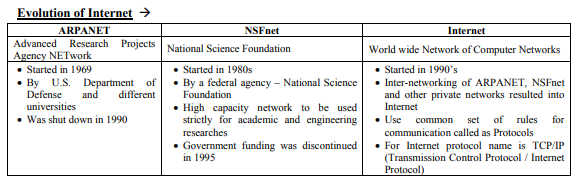


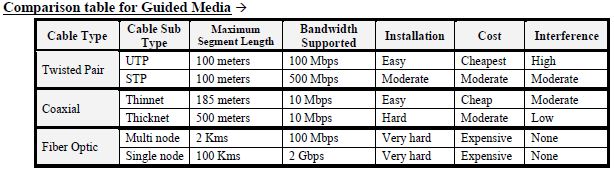
The communication media is divided into two categories :-
1. Guided Media ---- includes cables for transmission. The basic types are :-
a. Twisted Pair Cables
b. Coaxial Cables
c. Optical Fiber Cables
2. Unguided Media ---- includes waves through air, water or vacuum for transmission. The basic types are:-
a. Micro Wave
b. Radio Wave
c. Satellite
d. Infrared
e. Laser
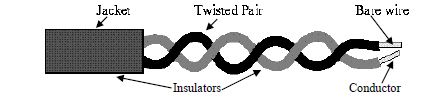
Twisted Pair Cables Cables without a shield are called Unshielded Twisted Pair (UTP). As shown in Fig below:-
Important point related to twisted pair cables :-
• The wire comes in pairs and the pair are twisted around each other
• VGM (Voice Grade Medium) for telephone wiring
• DGM (Data Grade Medium) a high quality cable used for LAN applications
• It stops signal interference that is crosstalk (Bleeding of signals from one wire to another) which can corrupt signals and cause network errors.
• The degree of reduction in noise interference is determined by the number of turns per foot. Increasing the number of turns per foot reduces the noise interference.
• To further improve noise rejection, a foil or wire braid shield is woven around the twisted pairs. Cables with a shield are called Shielded Twisted Pair (STP). As shown is figures A and B given below :-

Advantages :-
1. It is simple 5. It is very inexpensive
2. It is physically flexible 6. Easy to add additional network devices, therefore supports large
3. It can be easily connected number of network devices
4. It is easy to install and maintain 7. It has a low weight
Disadvantages :-
1. High attenuation (signal loss) limits individual runs to 100 meters
2. Repeaters should be used to carry signals for long distances
3. Its low bandwidth makes it unsuitable for broadband applications
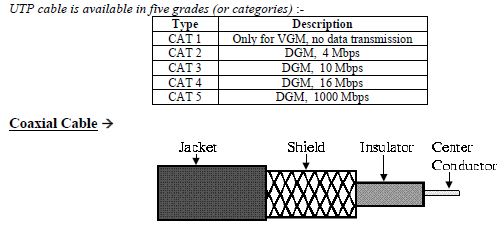
4. Maximum data rate without conditioning 1Mbps and with conditioning 10 Mbps UTP cable is available in five grades (or categories) :-
Important point related to Coaxial pair cables :-
• Coaxial Cable consists of two conductors.
• The inner conductor is held inside an insulator with the other conductor woven around it providing a shield. An insulating protective coating called a jacket covers the outer conductor.
• The outer shield protects the inner conductor from outside electrical signals.
• Coaxial cables are used for Cable TV (in CATV form) and Ethernets.
• This cable allows higher data rates to be transferred than the Twisted Pair cable.
Advantages :-
1. Can be used for broadband transmissions i.e. many channels transmitted simultaneously
2. Offer higher bandwidths upto 400 MBPS
3. Data transmission is better than Twisted Pair cable
4. Low cost due to less total footage of cable, hubs not needed
5. Lower attenuation (disturbance)than twisted pair Optical Fiber ′ Jacket Thin Glass Rods Cladding Core
Disadvantages :-
1. Expensive as compared to Twisted Pair cables
2. They are not compatible with twisted pair cables
3. Limited in network speed
4. Limited in size of network
5. One bad connector can take down entire network
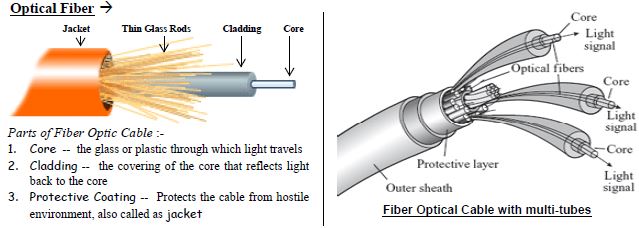
Important point related to Fiber Optical cables :-
• It consists of thin strands of glass or glass like material that carry light from a source at one end to a detector at the other end
• Light sources used are either LEDs (Light Emitting Diodes) or LDs (Laser Diodes)
• Data transmitted is modulated onto light using frequency modulation techniques
• Bandwidth is very high, for LEDs is 20 to 150 Mbps and for LDs even higher
Advantages :-
1. Can be used for broadband transmissions where many channels are handled in parallel
2. Guarantee Secure Transmission: cannot tap into cable.
3. Noise, Radio-Frequency, Electrical and Magnetic Immunity
4. Longer distances than copper wire
5. Smaller and lighter than copper wire
6. Faster transmission rate
Disadvantages :-
1. Difficult to install
2. Connecting two fibers or a fiber to a light source is a difficult process
3. Light can reach the receiver out of phase
4. Difficult to solder and slice
5. Limited physical arc of cable. Bend it too much & it will break!
6. Expensive than all cables
7. Connection losses are common problem
Micro Wave →
How it works :-
• Microwave Signals are used to transmit data instead of cable which are similar to radio and television signals and are used for long distance communications
• Microwave transmission consists of transmitter, receiver and the atmosphere.
• This transmission is also known as Line-of-Sight transmission. The Transmit station must be in visible contact with the receive station.
• Parabolic antennas are mounted on towers to send a beam to other antenna far away.
• The higher the tower, higher is the range. With 100 meter high tower a distance of 100 Km is feasible.
Please click the link below to download pdf file for CBSE Class 12 Computer Science - Communication and Computer Networks.
Free study material for Computer Science
Download CBSE Revision Notes: Class 12 Computer Science Communication And Computer Networks
Key Concepts and Summary for Class 12 Computer Science Communication And Computer Networks
Review targeted chapter notes for Class 12 Computer Science Communication And Computer Networks. Built according to official CBSE guidelines, these summaries highlight high-yield topics frequently tested in school evaluations.
NCERT-Aligned Chapter Summary and Notes
Each chapter summary is structured around standard CBSE textbooks, allowing students to check their understanding and clarify complex ideas early in their revision.
Next Steps in Your Exam Preparation
Explore our broader library of printable assignments, chapter notes, and mock tests designed to support continuous revision and secure higher marks in CBSE assessments.
FAQs
You can download the teacher prepared revision notes for CBSE Class 12 Computer Science Communication And Computer Networks Notes from StudiesToday.com. These notes are designed as per 2026-27 academic session to help Class 12 students get the best study material for Computer Science.
Yes, our CBSE Class 12 Computer Science Communication And Computer Networks Notes include 50% competency-based questions with focus on core logic, keyword definitions, and the practical application of Computer Science principles which is important for getting more marks in 2026 CBSE exams.
Yes, our CBSE Class 12 Computer Science Communication And Computer Networks Notes provide a detailed, topic wise breakdown of the chapter. Fundamental definitions, complex numerical formulas and all topics of CBSE syllabus in Class 12 is covered.
These notes for Computer Science are organized into bullet points and easy-to-read charts. By using CBSE Class 12 Computer Science Communication And Computer Networks Notes, Class 12 students fast revise formulas, key definitions before the exams.
No, all study resources on StudiesToday, including CBSE Class 12 Computer Science Communication And Computer Networks Notes, are available for immediate free download. Class 12 Computer Science study material is available in PDF and can be downloaded on mobile.