

Computer Science Concept Notes for Class 12: Cloud Computing And Open Standards
Explore reliable concept summaries and revision materials through the CBSE Class 12 Computer Science Notes Of Cloud Computing And Open Standards Notes. Tailored for Class 12 learners, utilizing these notes for Computer Science Cloud Computing And Open Standards ensures thorough preparation and strengthens core academic definitions before final evaluations.
Download Cloud Computing And Open Standards Revision Notes PDF
Access the complete concept summary PDF for Cloud Computing And Open Standards below. Regular review of these targeted notes builds familiarity with complex Class 12 Computer Science themes and helps secure higher marks in final school evaluations.
CBSE Class 12 Computer Science - Notes of Cloud computing & Open Standards. Learning the important concepts is very important for every student to get better marks in examinations. The concepts should be clear which will help in faster learning. The attached concepts made as per NCERT and CBSE pattern will help the student to understand the chapter and score better marks in the examinations.
Cloud computing
Cloud computing is a phrase used to describe a variety of computing concepts that involve a large number of computers connected through a real-time communication network.. It is a synonym for distributed computing over a network, and means the ability to run a program or application on many connected computers at the same time.
It commonly refers to network-based services, which appear to be provided by real server hardware, and are in fact served up by virtual hardware. Such virtual servers do not physically exist and can therefore be moved around without affecting the end user. Characteristics The National Institute of Standards and Technology's definition of cloud computing identifies "five essential characteristics":
•On-demand self-service.
A consumer can unilaterally provision computing capabilities, such as server time and network storage, as needed automatically without requiring human interaction with each service provider.
•Broad network access.
Capabilities are available over the network and accessed through standard mechanisms that promote thin or thick client platforms (e.g., mobile phones, tablets, laptops, and workstations).
• Resource pooling.
The provider's computing resources are pooled to serve multiple consumers using a multi-tenant model, with different physical and virtual resources .
• Rapid elasticity.
To the consumer, the capabilities available for provisioning often appear unlimited and can be appropriated in any quantity at any time.
• Measured service.
Cloud systems automatically control and optimize (e.g., storage, processing, bandwidth, and active user accounts). Resource usage can be monitored, controlled, and reported, providing transparency for both the provider and consumer of the utilized service.
Service models
Cloud computing providers offer their services according to several fundamental models:
• Infrastructure as a service (IaaS),
• Platform as a service (PaaS), and
• Software as a service (SaaS)
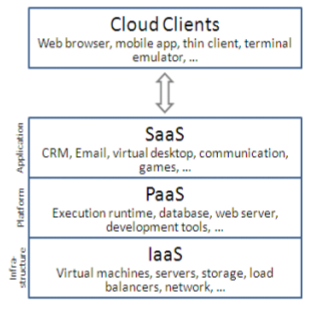
Infrastructure as a service (IaaS
In the most basic cloud-service model, providers of IaaS offer computers – physical or (more often) virtual machines – and other resources. IaaS-cloud providers supply these resources on-demand from their large pools installed in data centers.
Cloud communications and cloud telephony, rather than replacing local computing infrastructure, replace local telecommunications infrastructure with Voice over IP and other off-site Internet services.
Platform as a service (PaaS
In the PaaS models, cloud providers deliver a '''computing platform''', typically including operating system, programming language execution environment, database, and web server. Application developers can develop and run their software solutions on a cloud platform without the cost and complexity of buying and managing the underlying hardware and software layers.

Cloud clients
Users access cloud computing using networked client devices, such as desktop, computers, laptops, tablets and smartphones. Some of these devices – cloud clients – rely on cloud computing for all or a majority of their applications so as to be essentially useless without it.
Examples are thin clients and the browser-based Chromebook.
Some cloud applications, however, support specific client software dedicated to these applications (e.g., virtual desktop clients and most email clients).
Deployment models
Private cloud
Private cloud is cloud infrastructure operated for a single organization, whether managed internally or by a third-party and hosted internally or externally. Private cloud project requires a significant level and degree of engagement to virtualize the business environment.
Self-run data centers are generally capital intensive. They have a significant physical footprint, requiring allocations of space, hardware, and environmental controls. These assets have to be refreshed periodically, resulting in additional capital expenditures.
Public cloud
A cloud is called a "public cloud" when the services are rendered over a network that is open for public use. Technically there may be little or no difference between public and private cloud architecture, however, security consideration may be substantially different for services (applications, storage, and other resources) that are made available by a service provider for a public audience and when communication is effected over a non-trusted network. Generally, public cloud service providers like Amazon AWS, Microsoft and Google own and operate the infrastructure and offer access only via Internet (direct connectivity is not offered)
Community cloud
Community cloud shares infrastructure between several organizations from a specific community with common concerns (security, compliance, jurisdiction, etc.), whether managed internally or by a third-party and hosted internally or externally.
The costs are spread over fewer users than a public cloud (but more than a private cloud.
Hybrid cloud
Hybrid cloud is a composition of two or more clouds (private, community or public) that remain unique entities but are bound together, offering the benefits of multiple deployment models.
A hybrid cloud service as a cloud computing service that is composed of some combination of private, public and community cloud services, from different service providers. It allows one to extend either the capacity or the capability of a cloud service, by aggregation, integration or customization with another cloud service.
Distributed cloud
Cloud computing can also be provided by a distributed set of machines that are running at different locations, while still connected to a single network or hub service. Examples of this include distributed computing platforms such as BOINC and Folding@Home.
Issues
Privacy
The increased use of cloud computing services such as Gmail and Google Docs has pressed the issue of privacy concerns of cloud computing services to the utmost importance. The provider of such services lie in a position such that with the greater use of cloud computing services has given access to a excess of data. This access has the immense risk of data being disclosed either accidentally or deliberately.
Privacy advocates have criticized the cloud model for giving hosting companies' greater ease to control—and thus, to monitor at will—communication between host company and end user, and access user data (with or without permission).
Privacy solutions
Solutions to privacy in cloud computing include policy and legislation as well as end users' choices for how data is stored. The cloud service provider needs to establish clear and relevant policies that describe how the data of each cloud user will be accessed and used. Cloud service users can encrypt data that is processed or stored within the cloud to prevent unauthorized access. Compliance To comply with regulations including FISMA, HIPAA, and SOX in the United States, the Data Protection Directive in the EU and the credit card industry's PCI DSS, users may have to adopt community or hybrid deployment modes that are typically more expensive and may offer restricted benefits. This is how Google is able to "manage and meet additional government policy requirements beyond FISMA".
These policies may dictate a wide array of data storage policies, such as how long information must be retained, the process used for deleting data, and even certain recovery plans. Below are some examples of compliance laws or regulations.
• In the United States, the Health Insurance Portability and Accountability Act (HIPAA) requires a contingency plan that includes, data backups, data recovery, and data access during emergencies.
In fact, data may be stored across multiple data centers in an effort to improve reliability, increase performance, and provide redundancies. Thisgeographic dispersion may make it more difficult to ascertain legal jurisdiction if disputes arise.
Legal
As with other changes in the landscape of computing, certain legal issues arise with cloud computing, including trademark infringement, security concerns and sharing of proprietary data resources.
One important but not often mentioned problem with cloud computing is the problem of who is in "possession" of the data. If a cloud company is the possessor of the data, the possessor has certain legal rights. If the cloud company is the "custodian" of the data, then a different set of rights would apply. The next problem in the legalities of cloud computing is the problem of legal ownership of the data. Many Terms of Service agreements are silent on the question of ownership.
These legal issues are not confined to the time period in which the cloud-based application is actively being used. There must also be consideration for what happens when the provider-customer relationship ends.
Security
The relative security of cloud computing services is a contentious issue that may be delaying its adoption.] Physical control of the Private Cloud equipment is more secure than having the equipment off site and under someone else's control. Physical control and the ability to visually inspect data links and access ports is required in order to ensure data links are not compromised. Issues barring the adoption of cloud computing are due in large part to the private and public sectors' unease surrounding the external management of security-based services. It is the very nature of cloud computing-based services, private or public, that promote external management of provided services. This delivers great incentive to cloud computing service providers to prioritize building and maintaining strong management of secure services. Security issues have been categorized into sensitive data access, data segregation, privacy, bug exploitation, recovery, accountability, malicious insiders, management console security, account control, and multi-tenancy issues. Solutions to various cloud security issues vary, from cryptography, particularly public key infrastructure (PKI), to use of multiple cloud providers, standardisation of APIs, and improving virtual machine support and legal support.
Sustainability
Although cloud computing is often assumed to be a form of green computing, there is currently no way to measure how "green" computers are.
The primary environmental problem associated with the cloud is energy use. Greenpeace ranks the energy usage of the top ten big brands in cloud computing, and successfully urged several companies to switch to clean energy.
Abuse
As with privately purchased hardware, customers can purchase the services of cloud computing for nefarious purposes. This includes password cracking and launching attacks using the purchased services. In 2009, a banking trojan illegally used the popular Amazon service as a command and control channel that issued software updates and malicious instructions to PCs that were infected by the malware.
IT governance
The introduction of cloud computing requires an appropriate IT governance model to ensure a secured computing environment and to comply with all relevant organizational information technology policies. As such, organizations need a set of capabilities that are essential when effectively implementing and managing cloud services, including demand management, relationship management, data security management, application lifecycle management, risk and compliance management. A danger lies with the explosion of companies joining the growth in cloud computing by becoming providers. However, many
Please click the link below to download pdf file for CBSE Class 12 Computer Science - Notes of Cloud computing & Open Standards.
Free study material for Computer Science
Study Material and Revision Notes for Class 12 Computer Science Cloud Computing And Open Standards
Quick Revision Notes: Cloud Computing And Open Standards (CBSE)
Access structured revision notes for Cloud Computing And Open Standards designed in alignment with the latest CBSE curriculum for Class 12 Computer Science. These summaries help clarify core themes and support effective daily study.
Expert Study Material for Class 12 Computer Science
Built using the official NCERT book for Class 12 Computer Science, these notes provide reliable academic guidance. Pair your summary review with our recommended NCERT solutions to master optimal problem-solving approaches.
Complete Your Chapter Revision
Follow up your revision by attempting the interactive online Computer Science MCQ test and practice worksheets for this chapter to verify your mastery. All platform resources are free to access.
FAQs
You can download the teacher prepared revision notes for CBSE Class 12 Computer Science Notes Of Cloud Computing And Open Standards Notes from StudiesToday.com. These notes are designed as per 2026-27 academic session to help Class 12 students get the best study material for Computer Science.
Yes, our CBSE Class 12 Computer Science Notes Of Cloud Computing And Open Standards Notes include 50% competency-based questions with focus on core logic, keyword definitions, and the practical application of Computer Science principles which is important for getting more marks in 2026 CBSE exams.
Yes, our CBSE Class 12 Computer Science Notes Of Cloud Computing And Open Standards Notes provide a detailed, topic wise breakdown of the chapter. Fundamental definitions, complex numerical formulas and all topics of CBSE syllabus in Class 12 is covered.
These notes for Computer Science are organized into bullet points and easy-to-read charts. By using CBSE Class 12 Computer Science Notes Of Cloud Computing And Open Standards Notes, Class 12 students fast revise formulas, key definitions before the exams.
No, all study resources on StudiesToday, including CBSE Class 12 Computer Science Notes Of Cloud Computing And Open Standards Notes, are available for immediate free download. Class 12 Computer Science study material is available in PDF and can be downloaded on mobile.