

Computer Science Concept Notes for Class 12: All topics
Access comprehensive revision notes for All topics using the CBSE Class 12 Computer Science All Chapters Notes. Designed to align with the 2026-27 academic syllabus for Class 12 Computer Science, these concept summaries help students streamline their exam preparation and review complex topics efficiently.
Download All topics Revision Notes PDF
View or download the dedicated All topics revision resource below. Engaging with these structured concept notes daily ensures continuous academic progress and mastery of the 2026-27 curriculum for Computer Science.
STRUCTURE ............ 3
typedef ...................... 5
Enumerated data type .................. 5
#define preprocessor directive............ 6
Macros ....................... 6
Assignment .................. 6
OOP CONCEPTS ................... 7
CLASSES & OBJECTS ...................... 8
Assignment .................... 8
CONSTRUCTOR AND DESTRUCTOR ............... 9
Assignment ..................... 10
INHERITANCE ................... 11
Assignment .......................12
DATA FILE HANDLING IN C++ ............13
BASIC OPERATION ON TEXT FILE IN C++ ..................15
Assignment Text File ............... 17
BASIC OPERATION ON BINARY FILE IN C++ ............... 18
Assignment binary file .............. 20
ARRAY ................ 21
Assignment ............. 27
POINTER ................. 28
Assignment ............31
DATA STRUCTURE ................ 32
STATIC STACK .........32
STATIC CIRCULAR QUEUE ..........34
DYNAMIC STACK ..............35
DYNAMIC QUEUE ......... 37
Assignment ......................39
C++ BASIC CONCEPTS (REVISION TOUR OF CLASS 11) ........... 40
LIBRARY FUNCTION ................ 42
Assignment ...............................45
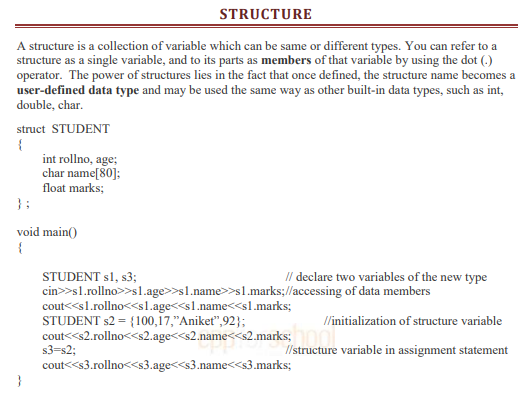
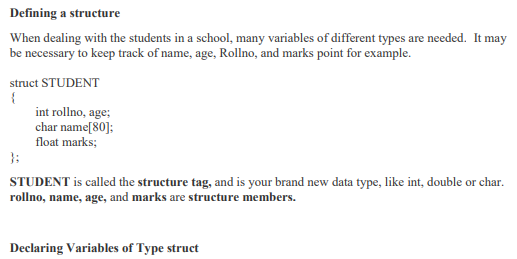
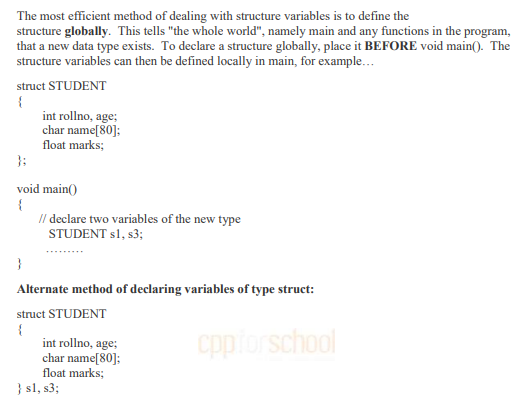
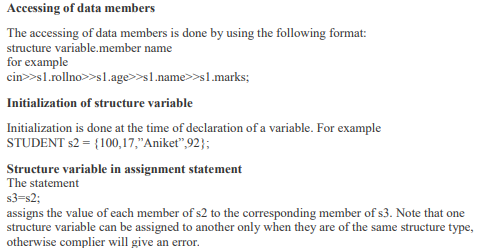
Nested structure (Structure within structure)
It is possible to use a structure to define another structure. This is called nesting of structure.
consider the following program
struct DAY
{
int month, date, year;
};
struct STUDENT
{
int rollno, age;
char name[80];
day date_of_birth;
float marks;
};
typedef
It is used to define new data type for an existing data type. It provides and alternative name for standard data type. It is used for self documenting the code by allowing descriptive name for the standard data type.
The general format is:
typedef existing datatype new datatype
for example:
typedef float real;
Now, in a program one can use datatype real instead of float.
Therefore, the following statement is valid:
real amount;
Enumerated data type
The enum specifier defines the set of names which are stored internally as integer constant. The first name was given the integer value 0, the second value 1 and so on.
for example:
enum months{jan, feb, mar, apr, may} ;
It has the following features:
• It is user defined.
• It works if you know in advance a finite list of values that a data type can take.
• The list cannot be input by the user or output on the screen.
#define preprocessor directive
The #define preprocessor allows to define symbolic names andconstants e.g.
#define pi 3.14159
This statement will translate every occurrence of PI in the program to 3.14159
Macros
Macros are built on the #define preprocessor. Normally a macro would look like:
#define square(x) x*x
Its arguments substituted for replacement text, when the macro is expanded
Please click the link below to download pdf file for CBSE Class 12 Computer Science - All Chapters.
Free study material for Computer Science
Download CBSE Revision Notes: Class 12 Computer Science All topics
Key Concepts and Summary for Class 12 Computer Science All topics
Explore reliable chapter overviews for All topics tailored for Class 12 learners. Use these structured points to grasp difficult themes and ensure solid preparation for upcoming assessments.
NCERT-Aligned Chapter Summary and Notes
Built using the official NCERT book for Class 12 Computer Science, these notes provide reliable academic guidance. Pair your summary review with our recommended NCERT solutions to master optimal problem-solving approaches.
Next Steps in Your Exam Preparation
Explore our broader library of printable assignments, chapter notes, and mock tests designed to support continuous revision and secure higher marks in CBSE assessments.
FAQs
You can download the teacher prepared revision notes for CBSE Class 12 Computer Science All Chapters Notes from StudiesToday.com. These notes are designed as per 2026-27 academic session to help Class 12 students get the best study material for Computer Science.
Yes, our CBSE Class 12 Computer Science All Chapters Notes include 50% competency-based questions with focus on core logic, keyword definitions, and the practical application of Computer Science principles which is important for getting more marks in 2026 CBSE exams.
Yes, our CBSE Class 12 Computer Science All Chapters Notes provide a detailed, topic wise breakdown of the chapter. Fundamental definitions, complex numerical formulas and all topics of CBSE syllabus in Class 12 is covered.
These notes for Computer Science are organized into bullet points and easy-to-read charts. By using CBSE Class 12 Computer Science All Chapters Notes, Class 12 students fast revise formulas, key definitions before the exams.
No, all study resources on StudiesToday, including CBSE Class 12 Computer Science All Chapters Notes, are available for immediate free download. Class 12 Computer Science study material is available in PDF and can be downloaded on mobile.