

Biology Concept Notes for Class 11: Chapter 13 Plant Growth and Development
Review targeted revision notes for Class 11 Biology with the CBSE Class 11 Biology Plant Growth And Development Notes Set 02. Built according to official educational guidelines for the 2026-27 academic year, these downloadable summaries for Chapter 13 Plant Growth and Development support daily study and last-minute exam readiness.
Download Chapter 13 Plant Growth and Development Revision Notes PDF
View or download the dedicated Chapter 13 Plant Growth and Development revision resource below. Engaging with these structured concept notes daily ensures continuous academic progress and mastery of the 2026-27 curriculum for Biology.
Points To Remember
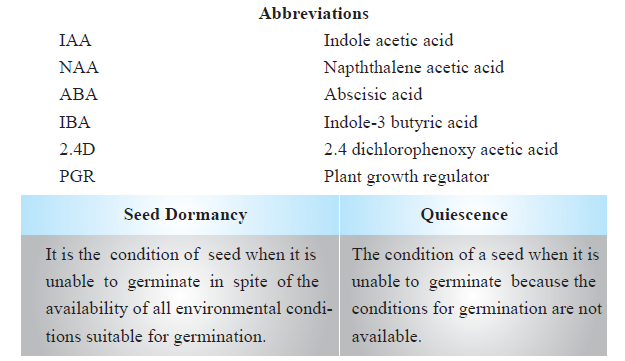
Seed Germination : The seed germinates only when favourable conditions for growth exists in the environment. In absence of favourable conditions it goes into a period of suspended growth or rest, called dormancy.
Abscission : Shedding of plant organs like leaves, flowers and fruits etc. from the mature plant.
Apical dominance : Suppression of the growth of lateral buds in presence of apical bud.
Dormancy :A period of suspended activity and growth usually associated with low metabolic rate. Some, seeds undergo a period of dormancy and can germinate only after dormancy period gets over.
Phytochrome : A pigment, found in plants which control the light dependent developmental process.
Phytohormone: Chemicals’ secreted by plants in minute quantities which influence the physiological activities.
Sensecene : The last phase of growth when metabolic activities decrease.
Vernalisation : A method of promoting flowering by exposing the young plant to low temperature.
Growth : An irreversible permanent increase in size, volume and weight of an organ or its parts or even of an individual.
Quiescence : Non germination of a viable seed due to non-availability of proper environmental conditions.
Vivipary :It is the germination of seed while it is still attached to the parent plant and is nourished by it. e.g., Rhizophora and Sonneratia. As the germinating seed forms a seedling. It all down into the mud due to increase in weights. In the mud, lateral roots develops for anchorage.
Heterophylly :Occurrence of more than one type of leaves in plants e.g., larkspur, Coriander leaves of Juvenile plant are different in shape from mature plant.
Bolting : Elongation of internodes prior to flowering in plants like Cabbage. Photoperiodism : Response of Plants to relative periods of day/night to induce flowering.
According to duration of exposure of plants to light, plants are divided in 3 categories :
1. Long Day Plants (LDP)-Plants which need exposure to light for period exceeding critical duration e.g., wheat, rice, cucumber.
2. Short Day Plants (SDP)-Plants that need exposure to light for period less than the critical length e.g., Cabbage.
3. Day Neutral Plants (DNP)-There is no correlation between exposure to light duration & induction of flowering e.g., Tomato.
Measurement of growth : Plant growth can be measured by a variety of ft parameters like increase in fresh weight, dry weight, length, area, volume and cell number.
Phases of growth : The period of growth is generally divided into three phases, namely, meristematic, elongation and maturation.
(i) Meristematic zone: New cell produced by mitotic division at root-tip and shoot-tip thereby show increase in size. Cells are rich in protoplasm and nuclei.
(ii) Elongation zone : Zone of elongation lies just behind the meristematic zone and concerned with enlargement of cells.
(iii) Maturation zone : The portion lies proximal to the phase of elongation. The cells of this zone attain their maximum size in terms of wall thickning and protoplasmic modification.
Growth rate : The increased growth per unit time is termed as growth rate. The growth rate shows an increase that may be arithmetic or geometrical.
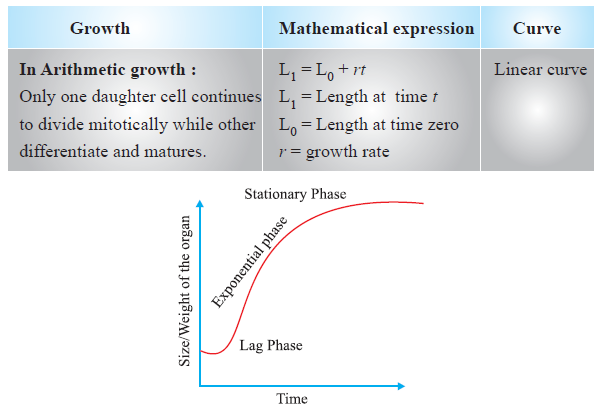
Sigmoid growth curve
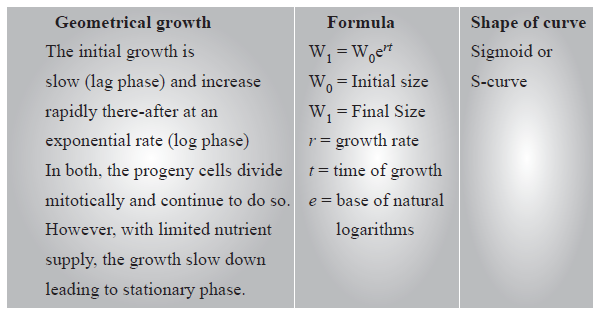
Lag phase-Growth is slow in initial stage.
Log phase :Period of maximum growth
Stationary phase–When the nutrients become limiting, growth slows down.
Relative Growth :The growth per unit time as percentage of initial size

Differentiation : A biochemical or morphological change in meristemic cell (at root apex and shoot apex) to differentiate into permanent cell is called differentiation.
Dedifferentiation : The phenomenon of regeneration of permanent tissue to become meristematic is called dedifferentiation.
Rediffet·entiation : Meristems/tissue are able to produces new cells that once again lose the capacity to divide but nature to perform specific functions.
Conditions or factors influencing Growth
1. Nutrition 2. Availability of water 3. Temperature 4. Oxygen 5. Light 6. Gravity 7. Stress factors like minerals, water or temperature etc.
Phytohormone or Plant Growth-Regulator
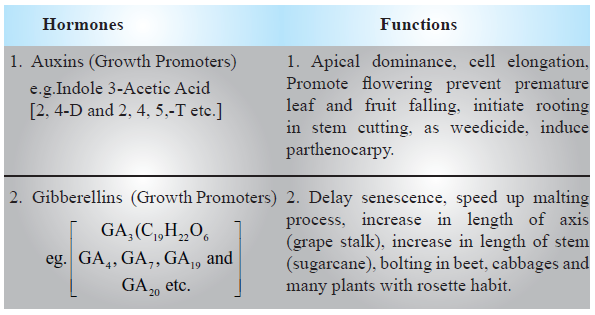
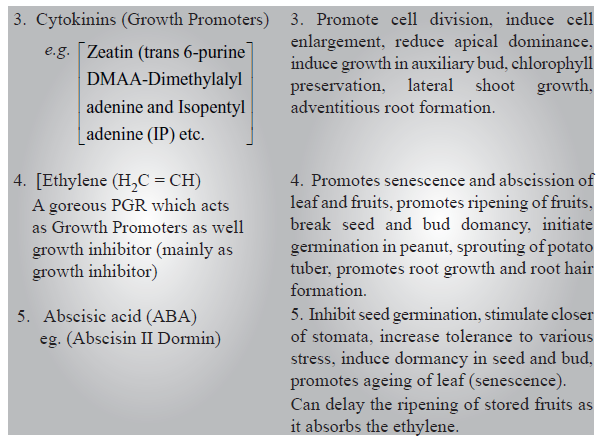
Growth promoting hormones : These are involved in growth promoting activities such as cell division, cell enlargement, flowering, fruiting and seed formation. e.g., Auxin, gibberellins, cytokinis.
Growth inhibitor : Involved in growth inhibiting activities such as dormancy and abscission. e.g., Abscisic acid and Ethylene.
Free study material for Biology
Study Material and Revision Notes for Class 11 Biology Chapter 13 Plant Growth and Development
About Chapter 13 Plant Growth and Development Revision Notes
Explore reliable chapter overviews for Chapter 13 Plant Growth and Development tailored for Class 11 learners. Use these structured points to grasp difficult themes and ensure solid preparation for upcoming assessments.
How to Use These Revision Notes
Built using the official NCERT book for Class 11 Biology, these notes provide reliable academic guidance. Pair your summary review with our recommended NCERT solutions to master optimal problem-solving approaches.
Enhance Practice with MCQs and Worksheets
Follow up your revision by attempting the interactive online Biology MCQ test and practice worksheets for this chapter to verify your mastery. All platform resources are free to access.
FAQs
You can download the teacher prepared revision notes for CBSE Class 11 Biology Plant Growth And Development Notes Set 02 from StudiesToday.com. These notes are designed as per 2026-27 academic session to help Class 11 students get the best study material for Biology.
Yes, our CBSE Class 11 Biology Plant Growth And Development Notes Set 02 include 50% competency-based questions with focus on core logic, keyword definitions, and the practical application of Biology principles which is important for getting more marks in 2026 CBSE exams.
Yes, our CBSE Class 11 Biology Plant Growth And Development Notes Set 02 provide a detailed, topic wise breakdown of the chapter. Fundamental definitions, complex numerical formulas and all topics of CBSE syllabus in Class 11 is covered.
These notes for Biology are organized into bullet points and easy-to-read charts. By using CBSE Class 11 Biology Plant Growth And Development Notes Set 02, Class 11 students fast revise formulas, key definitions before the exams.
No, all study resources on StudiesToday, including CBSE Class 11 Biology Plant Growth And Development Notes Set 02, are available for immediate free download. Class 11 Biology study material is available in PDF and can be downloaded on mobile.