

Download Class 11 Biology Concept Summaries: CBSE Class 11 Biology Respiration In Plants Notes Set 02
Explore reliable concept summaries and revision materials through the CBSE Class 11 Biology Respiration In Plants Notes Set 02. Tailored for Class 11 learners, utilizing these notes for Biology Chapter 12 Respiration in Plants ensures thorough preparation and strengthens core academic definitions before final evaluations.
Access Chapter 12 Respiration in Plants Notes and Study Material
Navigate directly to the revision notes for Chapter 12 Respiration in Plants using the digital viewer below. Each summary is structured to highlight high-weightage sections, allowing students to instantly access critical definitions and focus on core exam topics.
Points To Remember
Aerobic respiration : Complete oxidation of organic food in presence of oxygen thereby producing C02, water and energy.
Anaerobic respiration : Incomplete breakdown of organic food to liberate energy in the absence of oxygen.
ATP Synthetase : An enzyme complex that catalysis synthesis of ATP during oxidative phosphorylation
Biological oxidation : Oxidation in a series of reaction inside a cell.
Cytochromes : A group of iron containing compounds of electron transport system present in inner wall of mitochondria.
Dehydrogenase : Enzyme that catalyses removal of H atom from the substrate.
Electron acceptor : Organic compound which receive electrons produced during oxidation-reduction reactions.
Electron transport : Movement of electron from substrate to oxygen through respiratory chain during respiration.
Fermentation : Breakdown of organic substance that takes place in certain microbe like yeast under anaerobic condition with the production of C02 and ethanol.
Glycolysis: Enzymatic breakdown of glucose into pyruvic acid that occurs in the cytoplasm.
Oxidative phosphorylation : Process of formation of ATP from ADP and Pi using the energy from proton gradient.
Respriation : Biochemical oxidation food to release energy.
Respiratory Quotient : The ratio of the volume of C02 produced to the volume of oxygen consumed.
Proton gradient : Difference in proton concentration across the tissue membrane.
Mitochondrial matrix : The ground material of mitochondria in which pyruvic acid undergoes aerobic oxidation through Kreb's cycle.
Electron Transport Chains (ETC)-A series of co-enzymes and electron/carriers where electrons can pass along increasing redox potential losing a bit of energy at every step of transfer.
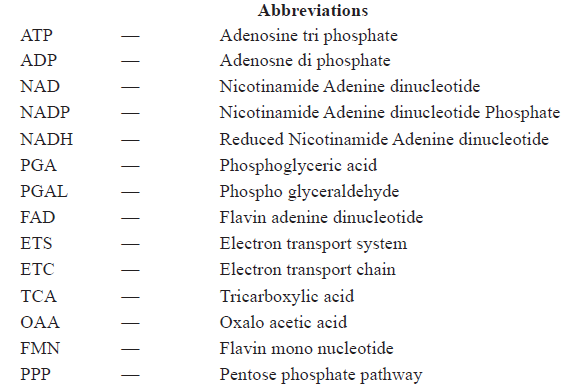
Cellular Respiration-The process of oxidation/breakdown of food materials within the cell to release energy. Respiratory substarate to be oxidized during respiration is usually glucose, but these can also be proteins, fats or organic acids. In plants, respiratory gaseous exchange occurs through stomata and lenticels :
Overall cellular respiration is :
C6H12O6 + 6O2 → 6CO2 + 6H2O + Energy (36ATPs)
Aerobic Respiration
Overall mechanism of aerobic respiration can be studied under the following steps:
(A) Glycolysis (EMP pathway) in cytoplasm
(B) Oxidative Decarboxylation-(Gateway Reaction)-in Mitochondrial matrix
(C) Kreb's cycle (TCA-cycle)-Matrix of mitochondria
(D) Oxidative phosphorylation
A. Glycolysis : The term has origianted from the Greek word, glycos = glucose, lysis = splitting, or breakdown means breakdown of glucose molecule to pyruvic acid. It was given by Embden Meyerhof and Parnas. It is a chain of 10 reactions to convert glucose into pyruvate. It is common for acerobic and anaerdomic respiration.
Steps for Glycolysis-(EMP Pathway)
1. Phosphorylation of Glucose into Glucose-6-phosphate
2. Isomerisation of Glucose-6-Phosphate into fractose-6-phosphate
3. Second phosphorylation in which Fructose-6-phosphate changes into Fructose-1, 6-biphosphate
4. Splitting ofFructiose-1, 6-biphosphate into DiHAP and PGAL
5. Isomerisation of DiHAP into PGAL
6. Oxidation ofPGAL into 1, 3-biphosphosphoglycerate
7. Synthesis ofATP and converssion of 1, 3-biphosphoglycerate into 3-phospholycerate
8. Isomerisation of 3-phosphoglycerate into 2-phospholycerate
9. Dehydration of2-phosphoglycerate into PEP
10. Substrate level ATP synthesis and formation of Pyruvic Acid.
- It is also called Embden- Meyerhof- Paranas pathway. (EMP pathway)
- It is common in both aerobic and anaerobic respiration.
- It takes palce outside the mitochondria, in the cytoplasm.
- One molecule of glucose (Hexosesugar) ultimately produces two molecules of pyruvic acid through glycolysis.'
- During this process 4 molecules of ATP are produced while 2 molecules
ATP are utilised. Thus net gain of ATP is of 2 molecules.
Input and Output of glycolysis
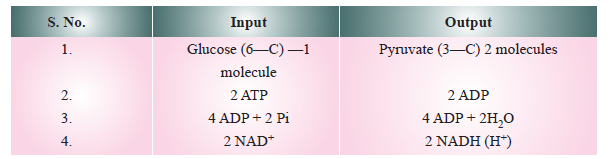
Net out put ...... 2 Pyruvate + 2ATP + 2NADH (+ H+) OR 2 Pyruvate + 8 ATP
The pyruvate, so produced, may under go (i) Lactic acid fermentation, Alcoholic fermentation of Aerobic Respiration (Krebs Cycle)
B. Oxidative decarboxylation : Pyruvic acid is converted into Acetyle CoA in presence of pyruvate dehydrogenase complex.
The Acetyle CoA enters in TCA cycle.
C. Tri Carboxylic Acid Cycle (Kereb's cycle) or Citric acid Cycle : This cycle starts with condensation of acetyle group with oxaloacitic acid and water t o yield citric acid which under goes a series of reactions.

- It is aerobic and takes a place in mitochondrial matrix.
- Each pyruvic acid molecule produces 4 NADH + H+, one FADH2 , one ATP.
- One glucose molecule has been broken down t o release C02 and eight molecules of NADH + H+, two molecules of FADH2 and 2 molecules of ATP.
Compensation Point : It is the value of a factor at which the rate of photosynthesis controlled by it is just equal to the rate of respiration and photorespiration so that there is not net exchcange of gases between the phtosynthetic organ and the environment.
At compensation point the photosynthetic tissue manufacture only such amount of food which of sufficient for it to remain alive. No food is supplied to rest of the plant. Therefore, net photosynthesis is zero.
(D) Oxidative Phosphorylation
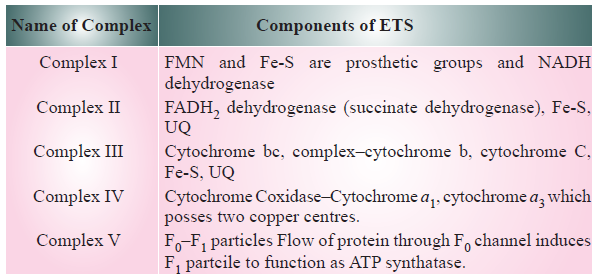
The synthesis of ATP from ADP and inorganic phosphate using energy from proton gradient is called oxidative phosphorylation. This takes place in elementry particles present on the inner membrane of cristae of mitochondria. This process in mitochondria is catalysed by ATP synthestase (complex V). This compmlex has two major components F0 and and F1' F0 acts a channel for proton and F1 acts as an ATP synthetase.
Electron Transport System and Oxidative Phosphorylation
Respiratory Balance Sheet :
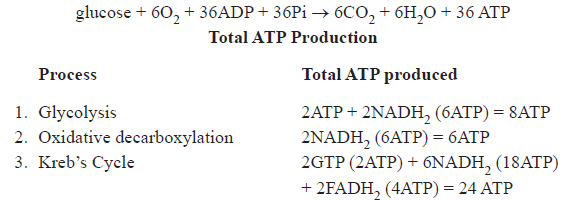
Energy production in prokaryotes during aerobic respiration = 38 ATP
Energy poroduction in eukaryotes during aerobic respiration= 38 -2 = 36 ATP
In eukaryotes 2 ATP are used in transporting 2 molucules of NADH + H+ formed in glycolysis from cytoplasm to mitochandria for oxidation through ETS shuttle.
(2) Anaerobic Respiration-In anaerobic respiration, Glycolysis is followed by formation of ethanol or lactic acid in the cytoplasm.
Fermentation :It is the process of anaerobic respiration which occurs in yeast and some bacteria. Fermentation involves incomplete oxidation of food into enthanol and carbon-dio-oxide. It results in the production of 2 ATP molcules.

(i) Conversion of Acetyl CoA into fatty acid and PGA.
(ii) Synthesis of chlorophyll and cytochromes from Succinyl CoA
(iii) Synthesis of Amino acids from OAA and α-ketoglutaric acid
(iv) Synthesis of Alkaloid from OAA.
Enzymes involved-Pyruvic acid decarboxylase, Alcohol dehydrogenase
Anaerobic respiration in muslces : During vigrous exercise a person feels pain and fatigue in his muscles. This is due to accumulation of lactic acid in muscles. When oxygen is inadequate pyruvic acid is reduced to lactic acid in presence of enzyne-lactic dehydrogenase.

During rest lactic acid is reconverted to pyruvic acid.
Amphibolic Pathway :
During the process of cellular respiration Carbohydrates, fats and protiens are broken down to release energy and hence respiration is a catabolic process/ catabolic pathway. From this pathway many compound are withdrawn for synthesis of substrates. Some anabolic processes are formation of pyruvic acid from amino acids, and formation of Acetyl CoAfrom Fatty acid. So-Respiratory pathway is involved in both catabolism and anabolism, it is better to consider the respiratory pathway as an amphibalic pathway.
RQ (Respiratory quotient)
(a) RQ = 1 (When carbohydrate is used as substrate)
C6H12O6 + 6O2 → 6CO2 + 6 H2O + Energy
(b) RQ is less than 1 (i.e., < 1) for fats.

(c) RQ is 0.9 for proteins.
(d) RQ is more than 1 (i.e., > 1) for organic acids.
(e) RQ is inifinite in case of anerobic respiration, because C02 is evolved but 02 is not consumed.
Free study material for Biology
Study Material and Revision Notes for Class 11 Biology Chapter 12 Respiration in Plants
Download Chapter Summary: Class 11 Biology Chapter 12 Respiration in Plants
Access structured revision notes for Chapter 12 Respiration in Plants designed in alignment with the latest CBSE curriculum for Class 11 Biology. These summaries help clarify core themes and support effective daily study.
Concept Clarification for Chapter 12 Respiration in Plants
Each chapter summary is structured around standard CBSE textbooks, allowing students to check their understanding and clarify complex ideas early in their revision.
Additional Study Resources for Class 11 Biology
Follow up your revision by attempting the interactive online Biology MCQ test and practice worksheets for this chapter to verify your mastery. All platform resources are free to access.
FAQs
You can download the teacher prepared revision notes for CBSE Class 11 Biology Respiration In Plants Notes Set 02 from StudiesToday.com. These notes are designed as per 2026-27 academic session to help Class 11 students get the best study material for Biology.
Yes, our CBSE Class 11 Biology Respiration In Plants Notes Set 02 include 50% competency-based questions with focus on core logic, keyword definitions, and the practical application of Biology principles which is important for getting more marks in 2026 CBSE exams.
Yes, our CBSE Class 11 Biology Respiration In Plants Notes Set 02 provide a detailed, topic wise breakdown of the chapter. Fundamental definitions, complex numerical formulas and all topics of CBSE syllabus in Class 11 is covered.
These notes for Biology are organized into bullet points and easy-to-read charts. By using CBSE Class 11 Biology Respiration In Plants Notes Set 02, Class 11 students fast revise formulas, key definitions before the exams.
No, all study resources on StudiesToday, including CBSE Class 11 Biology Respiration In Plants Notes Set 02, are available for immediate free download. Class 11 Biology study material is available in PDF and can be downloaded on mobile.