CBSE Class 7 Social Science Geography Our Changing earth Assignment

Read and download the CBSE Class 7 Social Science Geography Our Changing earth Assignment for the 2025-26 academic session. We have provided comprehensive Class 7 Social Science school assignments that have important solved questions and answers for Our Environment Chapter 3 Our Changing Earth. These resources have been carefuly prepared by expert teachers as per the latest NCERT, CBSE, and KVS syllabus guidelines.

Solved Assignment for Class 7 Social Science Our Environment Chapter 3 Our Changing Earth

Practicing these Class 7 Social Science problems daily is must to improve your conceptual understanding and score better marks in school examinations. These printable assignments are a perfect assessment tool for Our Environment Chapter 3 Our Changing Earth, covering both basic and advanced level questions to help you get more marks in exams.

Our Environment Chapter 3 Our Changing Earth Class 7 Solved Questions and Answers


The Internal and External Face Of the Earth
 
Give answer to the following questions approximately in 1- 15 words
 
Q 1. How many shells of the earth are there? Name them.
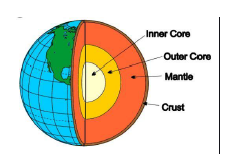
Ans. There are three shells of the earth: - 1. Lithosphere (crust) 2. Mantle, 3. Core.
7th SS Eng. Medium 2021-22 ( Solved Whole Year). 2
 
Q 2. How many types of rocks are found on the earth?
Ans. Basically, there are three types of rocks:-
1. Igneous 2. Sedimentary 3. Metamorphic
 
Q 3. Write down about the Mantle part of the earth.
Ans. Below the upper layers of earth is Mantle. It is 2900 km deep. It is also called SIMA because of its’ main elements Silicon and Magnesium.
 
Q 4. By which name the innermost part of the earth called? What are the components of this part?
Ans. The innermost part of the earth is called ’Core’. The core known as NiFe, mainly consists of two elements Nickel (Ni) & Ferrous (Fe).
 
Q 5. How can we avoid soil erosion?
Ans. 1. By planting new trees 2. By adopting better agricultural practices 3. By checking over grazing etc.
 
Give answer to the following questions approximately in 50-60 words
 
Q 6. What are igneous rocks? How many types are there in these rocks? Write about the intrusive rocks.
Ans. ‘Igneous’ means fire. These rock are of two types:-1. Intrusive 2.Extrusive
These rocks are formed out of the cooling of the hot and liquid material from the interior of the Earth.
Intrusive Igneous rocks: - Rocks formed by the cooling of the Magma, in the interior of the earth are called as Intrusive Rocks.
 
Q 7. What are the Sedimentary ocks? How many types are there of these rocks?
Ans. These rocks are formed by the hardening of the layers of the matter brought by agents of denudation (like water, air and river etc.).
There are three types of sedimentary rocks: - 1. Clastic 2. Chemical 3. Organic.
 
Q 8. Write about the metamorphic rocks, give specific example of these rocks.
Ans. As a result of the effect of temperature and pressure, igneous rocks and sedimentary rocks undergo a change in their form, structure and hardness. Such transformed rocks are called metamorphic rocks. Examples: - Marble, slate, coal etc.
 
Q 9. What kind of mineral is Mica? For what purpose is it used?
Ans. Mica is a non-metallic mineral. It is used in making electric goods. It is also used in making lamps, paints, radars, rubber, paper, aeroplanes etc.
 
Q 10. Which mineral is called as 'Liquid Gold'? Give brief introduction.
Ans. Petroleum is called as ‘Liquid Gold’. It is made out of the vegetation and animals trapped between layers of sedimentary rocks. It is refined in refineries before use.
 
Q 11. Write down the importance of the soil on the earth.
Ans. Fertile soil has always been very important for human civilizations. The fertile soils of Indus, Nile etc. led to the development of the civilizations. Even today high density of population is found in fertile river valleys and plains.


OUR CHANGING EARTH

1. What are the earthquake waves called?

2. What happens when lithospheric plates move slowly?

3. Which type of force is responsible for the formation of mountains?

4. Which machine is used to measure the intensity of the earthquake?

5. How and in which direction do the vibration move during a earthquake?

6. Define the terms "Epicenter".

7. What do you mean by earthquake preparadness?

8. Define weathering.

9. Define erosion.

10. What is a "volcano"?

OUT CHANGING EARTH

OUT CHANGING EARTH

OUT CHANGING EARTH

~ Class 7 Social Science (Old Chapters)
CBSE Class 7 Social Science Geography Air Assignment
CBSE Class 7 Social Science Geography Environment Assignment
CBSE Class 7 Social Science Geography Human Environment Assignment
CBSE Class 7 Social Science Geography Inside Our Earth Assignment
CBSE Class 7 Social Science Geography Natural Vegetation And Wild Life Assignment
CBSE Class 7 Social Science Geography Our Changing earth Assignment
CBSE Class 7 Social Science Geography Water Assignment
CBSE Class 7 Social Science History Devotional Paths To The Divine Assignment
CBSE Class 7 Social Science History Eighteenth Century Political Formations Assignment
CBSE Class 7 Social Science History New Kings and Kingdoms Assignment
CBSE Class 7 Social Science History Ruler and Buildings Assignment
CBSE Class 7 Social Science History The Delhi Sultanate Assignment
CBSE Class 7 Social Science History the Mughal Empire Assignment
CBSE Class 7 Social Science History Tracking Changes Through A Thousand Years Assignment
CBSE Class 7 Social Science History Tribes Nomads And Settled Communities Assignment
CBSE Class 7 Social Science Life in deserts Assignment
CBSE Class 7 Social Science Market around Us Assignment
CBSE Class 7 Social Science Revision Assignment Set A
CBSE Class 7 Social Science Revision Assignment Set B
CBSE Class 7 Social Science Revision Assignment Set C
CBSE Class 7 Social Science Role of the State Government Assignment
CBSE Class 7 Social Science State Government Executive Assignment
CBSE Class 7 Social Science The Flowering Of Regional Cultures Assignment
CBSE Class 7 Social Science The Media and democracy Assignment
CBSE Class 7 Social Science Tower Traders and Crafts Persons Assignment

CBSE Class 7 Social Science Our Environment Chapter 3 Our Changing Earth Assignment

Access the latest Our Environment Chapter 3 Our Changing Earth assignments designed as per the current CBSE syllabus for Class 7. We have included all question types, including MCQs, short answer questions, and long-form problems relating to Our Environment Chapter 3 Our Changing Earth. You can easily download these assignments in PDF format for free. Our expert teachers have carefully looked at previous year exam patterns and have made sure that these questions help you prepare properly for your upcoming school tests.

Benefits of solving Assignments for Our Environment Chapter 3 Our Changing Earth

Practicing these Class 7 Social Science assignments has many advantages for you:

  • Better Exam Scores: Regular practice will help you to understand Our Environment Chapter 3 Our Changing Earth properly and  you will be able to answer exam questions correctly.
  • Latest Exam Pattern: All questions are aligned as per the latest CBSE sample papers and marking schemes.
  • Huge Variety of Questions: These Our Environment Chapter 3 Our Changing Earth sets include Case Studies, objective questions, and various descriptive problems with answers.
  • Time Management: Solving these Our Environment Chapter 3 Our Changing Earth test papers daily will improve your speed and accuracy.

How to solve Social Science Our Environment Chapter 3 Our Changing Earth Assignments effectively?

  1. Read the Chapter First: Start with the NCERT book for Class 7 Social Science before attempting the assignment.
  2. Self-Assessment: Try solving the Our Environment Chapter 3 Our Changing Earth questions by yourself and then check the solutions provided by us.
  3. Use Supporting Material: Refer to our Revision Notes and Class 7 worksheets if you get stuck on any topic.
  4. Track Mistakes: Maintain a notebook for tricky concepts and revise them using our online MCQ tests.

Best Practices for Class 7 Social Science Preparation

For the best results, solve one assignment for Our Environment Chapter 3 Our Changing Earth on daily basis. Using a timer while practicing will further improve your problem-solving skills and prepare you for the actual CBSE exam.

Where can I download the latest CBSE Class 7 Social Science Chapter Our Environment Chapter 3 Our Changing Earth assignments?

You can download free PDF assignments for Class 7 Social Science Chapter Our Environment Chapter 3 Our Changing Earth from StudiesToday.com. These practice sheets have been updated for the 2025-26 session covering all concepts from latest NCERT textbook.

Do these Social Science Chapter Our Environment Chapter 3 Our Changing Earth assignments include solved questions?

Yes, our teachers have given solutions for all questions in the Class 7 Social Science Chapter Our Environment Chapter 3 Our Changing Earth assignments. This will help you to understand step-by-step methodology to get full marks in school tests and exams.

Are the assignments for Class 7 Social Science Chapter Our Environment Chapter 3 Our Changing Earth based on the 2026 exam pattern?

Yes. These assignments are designed as per the latest CBSE syllabus for 2026. We have included huge variety of question formats such as MCQs, Case-study based questions and important diagram-based problems found in Chapter Our Environment Chapter 3 Our Changing Earth.

How can practicing Chapter Our Environment Chapter 3 Our Changing Earth assignments help in Social Science preparation?

Practicing topicw wise assignments will help Class 7 students understand every sub-topic of Chapter Our Environment Chapter 3 Our Changing Earth. Daily practice will improve speed, accuracy and answering competency-based questions.

Can I download Social Science Chapter Our Environment Chapter 3 Our Changing Earth assignments for free on mobile?

Yes, all printable assignments for Class 7 Social Science Chapter Our Environment Chapter 3 Our Changing Earth are available for free download in mobile-friendly PDF format.