

School Assignments for Class 7 Social Science: Our Environment Chapter 02 Inside Our Earth
Explore structured practice materials through the CBSE Class 7 Social Science Geography Inside Our Earth Assignment. Tailored for Class 7 learners, utilizing these Social Science assignments ensures thorough preparation and strengthens foundational knowledge before final CBSE evaluations.
Practice Class 7 Social Science Assignments: Our Environment Chapter 02 Inside Our Earth
Access the complete assignment PDF for Class 7 Social Science below. Regular practice with these targeted academic tasks builds familiarity with standard question patterns and helps secure higher marks in final school evaluations.
TICK THE CORRECT ANSWER :
Question.The scientists who study the structure of the earth are called –
1] Ecologist
2] Geographer
3] Geologists
Answer :{ 3 }
Question.The thinnest layer of the earth is –
1] crust
2] mantle
3] core
Answer : { 1 }
Question.The rock which is made up of molten magma is-
1] Sedimentary
2] Metamorphic
3] Igneous
Answer : { 3 }
Question.The sedimentary are transported and deposited by-
1] wind and water
2] plants
3] None of these
Answer : { 1 }
Question.Coal may be metamorphosed into –
1] marble
2] quartzite
3] graphite
Answer : { 3 }
FILL IN THE BLANKS :
Question.The……………is the outermost and the thinnest layer of the earth.
Answer : crust
Question. Intrusive igneous rocks are also called ………………. rocks.
Answer : plutonic
Question. Limestone is metamorphosed into ………………
Answer : marble
Question. The rock cycle is the process of …………………of one rock form to another.
Answer : transformation
Question. ……………are solid substances which occur naturally in the rock .
Answer : minerals
VERY SHORT TYPE QUESTION ANSWERS :
Question. What are the three main types of rocks on earth ?
Answer : Rocks are natural mass of mineral matter on the earth’s crust . The three Main types of rocks are Igneous, Sedimentary and Metamorphic.
Question. What are minerals ?
Answer : Minerals are solid chemical substances which occur naturally in the rocks.They have definite and specific physical and chemical properties.
Question. What are called Igneous rocks ?
Answer : When molten magma cools ,becomes solid. These rocks were the first to be formed . These solid rocks are called Igneous rocks.
Question. What are fossils ?
Answer : The remains of the dead plants and animals trapped in the layer of rockare called fossils fuels
Question. Define the sediment ?
Answer : Rocks due to cracks and hitting , breakdown by the natural forces like Glaciers , rivers wind into smaller fragments called sediments.
SHORT TYPE QUESTION ANSWERS :
Question. How are intrusive and extrusive igneous rocks formed ?
Answer : Intrusive igneous rocks are formed when the molten magma fails to break through the crust and slowly solidifies under the earth’s surface.e.g. granite, dolerite, etc.
Extrusive igneous rocks are formed when the molten magma comes out on the earth’s surface as lava and cools quicly , e.g. basalt pumice ,etc.
Question. How are rocks useful to us ?
Answer : Rocks are made of different minerals.They are of immense value to man-Kind.
*Rocks are used in building material ,e.g.basalt,granite,marble and Sandstone
*Many of the metals are obtained as ores from rocks.Iron ore and Bauxite are examples.
*Chemicals found in rocks are also used to make fertilizers.
*Rocks contain fossils which help scientists to know about pre-Historic life on the plants.
LONG TYPE QUESTION ANSWER :
Question. Describe the rock cycle ?
Answer : One rock changes into another under certain conditions in a cycle manner . Molten magma cools down and solidify to form igneous rocks.These rocks are broken down due to pressure and climatic conditions into sediments. These are transported and deposited to form sedimentary rocks. The igneous and sedimentary rocks under heat and pressure changes into Metamorphic rocks . These metamorphic rocks under great heat melt down to form molten magma . This again cools down to form igneous rocks . This process of transformation of rocks is called rock cycle.
1. What is the earth made up of?
2. What is the middle layer of the earth called?
3. Name two agents which help in transportation of sediments?
4. Give one special feature of the sedimentary rocks.
5. What are the rocks made up of?
6. What is magma?
7. Name the minerals found in your state.
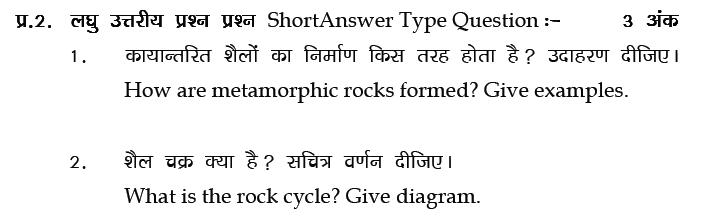
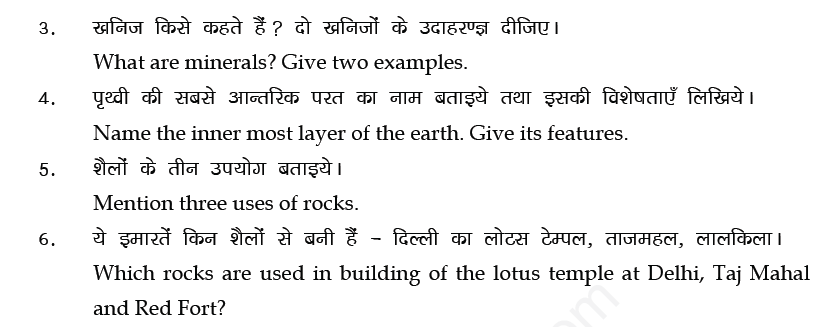
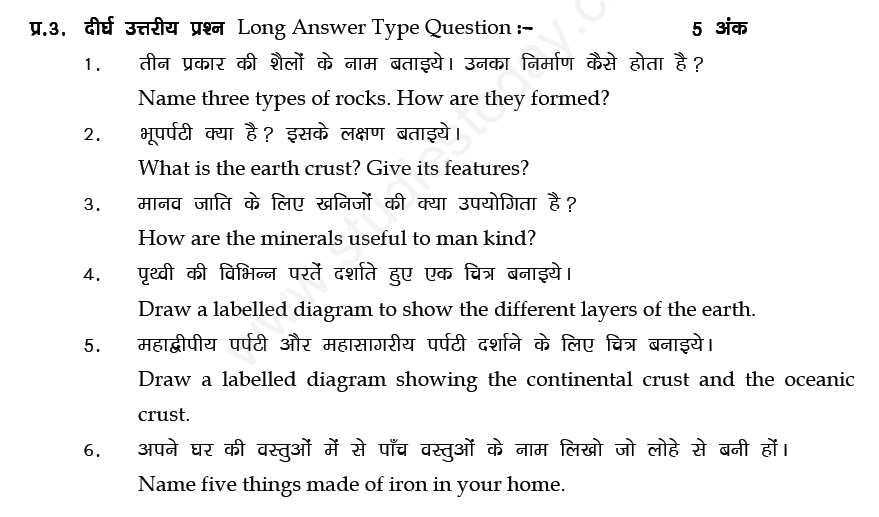
Q.1 Fill in the blanks
a. The molten rock found below the earth surface is called __________ rock.
b. The process by which gas changes into liquid is called ___________
c. Rain caused by the rising of air heated on contact with hot ground is _________ rainfall.
d. The weight of the atmosphere pushing down on a unit area on the earth surface is called ________
e. The undesirable change in the air is called ____________
f. The physical and biological conditions in which organisms lives is _________.
g. The blanket of air that surrounds the earth is known as ___________
h. Mass of ocean water moving in a particular direction is called _________
i. The wind that blows from permanent high pressure belt to permanent low pressure belt are called ___________
Q.2 Complete the terms (definitions)
a. The state of the atmosphere at particular place at a particular time is weather where as climate is the _________________________________
b. Evaporation is the process by which _________________________________
c. Humidity is the amount of water vapour _______________________________
d. The remains of _____________________________ within layers of rocks are called fossils.
a. The falling of condensed _______________ is called precipitation.
Q.3 Match the following.
A B
1. Sedimentary a. air from land moves towards sea
2. Igneous b. rock changed from its original form
3. Sea breeze c. rocks formed by cooling & hardening of Magma
4. Metamorphic d. air from sea moves towards land
5. Land breeze e. deposition and hardening of sediments in layers
Q.4 Solve the cross word puzzle and mark it (first one is done for you)
a. The parts of different spheres in which life exists together is - BIOSPHERE
b. The alternate rise and fall in the level of sea water _________
c. An instrument for measuring rainfall ______________
d. It is an instrument used to measure atmosphere pressure ___________
e. The lowest and densest layer of the atmosphere is known as the ___________
f. The top of the volcanic cone has a cuplike depression called a ___________
Free study material for Social Science
Our Environment Chapter 02 Inside Our Earth Printable Assignments & Solutions for Class 7 Social Science
Class 7 Social Science Our Environment Chapter 02 Inside Our Earth Printable Assignments
Explore reliable practice questions for Our Environment Chapter 02 Inside Our Earth tailored for Class 7 learners. Use these structured worksheets to evaluate preparedness and strengthen core problem-solving skills.
Why Practice Class 7 Social Science Assignments?
- Exam Alignment: Questions strictly follow contemporary CBSE sample papers and grading schemes.
- Comprehensive Coverage: Features objective drills, case studies, and structured descriptive problems for Our Environment Chapter 02 Inside Our Earth.
- Pacing & Precision: Regular problem-solving builds critical calculation speed and test-taking accuracy.
How to Approach Social Science Our Environment Chapter 02 Inside Our Earth Assignments
- Initial Reading: Begin by reading the NCERT book for Class 7 Social Science to build a baseline understanding.
- Independent Testing: Attempt assignment questions unassisted, then verify work using provided answer keys.
- Supplementary Aids: Leverage revision notes and worksheets whenever you encounter difficult topics.
FAQs
You can download free PDF assignments for Class 7 Social Science Our Environment Chapter 02 Inside Our Earth from StudiesToday.com. These practice sheets have been updated for the 2026-27 session covering all concepts from latest NCERT textbook.
Yes, our teachers have given solutions for all questions in the Class 7 Social Science Our Environment Chapter 02 Inside Our Earth assignments. This will help you to understand step-by-step methodology to get full marks in school tests and exams.
Yes. These assignments are designed as per the latest CBSE syllabus for 2026. We have included huge variety of question formats such as MCQs, Case-study based questions and important diagram-based problems found in Our Environment Chapter 02 Inside Our Earth.
Practicing topicw wise assignments will help Class 7 students understand every sub-topic of Our Environment Chapter 02 Inside Our Earth. Daily practice will improve speed, accuracy and answering competency-based questions.
Yes, all printable assignments for Class 7 Social Science Our Environment Chapter 02 Inside Our Earth are available for free download in mobile-friendly PDF format.