

Download CBSE Class 7 Social Science Assignments
Review targeted academic assignments with the CBSE Class 7 Social Science The Flowering Of Regional Cultures Assignment. Built according to official CBSE standards for the 2026-27 term, these downloadable Class 7 Social Science worksheets support effective daily practice for Our Pasts II Chapter 09 The Making Of Regional Cultures.
Access CBSE School Assignments and Answers
Navigate directly to the solved Social Science assignments using the digital viewer below. Each practice set includes detailed step-by-step solutions, allowing students to instantly cross-check their work and identify areas requiring further revision.
Question. Write the names of regional languages of North India during the medieval period (800-1200 AD.).
More Question-
1. FILL IN THE BLANKS
a) Lilatilakam was written in the _____ style.
b)______ is famous for its annual rathayatra festival.
c)________ and _____ schools are the two most well known schools of the pahari style of painting.
d)_______ is believed to have been a tribal deity who came to be identified with Lord Krishna.
e)________ is a literary work based on the life and teachings of chaitanyadeva.
f ) An ________ roof consists of two ________ placed one over another.
g) _________ was the first independent ruler of the 7th century Bengal.
2. EXPLAIN THE FOLLOWING
a) Alpana
b) Kathakas
c) Jauhar
d) Miniatures
e) Book-illumination
f) Manipravala
3. NAME THE FOLLOWING
a) A place famous for its Bangla style temples.
b) The place famous for terracotta bricks.
c) He translated the Ramayana into Bengali
d) The Mughal emperor who established Tasvir khana.
e) The ruler of Awadh during whose rule several regional gharanas of kathak developed.
f) The language which was promoted by the Perumals of Kerala.
g) It occupies an important place in Bengali culture.
h) One of the classical dance forms of North India.
4. ANSWER IN NOT MORE THAN 20 WORDS.
a) Why did all the conquerors of Orissa protect the interest of the Jagannath temple of Puri?
b) How did the Bhakti movement influence Kathak dance?
c) Why and by whom was jauhar committed?
d) Write a short note on the image of Lord Jagannath.
e) Explain the importance of fish in Bengali culture.
f) What are the main features of the medeival Bengali style of temple architecture?
Please click the link below to download CBSE Class 7 Social Science The Flowering Of Regional Cultures Assignment Set A
Q. 1: Fill in the blanks
i) Lilatilakam was written in the _____ style.
ii) ______ is famous for its annual rathayatra festival.
iii) ________ and _____ schools are the two most well known schools of the pahari style of painting.
iv) _______ is believed to have been a tribal deity who came to be identified with Lord Krishna.
v) _______ is a literary work based on the life and teachings of chaitanyadeva.
vi) An ________ roof consists of two ________ placed one over another
vii) _________ was the first independent ruler of the 7th century Bengal.
Q. 2: Explain the following
i) Alpana
ii) Kathakas
iii) Jauhar
iv) Miniatures
v) Book-illumination
vi) Manipravala
Q. 3: Name the following:
i) A place famous for its Bangla style temples.
ii) The place famous for terracotta bricks.
iii) He translated the Ramayana into Bengali
iv) The Mughal emperor who established Tasvir khana.
v) The ruler of Awadh during whose rule several regional gharanas of kathak developed.
vi) The language which was promoted by the Perumals of Kerala.
vii) It occupies an important place in Bengali culture.
viii) One of the classical dance forms of North India.
Q. 4: Answer in not more than 20 words.
i) Why did all the conquerors of Orissa protect the interest of the Jagannath temple of Puri?
ii) How did the Bhakti movement influence Kathak dance?
iii) Why and by whom was jauhar committed?
iv) Write a short note on the image of Lord Jagannath.
v) Explain the importance of fish in Bengali culture.
vi) What are the main features of the medeival Bengali style of temple architecture?
vii) Who were Perumulas?
viii) Name two rulers who got the famous Jagnath temple built.
ix) Who patronised the use of miniatures to illustrate Buddhist text.
x) Mention about the two types of literature composed by Nathpanthis.
xi) Who was Dharma Thakur?
1. Which language was introduced in inscriptions by the Chera kings?
2. What is meant by the term Kathak?
3. Name the four classical dance forms of our country
4. What do you mean by Basohli?
5. What are miniature paintings?
6. Who decided to build Jagannatha temple at Puri?
7. Name two gharanas associated with Kathak.
8. What are the two categories of early Bengali literature?
9. What do you mean by "Pir"?
10. In which State is Khajuraho situated?
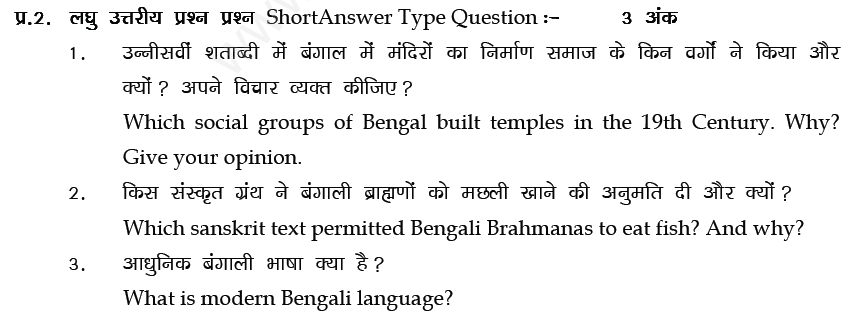
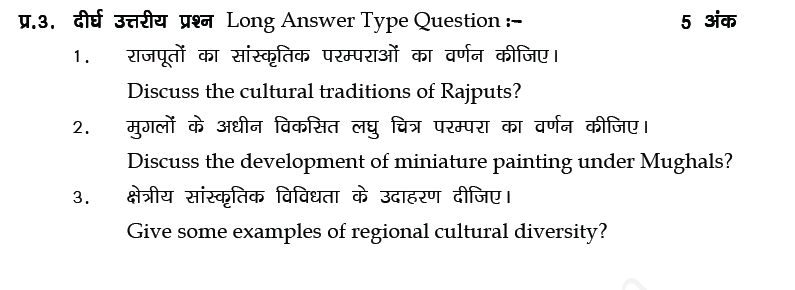
Free study material for Social Science
Download Practice Assignments: Class 7 Social Science Our Pasts II Chapter 09 The Making Of Regional Cultures
Class 7 Social Science Our Pasts II Chapter 09 The Making Of Regional Cultures Printable Assignments
Review targeted chapter assignments for Class 7 Social Science Our Pasts II Chapter 09 The Making Of Regional Cultures. Built according to official CBSE guidelines, these downloadable problem sets help students build accuracy and prepare effectively for school tests.
Key Advantages of Solving Our Pasts II Chapter 09 The Making Of Regional Cultures Assignments
- Curriculum Standards: Assignments match modern CBSE sample formats to ensure relevant preparation.
- Thorough Revision: Detailed problem sets reinforce core concepts and eliminate conceptual weak spots.
- Execution Speed: Timed practice with assignment sets sharpens overall response timing.
How to Approach Social Science Our Pasts II Chapter 09 The Making Of Regional Cultures Assignments
- Initial Reading: Begin by reading the NCERT book for Class 7 Social Science to build a baseline understanding.
- Independent Testing: Attempt assignment questions unassisted, then verify work using provided answer keys.
- Supplementary Aids: Leverage revision notes and worksheets whenever you encounter difficult topics.
FAQs
You can download free PDF assignments for Class 7 Social Science Our Pasts II Chapter 09 The Making Of Regional Cultures from StudiesToday.com. These practice sheets have been updated for the 2026-27 session covering all concepts from latest NCERT textbook.
Yes, our teachers have given solutions for all questions in the Class 7 Social Science Our Pasts II Chapter 09 The Making Of Regional Cultures assignments. This will help you to understand step-by-step methodology to get full marks in school tests and exams.
Yes. These assignments are designed as per the latest CBSE syllabus for 2026. We have included huge variety of question formats such as MCQs, Case-study based questions and important diagram-based problems found in Our Pasts II Chapter 09 The Making Of Regional Cultures.
Practicing topicw wise assignments will help Class 7 students understand every sub-topic of Our Pasts II Chapter 09 The Making Of Regional Cultures. Daily practice will improve speed, accuracy and answering competency-based questions.
Yes, all printable assignments for Class 7 Social Science Our Pasts II Chapter 09 The Making Of Regional Cultures are available for free download in mobile-friendly PDF format.