

Download CBSE Class 12 Computer Science Assignments
Explore structured practice materials through the CBSE Class 12 Computer Science Database Concepts Assignment. Tailored for Class 12 learners, utilizing these Computer Science assignments ensures thorough preparation and strengthens foundational knowledge before final CBSE evaluations.
Access CBSE School Assignments and Answers
Access the complete assignment PDF for Class 12 Computer Science below. Regular practice with these targeted academic tasks builds familiarity with standard question patterns and helps secure higher marks in final school evaluations.
Short Answer Type Questions :
Question. What is the difference between degree and cardinality of a table? What is the degree and cardinality of the following table?
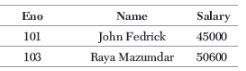
Answer: Degree The number of attributes or columns in a table is called the degree of the table.
The degree of the given table is 3.
Cardinality The number of rows or records in a table is called the cardinality of the table. The cardinality of the given table is 2.
Question. What is a table? Also,write the other name of table.
Answer: Table is also called a relation, it is a diagrammatically a matrix of rows and columns that store the data of a particular system. A table is just like a sheet in Excel, that stores data in some columns and rows. The data is arranged under some fields, where each field stores similar kind of data.
Question. What is candidate key?
Answer: All the field combinations that can serve as primary key for unique identification of records in a table are called candidate keys.
For example, If a student table carries “RollNo., Name, Class, AadharNo., AdmissionNo” columns, then columns RollNo., AadharNo. and AdmissionNo can become the candidate keys since all carry unique values.
Question. What do you understand by the term domain?
Answer: Domain refers to the pool or set of values from which a field of a table derives its values. e.g. The Roll No field derives its values from the set of integers from 1-100 (approx.). The “Dept” field derives its values from the domain of possible departments and the “Marks” field derives its values from the range of marks in an examination.
Question. What do you mean by fields of a table? Give examples.
Answer: A field of a table is simply a vertical column of the table. A field is also called an attribute. It stores similar kind of data. e.g. Name,Class ,Marks etc., can be fields of student table, EmpId, Empname,Dept can be fields of Employee table. Each field derives its values from a pool of data which is called as the domain. All the values in a single field will be of same data type.
Question. How many foreign keys can be there in a table?
Answer: A table can have multiple foreign keys depending on the number of tables to which the mother table has links.
Multiple tables can be linked by the foreign key which will be common in all of them . It is by the foreign key that the corresponding values will be obtained from the tables.
Question. Mention atleast three limitations of DBMS.
Answer: Some limitations of DBMS are given below
(i) High Cost DBMS requires various software, hardware and highly intelligent people for operating and maintaining the database system. It increases its cost.
(ii) Database Failure If database is corrupted due to power failure or any other reason, our valuable data may be lost or whole system stops.
(iii) Data Quality With increased number of users accessing data directly. There are enormous opportunities for users to damage data. So, it is not easy to provide a strategy to support multiple users to update data simultaneously.
Question. What are records? Also, write the other name of record.
Answer: A record is a horizontal row of a table storing complete data of one entity. It is also called a tuple.

The above record of Mr. Das carries all the information about him. Similarly other records of the table carry data about other employees.
All the records together make up the data of the table.
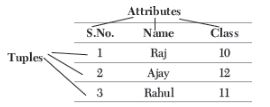
Question. Differentiate between an attribute and a tuple with an example.
Answer: The columns of a table are referred to as attributes. It is also known as field which is reserved for a specific piece of data. The rows of a table are referred to as tuples.
Question. What do you understand by the term cardinality of a table? How can it be modified?
Answer: The total number of rows of a table is called the cardinality. It gets modified by the addition or deletion of rows. If rows are added to the table the cardinality increases . If rows are deleted the cardinality decreases.
Question. What is a DBMS? Expand and explain in short.
Answer: A Database Management System is a software system that enables users to define, create and maintain the database and provides controlled access to this database.
The primary goal of a DBMS is to provide a way to store and retrieve database information that is both convenient and efficient. Data in a database can be added, deleted, changed, sorted or searched, all using a DBMS.
Question. Can we have multiple candidate keys in a table? Give example.
Answer: Yes, we can have multiple candidate primary keys.
e.g. In an Employee table, ENo and AadharNo both can serve as primary key, hence both are candidate keys. Only primary key in a table will be a single field , candidate keys can be multiple.
Question. Give suitable example of a table with sample data and illustrate primary and candidate keys in it.
Answer: Candidate Key It is a set of all attributes that uniquely identifies records in a table. Each table may have one or more candidate keys.
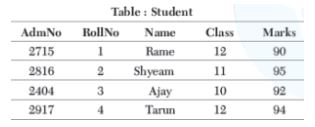
e.g. In Student table, AdmNo and RollNo both can identify records uniquely. So, both are candidate key.
Primary Key It is a set of one or more attributes that can uniquely identify each tuple of a relation. A relation can have only one primary key.
e.g. In Student table, AdmNo of all students are different. So, we have created AdmNo as primary key.
Question. What do you understand by the term degree of a table? Can it change?
Answer: The term degree refers to the total number of columns in a table. Yes the degree changes with addition or deletion of columns.
e.g. If a table “Product” stores the data in columns “PNo, PName,Qty,Price’’, there are 4 columns , hence the degree will be 4.
Question. Write names of few softwares used as DBMS.
Answer: MySQL, Oracle , DB/2, Ingres softwares obey certain common rules of relational algebra. Like they all support most of the codd’s rules and support SQL . Some of these softwares like MySQL are free and some like Oracle is proprietary, that it has to be bought.
Question. List some commonly used DBMS software packages.
Answer: Some commonly used DBMS software packages are
(i) MySQL
(ii) Oracle
(iii) Postgre
(iv) DB2
(v) MS-SQL
(vi) Sybase
Question. Which fields are regarded as alternate keys?
Answer: All the candidate key fields that are not primary key are alternate keys.
e.g. If a table Employee carries columns
“ENo,EName,PFNo,VoterId”, then “ENo” is set as primary key and the other candidate keys “PFNo” and “VoterId” will be the alternate keys.
Question. What is a primary key? How many primary keys can be there in a table?
Answer: It is a combination of one or more fields in a table that can uniquely identify a record. There can be only one primary key in a table. It plays an important role in identifying the records, because it is the primary key who carries unique values. The criteria for a field to become primary key is :
It must be carrying unique and NOT NULL values.
Question. What do you understand by the term database?
Answer: A database is a huge collection of data accumulating in a particular system. It comprises of historical data, operational and transactional data. The database grows everyday with the transactions dealing with it.
A database has the following properties
(i) It is a collection of data elements representing real-world information.
(ii) It is logical, coherent and internally consistent.
Question. Why foreign keys are allowed to have NULL values?
Answer: A foreign key is a field that links two tables . A table may have links to multiple tables . Each link is supported by a value that is common in the two tables . If there is a missing foreign key value for a record, it means the link is missing and no matching values are present. This is perfectly a valid situation, not an error .
Long Answer Type Questions :
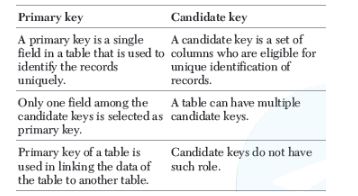
Question. Differentiate the terms primary key and candidate key.
Answer: Differences between primary key and candidate key are
Question. Explain the role of database management system in maintaining huge volumes of data of different domains. Explain your views using an example.
Answer: A database management system is a specialised software that helps maintain large volumes of data pertaining to a real life system . Examples of such systems include business houses , transport systems, libraries , schools etc.
It not only stores bulk data in structured way but also helps to add , modify ,search , update and delete data from such databases. Examples of DBMS softwares are MySQL , Microsoft SQL Server , Oracle etc.
Application program accesses the data stored in the database by sending request to the DBMS.
For example, MySQL, INGRES, MS-ACCESS etc.
The purpose of a Database Management System is to bridge the gap between information and data. The data stored in memory or on disk must be converted to usable information.
Question. Explain by an example how foreign key is useful for bringing data from multiple tables?
Answer: Consider the two tables given below
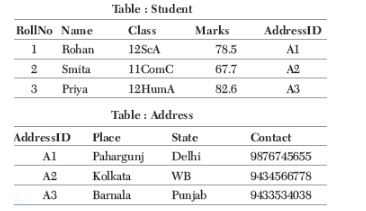
Referring to the above tables , if we look for Place to which “Priya” belongs” , we can link the tables by the foreign key “AddressID” of the Student table to get place as “Barnala” by the AddressID “A3”. So, a foreign key helps in bringing data from multiple tables.
Question. A table “Sports” exists with 3 columns and 5 rows. What is its degree and cardinality? 2 rows are added to the table and 1 column deleted. What will be the degree and cardinality now?
Answer: The term degree refers to the total number of columns in a table. The term cardinality refers to the total number of rows in a table.
Initially, Sports table has 3 columns and 5 rows, so
Degree : 3
Cardinality : 5
After operations, 2 rows are added to the table and 1 column deleted.
Now, degree : 2 cardinality : 7.
Free study material for Computer Science
Download Practice Assignments: Class 12 Computer Science Database Concepts
Class 12 Computer Science Database Concepts Printable Assignments
Explore reliable practice questions for Database Concepts tailored for Class 12 learners. Use these structured worksheets to evaluate preparedness and strengthen core problem-solving skills.
Key Advantages of Solving Database Concepts Assignments
- Exam Alignment: Questions strictly follow contemporary CBSE sample papers and grading schemes.
- Comprehensive Coverage: Features objective drills, case studies, and structured descriptive problems for Database Concepts.
- Pacing & Precision: Regular problem-solving builds critical calculation speed and test-taking accuracy.
How to Approach Computer Science Database Concepts Assignments
- Textbook Review: Always study the core NCERT book for Class 12 Computer Science prior to beginning the assignment.
- Independent Attempt: Solve Database Concepts questions on your own initially before cross-checking with expert solutions.
- Error Tracking: Record challenging concepts in a dedicated notebook and practice online MCQ tests for revision.
FAQs
You can download free PDF assignments for Class 12 Computer Science Database Concepts from StudiesToday.com. These practice sheets have been updated for the 2026-27 session covering all concepts from latest NCERT textbook.
Yes, our teachers have given solutions for all questions in the Class 12 Computer Science Database Concepts assignments. This will help you to understand step-by-step methodology to get full marks in school tests and exams.
Yes. These assignments are designed as per the latest CBSE syllabus for 2026. We have included huge variety of question formats such as MCQs, Case-study based questions and important diagram-based problems found in Database Concepts.
Practicing topicw wise assignments will help Class 12 students understand every sub-topic of Database Concepts. Daily practice will improve speed, accuracy and answering competency-based questions.
Yes, all printable assignments for Class 12 Computer Science Database Concepts are available for free download in mobile-friendly PDF format.