

Class 12 Computer Science Practice Assignments: CBSE Class 12 Computer Science Concept of Networking Assignment
Access comprehensive school assignments for Concept of Networking using the CBSE Class 12 Computer Science Concept of Networking Assignment. Designed to align with the 2026-27 CBSE academic guidelines, these practice sets help Class 12 Computer Science students reinforce core concepts and improve their problem-solving accuracy.
Download Concept of Networking Assignment PDF with Solutions
View or download the dedicated CBSE Class 12 Computer Science Concept of Networking Assignment resource below. Engaging with these assignments under focused study conditions ensures continuous academic progress and mastery of the 2026-27 curriculum.
Question. A medium for transferring data between two locations is called_______________
a. Network
b. Hard Disk
c. CD ROM
d. All of these
Answer: A
Question. Sending a file from PC’s primary memory or disk to another computer is called ______________
a. uploading
b. downloading
c. logging on
d. hang on
Answer: A
Question. What is the name of device that connects two computers by means of telephone lines ?
a. tape
b. modem
c. bus
d. cable
Answer: B
Question. The transfer of data from CPU to peripheral devices of computer is achieved through ___________
a. modems
b. computer ports
c. interfaces
d. buffer memory
Answer: B
Question. HTTP is a protocol for _______________
a. email
b. moving news articles around world
c. fetching pages on www
d. All of these
Answer: C
Question. Which of the following is not a goal of computer network?
a. resource sharing
b. high reliability
c. scalability
d. none of the above
Answer: D
Question. A distributed network configuration in which all data/information pass through central computer is ________
a. bus network
b. ring network
c. star network
d. point to point network
Answer: C
Question. Which of the following is not a transmission media _______________?
a. telephone line
b. coaxial cable
c. modem
d. twisted pair cable
Answer: C
Question. Terminals are used to ______________
a. To enter data from user
b. provide information to school head
c. distribute the data in network
d. none of the above
Answer: A
Question. The software that you can install on PC to access the internet is the __________
a. www
b. TCP/IP
c. browser
d. URL
Answer: C
Write one word for the following:
Question. Star, ring and bus network are the examples of ____________
Answer: network topologies
Question. A medium of transferring data between two locations is called _____________
Answer: communication channel
Question. A small computer networks that are confined to localized area is called __________
Answer: (LAN
Question. A collection of interlinked computer by means of communication system?
Answer: network
Question. A pattern of interconnections of nodes in a network is?
Answer: Topology
Question. A topology that consists of a central node and all other nodes are connected by a single path?
Answer: star Topology
Question. The first WAN to be designed and developed was the private network?
Answer: ARPANET
Question. A unit of measuring data transmission speed?
Answer: baud
Question. Connection of two or more networks are called ____________
Answer: network topologies
Question. It’s a terminology of networks ___________
Answer: Server
Question. It’s an application of network ___________
Answer: data sharing
Question. The rules that take care of file transfer __________
Answer: FTP
Question. You can send and receive messages through computers via ___________
Answer: email
Question. The set of rules that govern the way a service is provided ____________
Answer: protocol
Question. The cables that made of plastic or glass and are about as thick as human hair, used for data communication is ___________
Answer: optical fibers
Exercise Questions (Short Answer type questions)
Question. What is a Network?
Answer: Computer network is an interconnection of two or more computers to share resources (hardware, software or data). These computers are connected with each other using some communication medium. These communication medium can be wired (twisted pair cable, co-axial cable, fiber optics etc.) or wireless (Bluetooth, infrared etc.) There is no limit to the distance between computers in a network.
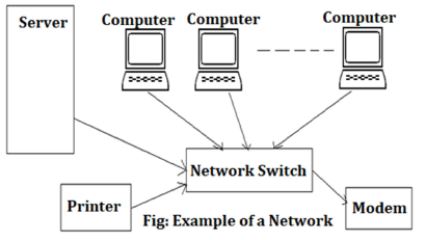
Question. Name the devices that are used to connect a computer to an analog telephone lines. What are its different types?
Answer: It is the Modem that is used to connect a computer to an analog telephone lines. These modems are of two types: External Modem and Internal Modem.
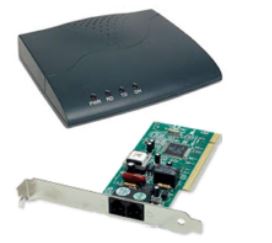
• External Modem: It is a separate device from the computer. It is connected with serial port COM1 or COM2 of the computer. These modems are more expensive than the internal modems. But these modems are faster then the internal modems.
• Internal Modems: It is a printed circuit board. It is attached in the system unit. These modems are cheaper then the external modems. These modems are also slower then the external modems.
Question. Define the term communication channel?
Answer: Communication Channels are also called Communication Media. Communication channels are those channels which are used to transfer data from one computer to another in a network. Communication channels are of two types: Guided Media and Unguided Media.
Question. What is network topology?
Answer: Network topology is the arrangement of the various elements (links, nodes, etc.) in a computer network.
Computers can be connected in different ways in a network. So there are different types of topologies. Commonly used topologies are Bus topology, ring topology, star topology, mesh topology and tree topology.
Question. What is URL?
Answer: Each web page on the web has a unique name or address. This name or address is called Uniform Resource Locator. To access any webpage on the internet, we have to type the URL of website in the web-browser. Example of URL is
 :
:
Question. What is WWW?
Answer: The World Wide Web is also called www or web or W3. It is a system of web servers. In www, information is stored in the form of web-pages. Web pages are written in HTML (Hypertext Mark Language). HTML defines the structural elements of web page. A web-page contains text, picture, audio, animations etc. The collection of related web-pages is called a website. Websites are stored on the web-servers. The web-pages of a website are linked with each other. These links are called hyperlinks. By default, hyperlinks are shown in blue color with underline. The first web-page of a website is known as Homepage.
Each web-site/page has a unique address. This address is called URL (Uniform Resource Locater). Example of URL is: www.google.com. To use these web pages, we have to use Web browsers. Some popular web browsers are Google Chrome, Firefox and Microsoft’s Internet Explorer.
Question. What is internetworking?
Answer: When two or more computer networks are connected with each other, it is called as computer internetworking. To inter-connect different networks, various types of devices are used such as router, gateway etc.
Question. What is FTP and what are its uses or advantages?
Answer: It is a standard Internet protocol. These protocols are used to exchange files between computers on the Internet. FTP uses the Internet’s TCP/IP protocols to exchange files. It’s also commonly used to download programs and other files to our computer from other server computers.
Question. What is a network hub and what are its uses or advantages?
Answer: Network hub is a communication device which is used to create a network. It is used to connect two or more Ethernet networks. After connecting networks with it, it represents the
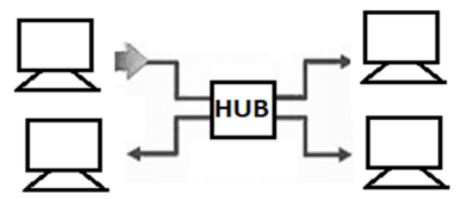
network’s as a single network. A hub can receive input from many lines. When hub receives input from any of the input lines, it sends the received data to all other lines of hub. Hubs are commonly used in the Star Network topology.
Question. Define the term Data Transfer Rate. What are its units?
Answer: The transfer of data from one computer to other is called data transfer. The amount of data that can be transferred from one computer to another in a given time period (usually a second) is called Data Transfer Rate.
Data transfer speed is expressed in bits. Units of data transfer rate can be:
kbps – kilo bits per second
mbps – mega bits per second
gbps – giga bits per second
tbps – tera bits per second
Question. What do you understand by the term Transmission media?
Answer: Communication Media is also called Communication Channels. Communication channels are those channels which are used to transfer data from one computer to another in a network. Communication channels are of two types: Guided Media and Unguided Media.
Long Answer Type Questions
Question. Why networking is needed?
Answer: Networking is needed mainly due to following reasons:
• To share computer resources
• To share hardware components
• To enable communication between computers
• To increase the spped and accuracy in communications
• To reduce the cost of data transfer
• To work in a team/group
Question. Why data sharing is considered as an important application of networking?
Answer: Data sharing is considered as an important application of networking. There are many reasons. Users can share data esily with the help of networks. For example: in an organization, users of different departments can share files easily with the help of network. Networking helps to increase the speed and accuracy of data communication. Data can be transferred to others within seconds using networks. Besides this, cost of data transfer using netowkrs is also very low. Using networks, a single task can be performed by dividing the work into team-groups. It increases the productivity of work. Due to these reasons we can say that data sharing is considered as an important application of networking
Question. Which type of network is useful for cable TV network? How it is different from WAN?
Answer: Cable TV network is such a network that spreads across a city. For such networks, MAN type of networks is used. Therefore, we can say that MAN type of network is useful for cable TV networks. These networks are different from WAN networks. WAN networks spread across the whole country or continent or world. In this way, we can say that cable TV networks are very small as competed to Wide Area Networks (WAN).
Question. What are guided and unguided data transmission media? Give examples.
Answer: The media through which data is transformed from one place to another is called transmission media. It is also known as or communication media. There are two categories of transmission media used in computer communications.
• Guided/Bounded Media
• Unguided/Unbounded Media
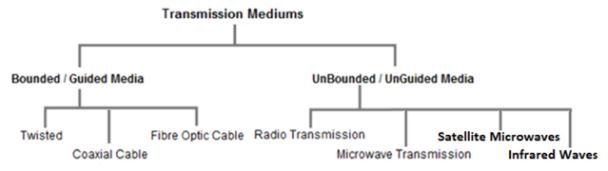
BOUNDED/GUIDED TRANSMISSION MEDIA
In this transmission media, signals are passed through a specific path using wire or cable. There are many types of bounded transmission media, such as twisted pair cables, co-axial cables, fiber optics etc.
UNBOUNDED/UNGUIDED TRANSMISSION MEDIA
Unguided or wireless media sends the data through air (without wires). This media is not guided or bounded to a channel to follow. Wireless media is particularly useful in those regions where cables are difficult to implement or install. The main types of unguided media are: Radio waves, Microwaves, Satellite Microwaves, Infrared waves.
Question. What is the function of modem in networking?
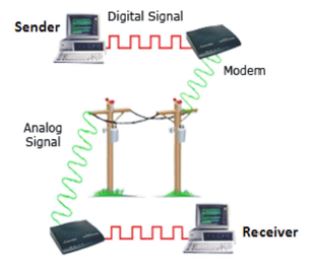
Answer: Full form of Modem is Modulator Demodulator. It is a communication device. It is used to convert the digital signals into analog signals and vice versa. Computer generates digital data which is not suitable for long distance communication. So, this data must be converted to analog data for long distance communication. It is the modulation which converts digital data into analog data. This analog data can travel without any noise over long distance.
When this data riches at its destination, then it is converted back to digital data. This process of analog to digital conversion is called demodulation. In this way, we can say that modems play an important role in communication.
Other Important Long Answer type questions
Question. What are networks? Explain different types of networks.
Answer: Computer network is an interconnection of two or more computers to share resources (hardware, software or data). These computers are connected with each other using some communication medium. These communication medium can be wired (twisted pair cable, co-axial cable, fibre optics etc.) or wireless (Bluetooth, infrared etc.) There is no limit to the distance between computers in a network.
Types of Networks:
There are many types of networks. Networks can be classified according to span of their geographical area. They can
be classified into three categories:
1. Local Area Network (LAN)
2. Metropolitan Area Network (MAN)
3. Wide Area Network (WAN)
1. Local Area Network (LAN):
A LAN network interconnects computers within a limited area. This area can be a residence, school, library, or office building. LAN is relatively smaller than MAN and WAN. It is privately owned network. It provides local connectivity.
In Offices, LAN is used to share resources. It can also be used to exchange information. A LAN is made up of many components. These components are Transmission channels (twisted pair cable, coaxial cable, fibre-optic cable etc.),
Server Computer, Work Station or Client Computers, Network Interface Card (NIC), Hub, and shared resources (printers etc.)
2. Metropolitan Area network (MAN):
MAN networks are larger then a local area networks. It covers a large geographical area as compared to LAN. It can be the area of an entire city. MAN may be a single network like cable TV network. It may be interconnection of many LANs. For example, a company can use MAN to connect it’s all office LANs in a city. MAN might be either private or public. MAN is slower than LAN but Faster than WAN.
3. Wide Area networks (WAN):
These are the largest networks. These networks have no limit of geographical distance. This geographical area can be a country, a continent or the whole world. Public networks can be used to connect computers in a wide-area network. For example, telephone network system is used to connect computers to WAN. WANs can also be connected through satellites. Internet is the best example of Wide Area Network. Many components are used in WAN. These components are Bridges, Routers, and Gateways etc. Railway, airlines and banks etc. are the main application areas of WAN. WAN is slower than LAN and MAN.
Question. What are network topologies? Explain different types of network topologies.
Answer: Network topology is the arrangement of the various elements (links, nodes, etc.) of a computer network. Computers can be connected in different ways in a network. So there are different types of topologies. Commonly used topologies are discussed below:
Bus Topology:
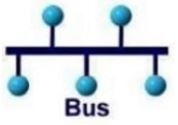
A bus network is a local area network (LAN). It is the simplest network topology. In this topology, all the nodes (computers as well as servers) are connected to the single cable. This cable is called the Bus. This central cable is the backbone of the network. Every node communicates with the other nodes through this Bus. A terminator is added at ends of bus. It prevents bouncing of signals.
Star Topology
A star network is a local area network (LAN). In this topology, all the components (nodes) of network are connected to the central device. This central device is called Hub. The connection between nodes and central device is point-to-point. Every node is indirectly connected to every other node by the Hub. All the data passes through the central device. Unshielded Twisted Pair (UTP) Ethernet cable is used to connect workstations to the central node.

Ring Topology
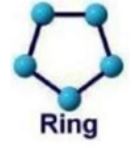
A ring network is a local area network (LAN). In Ring Topology, all the nodes are connected to eachother like a closed loop. Each node is connected to two other nodes on both sides. A node can communicate with its neighbouring nodes. In the network, data travels in one direction. Sending and receiving of data takes place with the help of TOKEN. A Token contains the information about the sender and receiver.
Mesh Topology
A mesh network is a local area network (LAN). In this topology, all nodes are interconnected with one another. This type of topology is very expensive. It is commonly used in wireless networks. In this topology, each node is directly connected with all other nodes of a network. Flooding or routing techniques are used in mesh topology for communication.

Tree Topology
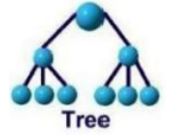
It combines the features of Star and Bus Topology. In Tree Topology, the numbers of Star networks are connected using Bus. This topology is also called Expanded Star Topology. Ethernet protocol is commonly used in this type of topology.
Free study material for Computer Science
CBSE Class 12 Computer Science Assignments for Concept of Networking
Class 12 Computer Science Concept of Networking Printable Assignments
Explore reliable practice questions for Concept of Networking tailored for Class 12 learners. Use these structured worksheets to evaluate preparedness and strengthen core problem-solving skills.
Maximize Exam Scores with Chapter Practice Sets
- Exam Alignment: Questions strictly follow contemporary CBSE sample papers and grading schemes.
- Comprehensive Coverage: Features objective drills, case studies, and structured descriptive problems for Concept of Networking.
- Pacing & Precision: Regular problem-solving builds critical calculation speed and test-taking accuracy.
Steps to Complete Concept of Networking Assignments Successfully
- Textbook Review: Always study the core NCERT book for Class 12 Computer Science prior to beginning the assignment.
- Independent Attempt: Solve Concept of Networking questions on your own initially before cross-checking with expert solutions.
- Error Tracking: Record challenging concepts in a dedicated notebook and practice online MCQ tests for revision.
FAQs
You can download free PDF assignments for Class 12 Computer Science Concept of Networking from StudiesToday.com. These practice sheets have been updated for the 2026-27 session covering all concepts from latest NCERT textbook.
Yes, our teachers have given solutions for all questions in the Class 12 Computer Science Concept of Networking assignments. This will help you to understand step-by-step methodology to get full marks in school tests and exams.
Yes. These assignments are designed as per the latest CBSE syllabus for 2026. We have included huge variety of question formats such as MCQs, Case-study based questions and important diagram-based problems found in Concept of Networking.
Practicing topicw wise assignments will help Class 12 students understand every sub-topic of Concept of Networking. Daily practice will improve speed, accuracy and answering competency-based questions.
Yes, all printable assignments for Class 12 Computer Science Concept of Networking are available for free download in mobile-friendly PDF format.