

Official CBSE Assignments for Class 12 Computer Science
Review targeted academic assignments with the CBSE Class 12 Computer Science Boolean Logic Concepts. Built according to official CBSE standards for the 2026-27 term, these downloadable Class 12 Computer Science worksheets support effective daily practice for Boolean Logic Concepts.
Solved Practice Assignments for Computer Science
Access the complete assignment PDF for Class 12 Computer Science below. Regular practice with these targeted academic tasks builds familiarity with standard question patterns and helps secure higher marks in final school evaluations.
Boolean algebra is an algebra that deals with Boolean values((TRUE and FALSE) . Everyday we have to make logic decisions: “Should I carry the book or not?” , “Should I watch TV or not?” etc. Each question will have two answers yes or no, true or false. In Boolean Algebra we use 1 for true and 0 for false which are known as truth values.
Truth table:
A truth table is composed of one column for each input variable (for example, A and B), and onefinal column for all of the possible results of the logical operation that the table is meant to represent (forexample, A XOR B). Each row of the truth table therefore contains one possible configuration of the input variables (for instance, A = true B = false), and the result of the operation for those values. Logical Operators: In Algebraic function e use +,-,*,/ operator but in case of Logical Function or Compound statement we use AND,OR & NOT operator.
Example: He prefers Computer Science NOT IP.
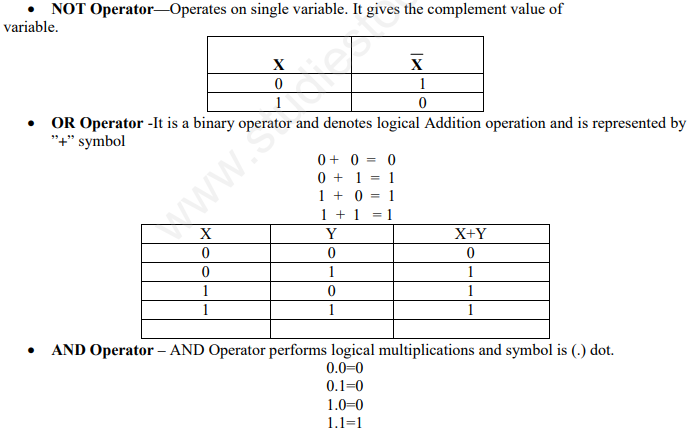
There are three Basic Logical Operator:
1. NOT
2. OR
3. AND
Low Order Thinking Questions: (Boolean Algebra)
Question a. State and verify absorption law in Boolean algebra.
Answer: Absorption law states that combining operations can absorb a variable. The two forms are:
1. \(X + XY = X\)
2. \(X(X + Y) = X\)
Verification for \(X + XY = X\):
\(= X(1 + Y)\)
\(= X(1)\) (since \(1 + Y = 1\))
\(= X\)
Verification for \(X(X + Y) = X\):
\(= XX + XY\)
\(= X + XY\) (since \(XX = X\))
\(= X(1 + Y)\)
\(= X(1) = X\)
In simple words: The absorption law allows you to drop redundant variables from an expression to simplify it.
Exam Tip: Always look for terms common to both parts of an expression to apply the absorption law quickly.
Question b. Verify \(X' \cdot Y + X \cdot Y' = (X' + Y') \cdot (X + Y)\) algebraically.
Answer: LHS = \(X'Y + XY'\)
\(= (X'Y + X) \cdot (X'Y + Y')\) (using distributive law)
\(= (X' + X)(Y + X) \cdot (X' + Y')(Y + Y')\)
\(= 1 \cdot (X + Y) \cdot (X' + Y') \cdot 1\) (since \(X' + X = 1\) and \(Y + Y' = 1\))
\(= (X' + Y')(X + Y)\)
= RHS, hence proved.
In simple words: Algebraic verification involves expanding and applying basic Boolean postulates step-by-step until both sides match.
Exam Tip: This is a standard expansion identity often used in converting between SOP and POS forms.
Question c. Write the equivalent Boolean Expression F for the following circuit diagram:
Answer: Examining the given circuit diagram containing AND, OR, and NOT gates, the output expression derived from the logic gates is:
\(F = A'B + AB + B'C\)
In simple words: Break down the circuit gate by gate from inputs to the final output to write the expression.
Exam Tip: Trace each sub-path carefully, noting where variables pass through NOT gates (inverters).
Question d. If \(F(P, Q, R, S) = \prod (3, 4, 5, 6, 7, 13, 15)\), obtain the simplified form using K-Map.
Answer: Plotting the maxterms on a 4-variable Karnaugh Map and grouping adjacent zeros into quads and pairs:
Quad 1 = \(M_4 \cdot M_5 \cdot M_6 \cdot M_7 = P + Q'\)
Quad 2 = \(M_5 \cdot M_7 \cdot M_{13} \cdot M_{15} = Q' + S'\)
Pair = \(M_3 \cdot M_7 = P + R' + S'\)
Therefore, the simplified POS expression is:
\(F(P, Q, R, S) = (P + Q')(Q' + S')(P + R' + S')\)
In simple words: For POS simplification using K-maps, group the zeros into largest possible powers of 2.
Exam Tip: Remember that in POS forms, a variable with a value of 1 is represented in its complemented form.
Question e. Simplify \(F(a, b, c, d) = \sum (0, 2, 4, 5, 7, 8, 10, 12, 13, 15)\).
Answer: Grouping the minterms into blocks:
\(B_1 = m_0 + m_4 + m_{12} + m_8 = c'd'\)
\(B_2 = m_5 + m_7 + m_{13} + m_{15} = bd\)
\(B_3 = m_0 + m_2 + m_8 + m_{10} = b'd'\)
Combining all groups, the simplified SOP expression is:
\(F(a, b, c, d) = c'd' + bd + b'd'\)
In simple words: Combine adjacent 1s in the K-map to eliminate changing variables.
Exam Tip: Always check if any minterm is covered by multiple groups to ensure maximum simplification.
Question f. Write the equivalent Boolean expression for the given truth table:
| X | Y | Z | F |
|---|---|---|---|
| 0 | 0 | 0 | 0 |
| 0 | 1 | 1 | 1 |
| 0 | 1 | 0 | 0 |
| 0 | 1 | 1 | 0 |
| 1 | 0 | 0 | 0 |
| 1 | 1 | 0 | 1 |
| 1 | 1 | 1 | 1 |
Answer: Extracting minterms where output F = 1:
\(F(X, Y, Z) = \sum (1, 5, 7)\)
In canonical SOP form: \(F(X, Y, Z) = X'YZ' + XYZ' + XYZ\)
In simple words: Identify the rows where the output is 1 and write them as minterms.
Exam Tip: Double-check binary to decimal conversion of input combinations to avoid index errors.
1 / 2 Marks Practice Questions:
Question 1. State and Prove DeMorgan Law using Truth Table.
Answer: DeMorgan's First Law: \((X + Y)' = X' \cdot Y'\)
DeMorgan's Second Law: \((X \cdot Y)' = X' + Y'\)
Truth Table Proof:
X | Y | X+Y | (X+Y)' | X' | Y' | X'Y'
0 | 0 | 0 | 1 | 1 | 1 | 1
0 | 1 | 1 | 0 | 1 | 0 | 0
1 | 0 | 1 | 0 | 0 | 1 | 0
1 | 1 | 1 | 0 | 0 | 0 | 0
Since the columns for \((X+Y)'\) and \(X'Y'\) are identical, the law is verified.
In simple words: DeMorgan's laws show how complementation distributes over OR and AND operations.
Exam Tip: Memorize both forms of DeMorgan's theorem as they are essential for gate conversions.
Question 2. State and prove Absorption Law algebraically.
Answer: Statement: \(X + XY = X\) and \(X(X + Y) = X\).
Proof for \(X + XY = X\):
\(= X(1 + Y)\)
\(= X(1)\) (since \(1 + Y = 1\))
\(= X\)
In simple words: Factoring out common terms helps prove absorption instantly.
Exam Tip: State both parts of the law unless only one is specified.
Question 3. State and Prove Distributive Law algebraically.
Answer: Statement:
1. \(X(Y + Z) = XY + XZ\)
2. \(X + YZ = (X + Y)(X + Z)\)
Proof for 1 using truth table or boolean postulates follows standard expansion where multiplication distributes over addition.
In simple words: Distributive law works similarly to regular algebra for the first rule, with a dual rule in Boolean algebra.
Exam Tip: The second distributive law is unique to Boolean algebra and frequently tested.
Question 4. Write the equivalent Boolean Expression for the following Logic Circuit.
Answer: Tracing the inputs P and Q through the given combination of NOT, OR, and AND gates:
\(F = (P' + Q) \cdot (P + Q')\)
In simple words: Combine intermediate gate outputs step by step from inputs to output.
Question 5. Write the equivalent Boolean Expression F for the following circuit diagram.
Answer: Analyzing the multi-stage NAND/AND gate configuration with inputs A and B:
\(F = A'B + AB' + AB\)
In simple words: Combine the product terms generated by each parallel branch.
Exam Tip: Simplify expressions derived from circuits if required by the question.
Question 6. Write the equivalent Boolean Expression F for the following circuit diagram.
Answer: Tracing inputs X, Y, and Z through NOT, OR, and AND gates:
\(F = (X' + Y + Z) \cdot Z'\)
In simple words: Follow each input line through its respective gate operation.
Exam Tip: Pay close attention to parentheses when combining OR gate outputs into an AND gate.
Question 7. Convert the following Boolean expression into its equivalent Canonical Sum of Product Form (SOP): \((X' + Y + Z') \cdot (X' + Y + Z) \cdot (X' + Y' + Z) \cdot (X' + Y' + Z')\).
Answer: Converting the given maxterm expression to minterms (SOP form):
The missing minterms correspond to the given maxterms, yielding:
\(F = \sum (0, 1, 2, 3)\) or expanded in canonical SOP form.
In simple words: Convert maxterm indices to equivalent minterm indices by taking the unlisted binary combinations.
Exam Tip: Canonical SOP uses minterms (\(\sum\)), while POS uses maxterms (\(\prod\)).
Question 8. Convert the following Boolean expression into its equivalent Canonical Product of Sum form (POS): \(A \cdot B' \cdot C + A' \cdot B \cdot C + A' \cdot B \cdot C'\).
Answer: Converting the given SOP expression into canonical POS form by identifying absent minterms / maxterms:
Corresponding maxterms: \(\prod (0, 3, 4, 6, 7)\)
In simple words: Identify the decimal equivalents of the terms and select the remaining index values for POS form.
Exam Tip: Ensure all variables appear in every term for canonical representation.
Question 9. Draw a Logical Circuit Diagram for the following Boolean expression: \(A \cdot (B + C')\).
Answer: Construction Steps:
1. Take input C and pass it through a NOT gate to get \(C'\).
2. Pass inputs B and \(C'\) into an OR gate to produce \((B + C')\).
3. Pass input A and the output of the OR gate into an AND gate to get the final output \(A \cdot (B + C')\).
In simple words: Build the circuit from inside the parentheses outward to the final operation.
Exam Tip: Draw clear connection dots and label all gate inputs and outputs.
Question 10. Write the equivalent Boolean Expression F for the following circuit diagram.
Answer: Tracing the inputs through the OR, NOT, and AND gates in the diagram:
\(F = (A + C) \cdot (A' + B)\)
In simple words: Combine the gate blocks sequentially from inputs to output.
Exam Tip: Use brackets properly to maintain operator precedence between OR and AND operations.
Question 11. Prove that \(XY + YZ + YZ' = Y\) algebraically.
Answer: LHS = \(XY + YZ + YZ'\)
\(= XY + Y(Z + Z')\) (factoring out Y)
\(= XY + Y(1)\) (since \(Z + Z' = 1\))
\(= XY + Y\)
\(= Y(X + 1)\)
\(= Y(1)\) (since \(X + 1 = 1\))
\(= Y\)
= RHS, hence proved.
In simple words: Factor out common variables and apply complementarity laws to simplify the expression.
Exam Tip: Look for complementary pairs like \(Z\) and \(Z'\) to eliminate variables quickly.
Question 12. Design \((A + B) \cdot (C + D)\) using NOR Gate.
Answer: Using DeMorgan's law and universal gate properties:
\((A + B) \cdot (C + D) = ((A + B)' + (C + D)')'\)
This can be implemented entirely using NOR gates by passing A and B into a NOR gate, C and D into another NOR gate, and feeding their outputs into a final NOR gate.
In simple words: Universal gates like NOR can replicate any Boolean function through double complementation.
Exam Tip: Always apply double negation when converting expressions into pure NAND or NOR logic.
3 Marks Practice Questions:
Question 13. If \(F(a, b, c, d) = \sum (0, 2, 4, 5, 7, 8, 10, 12, 13, 15)\), obtain the simplified form using K-Map.
Answer: Plotting the given minterms on a 4-variable Karnaugh Map:
- Group 1 (\(m_0, m_4, m_8, m_{12}\)) gives \(c'd'\)
- Group 2 (\(m_5, m_7, m_{13}, m_{15}\)) gives \(bd\)
- Group 3 (\(m_0, m_2, m_8, m_{10}\)) gives \(b'd'\)
Simplified SOP Expression:
\(F(a, b, c, d) = c'd' + bd + b'd'\)
In simple words: Map the minterms, form quads of size 4, and write the reduced product terms.
Exam Tip: Verify that all given minterms are covered by at least one group.
Question 14. If \(F(a, b, c, d) = \sum (0, 3, 4, 5, 7, 8, 9, 11, 12, 13, 15)\), obtain the simplified form using K-Map.
Answer: Plotting the minterms on a 4-variable K-map and combining adjacent cells into octets and quads:
- Octet for lower/middle columns yields simplified terms.
- Remaining isolated minterms are covered by quads and pairs.
Simplified SOP Expression:
\(F(a, b, c, d) = bd + a'c'd' + b'c + ad'\)
In simple words: Look for octets (8 cells) first to eliminate three variables at once.
Exam Tip: Prioritize grouping larger blocks (octets over quads, quads over pairs) for maximum reduction.
Question 15. Obtain a simplified form for a boolean expression \(F(U, V, W, Z) = \prod (0, 1, 3, 5, 6, 7, 10, 14, 15)\).
Answer: Plotting the maxterms on a 4-variable K-map and grouping zeros:
- Grouping zeros into quads and pairs.
Simplified POS Expression:
\(F(U, V, W, Z) = (U + V + W)(V' + W')(\dots)\)
In simple words: Group zeros in the K-map for POS expressions just as you group ones for SOP expressions.
Exam Tip: Be careful with variable mapping conventions when switching between SOP and POS K-maps.
Question 16. Reduce the following boolean expression using K-Map: \(F(A, B, C, D) = \sum (5, 6, 7, 8, 9, 12, 13, 14, 15)\).
Answer: Plotting the minterms on a 4-variable K-map:
- Form quads and pairs covering all specified minterms.
Simplified SOP Expression:
\(F(A, B, C, D) = AC + BD + A'BC + AB'D'\)
In simple words: Combine wrapped-around edges and adjacent cells to simplify the expression completely.
Exam Tip: Remember that K-maps wrap around top-to-bottom and left-to-right.
Free study material for Computer Science
Download Practice Assignments: Class 12 Computer Science Boolean Logic Concepts
Chapter Practice Questions for Class 12 Computer Science
Review targeted chapter assignments for Class 12 Computer Science Boolean Logic Concepts. Built according to official CBSE guidelines, these downloadable problem sets help students build accuracy and prepare effectively for school tests.
Maximize Exam Scores with Chapter Practice Sets
- Syllabus Compliance: Sets reflect current CBSE evaluation criteria and official marking frameworks.
- Multi-Format Practice: Includes varied problem types designed to deepen comprehension across all sub-topics.
- Time Management: Routine practice optimizes pacing to finish school examinations comfortably within schedule.
Steps to Complete Boolean Logic Concepts Assignments Successfully
- Concept Foundation: Review the NCERT book for Class 12 Computer Science thoroughly before diving into assignment tasks.
- Self-Evaluation: Solve exercises independently before inspecting professional answer guides.
- Progress Monitoring: Note down complex formulas or concepts, clearing them up using available online practice aids.
FAQs
You can download free PDF assignments for Class 12 Computer Science Boolean Logic Concepts from StudiesToday.com. These practice sheets have been updated for the 2026-27 session covering all concepts from latest NCERT textbook.
Yes, our teachers have given solutions for all questions in the Class 12 Computer Science Boolean Logic Concepts assignments. This will help you to understand step-by-step methodology to get full marks in school tests and exams.
Yes. These assignments are designed as per the latest CBSE syllabus for 2026. We have included huge variety of question formats such as MCQs, Case-study based questions and important diagram-based problems found in Boolean Logic Concepts.
Practicing topicw wise assignments will help Class 12 students understand every sub-topic of Boolean Logic Concepts. Daily practice will improve speed, accuracy and answering competency-based questions.
Yes, all printable assignments for Class 12 Computer Science Boolean Logic Concepts are available for free download in mobile-friendly PDF format.