

Official CBSE Assignments for Class 12 Computer Science
Review targeted academic assignments with the CBSE Class 12 Computer Science User Defined Functions Assignment. Built according to official CBSE standards for the 2026-27 term, these downloadable Class 12 Computer Science worksheets support effective daily practice for User Defined Functions.
Solved Practice Assignments for Computer Science
Navigate directly to the solved Computer Science assignments using the digital viewer below. Each practice set includes detailed step-by-step solutions, allowing students to instantly cross-check their work and identify areas requiring further revision.
Question. In C, the program execution starts from?
Answer: main() function
Question. A function that perform no action?
Answer: dummy function
Question. The default return data type in function is?
Answer: int
Question. The parameter passing mechanism used in C is?
Answer: Call by Value and call by Reference
Question. The function main() is?
Answer: A user define function
Question. How many main() functions can be defined in a C program?
Answer: one
Question. ____________ function is used to calculate the power of a number.
Answer: pow()
Question. The functions are predefined and supplied along with the compiler?
Answer: Built-in functions
Question. Function declaration ends with a _?
Answer: ; (semicolon)
Question. A function that does not return anything has return type?
Answer: void
Question. Functions are commonly divided into __ types.
Answer: two
State Whether True or False?
Question. Is it compulsory to have one return statement in a function?
Answer: False
Question. Is it possible that a function can contain more than one return statement?
Answer: True
Question. Can we pass a constant through a function?
Answer: True
Question. Function can return more then one values using return statement?
Answer: False
Question. To get back from a function, we must use return statement?
Answer: True
Exercise Questions
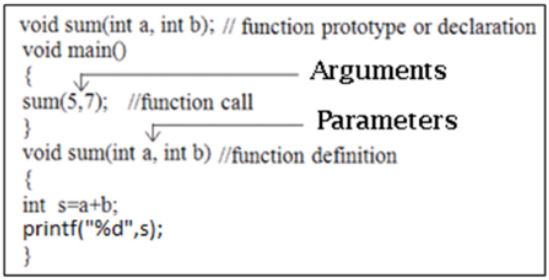
Question. Distinguish between arguments and parameters?
Answer: These are variables used in function. These are the optional part of the function. Their existence depends on the requirement of the user. It means there may be zero or more arguments. These arguments are of two types:
• Arguments (Actual parameters)
• Parameters (Formal parameters)
Arguments: Variables used in a function call are called arguments. These are written within the parentheses ( ) after the function name in the function call. They are also called actual parameters.
Parameters: Variables used in the function definition are called parameters. They are also called formal parameters. They receive values form the calling function. Parameters must be written within the parentheses ( ) after the function name in function definition.
Question. What is the need of function declaration?
Answer: Function declaration is also called Function Prototyping. It is different from function definition. It does npot have any body. It is terminated with semicolon (;). Function declaration provides the information to the compiler about the type of function, its name and arguments. When we call a function to use it, compiler verifies the function call with its declaration. If function declaration does not found, compiler will display an error message.
Question. How does a function definition differ from function declaration?
Answer: Function declaration is also called Function Prototyping. It is different from function definition. It does npot have any body. It is terminated with semicolon (;). Function declaration provides the information to the compiler about the type of function, its name and arguments. When we call a function to use it, compiler verifies the function call with its declaration. If function declaration does not found, compiler will display an error message.
Function Definition defines the working of the function. In the definition of a function, we define the type, name, arguments and body of the function.
Question. What role does the return statement play?
Answer: Return is a keyword. It is used in the definition of functions. This keyword is used in those functions which return a value to their calling function. Return statement must be the last statement in the body of the function. For
example:
int sum(int a, int b)
{
int c=a+b;
return c;
}
In the above example, the function sum() returns the value of c to its calling functions with the help of return statement.
Question. When will the execution of the function terminates?
Answer: Function is the logical grouping of statements. Functions are used to solve a complex problem by dividing it into smaller parts. A function once defined can be used many times. When a function is called, it starts its execution. This execution goes on till the end of the body of the function. When function completes its execution, program control is returned to the calling function.
Question. Explain the advantages or uses of function?
Answer: Using functions have a number of advantages. The main advantages of using a function are:
• It becomes easy to solve a complex program by dividing it into small functions.
• It becomes easy to debug the program.
• It is easy to maintain and modify a function.
• It allows the reusability of code. A function can be called any number of times but defined only once.
• Small functions are self-documenting.
• It allows the programmer to build a library of the commonly used functions.
• It facilitates top-down modular programming approach.
Other Important Questions
Question. What are functions? Write their types.
Answer: A function is a subprogram. It is also called a Routine or Procedure. It is a logical grouping of statements in a program. Functions are used to solve a complex problem by dividing it into smaller parts. A function once defined can be used many times. In every executable programs, there must be a main() function in the program. Program execution starts from this main function. In other words, we can say that main function act as a entry point of execution on the program. Types of Functions:
Functions can be classified mainly into two categories:
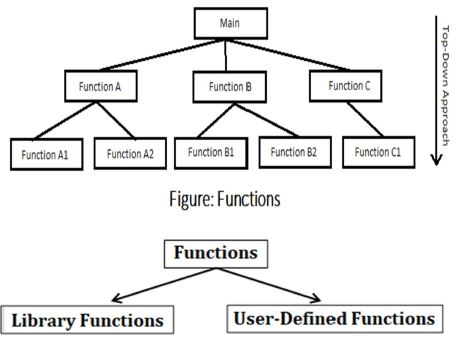
1. Library or Built-in functions
2. User defined functions
Question. What are Library Functions?
Answer: Those functions, which are in-built or pre-defined in the C language, are called standard or library functions. All these functions are organized in header files (also called library files). To use any library function, we must include the corresponding header file (in which it is defined) in our program. For example: clrscr( ), printf(), scanf(), sqrt(), strcpy() etc. are the predefined functions. The input output functions scanf( ) and printf( ) are defined in the stdio.h header file. So, we have to include this file in our program if we want to use these functions. Similarly, string functions strlen( ), strcpy( ), strcat( ), strcmp( ), strupr( ), strlwr( ) etc. are defined in the string.h header file. So, we must include string.h header file to use these string functions in our program.
Question. What are User Defined Functions?
Answer: Those functions, which are defined by the user, are called user defined functions. User can define his own functions to fulfil his requirements. The function main() is an example of user defined function. Its body is defined by user.
Question. What are Storage Classes?
Answer: Storage classes are used to define the scope, life and location of a variable in the program. In C, four storage classes are used to define scope, life and location of variable. These are:
1. Automatic Variables 2. Register Variables 3. Static Variables 4.External Variables
Free study material for Computer Science
User Defined Functions Printable Assignments & Solutions for Class 12 Computer Science
Download Assignment: User Defined Functions (Class 12 Computer Science)
Access structured practice assignments for User Defined Functions designed in alignment with the latest CBSE curriculum for Class 12 Computer Science. These printable sets cover objective and descriptive problem types to support thorough revision.
Why Practice Class 12 Computer Science Assignments?
- Curriculum Standards: Assignments match modern CBSE sample formats to ensure relevant preparation.
- Thorough Revision: Detailed problem sets reinforce core concepts and eliminate conceptual weak spots.
- Execution Speed: Timed practice with assignment sets sharpens overall response timing.
Steps to Complete User Defined Functions Assignments Successfully
- Textbook Review: Always study the core NCERT book for Class 12 Computer Science prior to beginning the assignment.
- Independent Attempt: Solve User Defined Functions questions on your own initially before cross-checking with expert solutions.
- Error Tracking: Record challenging concepts in a dedicated notebook and practice online MCQ tests for revision.
FAQs
You can download free PDF assignments for Class 12 Computer Science User Defined Functions from StudiesToday.com. These practice sheets have been updated for the 2026-27 session covering all concepts from latest NCERT textbook.
Yes, our teachers have given solutions for all questions in the Class 12 Computer Science User Defined Functions assignments. This will help you to understand step-by-step methodology to get full marks in school tests and exams.
Yes. These assignments are designed as per the latest CBSE syllabus for 2026. We have included huge variety of question formats such as MCQs, Case-study based questions and important diagram-based problems found in User Defined Functions.
Practicing topicw wise assignments will help Class 12 students understand every sub-topic of User Defined Functions. Daily practice will improve speed, accuracy and answering competency-based questions.
Yes, all printable assignments for Class 12 Computer Science User Defined Functions are available for free download in mobile-friendly PDF format.