

Class 7 Social Science Study Guide: Class 7 Social Science Air Exam Notes Set 02
Review targeted academic resources with the Class 7 Social Science Air Exam Notes Set 02. Built according to official CBSE standards for the 2026-27 term, these downloadable Class 7 Social Science study materials support effective daily practice and deeper conceptual understanding for Our Environment Chapter 04 Air.
Download Our Environment Chapter 04 Air Study Material PDF
Access the complete useful resource PDF for Class 7 Social Science below. Regular practice with these targeted academic notes builds familiarity with complex topics and helps secure higher marks in final school evaluations.
Class 7 Social Science Air Exam Notes Set B. Please refer to the examination notes which you can use for preparing and revising for exams. These notes will help you to revise the concepts quickly and get good marks.
Ø INTRODUCTION
To understand the weather or climate of a place, we must learn about the basic elements, such as insolation, temperature, atmospheric pressure, humidity, winds and the sky conditions. These are known as the elements of weather and climate.
- (i) Weather is defined as the condition of the atmosphere at a definite place at a fixed time.
(ii) Thus weather is the hour to hour or day to day condition of the atmosphere with respect to its basic elements.
(iii) The elements of weather constantly change.
(iv) The weather of a place can change any time and hence it cannot be generalized.
B.(i) Climate is defined as the average weather conditions over a long period of time.
(ii) When we speak about climatic conditions of a certain region, we mean the average atmospheric conditions of that region over a considerable length of time.
(iii) This involves keen observations and accurate recording and processing of the elements of climate, such as temperature , rainfall , air pressure, clouds, etc.
- C. Difference between weather and Climate
(i) Weather is the condition of the atmosphere at a particular area over a short period of time. It may change from day to day or even within the same day. For example, one day one place may be bright and sunny whereas next day it might have rain. Similarly, within the same region, on a particular day one town might have a clear sky whereas another town might have an overcast sky with strong winds. Thus weather is not constant.
(ii) We arrive at the climatic conditions of a place from the analysis of the daily weather recordings such as rainfall, temperature, humidity, winds etc. for period of several years. Climate thus refers to the average weather conditions of a large area over a long period of time, may be 25 or 30 years The climate of a place is of permanent nature and does not change like the weather. For example we say that India has a tropical monsoon climate or Antarctica has a polar climate. Climate too influences our ways of life – the clothes we wear, the houses we live in, the crops we grow and so on.
(iii) The element of weather and climate are the same. They are temperature, pressure, winds, humidity, precipitation, sunshine and cloudiness. Among these, temperature is the most important determining
factor of climate.
Ø TEMPERATURE
- The temperature of everyday is the temperature of the atmosphere. The degree of hotness and coldness of the air is known as temperature.
- The temperature of the atmosphere changes not only between day and night but also from season to season. Summers are hotter than winters.
iii. The sun is continuously radiating heat and light energy in all directions. It is known as the solar radiations.
The earth receives its heat from the solar radiations.
- Thus the distribution of temperature is not uniform. The temperature of the atmosphere of a place depends upon a number of factors such as insolation, latitude of the place, height of the place above sea level, distance from the sea, direction of prevailing winds, nautral vegetation, humidity, differential heating and cooling of land and water. etc.
(a) (i) Insolation is one of the most important factor that influences the distribution of temperature on the earth.
(ii) Insolation is defined as the incoming solar radiations, which reaches the surface of the earth.
(iii) The total amount of insolation received at the surface of the earth decreases from the equator towards the poles.
(iv) The maximum isolation is received in the tropical zone.
(b) Thus the temperature also decreases in the same manner, that is, it decreases from the equator towards the pole. The polar regions experience low temperature, and these regions remain covered with snow almost throughout the year.
(c) Any abnormal increase in temperature can be harmful for the survival of life on earth It will be difficult to grow crops in extra hot weather.
(d) The cities are much warmer than the villages. In cities, the high rise pucca concrete buildings trap the warm
air that increases the temperature in the cities.
Ø MEASUREMENT OF TEMPERATURE
- The temperature of the air can be measured with the help of a thermometer.
- Two scales are generally used to measure the temperature the Centigrade scale and the Fahrenheit scale
- The standard unit of measuring temperature in our country is degree Celsius. This scale was invented by
Anders Celsius.
- In the Celsius (Centigrade) scale, the freezing point of water is 0ºC and the boiling point of water is 100ºC, while in the Fahrenheit scale, it is 32ºF and 212ºF respectively.
- The thermometer with Celsius scale has 100 divisions, while with Fahrenheit scale has 180 divisions.
- In order to measure the highest and the lowest temperature in a day (24 hours), we use a specially developed thermometer, which is known as the Six's Maximum and Minimum Thermometer. We have to record the readings from this thermometer only once in 24 hours, to get the maximum and minimum temperature.
- The difference between the mean temperature and the minimum temperature on any on day is known as the Daily Range of Temperature.
- The difference between the maximum temperature of the hottest month and the mean temperature of the
coldest month is known as Annual Range of Temperature.
Ø ATMOSPHERIC PRESSURE
- Air is a mixture of gases and like other substances, the air has weight.
- The air exerts its weight as pressure on the earth's surface.
- The weight of air on a unit area of the earth is called the atmospheric pressure or air pressure.
- Air pressure is defined as the pressure exerted by the weight of air on the earth's surface.
- The air is also exerting pressure on our body, but we do not experience it. The air presses us from all directions and our body exerts a counter pressure to neutralize its effect.
- The weight of the column of air is about one kg on one sq cm area.
- The atmospheric pressure is highest at sea level and it decreases with increase in height above the sea level and vice versa.
- In those regions, where the temperature is high, the air on the surface of earth gets heated. It expands, becomes light and thus rises upward. This creates a low pressure area, which is normally associated with cloudy skies and wet weather.
- In those regions, where the temperature is low, the air on the surface of the earth gets cooled. It becomes heavy and thus starts sinking downward. This creates a high pressure area, which is normally associated
with clear and sunny skies.
Ø MEASURMENT OF ATMOSPHERIC PRESSURE
The atmospheric pressure can be measured with the help of an instrument, called barometer.
(a) The mercury barometer has a long narrow tube filled with mercury. The normal atmospheric pressure at the sea level is equal to the weight of 76 cm high mercury column.
(b) Aneroid barometer is also used for measuring atmospheric pressure. It does not contain mercury and is thus very handy.
(c) Automatic and continuous measurements barographs are used. The unit of measurement is millibars (mb).
The normal pressure at sea level is exactly 1013 mb.
Ø DISTRIBUTION OF ATMOSPHERIC PRESSURE
All parts of the earth do not receive the same amount of insolatin. Thus, the distribution of atmospheric pressure is not uniform on the earth. There is no fixed pattern of distribution of atmospheric pressure on the earth. There is a pattern of high pressure belts and low pressure belts over the earth.
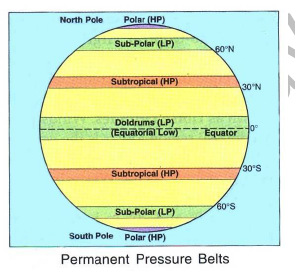
You notice in the above figure that there are seven distinct pressure belts. These are.
v The Equatorial Low-1,
v The Sub-tropical Highs-2,
v The Sub-Polar Lows-2, and
v The Polar Highes-2
Except the Equatorial Low, other pressure belts have matching pairs in the Northern and the Southern
Hemispheres.
(1) The Equatorial Low Pressure Belt
(a) It extends from about 10ºN to about 10ºS latitudes in both hemispheres.
(b) Due to intense heating, the air expands, becomes light and rises as convection currents, causing a low pressure region, known as doldrums.
(c) It enjoys absolutely calm conditions.
(2) The Sub-tropical High Pressure Belts
(a) These are near 30º north and south of equator, where the rising equatorial air currents move downward, developing a high pressure region.
(b) This is also known as Horse latitudes. Winds blow from the subtropical region towards the equator as Trade
Winds.
(c) Another set of wind blows towards the sub-polar lows, are the Westerlies.
(3) The Sub-polar low Pressure Belts
(a) They are located between 60º and 70º in both the hemispheres.
(b) The winds coming from the sub-tropics and the polar regions, converge in this belt and rise upward. (c) Due to the rotation of earth and the centrifugal forces, a low pressure belt is developed.
(d) This region is marked by violent storms during the winter season.
(4) The Polar High Pressure Belts
(a) They are located at North and South, Poles, between 70º to 90º in both hemispheres. (b) The temperature is extremely low in these belts, almost throughout the year.
(c) The cold descending air develops high pressure in the polar regions
(d) These regions have permanent ice caps.
Ø WINDS
The air always moves from the high pressure areas to the low pressure areas. This horizontal movement of the air is called wind, while the vertical or nearly vertical movement of air is called air current. The wind is always named after the direction from which it is coming.
The direction and speed of the wind is controlled by the following factors.
v The Pressure gradient : The difference in the atmospheric pressure between two places, gives us the pressure gradient. The greater the difference in pressure between two places, the steeper is the pressure gradient and higher is the speed of wind.
v The Coriolis force : The axis of the earth is inclined and the earth is rotating around it. The rotation of the earth produces the Coriolis force, which deflects the wind. The winds deflect to its right in the Northern hemisphere and to its left in the Southern hemisphere. The minimum deflection is at the equator and maximum at the poles.
v The Frictional force : Along the surface of the earth, the winds do not move freely due to the irregularities in the surface. The roughness of the surface causes friction, which reduces the speed of the wind and also changes the direction of wind. The ocean surface is smooth, thus the friction is less and the wind blows smoothly with higher speed over oceans.
v TYPES OF WINDS
Winds can be broadly classified into the permanent winds, the Seasonal Winds and the Local Winds.
v THE PERMANENT WINDS
The winds which blow regularly and constantly in a particular direction throughout the year are the permanent or prevailing winds. The main permanent winds are the Trades, the Westerlies and the Polar Winds.
v The Trade Winds blow from the sub-tropical high pressure belts towards the equatorial low pressure belts in both the Hemispheres. Their direction is from northwest to southwest in the Northern hemisphere and from southeast to northwest in the Southern Hemisphere. These winds blow from cooler to warmer areas. Thus these are dry winds.
v The Westerlies blow from the sub-tropical high pressure belts to the sub-polar low pressure belts in both the hemispheres. Their direction is from southwest to northeast in the Northern hemisphere and from northwest to southeast in the Southern hemisphere. These winds blow from warmer to cooler areas, thus provide rainfall almost throughout the year. Due to their high velocity, they are also called the Roaring Forties.
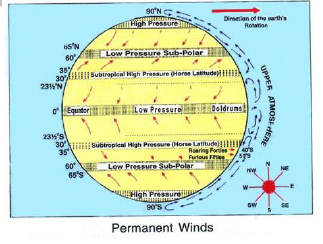
v The Polar Winds blow from polar high pressure belts to the sub-polar low pressure belts in the both the hemispheres. These winds blow from northeast in the Northern hemisphere and from southeast in the Southern hemisphere. These are very cold winds, but when they blow over oceans, these winds become comparatively warm.
v THE SEASONAL WINDS
These winds are caused due to unequal heating and cooling of land masses and water bodies. These winds can change their direction with the change in seasons. The main seasonal winds are the Monsoon, the Land Breezes and the Sea Breezes.
v The Monsoon Winds blow from sea to land during the summer season and from land to sea during the winter season. The word Monsoon has been derived from the Arabic word Mausim meaning season. They are divided into the summer and the winter monsoons.
During the summer seasons, land is hot and has a low pressure area, while the adjoining sea is comparatively cool and has a high pressure area. Thus the winds blow from sea to land and cause heavy rainfall in the June to September months.
During the winter season, the conditions are just reversed of those of the summer season. A high pressure develops over the landmass while there is low pressure over the Indian Ocean. Thus the winds blow from land to sea and bring cool and dry weather in the months from November to February.
v The Land and Sea Breezes are experienced in the narrow coastal regions. These winds are caused by the unequal rate of heating of the land and the adjoining sea.
In day time, the land is heated faster than adjoining sea, which creates a low pressure zone on the land and a comparatively high pressure zone on the adjoining sea. Thus the winds blow from sea to land and are called Sea Breezes.
At night time, the conditions are reversed. The land is cool and the seas is still warm. Thus the winds blow from land to sea and are called Land Breezes.
v THE LOCAL WINDS
These winds are restricted to a small area and blow only during a particular period of the day or year. These winds can be warm or cold depending upon the area from which they blow. The well-known local winds are Loo, Foehn, Chinook, Mistral, Harmattan, Sirocco, etc.
In the plains of Northern India, very hot and dry winds blow in the afternoons during the months of May and June. These are called Loo.
The strong dry and hot wind which develops on the leeward side of the Alps mountains, is called Foehn.
The strong dry wind which blows over northwest Africa from northeast is called Harmattan. The warm dry southwesterly wind which blows down the eastern slopes of the Rockies in USA and Canada is called
Chinook.
Ø MOISTURE IN THE ATMOSPHERE
Water is found on the surface of the earth in oceans, seas, gulfs, bays, lakes, ponds, rivers and even in the soil. The heat from the sun converts the water into water vapour through the process of evaporation. The most important source of moisture in the atmosphere varies not only from place to place, but also from time to time.
v The process by which water vapour enters the atmosphere on heating is known as evaporation.
v The process by which the water vapour is converted into water droplets on cooling is known as
condensation.
v The process by which the water droplets fall on the ground in liquid, solid or frozen from is known as
precipitation.
Ø HUMIDITY
The amount of water vapour or moisture present in the atmosphere at a particular time and place is known as humidity. Humidity is expressed as absolute humidity and relative humidity.
The actual amount of moisture present in the atmosphere is known as absolute humidity. The ratio between the actual amount of moisture present in the air at a given temperature and the maximum capacity of the air to hold moisture at the that temperature is known as relative humidity. The relative humidity is always expressed in percentage.
The humidity in the atmosphere is measured with help of a hygrometer, which is also called the wet and
dry bulb thermometer.
Ø CONDENSATION
It is the reverse process of evaporation. The process of converting the water vapour into water or ice is called condensation. It takes place due to loss of heat. When the water vapour in the atmosphere condenses, they may take the form of dew, frost, fog, mist, clouds, etc.
These should not be confused with the form of precipitation such as rain, drizzle, snow, sleet and hails.
Clouds are the most important form of condensation. They are formed when condensation of moisture occurs far above the ground. This condensation occurs around tiny solid particles like dust or smoke particles.
The tiny droplets do not fall on the ground and remain suspended in the air. Clouds then ries upward. More and more droplets are added and the clouds slowly grow in size. When the air is fully saturated, these droplets may fall down as rain drops on the ground. All clouds do not provide precipitation.
Depending upon their, shape and the formation the clouds are of three major types.
v Cirrus clouds are fleecy like wood, generally at high altitude.
v Cumulus clouds have a cauliflower-like shape.
v Stratus clouds have a layered structure.
Ø PRECIPITATION
Small droplets of water, ice crystals, etc. fall to the ground, by the process of precipitation. The small drops of water join together to form large-sized water drops, which become too heavy to remain suspended in air. Thus precipitation takes place. The main forms of precipitation are drizzle, rain, snow, sleet, hail, etc.
v Drizzle : Drizzle are raindrops of smaller size and less intensity.
v Snow : Snow are water droplets which rise higher and freeze on account of fall in temperature.
v Sleet : Sleet is a mixture of rain and ice.
v Hail : Vertical air current may push water droplets higher. They form into solid ice balls and fall as hail.
v Rain is the most important and most common form of precipitation. Rainfall occurs only when the cloud droplets change to rain drops. The average diameter of a raindrop is about 5 mm and one raindrop has about 5 million cloud droplets.
The way in which the condensation and cooling of the warm moist air takes place, the rainfall can be of the
Convectional rainfall, Orographic rainfall and Cyclonic rainfall, types.
The Convectional rainfall : The heated air with moisture rises in the form of convectional current, leading to the development of clouds at about 10 km height. The ascending hot and humid air current causes condensation of the clouds, resulting in heavy rainfall for a short duration. Such rainfall is also accompanied by thunder and lightning. It occurs mostly in equatorial regions.
The Orographic rainfall : it is also known as relief rainfall, because it occurs from the cooling of warm moist air which ascend above the mountain barrier lying in the direction of the prevailing winds. The sudden ascent causes cooling of air, which causes condensation and precipitation. Most of the precipitation in the world is orographic in nature.
The Cyclonic rainfall : This type of rainfall is associated with the tropical and temperature cyclones. When warm and cold air masses confront each other, the warmer air (lighter) generally climbs above the colder air (heavier). The boundary between the warm and cold air masses is called fronts. The rising air is cooled and causes heavy precipitation. The tropical cyclones are also known as typhoons, hurricanes, tornadoes, etc.
Rainfall is very useful, as it brings fresh water on the earth's surface. This is needed for the survival of human beings, animals and plants. More rainfall can cause floods, and less rainfall can cause drought conditions
Please click on below link to download pdf file for Class 7 Social Science Air Exam Notes Set B.
Free study material for Social Science
CBSE Class 7 Social Science Study Material: Our Environment Chapter 04 Air
Comprehensive Study Resources for Our Environment Chapter 04 Air
Access comprehensive study material for Our Environment Chapter 04 Air, including revision notes, concept maps, and high-probability questions. These resources are designed in alignment with the latest 2026 CBSE syllabus for Class 7 Social Science to support effective exam preparation.
Understanding Marking Schemes
Each resource draws directly from authorized textbooks to maintain academic accuracy. Evaluating solved examples allows Class 7 students to master the formal presentation and answer-writing standards expected in upcoming school exams.
Complete Revision for Social Science
Maximize your grade potential by utilizing Class 7 Social Science practice papers in tandem with these structured notes. All printable assignments and interactive mock tests on our platform are updated for the 2026 session and available free of charge.
FAQs
Our advanced study package for Our Environment Chapter 04 Air includes detailed concepts, diagrams, Mind Maps, and explanation of complex topics to ensure Class 7 students learn as per syllabus for 2026 exams.
The Mind Maps provided for Our Environment Chapter 04 Air act as visual anchors which will help faster recall during high-pressure exams.
Yes, teachers use our Class 7 Social Science resources for lesson planning as they are in simple language and have lot of solved examples.
Yes, You can download the complete, mobile-friendly PDF of the Social Science Our Environment Chapter 04 Air advanced resources for free.
Yes, our subject matter experts have updated the Our Environment Chapter 04 Air material to align with the rationalized NCERT textbooks and have removed deleted topics and added new competency-based questions.