

Class 7 Social Science Study Guide: Class 7 Social Science Our Environment Exam Notes
Access comprehensive study materials and useful resources for Our Environment Chapter 01 Environment using the Class 7 Social Science Our Environment Exam Notes. Designed to align with the 2026-27 CBSE academic guidelines, these advanced resources help Class 7 Social Science students reinforce core concepts beyond standard textbooks.
Download Our Environment Chapter 01 Environment Study Material PDF
Access the complete useful resource PDF for Class 7 Social Science below. Regular practice with these targeted academic notes builds familiarity with complex topics and helps secure higher marks in final school evaluations.
Class 7 Social Science Our Environment Exam Notes. Please refer to the examination notes which you can use for preparing and revising for exams. These notes will help you to revise the concepts quickly and get good marks.
→INTRODUCTION
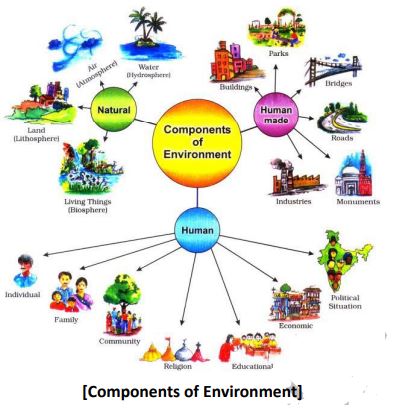
The word 'environment' stands for the surroundings, which include all the living and nonliving things around us. The environment provides us with the air we breathe, the water we drink, the food we eat, the clothes we wear and the land on which we live. The animals and plants are also part of our environment. Thus, our environment is a combination of both natural and human components or the natural environment and the human environment.
→ MEANING OF ENVIRONMENT
Environment is originated from French word environer which means neighborhood. Environment is our basic life support system.
→ DEFINITION OF ENVIRONMENT
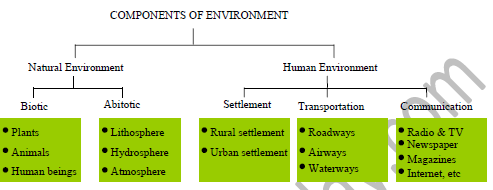
The place, people, things and nature that surround any living organism is called environment. It is a combination of natural and human made phenomena. While the natural environment refers to both biotic and abiotic conditions existing on the earth, human environment reveals the activities, creations and interactions among human beings.
→ THE NATURAL ENVIRONMENT
The natural environment has both biotic or living and abiotic or nonliving components existing on the earth. The biotic components include plants, animals and human beings, while the abiotic components include land, water and air. The natural environment is also known as the habitat of the organisms. The biotic and the abiotic components of the natural environment are interrelated and there is a constant interaction between them. Actually, the components of the natural environment are dynamic in nature. If there is a change in one component of the natural environment, it will create a change in the other.
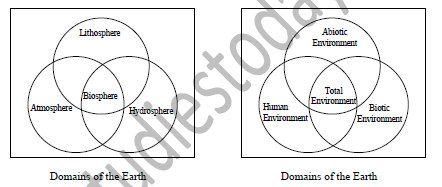
The components of the natural environment, such as land, water, air, plants, animals and human beings are called the domains or realms of our earth. The four realms are as under.
<The Lithosphere – the solid crust of the earth.
< The Hydrosphere – the waterbodies on the earth.
<The Atmosphere – the envelope of air around the earth.
<The Biosphere – the living world.
→THE LITHOSPHERE
The Greek word 'lithos' stands for rocks. Lithosphere is the outer skin of the earth or the crust. This hard and solid layer is made up of rocks and minerals. The upper layer is covered with a thin layer of soil. This rocky sphere extends both over continents and ocean basins. Its surface is not uniform and has a variety of
Iandforms, such as mountains, plateaus, ridges, plains, valleys, waterfalls, etc. These landforms are also found on the ocean floors. Most of the human needs are met from the lithosphere. It provides land for agriculture and settlement. The land is covered with forests and grasslands. A large variety of minerals is
found in the crust of the earth which are needed for the development of industries.
→ THE HYDROSPHERE
The word 'hydro' stands for water. About 71 percent of the total surface area of the earth is covered with water, which is called hydrosphere. The water on earth is found in oceans, seas, bays, gulfs, rivers, lakes , ponds etc. The earth is the only planet in the solar system, which has enough water. Thus, the earth is also called the Blue planet. Water is found in solid, liquid and gaseous forms at the same time. The fresh water is provided on the earth through the Water cycle or the Hydrological Cycle. Life cannot survive on the earth's surface without water. Thus, it is essential for all living organisms. Fresh water is in great demand
for domestic needs, agriculture and industries. Water is also used to generate hydroelectricity.
→THE ATMOSPHERE
The ocean of air which surrounds the earth from all sides is called the atmosphere. The gravitational pull of the earth holds the atmosphere around it . About 99 percent of the total mass of air lies within 32 km from the earth. Air is a mixture of gases (Nitrogen, Oxygen, Carbon dioxide, Ozone, Helium, Hydrogen, etc.), water vapour and dust particles. The atmosphere protects us from harmful radiations and scorching heat of the Sun. The air is vital for all forms of life on the earth. The condition of the atmosphere with respect to the temperature of air, atmospheric pressure, humidity, etc. makes up the weather of a place. The changes in the atmosphere can produce changes in the weather and climate of a place.
→ THE BIOSPHERE
The lithosphere, hydrosphere and atmosphere (land, water and air) are made up of nonliving matter, while Biosphere is a sphere of living organisms. It is found where lithosphere, hydrosphere and atmosphere meet and interact with each other to support life. It is a narrow zone, about 24 km in thickness, which extends a little above and below the surface of land and in water and air. The existence of biosphere has made the
earth a unique planet in the solar system. The living organisms in the biosphere vary greatly in size and shape. The variety of life on earth is called biodiversity. The living organisms in the biosphere can be classified into the plant kingdom and the animal kingdom.
COMPONENTS OF ENVIRONMENT
→ THE ECOSYSTEM
All the living organisms, i.e., plants, animals and human beings, depend on their immediate environment. They are also interdependent on each other. The relationship between the living organisms, as well as the relationship between the organisms and their surroundings form an ecosystem. The ecosystem has no particular size. It can be as large as a rainforest, grassland, desert, ocean, mountain or as small as a water pond or a small lake. Ecosystem can be natural or artificial. Sun is the main source of energy for the growth and development of an ecosystem. Ecology is the science which studies the relationship between the living
organisms and their environment.
→HUMAN ENVIRONMENT
<Human beings interact with the environment and modify it according to their need. Early humans adapted themselves to the natural surroundings. They led a simple life and fulfilled their requirements from the nature around them. With time needs grew and became more varied. Humans learn new ways to use and change environment.
<They learn to grow crops, domesticate animals and lead a settled life. The wheel was invented, surplus food was produced, barter system emerged, trade started and commerce developed Industrial revolution enabled large scale production. Transportation became faster.
<Information revolution made communication easier and speedy across the world.
<A perfect balance is necessary between the natural and human environment. Humans must learn to live and used their environment. Humans must learn to live and use their environment in a harmonious way.
Please click on below link to download pdf file for Class 7 Social Science Our Environment Exam Notes.
Free study material for Social Science
Social Science Class 7 Exam Resources: Our Environment Chapter 01 Environment
Essential Notes for Class 7 Social Science
Access comprehensive study material for Our Environment Chapter 01 Environment, including revision notes, concept maps, and high-probability questions. These resources are designed in alignment with the latest 2026 CBSE syllabus for Class 7 Social Science to support effective exam preparation.
Verified Solutions for Class 7 Social Science
Designed around the official curriculum, these study guides guarantee standard compliance. Reviewing step-by-step solutions clarifies complex sub-topics within Our Environment Chapter 01 Environment and demystifies standard marking schemes for Social Science evaluations.
Enhance Accuracy with Online Tests
Wrap up your chapter revision by testing your knowledge against standard objective question formats. Explore our full library of free, up-to-date sample papers and online assessments to secure top grades in your CBSE examinations.
FAQs
Our advanced study package for Our Environment Chapter 01 Environment includes detailed concepts, diagrams, Mind Maps, and explanation of complex topics to ensure Class 7 students learn as per syllabus for 2026 exams.
The Mind Maps provided for Our Environment Chapter 01 Environment act as visual anchors which will help faster recall during high-pressure exams.
Yes, teachers use our Class 7 Social Science resources for lesson planning as they are in simple language and have lot of solved examples.
Yes, You can download the complete, mobile-friendly PDF of the Social Science Our Environment Chapter 01 Environment advanced resources for free.
Yes, our subject matter experts have updated the Our Environment Chapter 01 Environment material to align with the rationalized NCERT textbooks and have removed deleted topics and added new competency-based questions.