

Official CBSE Study Materials for Class 7 Social Science
Review targeted academic resources with the Class 7 Social Science Air Exam Notes Set 01. Built according to official CBSE standards for the 2026-27 term, these downloadable Class 7 Social Science study materials support effective daily practice and deeper conceptual understanding for Our Environment Chapter 04 Air.
Advanced Resources for Social Science
Access the complete useful resource PDF for Class 7 Social Science below. Regular practice with these targeted academic notes builds familiarity with complex topics and helps secure higher marks in final school evaluations.
Class 7 Social Science Air Exam Notes Set A. Please refer to the examination notes which you can use for preparing and revising for exams. These notes will help you to revise the concepts quickly and get good marks.
Introduction
1.The vast blanket of air which is surrounding the earth is known as the atmosphere.
2.It is roughly estimated that the upper limit of atmosphere reaches up to a height of about 10,000 km from the surface of the earth.
3.The total weight of the atmosphere is approximately 500 million metric tons.
4.The atmosphere is held close to the earth by the force of gravity.
5.About 50 per cent of the total mass of air is found within 5 km from the earth's surface.
6.It exists in several layers around the earth.
7.The density of air decreases as one goes to high altitudes. So, it is hard to breathe as one goes up.
8.The atmosphere protects us from the harmful effects of the sun's rays.
9.The life on earth depends on the atmosphere for its survival.
10.The atmosphere has oxygen and nitrogen gases.
11.The atmosphere helps in retaining the warmth on the earth and also helps in the circulation of water vapour.
12.Without this vast blanket of air, we would be baked alive by the extreme heat of the sun during the daytime and would be frozen during the right time.
13.The existence of the air around the earth has made it a unique planet, as the temperature on the earth is suitable for the growth of life.
Composition Of The Air
1.The atmosphere is a mixture of many gases tiny dust particles, smoke and water vapour.
2.The composition is not fixed, rather varies from place to place and also from season to season. In the lower layers, the composition of dry air is uniform.
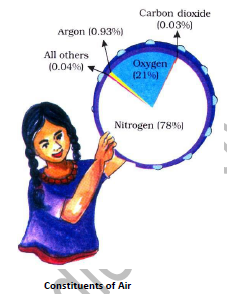
3.Nitrogen and Oxygen are two main gases which account for about 99 per cent of the atmosphere.
4.Other gases present in the atmosphere include carbondioxide, helium, ozone, argon and hydrogen.
5.Apart from the gases, the atmosphere also has varying quantities of dust particles and water vapour.
6.Nitrogen is the most abundant gas and accounts for about 78 per cent of the clean dry air. Nitrogen, a colourless inert gas, dilutes the oxygen and slows down the process of oxidation. Plants need nitrogen for their survival. They cannot use it directly and obtain it from the soil.
7.Oxygen is the second most important gas in the atmosphere. Its share is about 21 per cent of the clean dry air. It is found only in the lower layers of the atmosphere. All living beings need it for breathing.The share of oxygen in the atmosphere remains constant as the plants produce oxygen during photosynthesis.
8.Carbon dioxide is needed by plants for their survival. The human beings and animals release carbon dioxide. The amount is also equal to the amount consumed by the plants. This balance of carbon dioxide in the atmosphere is being disturbed by the increased burning of fossil fuels, like coal and petroleum.
9.The amount of water vapour present in the atmosphere depends upon the temperature. Water vapour is added to the atmosphere by evaporation from oceans, seas, lakes, rivers, etc. and transpiration from vegetation and respiration of animals. Water vapour is responsible for all forms of condensation and precipitation
- The atmosphere also has large amount of fine dust particles, salt particles, pollens from plants, ash from volcanic eruptions, smoke from fire, etc. They are found in the lower layers only. These particles act as nuclei for water vapour to form raindrops around them. They also scatter the sun's radiation during sunrise and sunset.
♦ STRUCTURE OF THE ATMOSPHERE
- The atmosphere has a layered structure.
- Each layer has different characteristics.
- The upper layer presses down the lower layers.
- Thus, the upper layers are less dense than the lower layers.
- It is estimated that about 90 per cent of the total mass of the atmosphere lies within a height of about 20 km from the earth's surface.
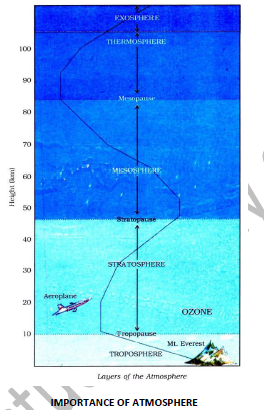
- The total extent of atmosphere, on the basis of temperature and atmospheric pressure, can be divided into five layers starting from the earth's surface. These are Troposphere, Stratosphere, Mesosphere, Thermosphere and Exosphere.
♦ TROPOSPHERE
- This is the most important layer of the atmosphere. It is the lower most and densest layer.
- The height of the troposphere varies from about 8 km at the Poles to about 18 km near the Equator.
- About three-fourth of the total mass of atmosphere is found in this layer.
- The air we breath is available in this layer only.
- In this layer, the temperature of the air decreases with increase in height.
- Almost all types of weather phenomena like rainfall, fog, clouds, hailstorm, etc. occur in this layer.
- The water vapour and dust particles are found only in this layer.
- This layer is heated more from below than from above.
- The upper limit of troposphere is known as tropopause.
♦ STRATOSPHERE
- This layer lies above the tropopause and extends up to a height of about 50 km from the sea level.
- Temperature in the lower part of this layer is mostly constant.
- The air is generally thin, cold and dry.
- Strong winds, known as jet stream, blow horizontally from west to east in this layer.
- The stratosphere is almost free from various weather phenomena and the lower part is completely free from water vapour and dust particles.
- Thus, the lower part of stratosphere is ideal for flying jet aircrafts.
- The upper limit of stratosphere is known as stratopause.
- An important feature of stratosphere is the presence of ozone in its lower part. The ozone can absorb the incoming ultraviolet rays of the solar radiations. Thus, this ozone layer is essential for sustainin life on the earth. The scientists have observed that there is a decline in the total global ozone. This can cause global warming.
♦ MESOSPHERE
- This layer lies above the stratosphere and extends up to a height of about 90 km from the sea level.
- The temperature in this layer decreases with height and reaches up to –110ºC near the upper limit.
- It is the coldest layer in the atmosphere.
- The meteors burn up in this layer on entering from space.
- The upper limit of mesosphere is known as the mesopause. From mesopause onwards, the temperature increases.
♦ THERMOSPHERE
- This layer lies above the mesosphere and extends up to a height of abut 400 km from the sea level.
- In this layer, the temperature increases rapidly with increase in height.
- Ionosphere is a part of this layer, which contains electrically charged particles, called ions. The ions reflect radio waves back to the earth's surface. This enables us to have wireless communication.
♦ EXOSPHERE
- This is the uppermost layer of the atmosphere and lies between 400 km to 1500 km above the earth.
- Here the air is very thin as the main gases present are hydrogen and helium.
- The temperature increases with height, may reach up to 5000ºC.
- This layer merges gradually with the interplanetary space.
The atmosphere is extremely significant for the growth and development of the life on the earth.
- The atmosphere protects us from harmful unltraviolet rays coming from the sun.
- It controls the extremes of temperature during the daytime and the night time through greenhouse effect.
- It protects us from the meteors coming towards the earth from the outer space.
- The air has weight and exerts pressure. Being pressed down, it always remains in contact with land and water.
- The change in the weather conditions is exclusively due to the presence of atmosphere.
- The gases, like oxygen and carbon dioxide, have made life possible on the earth.
- The ionosphere helps us in wireless and long distance communication.
- Sound waves can only travel through the air.
- The energy of the sun has made the atmosphere dynamic.
- Nitrogen is required to maintain the fertility of the soil and is vital for plants.
- Oxygen is the gas that animals breathe in.
- Carbon dioxide helps plants to produce food in the presence of sunlight. It also keeps the earth warm by absorbing the heat radiated from the surface. This is called the greenhouse effect.
- The water vapour in the atmosphere causes precipitation.
- The dust particles form the nucleus for condensation which results in the formation of clouds that cause rainfall and snowfall.
Please click on below link to download pdf file for Class 7 Social Science Air Exam Notes Set A.
Free study material for Social Science
CBSE Class 7 Social Science Study Material: Our Environment Chapter 04 Air
Essential Notes for Class 7 Social Science
Explore essential learning tools for Class 7 Social Science Our Environment Chapter 04 Air. This curated collection features in-depth notes and targeted practice questions built around the active 2026 curriculum to streamline your daily revision.
Verified Solutions for Class 7 Social Science
Built using official NCERT guidelines for Class 7 Social Science, these materials provide reliable academic support. Integrating past examination questions and step-by-step solutions helps students understand official CBSE grading criteria.
Enhance Accuracy with Online Tests
For peak performance in upcoming evaluations, integrate official Social Science sample papers directly into your study schedule. Follow up your revision by attempting online MCQ tests for Our Environment Chapter 04 Air to refine calculation speed and precision.
FAQs
Our advanced study package for Our Environment Chapter 04 Air includes detailed concepts, diagrams, Mind Maps, and explanation of complex topics to ensure Class 7 students learn as per syllabus for 2026 exams.
The Mind Maps provided for Our Environment Chapter 04 Air act as visual anchors which will help faster recall during high-pressure exams.
Yes, teachers use our Class 7 Social Science resources for lesson planning as they are in simple language and have lot of solved examples.
Yes, You can download the complete, mobile-friendly PDF of the Social Science Our Environment Chapter 04 Air advanced resources for free.
Yes, our subject matter experts have updated the Our Environment Chapter 04 Air material to align with the rationalized NCERT textbooks and have removed deleted topics and added new competency-based questions.