

Advanced Study Material for Class 9 English: Pronoun
Review targeted academic resources with the CBSE Class 9 English Pronoun Notes. Built according to official CBSE standards for the 2026-27 term, these downloadable Class 9 English study materials support effective daily practice and deeper conceptual understanding for Pronoun.
Practice Class 9 English Resources: Pronoun
View or download the dedicated CBSE Class 9 English Pronoun Notes resource below. Engaging with these advanced study guides under focused conditions ensures continuous academic progress and mastery of the 2026-27 curriculum for Pronoun.
PRONOUN:
Pronoun is a word used instead of a Noun.
E .g. Look at Jack. He is studying. John and Mary have come to see him. They are glad to see him studying.
He Is also glad to see them.
The different kinds of Pronouns are as follows
(a) Personal Pronouns :
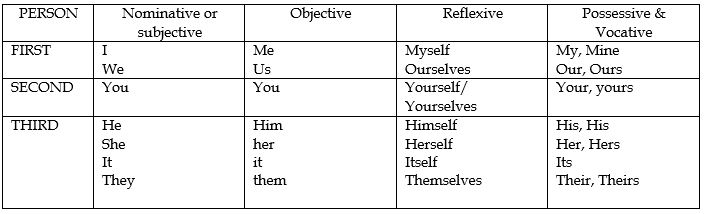
They stand for three Persons :
First person :
-> The pronouns which refer to the person or persons speaking :
E .g. I, we, me, us, mine, ours.
Second Persons :
-> The pronouns which refer to the person or persons spoken to.
E .g. you, your, thou, thee
Third person :
-> The pronouns which refer to the person or thing spoken of.
E .g. he, she, him, her, hers, they, them, theirs, it.
(b) Reflexive or Emphatic Pronouns :
E .g. are: myself, ourselves, yourself, yourselves, himself, herself, itself, and themselves.
Reflexive pronoun act as object to the verb but they refer to the same persons as the Subject of the Verbs:
E .g. I blame myself for my failure. We often talk to ourselves.
He hanged himself. They always talk about themselves.
She put herself to trouble for nothing.
Emphatic Pronouns are used with a Noun or a Pronoun for the sake of emphasis :
E .g. I myself was present at the accident site. You must do the assignment yourself.
She herself cooked food for the guests. Boys, you yourselves should should prepare your timetable.
He himself told me the story.
(c) Demonstrative Pronouns :
They are used to point out the object for which they are used.
- This & These refer to thing near at hand.
- That & Those refer to thing lying near at distance.
E .g. This is my book. That is my house. These are your friends. Those are Her friends.
(d) Distributive Pronoun :
It refer to a number of person or things, one at a time. These pronoun are always singular and are always followed by a verb in the singular.
- Each, Either, Neither are such pronouns.
E .g. Each student secured a reward. Neither of your answer is correct.
At either end of the road was a Park.
(e) Interrogative Pronoun are used for asking questions.
Who, whom and whose are used for asking questions about things.
E .g. Who is calling you? Whom do you want to meet? Whose book is this?
What is used for asking questions about thing?
E .g. What shall you do after graduation?
Which is used for asking questions about the particular person or thing?
E .g. Which is the most intelligent student in this class?(person)
Which is the best book? (Thing)
(f) Reciprocal Pronoun:
They are pronouns that denote reciprocal or mutual action. They are :
Each other : generally used when two persons or things are referred to.
E .g. Jack and Jill loved each other.
One another: generally used when more the two persons or things are referred.
E .g. The people of India love one another.
(g) Relative Pronoun :
The pronoun ‘Who, Whose, Whom, Which, That’, which join two sentences and relate or refer to Nouns which have gone before are called Relative Pronouns.
The Noun to which a Relative Pronoun refers or relates is called its Antecedent.
E .g. This is the boy who was punished. In this example ‘boy’ is the Antecedent of ‘who’.
USE OF RELATIVE PRONOUNS :
- Who :
- Used for persons only.
E .g. The man who is honest succeeds in his life.
The student who were lazy were punished.
They who live in glass houses should not throw stones at others.
The children who work hard always succeed.
- Whose :
- It is the possessive case of ‘Who’. It refer to persons but may also refer to things.
E .g. This is the question whose solution baffles me.
The school building whose roof was damaged, has now been repaired.
- Which :
- Used for animals and for things without life.
E .g. These are the books which we purchased yesterday.
The horse which won the race is John’s.
The thing which we lost have been found.
- Whom :
- Is used in formal written English. It is common to used ‘Who’ in place of ‘Whom’ in Ordinary conversation.
E .g. The man who (m) the police caught was a dreaded terrorist.
The student who (m) we praised were good in their studies.
Note : ‘Whom’ is often replaced by ‘That’ except after a preposition. The preposition may be placed at the end and ‘that’ used for ‘whom’.
E .g. That is the man about whom we were speaking.
That is the man that we were speaking about.
- That: Used for persons, animals and things.
- It may refer to singular or plural.
E .g. These are the boy that can be trusted.
This is the book that I want to buy.
This is the ring that I lost yesterday.
These are the only horses that neigh.
Note: ’That’ is preferred to ‘who’ or ‘which’ though ‘who’ or ‘which’ can be equally Used.
E .g.
a) After the superlative degree of adjectives:
Ashoka was the best king that (=who) ruled in India.
This is the best book that (=which) I have read.
b) After the words ‘all, noun, nothing, any, same’ etc.
All that (=which) glitters is not gold.
It is only you that (=who) can speak in such a way.
Nothing that (=which) we can do now will save him.
PRONOUNS AT A GLANCE
Free study material for English
English Class 9 Exam Resources: Pronoun
Quick Revision Material for Pronoun
Review targeted study resources for Pronoun tailored for Class 9 learners. Utilizing these structured notes and quick-revision tools ensures complete alignment with current CBSE evaluation standards.
Expert Notes and Solved Exam Questions
Designed around the official curriculum, these study guides guarantee standard compliance. Reviewing step-by-step solutions clarifies complex sub-topics within Pronoun and demystifies standard marking schemes for English evaluations.
Additional Study Resources for Class 9
Maximize your grade potential by utilizing Class 9 English practice papers in tandem with these structured notes. All printable assignments and interactive mock tests on our platform are updated for the 2026 session and available free of charge.
FAQs
Our advanced study package for Pronoun includes detailed concepts, diagrams, Mind Maps, and explanation of complex topics to ensure Class 9 students learn as per syllabus for 2026 exams.
The Mind Maps provided for Pronoun act as visual anchors which will help faster recall during high-pressure exams.
Yes, teachers use our Class 9 English resources for lesson planning as they are in simple language and have lot of solved examples.
Yes, You can download the complete, mobile-friendly PDF of the English Pronoun advanced resources for free.
Yes, our subject matter experts have updated the Pronoun material to align with the rationalized NCERT textbooks and have removed deleted topics and added new competency-based questions.