

Class 3 Mathematics Practice Sheet: CBSE Class 3 Mathematics Fractions Worksheet Set 03
Access comprehensive chapter-wise worksheets for Fractions using the CBSE Class 3 Mathematics Fractions Worksheet Set 03. Designed to align with the 2026-27 academic syllabus for Class 3 Mathematics, these printable practice sets help students reinforce key concepts and improve their overall exam readiness.
Download Fractions Worksheet PDF with Answers
Navigate directly to the solved Mathematics worksheets using the digital viewer below. Each practice set includes detailed step-by-step solutions, allowing students to instantly cross-check their work and identify areas requiring further revision.
LEARNING OBJECTIVES
This lesson will help us to:—
• define fractions, numerator and denominator.
• identify a fractions using object and shapes.
• understand equivalent fractions.
• compare fractions.
• add unit fractions with like denominators.
Real Life Examples
• An hour is divided in fraction of hours. For instance, half (1/2) an hour; quarter of an hour.
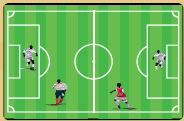
• Sports like football, have half time in the game. Half time shows a break marking the completion of half of a game.
Example: Find half of a day in hours.
Solution: 1/2 of day = 1/2 × 24 hours = 24/2 = 24 ÷ 2 = 12 hours
QUICK CONCEPT REVIEW
When a whole object or group is divided into equal parts, then each part is called a fraction of that whole.
Suppose, there is an apple and you want to divide it equally among 2 friends then equal pieces of the apple form fractions.
A fraction is a part of a whole divided in equal parts.
PROPERTIES OF FRACTION
• A fraction is written in the form of N/D ; D ≠ 0.
Here N is called the numerator and D is called the denominator.
For example : 1/3 means one part out of 3 equal parts.
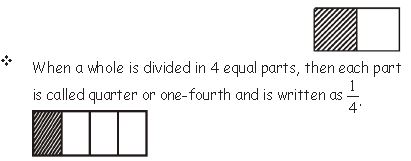
• When a whole is divided in 2 equal parts, then each part is called a half and is written as 1/2 .
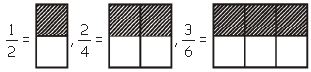
• Fractions that appear differently but have the same value are called equivalent fractions.
For example 1/2 , 2/4 and 3/6
• In a fraction, multiply the numerator and denominator by the same number to get an equivalent fraction.
For example : 1/4 = 1/4 × 3/3 = 3/12
So, 1/4 and 3/12 are equivalent fractions.
Historical preview
• The Egyptions were one of the first groups to study fractions. It evolved from problems like division of food as there was no money to make payment.
• The Arabs introduced the fractional bar in the 12th century.
TYPES OF FRACTIONS
Let us now understand different kinds of fractions.
Fractions can be divided into two categories:
1. Like and Unlike fractions.
2. Proper and Improper fractions.
Like Fractions are those fractions which have the same denominators.
1/9, 2/9, 3/9, 5/9, 6/9 etc. are all like fractions.
Unlike Fractions are those fractions which have different denominators. 1/3, 2/13, 4/9, 5/8, 6/11 are all unlike fractions.
Proper Fractions are those fractions in which the numerator is less than the denominator. 1/2, 2/3, 4/5, 6/7, 8/9, 9/11 are all proper fractions.
Improper Fractions are those fractions in which the numerator is greater than the denominator. 3/2, 8/5, 7/4, 12/10 are improper fractions.
Amazing Facts
• The word fraction has originated from a Latin word fraction, which means broken.
• Koalas sleeps for 3th 4 of the day.
• Our body is composed of an average of 3th 5 part of water.
GAMES
• Take paper cut outs of basic shapes like circle, square and rectangle. Now fold the paper to get equal parts. It’s time to colour. Colour half, quarter, one third of different shapes.
Misconcept/Concept
Misconcept: The bigger the number on the bottom the bigger the fraction.
Concept: The number in the bottom tells us the number of parts whole is divided into.
Misconcept: Half means dividing one whole into 2 pieces.
Concept: Half means dividing a whole in 2 equal parts
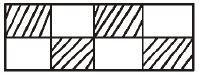
Question. What fraction of the figure is shaded ?
(a) 1/4
(b) 1/2
(c) 3/4
(d) 3/8
Answer : (B) Count the total number of parts = 8
The number of parts shaded = 4
Fraction of the figure shaded = 4/8 = 1/2
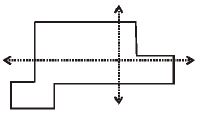
Question. How many equal parts does the figure below have ?
(a) 2
(b) 3
(c) 4
(d) 0
Answer : (D) The dotted lines divide the shape in 4 parts. However none of the parts are equal.
Hence there are 0 equal parts in the figure.
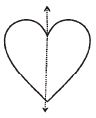
Question. How many equal parts does the shape below have ?
(a) 0
(b) 3
(c) 2
(d) 4
Answer : (C) The dotted line divided the heart shape in 2 equal parts
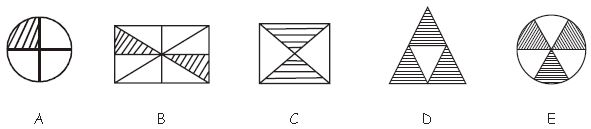
Question. Which shapes(s) show one-fourth shaded ?
(a) A and B
(b) B and D
(c) E and D
(d) A and C
Answer : A
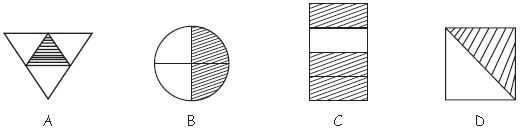
Question. Which shape is shown half shaded ?
(a) A
(b) B
(c) A and C
(d) B and D
Answer : D
Question. Which one of the following is correct about the shaded parts fo the following picture in the form of fraction?
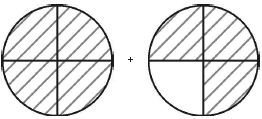
(a) 1(3/4)
(b) 1(5/3)
(c) 5(3/4)
(d) All of these
Answer : (A) 1 + 3/4 = 1(3/4)
Question. If

is equal to which one of the following?
(a) 3(1/2)
(b) 5(1/2)
(c) 2(1/2)
(d) 2(1/4)
Answer : C
Question. 1/4 : 2/8 : : 1/3 : ?
(a) 3/6
(b) 2/6
(c) 19
(d) 2/9
Answer : B
Question. 3/4: 4/3 : : 2/5 : ?
(a) 5/2
(b) 2/10
(c) 5/10
(d) 3/10
Answer : A
Question. 1/2 : 1/4 : : 1/5 : ?
(a) 1/8
(b) 1/10
(c) 1/15
(d) 1/6
Answer : B
Question. In the figure given below find the shaded parts of the whole figure.

(a) 7/3
(b) 3/7
(c) 3/4
(d) 4/3
Answer : (A) Shaded parts of figure = 3
Total number of parts in the figure = 7
Required shaded parts in the figure = 3/7
Question. Which one of the following is correctly matched for shaded parts?
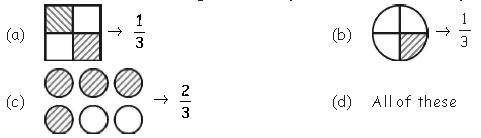
Answer : (C) Fraction for shaded parts = 4/6 = 2/6
Question. Which fraction is odd one out ?
1/2, 1/3, 2/10, 4/3
(a) 1/2
(b) 1/3
(c) 1/5
(d) 4/3
Answer : D
Question. Which fraction is odd one out ?
3/6, 2/4, 3/5, 4/10
(a) 3/6
(b) 2/4
(c) 3/5
(d) 4/10
Answer : C
Question. Find the unshaded parts of the given picture.
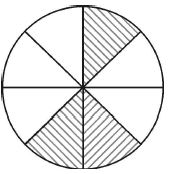
(a) 8/11
(b) 7/11
(c) 5/8
(d) 3/8
Answer : C
Question. Arrange the following fractions in descending order: 5/50, 1/50, 50/50
(a) 5/50 > 50/50 > 1/50
(b) 50/50 > 5/50 > 1/50
(c) 5/50 > 1/50 > 50/50
(d) All of these
Answer : B
Question. Which one of the following options has a pair of equivalent fraction?
(a) 1/3, 3/4
(b) 5/6, 10/6
(c) 4/9, 32/72
(d) 4/7, 24/28
Answer : C
Question. Identify the 3/4 part of 100.
(a) 25
(b) 50
(c) 75
(d) 100
Answer : C
Question. Which of these has the largest value?
(a) 2 times of (2 × 2)
(b) 14th of 8
(c) 1 × 10
(d) Half of 22
Answer : D
Page 1
Fractions
Question I. Fill in the blanks.
1) Fraction is also known as _________________
2) There are _________________ quarters in a Whole.
3) \( \frac{1}{2} + \frac{1}{2} = \) _________________
4) \( \frac{1}{2} \) can be read as _________________ or _________________
5) One part out of the 4 equal parts is called _________________
6) _________________ thirds make a whole.
7) 3 parts out of the 4 equal parts is called _________________
8) In \( \frac{3}{4} \) the denominator is _________________
9) One fourth of 20 = _________________
10) Three fourth and _________________ fourth make a whole.
11) \( \frac{1}{6} \) of 36 = _________________
12) The value of \( \frac{1}{3} \) of 9 is _________________
Answer:
1) part of a whole
2) four
3) 1 (or one whole)
4) half or one-half
5) one-quarter (or one-fourth)
6) Three
7) three-quarters (or three-fourths)
8) 4
9) 5
10) one
11) 6
12) 3
In simple words: This section has simple fill-in-the-blank questions to test your basic knowledge of fractions, numerators, and denominators.
Exam Tip: Remember that the denominator is the number at the bottom of a fraction, and it tells you the total number of equal parts in a whole.
Question II. Circle the figures that have been divided into halves.
A)
B)
C)
D)
E)
F)
Answer:
Figures A, B, and F have been divided into halves.
* A is a rectangle divided diagonally into two equal triangles.
* B is a horizontal arrow divided right down the middle line of symmetry.
* F is a pentagon divided vertically down its center line of symmetry.
In simple words: Look for shapes where the line cuts them into two exact, matching parts of the same size and shape.
Exam Tip: Halves must have identical shapes and equal areas. Symmetrical lines often help find them quickly.
Page 2
Question III. Circle the figures that have been divided into four quarters.
A)
B)
C)
D)
E)
F)
Answer:
Figures A, B, and E have been divided into four quarters.
* A is a circle cut by perpendicular lines into four identical sectors.
* B is a rectangle split into four identical smaller rectangles.
* E is a diamond split by its diagonals into four identical triangles.
In simple words: Quarters mean four parts of a shape that are all exactly the same size and the same shape.
Exam Tip: Always make sure all four parts are completely equal. If any part looks bigger or has a different shape, it is not divided into quarters.
Question IV. Write the fraction for the shaded portions.
A)
[ ]
B)
[ ]
C)
[ ]
D)
[ ]
Answer:
A) \( \frac{3}{11} \)
B) \( \frac{2}{4} \) (or \( \frac{1}{2} \))
C) \( \frac{3}{7} \)
D) \( \frac{16}{20} \) (or \( \frac{4}{5} \))
In simple words: Count the shaded parts to find the top number (numerator). Count the total parts to find the bottom number (denominator).
Exam Tip: Always make sure to count the total number of parts carefully, including both shaded and white parts.
Page 3
Question V. Solve the following.
A) \( \frac{1}{2} \) of 26 = _________________
B) \( \frac{1}{4} \) of 36 = _________________
C) \( \frac{1}{5} \) of 55 = _________________
D) \( \frac{1}{6} \) of 24 = _________________
E) \( \frac{1}{7} \) of 49 = _________________
F) \( \frac{1}{8} \) of 48 = _________________
G) \( \frac{1}{9} \) of 9 = _________________
H) \( \frac{1}{3} \) of 36 = _________________
Answer:
A) 13
B) 9
C) 11
D) 4
E) 7
F) 6
G) 1
H) 12
In simple words: To find a fraction of a number, divide the big number by the bottom number of the fraction.
Exam Tip: For any "fraction of a number" question, simply divide the total value by the denominator.
Question VI. Read the fraction given in the first column then calculate and circle the correct number of objects.
| Fraction / Text | Collection of Objects |
|---|---|
| One-half of 14 | 14 pins |
| One-third of 18 | 18 smiley faces |
| One-fourth of 8 | 8 motorcycles |
| One-fifth of 15 | 15 plus symbols |
Answer:
* One-half of 14: \( 14 \div 2 = 7 \). Circle any **7** pins.
* One-third of 18: \( 18 \div 3 = 6 \). Circle any **6** smiley faces.
* One-fourth of 8: \( 8 \div 4 = 2 \). Circle any **2** motorcycles.
* One-fifth of 15: \( 15 \div 5 = 3 \). Circle any **3** plus symbols.
In simple words: Do the math first to see how many objects you need, and then draw a circle around that exact number of items.
Exam Tip: Be neat when circling objects so that the examiner can easily count how many items you have selected.
Question VII. Shade the correct fraction of each collection.
| \( \frac{16}{20} \) | \( \frac{4}{6} \) | \( \frac{5}{12} \) | \( \frac{7}{11} \) |
|---|---|---|---|
| 20 soccer balls | 6 balloons | 12 smiley faces | 11 cups |
Answer:
* For \( \frac{16}{20} \): Shade exactly **16** soccer balls out of the 20 total.
* For \( \frac{4}{6} \): Shade exactly **4** balloons out of the 6 total.
* For \( \frac{5}{12} \): Shade exactly **5** smiley faces out of the 12 total.
* For \( \frac{7}{11} \): Shade exactly **7** cups out of the 11 total.
In simple words: Look at the top number of the fraction. That is the exact number of objects you need to color in with your pencil.
Exam Tip: Count the items carefully after you finish coloring to make sure you have colored the correct number of objects.
Page 4
Question VIII. Fill in the blanks.
A) Numerator = _________________
B) Numerator = _________________
C) Numerator = _________________
D) Numerator = _________________
Answer:
(Given the values: A) Numerator = 6, Denominator = 8; B) Numerator = 4, Denominator = 7; C) Numerator = 5, Denominator = 9; D) Numerator = 11, Denominator = 15)
A) \( \frac{6}{8} \)
B) \( \frac{4}{7} \)
C) \( \frac{5}{9} \)
D) \( \frac{11}{15} \)
In simple words: Put the numerator on top of the line and the denominator below the line to write the fraction.
Exam Tip: Always draw a straight line between the top and bottom numbers of your fraction.
Question IX. Write in words.
A) \( \frac{3}{5} = \) _________________
B) \( \frac{4}{7} = \) _________________
C) \( \frac{5}{9} = \) _________________
D) \( \frac{11}{15} = \) _________________
Answer:
A) Three-fifths
B) Four-sevenths
C) Five-ninths
D) Eleven-fifteenths
In simple words: This section asks you to write out the fractions using words instead of numbers.
Exam Tip: Use a hyphen when writing fraction words like "three-fifths" and "four-sevenths".
Question X. Word problems:
A) Mohan had 7 kites. In that 3 were colored what fraction of the kites were colored?
Ans: _________________
B) Out of 25 students in a class, 10 were good at swimming, what fraction of the class was good in swimming?
Ans: _________________
C) A circle is divided into 16 equal parts and 5 of them were colored. Find the fraction that was not colored.
Ans: _________________
Answer:
A) Total kites = 7, Colored kites = 3. Fraction = \( \frac{3}{7} \).
B) Total students = 25, Swimmers = 10. Fraction = \( \frac{10}{25} \) (or \( \frac{2}{5} \)).
C) Total parts = 16, Colored parts = 5. Uncolored parts = \( 16 - 5 = 11 \). Fraction = \( \frac{11}{16} \).
In simple words: Read carefully to find the total amount first. Use that as the bottom number. Put the counted group on top.
Exam Tip: Watch out for words like "not" or "remaining". They tell you to subtract before writing the final fraction.
Page 5
Question X. [Continued] Word problems:
D) In a row of 10 houses, 4 were painted blue and the rest white. What fraction of the houses was painted white?
Ans: _________________
Answer:
Total houses = 10
Blue houses = 4
White houses = \( 10 - 4 = 6 \)
Fraction of white houses = \( \frac{6}{10} \) (or \( \frac{3}{5} \))
In simple words: Subtract the blue houses from the total to find the white ones, then write it as a fraction.
Exam Tip: State your steps clearly by listing the counts for each category of house before writing the fraction.
Page 6
Geometry
Question I. Fill in the blanks.
1) A sphere is _________________ in shape and it has _________________ curved surface.
2) A cuboid is a _________________ solid. It has _________________ flat surfaces.
3) Two edges meet at a _________________ or _________________
4) All the surfaces of a cube are identical in _________________ and _________________
5) In a cuboid, the opposite faces are _________________
6) A cone has a _________________ surface.
7) A hemisphere has a _________________ and _________________ surfaces.
8) A cylinder is a solid object which has _________________ circular faces and _________________ curved surface.
9) `←------•------•------→` The figure is called a _________________
10) A line is made up of _________________ number of points.
11) A _________________ can be extended on either sides.
12) A _________________ can be extended on one side.
13) The line which is not a straight line is called a _________________
14) The line segment can be _________________ or _________________
15) The line which are neither vertical nor parallel are known as _________________
Answer:
1) round, one
2) rectangular, six
3) corner, vertex
4) shape, size
5) identical / equal
6) curved / circular
7) flat, curved
8) two, one
9) line
10) infinite / endless
11) line
12) ray
13) curved line
14) measured, drawn (or has two fixed endpoints)
15) slanting lines / oblique lines
In simple words: This section asks you basic facts about lines, points, and 3D shapes like cubes, cylinders, and spheres.
Exam Tip: Learn the spelling of geometry words like "hemisphere", "vertices", and "oblique" to avoid losing marks.
Question II. Identify and name the following figures.
A)
B)
Answer:
A) Ray CD
B) Line AB
In simple words: A line with one endpoint and one arrow is a ray. A line with arrows on both ends is a straight line.
Exam Tip: Look closely at the arrowheads. One arrow means a ray, and two arrows mean a line.
Page 7
Question II. [Continued] Identify and name the following figures.
C)
D)
E)
Answer:
C) Line EF
D) Curved line GH
E) Point X
In simple words: This section asks you to name basic geometric parts like straight lines, wavy lines, and single dots.
Exam Tip: A simple dot represents a "point" in geometry, and you must name it with its capital letter label.
Question III. Identify the following Plane Figures.
A) [A circular wall clock face]
B) [A rectangular photo frame]
C) [A circular car wheel]
D) [A triangular sign board]
Answer:
A) Circle
B) Rectangle
C) Circle
D) Triangle
In simple words: Identify the 2D shape of common objects, like clock faces or frames.
Exam Tip: Keep your answers simple by using standard plane shape names: circle, triangle, rectangle, or square.
Question IV. Shade the interior of the closed figures.
A)
B)
C)
D)
Answer:
* Figures B and C are closed shapes. Color their inside regions.
* Figures A and D are open shapes. Do not color them.
In simple words: A closed shape is fully shut with no openings. You only color in the shapes that are fully closed.
Exam Tip: Double-check the boundaries of the shape. If there is even a small gap, the shape is open, so do not shade it.
Question V. Circle the closed figures.
A) [Diamond]
B) [Cross]
C) [Open arch]
D) [Open crown]
E) [Star]
F) [Parallelogram with a missing corner line]
G) [Circle]
H) [H-like open shape]
I) [U-like open bracket]
J) [Burst / Spiky closed shape]
Answer:
Circle the following closed figures: A, B, E, G, and J.
* Figures C, D, F, H, and I are open figures and should not be circled.
In simple words: Circle the shapes that are completely closed on all sides.
Exam Tip: Closed shapes have a clear inside and outside region. Open shapes have lines that do not connect back to their starting point.
Page 8
Question VI. Measure the following line segments and write their lengths.
A) AB = _________________
B) CD = _________________
C) PQ = _________________
D) RS = _________________
Answer:
(Estimated measurements on a standard printed worksheet)
A) AB = 4.5 cm
B) CD = 3.0 cm
C) PQ = 4.0 cm
D) RS = 2.5 cm
In simple words: Put your ruler's 0-mark at the first point of the line, and read the number at the other end.
Exam Tip: Always make sure to start measuring from the "0" mark on your ruler, not from the very edge of the plastic.
Page 9
Data Handling
Question I. Use the given pictograph to answer the following Fill in the blanks.
Rakesh went to the beach with his father late at night after dinner, they watched five volunteers who were taking part in the turtle walk. The volunteers were helping to collect the eggs laid by the turtles and take them to a safe place for hatching.
Turtle Walk Pictograph:
Volunteer 1: 2 Large Circles, 3 Small Circles
Volunteer 2: 2 Large Circles
Volunteer 3: 4 Large Circles
Volunteer 4: 7 Large Circles
Volunteer 5: 1 Large Circle, 1 Small Circle
Answer:
(See questions and answers on Page 10)
In simple words: This is the story of Rakesh watching volunteers gather turtle eggs. Count the circles to find how many eggs each person found.
Exam Tip: Read the introduction carefully to understand the context of the data shown in the chart.
Page 10
Question I. [Continued] Fill in the blanks:
Key: 1 Large Circle = 10 eggs, 1 Small Circle = 1 egg
a) Volunteer _________________ collected 10 eggs more than Volunteer _________________
b) The least number of eggs collected is _________________
c) Volunteer 3 and volunteer 4 together collected _________________ eggs.
d) Volunteer _________________ collected the greatest number of eggs.
e) _________________ eggs were collected in all.
Answer:
Volunteer counts calculated from the pictograph:
* Volunteer 1: \( 2 \times 10 + 3 = 23 \) eggs
* Volunteer 2: \( 2 \times 10 = 20 \) eggs
* Volunteer 3: \( 4 \times 10 = 40 \) eggs
* Volunteer 4: \( 7 \times 10 = 70 \) eggs
* Volunteer 5: \( 1 \times 10 + 1 = 11 \) eggs
a) Volunteer 2 collected 10 eggs more than Volunteer 5 (if we consider only large eggs, or Volunteer 3 collected 20 eggs more than Volunteer 2).
b) 11 eggs
c) 110 eggs (since \( 40 + 70 = 110 \))
d) Volunteer 4 (70 eggs)
e) 164 eggs (since \( 23 + 20 + 40 + 70 + 11 = 164 \))
In simple words: Use the key to find the values of the circles. Large circles are worth 10, and small ones are worth 1.
Exam Tip: Pay close attention to the key before doing any math. The key tells you exactly what each symbol represents.
Question II. Use the given pictograph to answer the following questions:
Sale of tickets:
* Monday: 3 squares
* Tuesday: 3 squares
* Wednesday: 2 squares
* Thursday: 4 squares
* Friday: 1 square
* Saturday: 5 squares
* Sunday: 6 squares
Key: 1 square stands for 5 tickets
a) What does 1 square stands for?
Ans: _________________
Answer:
a) 5 tickets
In simple words: The key tells you that each square in the picture is equal to 5 tickets.
Exam Tip: Copy the exact wording from the key when answering the "stands for" question.
Page 11
Question II. [Continued] Sale of tickets:
b) On which day were the least number of tickets sold? How many were sold?
Ans: _________________
c) On which day were the maximum number of tickets sold?
Ans: _________________
d) On which two days were the same number of tickets sold?
Ans: _________________
Answer:
b) Friday; 5 tickets were sold.
c) Sunday; 30 tickets were sold.
d) Monday and Tuesday (15 tickets were sold on each day).
In simple words: Multiply the number of squares by 5 to find the number of tickets sold on each day.
Exam Tip: For the least or maximum day, write down both the name of the day and the total count to show complete working.
Question III. Use the given pictograph to answer the following questions:
Hobbies:
* Reading: 5 smilies
* Painting: 3 smilies
* Stamp Collecting: 2 smilies
* Craft: 3 smilies
Key: 1 smiley stands for 3 children
a) How many children have reading as a hobby?
Ans: _________________
Answer:
a) 15 children (since \( 5 \times 3 = 15 \))
In simple words: Multiply the 5 smilies shown next to "Reading" by 3 to get 15.
Exam Tip: Write down your multiplication steps so you do not make simple calculation mistakes.
Page 12
Question III. [Continued] Hobbies:
b) Which two hobbies are equally popular?
Ans: _________________
c) Which hobby shows six children?
Ans: _________________
d) How many children have craft as a hobby?
Ans: _________________
e) How many children in all are shown on the pictograph?
Ans: _________________
Answer:
b) Painting and Craft (both have 3 smilies / 9 children).
c) Stamp Collecting (since \( 2 \times 3 = 6 \) children).
d) 9 children (since \( 3 \times 3 = 9 \) children).
e) 39 children in total (since there are 13 smilies in total, \( 13 \times 3 = 39 \)).
In simple words: Multiply each smiley by 3 to find the number of children. Add all children together to get the total sum.
Exam Tip: Double check the total count of children by adding up all smilies first, then multiplying the total by 3.
Page 13
Money
Question I. Fill in the blanks:
1.) In India the unit of money is _________________
2.) 1 Rupee = _________________ paisa.
3.) We write _________________ for _________________ or _________________ and _________________ for paisa.
4.) We write rupees and paisa together separated by a _________________
5.) To convert rupees to paisa multiply by _________________
6.) To convert paisa into rupee divide by _________________
7.) Money means medium of _________________
Answer:
1.) Rupee
2.) 100
3.) Rs. for Rupee or Re. and p for paisa
4.) point / dot
5.) 100
6.) 100
7.) exchange
In simple words: This section has simple fill-in-the-blank questions to test your knowledge of Indian money and its units.
Exam Tip: Remember that we multiply by 100 to convert Rupees to Paisa, and divide by 100 to go the other way.
Question II. Convert into paisa
1. Rs. 8.00 _________________
2. Rs. 51.00 _________________
3. Rs. 29.00 _________________
4. Rs. 14.00 _________________
5. Rs. 7.00 _________________
6. Rs. 28.00 _________________
7. Rs. 4.00 _________________
Answer:
1. 800 p (since \( 8 \times 100 = 800 \))
2. 5100 p (since \( 51 \times 100 = 5100 \))
3. 2900 p (since \( 29 \times 100 = 2900 \))
4. 1400 p (since \( 14 \times 100 = 1400 \))
5. 700 p (since \( 7 \times 100 = 700 \))
6. 2800 p (since \( 28 \times 100 = 2800 \))
7. 400 p (since \( 4 \times 100 = 400 \))
In simple words: To convert rupees to paisa, simply remove the decimal point or multiply the number by 100.
Exam Tip: Do not forget to write "p" or "paisa" next to your final answer when converting to paisa.
Page 14
Question III. Convert into rupee and paisa
1. 700 P = _________________
2. 9000 P = _________________
3. 600 P = _________________
4. 50 P = _________________
5. 600 P = _________________
6. 800 P = _________________
7. 7000 P = _________________
Answer:
1. Rs. 7.00
2. Rs. 90.00
3. Rs. 6.00
4. Rs. 0.50
5. Rs. 6.00
6. Rs. 8.00
7. Rs. 70.00
In simple words: To convert paisa back to rupees, place a decimal point two places from the right side of the number.
Exam Tip: Always place the "Rs." symbol at the start of your rupee answers to show currency clearly.
Question IV. Add the following:
| Rs. P 12 . 65 + 10 . 45 ________ | Rs. P 68 . 00 + 49 . 00 ________ | Rs. P 88 . 70 + 48 . 45 ________ |
| 75 P 50 P + 75 P ________ | 10 P 25 P + 75 P ________ | 25 P 50 P + 25 P ________ |
Answer:
First row (rupees and paisa):
1) Rs. 23.10
2) Rs. 117.00
3) Rs. 137.15
Second row (paisa addition):
1) 200 P (or Rs. 2.00)
2) 110 P (or Rs. 1.10)
3) 100 P (or Rs. 1.00)
In simple words: Align your numbers vertically, add normally, and keep the decimal point in the exact same place.
Exam Tip: When adding paisa values, remember that 100 P makes 1 Rupee. Use carrying over rules correctly.
Page 15
Question V. Subtract the following:
| Rs. P 98 . 25 - 80 . 75 ________ | Rs. P 51 . 40 - 35 . 35 ________ | Rs. P 97 . 50 - 47 . 65 ________ |
| Rs. P 32 . 05 - 22 . 45 ________ | Rs. P 75 . 00 - 36 . 75 ________ | Rs. P 86 . 00 - 23 . 25 ________ |
Answer:
First row subtraction:
1) Rs. 17.50
2) Rs. 16.05
3) Rs. 49.85
Second row subtraction:
1) Rs. 9.60
2) Rs. 38.25
3) Rs. 62.75
In simple words: Subtract the columns from right to left. Borrow from the next column if the top digit is smaller.
Exam Tip: Be extra careful when borrowing from columns with zeros, like in Rs. 75.00 minus Rs. 36.75.
Page 16
Division
Question I. Fill in the blanks:
1. Division is a repeated subtraction of the _________________ number.
2. The number which is to be divided is called _________________
3. The number by which the dividend is to be divided is called _________________
4. The result obtained by the process of division is called _________________
5. The number which is left after division is called _________________
6. Any number when divided by 1 gives back the _________________ number.
7. Any number when divided by itself, gives 1 as _________________
8. Zero divided by any number is _________________
9. Division by zero is _________________
10. A number is said to be _________________ by another if the remainder obtained on division is zero.
11. The remainder will always be _________________ than the divisor.
12. \( 45 \div 9 = \) _________________
13. \( 36 \div 6 = 6 \) then the dividend = _________________, divisor = _________________, quotient = _________________
14. \( 45 \div 45 = \) _________________
Answer:
1. same
2. dividend
3. divisor
4. quotient
5. remainder
6. same / itself
7. quotient
8. zero / 0
9. not possible / not defined
10. divisible
11. smaller / less
12. 5
13. 36, 6, 6
14. 1
In simple words: This section tests your basic division facts and definitions. It is very similar to your earlier multiplication sheets.
Exam Tip: Remember that any number divided by 1 stays the same, and any non-zero number divided by itself is always 1.
Page 17
Question I. [Continued] Fill in the blanks:
15. \( 16 \div 16 = \) _________________
16. Any number \( \div \) 1 = _________________
17. \( 30 \div 1 = \) _________________
18. \( 35 \div 1 = \) _________________
19. \( 0 \div 4 = \) _________________
20. The symbol of division is _________________
Answer:
15. 1
16. the same number / the number itself
17. 30
18. 35
19. 0
20. \( \div \)
In simple words: Fill in these final division rule blanks. They are easy once you learn your standard division properties.
Exam Tip: Make sure to draw the division symbol \( \div \) neatly as a horizontal line with a dot above and below it.
Question II. Write the division facts for each of the following products:
1. \( 6 \times 10 = 60 \) [ ] [ ]
2. \( 4 \times 8 = 32 \) [ ] [ ]
3. \( 45 \times 10 = 450 \) [ ] [ ]
4. \( 20 \times 20 = 400 \) [ ] [ ]
5. \( 7 \times 6 = 42 \) [ ] [ ]
Answer:
1) \( 60 \div 10 = 6 \) and \( 60 \div 6 = 10 \)
2) \( 32 \div 8 = 4 \) and \( 32 \div 4 = 8 \)
3) \( 450 \div 10 = 45 \) and \( 450 \div 45 = 10 \)
4) \( 400 \div 20 = 20 \) (Only one division fact since the factors are identical)
5) \( 42 \div 6 = 7 \) and \( 42 \div 7 = 6 \)
In simple words: Divide the final product by one of the multiplying numbers to get the other multiplying number.
Exam Tip: Every normal multiplication fact with different factors yields exactly two division facts. If the factors are the same (like \( 20 \times 20 \)), it yields only one fact.
Page 18
Question III. Write the multiplication facts for the following divisions:
1. \( 28 \div 7 = 4 \) [ ] [ ]
2. \( 66 \div 6 = 11 \) [ ] [ ]
3. \( 20 \div 5 = 4 \) [ ] [ ]
4. \( 10 \div 10 = 1 \) [ ] [ ]
5. \( 60 \div 1 = 60 \) [ ] [ ]
Answer:
1) \( 7 \times 4 = 28 \) (or \( 4 \times 7 = 28 \))
2) \( 6 \times 11 = 66 \) (or \( 11 \times 6 = 66 \))
3) \( 5 \times 4 = 20 \) (or \( 4 \times 5 = 20 \))
4) \( 10 \times 1 = 10 \) (or \( 1 \times 10 = 10 \))
5) \( 1 \times 60 = 60 \) (or \( 60 \times 1 = 60 \))
In simple words: To write a multiplication fact, multiply the divisor by the quotient to get the original dividend.
Exam Tip: Remember that multiplication and division are inverse operations that undo each other.
Question IV. Divide by repeated subtraction:
a. \( 32 \div 8 \)
b. \( 48 \div 6 \)
c. \( 36 \div 6 \)
d. \( 20 \div 5 \)
e. \( 16 \div 2 \)
Answer:
a) \( 32 \div 8 \):
\( 32 - 8 = 24 \) (1st subtraction)
\( 24 - 8 = 16 \) (2nd subtraction)
\( 16 - 8 = 8 \) (3rd subtraction)
\( 8 - 8 = 0 \) (4th subtraction)
We subtracted 8 exactly 4 times. So, \( 32 \div 8 = 4 \).
b) \( 48 \div 6 \):
Subtract 6 from 48 repeatedly: \( 48 - 6 = 42 \), \( 42 - 6 = 36 \), \( 36 - 6 = 30 \), \( 30 - 6 = 24 \), \( 24 - 6 = 18 \), \( 18 - 6 = 12 \), \( 12 - 6 = 6 \), \( 6 - 6 = 0 \).
We subtracted 6 exactly 8 times. So, \( 48 \div 6 = 8 \).
c) \( 36 \div 6 \):
Subtract 6 from 36 repeatedly: \( 36 - 6 = 30 \), \( 30 - 6 = 24 \), \( 24 - 6 = 18 \), \( 18 - 6 = 12 \), \( 12 - 6 = 6 \), \( 6 - 6 = 0 \).
We subtracted 6 exactly 6 times. So, \( 36 \div 6 = 6 \).
d) \( 20 \div 5 \):
Subtract 5 from 20 repeatedly: \( 20 - 5 = 15 \), \( 15 - 5 = 10 \), \( 10 - 5 = 5 \), \( 5 - 5 = 0 \).
We subtracted 5 exactly 4 times. So, \( 20 \div 5 = 4 \).
e) \( 16 \div 2 \):
Subtract 2 from 16 repeatedly: \( 16 - 2 = 14 \), \( 14 - 2 = 12 \), \( 12 - 2 = 10 \), \( 10 - 2 = 8 \), \( 8 - 2 = 6 \), \( 6 - 2 = 4 \), \( 4 - 2 = 2 \), \( 2 - 2 = 0 \).
We subtracted 2 exactly 8 times. So, \( 16 \div 2 = 8 \).
In simple words: Subtract the smaller number over and over again from the bigger number until you reach zero. Count how many times you subtracted to get the answer.
Exam Tip: Be sure to write down every subtraction step clearly on your page until you get to zero to earn full marks.
Free study material for Mathematics
Download Class 3 Mathematics Fractions Practice Worksheets
Daily Practice Questions for Class 3 Mathematics
Review targeted practice exercises for Class 3 Mathematics Fractions. Curated to match official CBSE guidelines, these printable problem sets support daily revision and improve overall test readiness.
Detailed Answers for Class 3 Mathematics Fractions
Designed around the official curriculum for Class 3 Mathematics, these practice sheets guarantee standard compliance. Reviewing step-by-step solutions after completion sharpens your accuracy and clarifies complex sub-topics within Fractions.
Complete Your Chapter Revision
Wrap up your chapter revision by testing your knowledge against standard objective question formats. Explore our full library of free, up-to-date printable assignments to maximize your academic results in upcoming CBSE evaluations.
FAQs
You can download the latest chapter-wise printable worksheets for Class 3 Mathematics Fractions for free from StudiesToday.com. These have been made as per the latest CBSE curriculum for this academic year.
Yes, Class 3 Mathematics worksheets for Fractions focus on activity-based learning and also competency-style questions. This helps students to apply theoretical knowledge to practical scenarios.
Yes, we have provided solved worksheets for Class 3 Mathematics Fractions to help students verify their answers instantly.
Yes, our Class 3 Mathematics test sheets are mobile-friendly PDFs and can be printed by teachers for classroom.
For Fractions, regular practice with our worksheets will improve question-handling speed and help students understand all technical terms and diagrams.