

Official Class 3 Mathematics Worksheets: Time
Access comprehensive chapter-wise worksheets for Time using the CBSE Class 3 Mathematics Time Worksheet. Designed to align with the 2026-27 academic syllabus for Class 3 Mathematics, these printable practice sets help students reinforce key concepts and improve their overall exam readiness.
Solved Practice Worksheets for Mathematics
Navigate directly to the solved Mathematics worksheets using the digital viewer below. Each practice set includes detailed step-by-step solutions, allowing students to instantly cross-check their work and identify areas requiring further revision.
I. Fill in the blanks :
1. Multiplication is repeated _______________
2. The number to be multiplies is called the _______________
3. The number by which we multiply is called the _______________
4. The answer of multiplication is called the _______________
5. In 6 x 3 = 18 the multipilicand is ________ the multiplier is _______ and the product is _______________
6. 138 x 0 =
7. 625 x 1 =
8. 60 x 80 = 80 x __________
9. 45 x 20 x 70 x 20 x__________
10. 8 x 10 = ___________
11. 15 x 100 = ____________
12. 41 x 1000 = ___________
13. 6 x 100 = ___________
14. 35 x 10 = ___________
15. 85 x 1000 = ____________
16. 30 x 1000 = ___________
I. Fill in the blanks :
Question 1. Multiplication is repeated _______________
Answer: addition
In simple words: Adding the same number over and over again is called multiplication.
Exam Tip: Remember that multiplication is just a faster way of doing addition for the same number.
Question 2. The number to be multiplies is called the _______________
Answer: multiplicand
In simple words: The number that you want to multiply is called the multiplicand.
Exam Tip: Be careful with the spelling of "multiplicand" as it is often asked in vocabulary questions.
Question 3. The number by which we multiply is called the _______________
Answer: multiplier
In simple words: The number that tells us how many times to multiply is called the multiplier.
Exam Tip: Think of the "multiplier" as the one that does the work of multiplying.
Question 4. The answer of multiplication is called the _______________
Answer: product
In simple words: The final answer you get when you multiply numbers is called the product.
Exam Tip: The word "product" in a word problem always means you need to multiply the numbers.
Question 5. In 6 x 3 = 18 the multipilicand is ________ the multiplier is _______ and the product is _______________
Answer: 6, 3, 18
In simple words: In this math sum, 6 is the starting number, 3 is the number we multiply by, and 18 is the final total.
Exam Tip: Always write the terms in their correct order: first number is the multiplicand, second is the multiplier, and the final answer is the product.
Question 6. 138 x 0 =
Answer: 0
In simple words: Any number multiplied by zero is always zero.
Exam Tip: Do not get confused by the size of the number; multiplying by zero always gives zero as the final result.
Question 7. 625 x 1 =
Answer: 625
In simple words: Any number multiplied by one stays exactly the same.
Exam Tip: Multiplying a number by 1 does not change its value.
Question 8. 60 x 80 = 80 x __________
Answer: 60
In simple words: Changing the order of the numbers in multiplication does not change the final answer.
Exam Tip: This is called the order property of multiplication, where the numbers on both sides of the equals sign must be the same.
Question 9. 45 x 20 x 70 = 20 x 45 x__________
Answer: 70
In simple words: Even when multiplying three numbers, swapping their order does not change the answer.
Exam Tip: Match the numbers on both sides of the equals sign to easily find the missing value without calculating.
Question 10. 8 x 10 = ___________
Answer: 80
In simple words: To multiply a number by 10, simply add one zero at the end of that number.
Exam Tip: 8 times 1 is 8, then put one zero at the end to get 80.
Question 11. 15 x 100 = ____________
Answer: 1500
In simple words: When you multiply any number by 100, put two zeros at the end of the number.
Exam Tip: Write down 15 and then add two zeros next to it to get 1500.
Question 12. 41 x 1000 = ___________
Answer: 41000
In simple words: To multiply by 1000, write down the number and then add three zeros at the end.
Exam Tip: Count the number of zeros in 1000 (three zeros) and add them to the right of your number.
Question 13. 6 x 100 = ___________
Answer: 600
In simple words: Six times one hundred is equal to six hundred.
Exam Tip: Simply add two zeros to the number 6 to find the answer quickly.
Question 14. 35 x 10 = ___________
Answer: 350
In simple words: Thirty-five times ten is equal to three hundred fifty.
Exam Tip: Adding one zero to 35 gives 350 instantly.
Question 15. 85 x 1000 = ____________
Answer: 85000
In simple words: Eighty-five times one thousand is equal to eighty-five thousand.
Exam Tip: Put three zeros after 85 to find the product of 85 x 1000.
Question 16. 30 x 1000 = ___________
Answer: 30000
In simple words: Write down 30 first and then add three more zeros at the end of it.
Exam Tip: Make sure you count all the zeros carefully: one zero from 30 plus three zeros from 1000 equals four zeros in total.
Question 17. 49 x 100 = _____________
Answer: 4900
In simple words: Forty-nine times one hundred is equal to four thousand nine hundred.
Exam Tip: Place two zeros at the end of 49 to get 4900.
Question 18. 70 x 10 = ____________
Answer: 700
In simple words: Seventy times ten is equal to seven hundred.
Exam Tip: Write down 70 and add one zero to the end of it, making it 700.
Question 19. 20 x 100 = ____________
Answer: 2000
In simple words: Write down 20 and then add two zeros at the end of it.
Exam Tip: One zero from 20 plus two zeros from 100 gives a total of three zeros in 2000.
Question 20. 14 x 1000 = ____________
Answer: 14000
In simple words: Fourteen times one thousand is equal to fourteen thousand.
Exam Tip: Write 14 and put three zeros at the end of it to get 14000.
II Multiply
Question 1. 1845 x 3
Answer: 5535
In simple words: Multiply 1845 by 3 to get five thousand five hundred thirty-five.
Exam Tip: Multiply column by column starting from the ones place, and write down your carry-overs clearly on top.
Question 2. 5871 x 8
Answer: 46968
In simple words: Multiply 5871 by 8 to get forty-six thousand nine hundred sixty-eight.
Exam Tip: Keep your place value columns aligned neatly to avoid making calculation errors.
Question 3. 4621 x 7
Answer: 32347
In simple words: Multiply 4621 by 7 to get thirty-two thousand three hundred forty-seven.
Exam Tip: Always double check each multiplication step on rough paper before writing the final answer.
Question 4. 6087 x 4
Answer: 24348
In simple words: Multiply 6087 by 4 to get twenty-four thousand three hundred forty-eight.
Exam Tip: Remember that any digit multiplied by 0 is 0, but you must add any carried-over numbers to it.
Question 5. 7125 x 5
Answer: 35625
In simple words: Multiply 7125 by 5 to get thirty-five thousand six hundred twenty-five.
Exam Tip: Write down your carry-over numbers on top of the next column so you do not miss adding them.
Question 6. 2397 x 9
Answer: 21573
In simple words: Multiply 2397 by 9 to get twenty-one thousand five hundred seventy-three.
Exam Tip: Use your 9 times tables carefully to avoid simple calculation mistakes.
II Multiply the following
Question 1. 64 x 23
Answer: 1472
In simple words: Multiply 64 by 23 step-by-step to get one thousand four hundred seventy-two.
Exam Tip: When multiplying by the tens digit (2), remember to put a zero in the ones place of your second line before you start.
Question 2. 45 x 25
Answer: 1125
In simple words: Multiply 45 by 25 to get one thousand one hundred twenty-five.
Exam Tip: Add the two partial products (225 + 900) carefully to find the final answer.
Question 3. 58 x 37
Answer: 2146
In simple words: Multiply 58 by 37 to get two thousand one hundred forty-six.
Exam Tip: Line up your digits neatly so that adding the final two lines of numbers is easy.
Question 4. 38 x 46
Answer: 1748
In simple words: Multiply 38 by 46 to get one thousand seven hundred forty-eight.
Exam Tip: Write down your carry-overs separately for each step to avoid confusion.
Question 5. 95 x 18
Answer: 1710
In simple words: Multiply 95 by 18 to get one thousand seven hundred ten.
Exam Tip: Any number multiplied by 1 is the number itself, making the second line of multiplication easy to do.
Question 6. 83 x 49
Answer: 4067
In simple words: Multiply 83 by 49 to get four thousand sixty-seven.
Exam Tip: Double check your addition at the end to make sure your final sum is correct.
VI Do the following
Question 1. The cost of one book is Rs. 58. Find the cost of 25 such books.
Answer: Cost of one book = Rs. 58
Number of books = 25
Total cost of 25 books = Rs. 58 x 25 = Rs. 1450
The cost of 25 books is Rs. 1450.
In simple words: Multiply the price of one book by the total number of books to find the final price.
Exam Tip: Always write down your word statements step-by-step and include "Rs." in your final answer.
Question 2. A car travels 68 km in one hour. How far will it travel in 36 hours ?
Answer: Distance traveled in one hour = 68 km
Total time = 36 hours
Total distance traveled = 68 x 36 = 2448 km
The car will travel 2448 km in 36 hours.
In simple words: Multiply the speed of the car by the number of hours to find the total distance.
Exam Tip: Be sure to write the unit of distance (km) in your final statement answer.
Question 3. There are 46 students in a class. How many students are there in 24 such classes ?
Answer: Number of students in one class = 46
Number of classes = 24
Total number of students = 46 x 24 = 1104 students
There are 1104 students in 24 classes.
In simple words: Multiply the number of students in a single class by the total number of classes.
Exam Tip: Solve the multiplication vertically on the side of your page to avoid simple calculation errors.
Question 4. There are 59 racks in a library. Each rack contains 45 books. How many books are there in the library ?
Answer: Number of racks in the library = 59
Number of books in each rack = 45
Total number of books = 59 x 45 = 2655 books
There are 2655 books in the library.
In simple words: Multiply the total number of shelves by the number of books on each shelf.
Exam Tip: Write down what each number represents to show your working out clearly to the teacher.
MEASUREMENT OF TIME
I. Fill in the blanks :
Question 1. 1 day = ___________ hours
Answer: 24
In simple words: There are twenty-four hours in one full day.
Exam Tip: This is a fundamental time conversion fact that you should memorize.
Question 2. 1 hour = ___________ minutes
Answer: 60
In simple words: There are sixty minutes in one hour.
Exam Tip: Remember that we group sixty minutes to make one hour.
Question 3. 1 minute = ___________ seconds
Answer: 60
In simple words: There are sixty seconds in one minute.
Exam Tip: Both minutes-to-seconds and hours-to-minutes conversions use the number sixty.
Question 4. 1 week = ___________ days
Answer: 7
In simple words: There are seven days in a week.
Exam Tip: Count the days of the week starting from Monday to Sunday to remember this fact.
Question 5. 1 year = ___________ months
Answer: 12
In simple words: There are twelve months in one year.
Exam Tip: Memorize the order of the twelve months, from January to December.
Question 6. 1 year = ___________ days
Answer: 365
In simple words: A normal year has three hundred sixty-five days.
Exam Tip: This refers to a non-leap year, which has 365 days.
Question 7. 1 leap year = ___________ days
Answer: 366
In simple words: A leap year has one extra day, making it three hundred sixty-six days.
Exam Tip: The extra day in a leap year is added to the month of February, making it 29 days long instead of 28.
Question 8. The minute hand takes _________ hour to complete one round.
Answer: 1
In simple words: The big minute hand goes around the clock face once every hour.
Exam Tip: One complete rotation of the minute hand represents exactly one hour.
Question 9. The minute hand completes _________ rounds in a day.
Answer: 24
In simple words: Since there are 24 hours in a day, the minute hand goes around the clock 24 times.
Exam Tip: The number of rounds of the minute hand is equal to the number of hours in a day.
Question 10. The minute hand takes _________ minutes to move from one number to the next.
Answer: 5
In simple words: The space between any two numbers on a clock face is five minutes.
Exam Tip: Use the 5 times table to read minutes on a clock face.
Question 11. The hour hand takes _________ to complete one round.
Answer: 12 hours
In simple words: The small hour hand goes around the clock once in twelve hours.
Exam Tip: Since there are 12 numbers on a clock, it takes 12 hours for the hour hand to complete one circle.
Question 12. The hour hand completes _________ rounds in a day.
Answer: 2
In simple words: The short hour hand goes around the clock twice in a full twenty-four hour day.
Exam Tip: 24 hours in a day divided by 12 hours per round equals 2 full rounds.
Question 13. The hour hand takes _________ hour to move from one number to the next.
Answer: 1
In simple words: The small hand takes exactly one hour to move from one number to the next.
Exam Tip: Every time the hour hand moves to the next number, one full hour has passed.
Question 14. Between two consecutive numbers on the clock are ___________ minutes.
Answer: 5
In simple words: The gap between two neighboring numbers on the clock is five minutes.
Exam Tip: The clock is divided into 12 main sections, each containing exactly 5 minutes.
Question 15. 8:20 morning is shown as _________.
Answer: 8:20 a.m.
In simple words: We use the letters a.m. to show times in the morning.
Exam Tip: Remember that a.m. stands for ante meridiem, which means before noon.
Question 16. 5:45 in the evening is shown as _________.
Answer: 5:45 p.m.
In simple words: We use the letters p.m. to show times in the afternoon and evening.
Exam Tip: Any time after 12:00 noon until midnight is written with p.m.
Question 17. 9:30 at night is shown as _________.
Answer: 9:30 p.m.
In simple words: Night times are written with the letters p.m.
Exam Tip: Night times before midnight are part of the second half of the day, so use p.m.
Question 18. 10:00 before noon is shown as ___________.
Answer: 10:00 a.m.
In simple words: Before noon means morning, so we write it as a.m.
Exam Tip: Pay attention to terms like "before noon" which always translate to a.m. times.
II Write the time in two ways
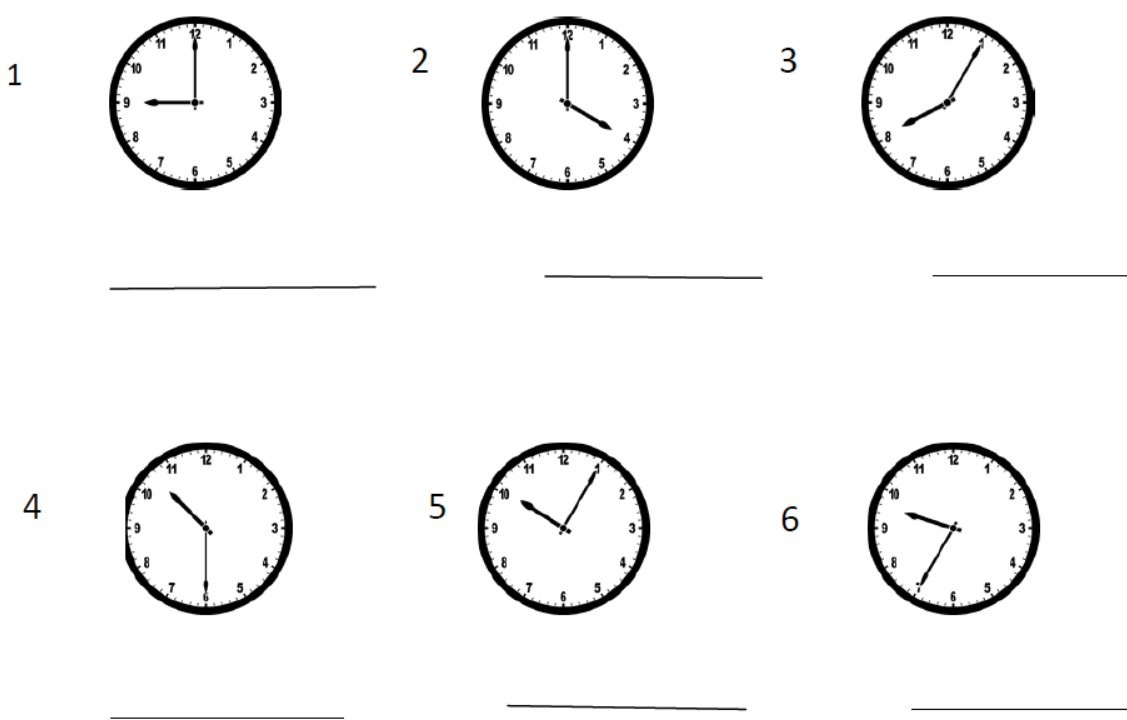
Question 1. Write the time shown on clock 1 in two ways.
Answer: 12:35 or 35 minutes past 12 (or 25 minutes to 1)
In simple words: The hour hand is between 12 and 1, and the minute hand is on 7, which means 35 minutes.
Exam Tip: Count the minutes by 5s around the clock face starting from 1 to find the minute hand's value.
Question 2. Write the time shown on clock 2 in two ways.
Answer: 4:25 or 25 minutes past 4
In simple words: The hour hand is past 4, and the minute hand is on 5, which means twenty-five minutes.
Exam Tip: When the minute hand is on the right side of the clock (from 1 to 6), we usually write it as "minutes past" the hour.
Question 3. Write the time shown on clock 3 in two ways.
Answer: 1:05 or 5 minutes past 1
In simple words: The hour hand points near 1, and the minute hand points to 1, which means 5 minutes.
Exam Tip: Do not write 1:5; always use a zero before single-digit minutes, like 1:05.
Question 4. Write the time shown on clock 4 in two ways.
Answer: 10:25 or 25 minutes past 10
In simple words: The short hand is past 10, and the long hand is on 5, representing 25 minutes.
Exam Tip: Check the short hour hand carefully to see which number it has just passed.
Question 5. Write the time shown on clock 5 in two ways.
Answer: 1:10 or 10 minutes past 1
In simple words: The hour hand is just past 1, and the minute hand is on 2, which means ten minutes.
Exam Tip: Look at where both hands point to make sure you write the numbers in their correct places.
Question 6. Write the time shown on clock 6 in two ways.
Answer: 7:50 or 10 minutes to 8
In simple words: The hour hand is almost at 8, and the minute hand points to 10, which means 50 minutes.
Exam Tip: When the minute hand is past 30, it is common to write how many minutes are left until the next hour (e.g., 10 minutes to 8).
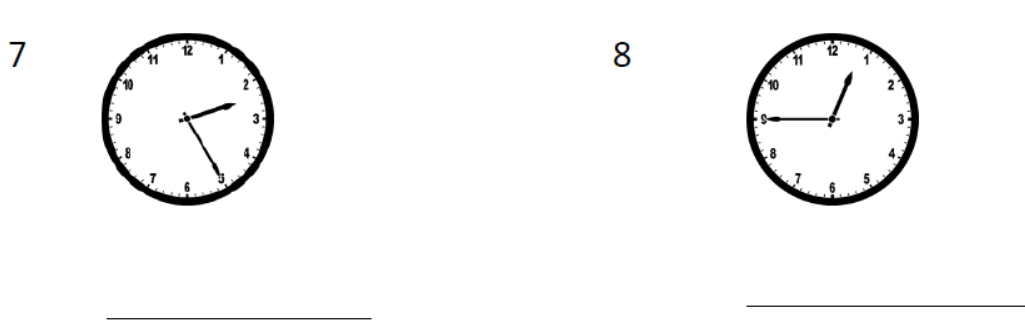
Question 7. Write the time shown on clock 7 in two ways.
Answer: 2:15 or Quarter past 2 (or 15 minutes past 2)
In simple words: The hour hand is past 2, and the minute hand points to 3, which is fifteen minutes.
Exam Tip: Remember that 15 minutes is the same as a quarter of an hour, so we often say "quarter past".
Question 8. Write the time shown on clock 8 in two ways.
Answer: 12:05 or 5 minutes past 12
In simple words: The short hand is near 12, and the long hand is on 1, which represents five minutes.
Exam Tip: Write down your hours first, followed by a colon and then the minutes to keep your work neat.
Free study material for Mathematics
Time Printable Worksheets and Exercises for Class 3 Mathematics
Practice Exercises for Class 3 Mathematics Time
Access structured practice worksheets for Time aligned with the 2026 CBSE curriculum. These downloadable exercises for Class 3 Mathematics help students build accuracy and reinforce core concepts for upcoming school tests.
Step-by-Step Solutions and Practice Guidelines
Each worksheet draws directly from authorized standard textbooks to maintain academic accuracy. Evaluating your finished exercises against expert-verified solutions helps master the formal presentation standards expected in school evaluations.
Enhance Speed with Online Practice
Consistent engagement with these exercises builds familiarity with recurring exam themes. If specific areas within Time cause trouble, utilize our dedicated NCERT solutions for Class 3 Mathematics to clear up doubts immediately.
FAQs
You can download the latest chapter-wise printable worksheets for Class 3 Mathematics Time for free from StudiesToday.com. These have been made as per the latest CBSE curriculum for this academic year.
Yes, Class 3 Mathematics worksheets for Time focus on activity-based learning and also competency-style questions. This helps students to apply theoretical knowledge to practical scenarios.
Yes, we have provided solved worksheets for Class 3 Mathematics Time to help students verify their answers instantly.
Yes, our Class 3 Mathematics test sheets are mobile-friendly PDFs and can be printed by teachers for classroom.
For Time, regular practice with our worksheets will improve question-handling speed and help students understand all technical terms and diagrams.