

Official Class 3 Mathematics Worksheets: All Chapters
Access comprehensive chapter-wise worksheets for All Chapters using the CBSE Class 3 Mathematics Revision Worksheet Set 07. Designed to align with the 2026-27 academic syllabus for Class 3 Mathematics, these printable practice sets help students reinforce key concepts and improve their overall exam readiness.
Solved Practice Worksheets for Mathematics
View or download the dedicated CBSE Class 3 Mathematics Revision Worksheet Set 07 resource below. Engaging with these practice papers under focused study conditions ensures continuous academic progress and mastery of the 2026-27 curriculum for All Chapters.
Q6) Solution :- L ml
0 12 9 10
Quantity of cold drink in jug - 1 3 0 0
Quantity of cold drink taken - -- 0 7 6 5
________
Total Quantity of cold drink left - 0 5 3 5
________
Ans - Total Quantity of cold drink left - 0L 535ml .
Q8) Solution :- L m
3 11 14 10
Quantity of milk in can - 4 2 5 0
Quantity of milk left in can - -- 3 4 7 5
___________
Quantity of milk spilled - 0 7 7 5
___________
Ans - Quantity of milk spilled - 0L 775ml .
Q10) Solution :- L ml
1 1 1 (carry over )
1st tanker of Petrol - 3 6 0 8 5 0
2nd tanker of Petrol - + 3 8 5 3 5 0
_____________
Total Quantity of Petrol 7 4 6 2 0 0
_____________
Now ,
9 9 9 10
Capacity of tank - 1 0 0 0 0 0 0
Total Quantity of Petrol - -- 7 4 6 2 0 0
____________
Quantity of morePetrol tank can hold- 2 5 3 8 0 0
Ans - Quantity of more Petrol tank can hold - 253 L 800 ml
Please click the below link to access CBSE Class 3 Mathematics Worksheet (69) - Revision
Q:1. Write the price of your school uniform and school bag,then find its face value and place value of each number and write it in expanded form.
Answer:
Let us take a realistic example of the prices of these school items:
- School uniform: Rs. 450
- School bag: Rs. 320
Now, let us find the place values, face values, and expanded forms for both numbers in the table below:
| Item Price | Digit | Place Value | Face Value | Expanded Form |
|---|---|---|---|---|
| Rs. 450 (Uniform) | 4 | 400 | 4 | \( 400 + 50 + 0 \) |
| 5 | 50 | 5 | ||
| 0 | 0 | 0 | ||
| Rs. 320 (School Bag) | 3 | 300 | 3 | \( 300 + 20 + 0 \) |
| 2 | 20 | 2 | ||
| 0 | 0 | 0 |
In simple words: The value of a digit is how much it is worth because of its place in the number. Expanded form is writing out a number as a sum of all its values.
Exam Tip: Remember that face value of a digit is always the digit itself, while place value changes depending on its position (ones, tens, or hundreds).
Q.2. Colour the circles and write the number, number name and make the greatest and smallest number.
Answer:
Let us look at the two abacuses shown in the worksheet:
First Abacus:
- Spikes show: Thousands (Th) = 3, Hundreds (H) = 3, Tens (T) = 0, Ones (O) = 2.
- Represented Number: 3302
- Number Name: Three thousand three hundred two
- Greatest number using digits (3, 3, 0, 2): 3320
- Smallest number using digits (3, 3, 0, 2): 2033 (Note: We cannot put 0 at the start of a 4-digit number)
Second Abacus:
- Spikes show: Thousands (Th) = 4, Hundreds (H) = 5, Tens (T) = 1, Ones (O) = 3.
- Represented Number: 4513
- Number Name: Four thousand five hundred thirteen
- Greatest number using digits (4, 5, 1, 3): 5431
- Smallest number using digits (4, 5, 1, 3): 1345
In simple words: Count the beads on each stick to find the number. To make the biggest number, arrange the digits from largest to smallest. To make the smallest number, arrange them from smallest to largest.
Exam Tip: Never place a zero in the leftmost place when writing the smallest four-digit number, as that would turn it into a three-digit number.
Q:3 Write the numbers from five, six cars number plates and arrange them in ascending order and also write even, odd numbers
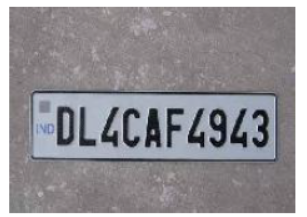
Answer:
Let us use five realistic examples of 4-digit numbers from car license plates:
1. 4943 (from DL4CAF4943)
2. 2816
3. 7350
4. 1985
5. 6042
Ascending Order (from smallest to largest):
\( 1985 < 2816 < 4943 < 6042 < 7350 \)
Even Numbers (ending in 0, 2, 4, 6, or 8):
- 2816, 6042, 7350
Odd Numbers (ending in 1, 3, 5, 7, or 9):
- 1985, 4943
In simple words: Ascending order means placing numbers in order from the smallest to the largest. Even numbers end with 0, 2, 4, 6, or 8, while odd numbers end with 1, 3, 5, 7, or 9.
Exam Tip: Look closely at the last digit of any number to quickly tell if it is even or odd.
Q:4 Match the followings.
Answer:
The correctly matched pairs from Column A to Column B are shown below:
| Column A | Column B |
|---|---|
| 1 more than 2674 | 2675 |
| 1000 less than 7276 | 6276 |
| 100 more than 2246 | 2346 |
| 1000 more than 6273 | 7273 |
| 10 less than 2629 | 2619 |
In simple words: This activity asks us to add or subtract numbers from the first list to find the matching total in the second list.
Exam Tip: When calculating "more than" or "less than" by tens, hundreds, or thousands, only the digit in that specific place value column changes.
Q:5 Round to the nearest 10 .Then fill yellow colour in those boxes whose tenth place is even number so the Rahul finds his way to books.
Answer:
Let us first round each number to the nearest 10:
- 17 rounds to 20 (2 is even)
- 76 rounds to 80 (8 is even)
- 59 rounds to 60 (6 is even)
- 43 rounds to 40 (4 is even)
- 82 rounds to 80 (8 is even)
- 67 rounds to 70 (7 is odd)
- 28 rounds to 30 (3 is odd)
- 89 rounds to 90 (9 is odd)
- 12 rounds to 10 (1 is odd)
- 22 rounds to 20 (2 is even)
- 79 rounds to 80 (8 is even)
- 38 rounds to 40 (4 is even)
- 44 rounds to 40 (4 is even)
- 77 rounds to 80 (8 is even)
- 64 rounds to 60 (6 is even)
- 19 rounds to 20 (2 is even)
- 49 rounds to 50 (5 is odd)
- 66 rounds to 70 (7 is odd)
- 88 rounds to 90 (9 is odd)
- 14 rounds to 10 (1 is odd)
- 39 rounds to 40 (4 is even)
- 63 rounds to 60 (6 is even)
- 18 rounds to 20 (2 is even)
- 84 rounds to 80 (8 is even)
Here is the pathway highlighted in yellow (represented by colored cells) for Rahul to reach his books:
| 17 (rounds to 20) | 76 (rounds to 80) | 59 (rounds to 60) | 43 (rounds to 40) | 82 (rounds to 80) |
| 67 (rounds to 70) | 28 (rounds to 30) | 89 (rounds to 90) | 12 (rounds to 10) | 22 (rounds to 20) |
| 79 (rounds to 80) | 38 (rounds to 40) | 44 (rounds to 40) | 77 (rounds to 80) | 64 (rounds to 60) |
| 19 (rounds to 20) | 49 (rounds to 50) | 66 (rounds to 70) | 88 (rounds to 90) | 14 (rounds to 10) |
| 39 (rounds to 40) | 63 (rounds to 60) | 18 (rounds to 20) | 84 (rounds to 80) | [BOOKS] |
In simple words: Round the numbers to the nearest ten. If the tens digit is even (like 2, 4, 6, 8), color that box to make a path.
Exam Tip: If the ones digit is 5 or more, round up to the next ten. If it is less than 5, round down to the nearest ten.
Q:6 . Write the cost of following items and then compare A and B ( < ,> ,=).
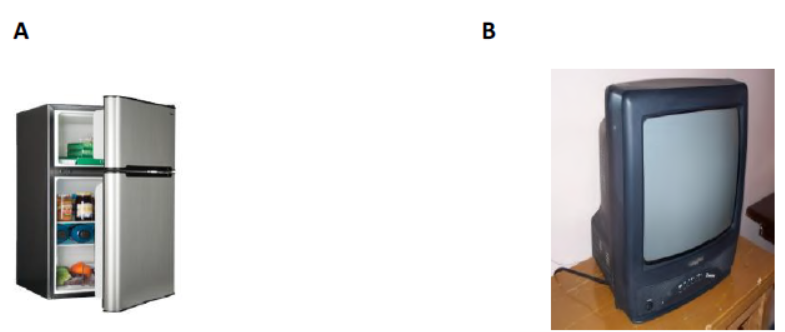
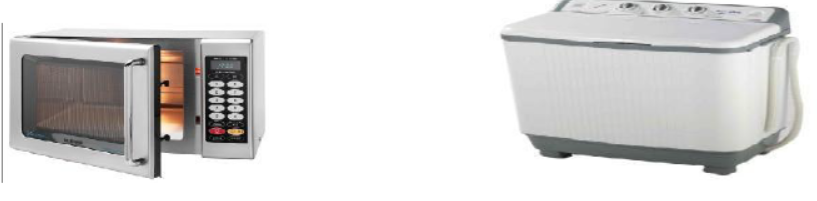
Answer:
Let us look at the prices of Refrigerator (A) and Television (B) to compare them:
- Price of Item A (Refrigerator) = Rs. 25,000
- Price of Item B (Television) = Rs. 15,000
Comparing the two prices:
Rs. 25,000 > Rs. 15,000
Therefore:
A > B
In simple words: The refrigerator is more expensive than the television, so we write the greater-than sign (>).
Exam Tip: Always compare the largest place value first when deciding which number is larger.
Q7.Solve:-
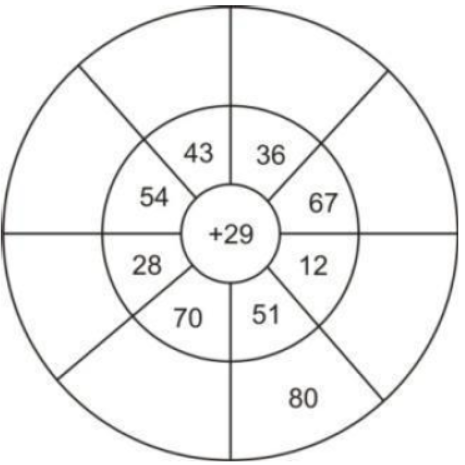
Answer:
To solve this magic wheel puzzle, add the center number (+29) to each number in the inner circle to find the matching outer circle number:
| Inner Circle Number | Operation | Outer Circle Number |
|---|---|---|
| 43 | + 29 | 72 |
| 36 | + 29 | 65 |
| 67 | + 29 | 96 |
| 12 | + 29 | 41 |
| 51 | + 29 | 80 |
| 70 | + 29 | 99 |
| 28 | + 29 | 57 |
| 54 | + 29 | 83 |
In simple words: Add 29 to each number in the middle ring to find the answer for the outer ring.
Exam Tip: You can quickly add 29 by adding 30 first and then subtracting 1 from the final sum.
Q9.Write down the cost of different electrical appliances at your home like refrigerator, T.V , microwave etc and add them. Then write the answer using place value system
Answer:
Let us use a realistic example with three home appliances:
- Refrigerator: Rs. 25,000
- Television: Rs. 15,000
- Microwave: Rs. 8,000
Now, let us find the sum of these costs:
\( 25,000 + 15,000 + 8,000 = 48,000 \)
Let us write this final sum (Rs. 48,000) inside the place value table:
| Ten Thousands (TTh) | Thousands (Th) | Hundreds (H) | Tens (T) | Ones (O) |
|---|---|---|---|---|
| 4 | 8 | 0 | 0 | 0 |
In simple words: Write down the prices of home machines, add them up, and place each digit of the total sum under its place value column.
Exam Tip: Line up all zeros carefully when adding large numbers vertically to keep your calculations clean.
Q:10 Solve the each problem by using the snack bar.
Answer:
Let us use the menu prices to solve each word problem:
- Popcorn: Rs. 600
- Burger: Rs. 500
- Ice cream: Rs. 300
- Pizza: Rs. 900
- Coke: Rs. 200
(i) Komal bought an ice cream and popcorn. How much did she has spend?
- Price of Ice cream: Rs. 300
- Price of Popcorn: Rs. 600
- Total spend: \( 300 + 600 = 900 \)
- Answer: Rs. 900
(ii) Aryan has 700/- rupees, he bought a coke. How much does he has left?
- Total money Aryan has: Rs. 700
- Price of Coke: Rs. 200
- Money left: \( 700 - 200 = 500 \)
- Answer: Rs. 500
(iii) Samira has 1000/- rupees. she bought a pizza. How much does she has left?
- Total money Samira has: Rs. 1000
- Price of Pizza: Rs. 900
- Money left: \( 1000 - 900 = 100 \)
- Answer: Rs. 100
(iv) Jack bought a burger and ice cream. How much money did he has spend?
- Price of Burger: Rs. 500
- Price of Ice cream: Rs. 300
- Total spend: \( 500 + 300 = 800 \)
- Answer: Rs. 800
In simple words: Find the prices of items on the snack bar menu. Add them up if you are buying things, or subtract the price from the total money if you are checking what is left.
Exam Tip: Read carefully to decide whether the question is asking you to add prices or subtract to find the remaining change.
Project: Make a abacus on chart ,showing place value up to ten thousand.(use waste material and make it creative)
Answer:
Here is a creative way to build your place value abacus chart using basic recycled materials:
- Materials needed: A clean piece of cardboard, five wooden skewers or straws, and recycled materials like colorful plastic bottle caps, small macaroni beads, or clay balls.
- Step 1: Securely glue five vertical skewers onto your cardboard base. These represent the place value columns.
- Step 2: Label the columns from right to left at the bottom of the board: Ones (O), Tens (T), Hundreds (H), Thousands (Th), and Ten Thousands (TTh).
- Step 3: Use painted macaroni beads or clay balls as your colorful abacus beads. Slide them onto the skewers to represent different five-digit numbers.
In simple words: Use a cardboard sheet, some vertical sticks, and old beads to make an abacus. Label each stick for ones, tens, hundreds, thousands, and ten-thousands.
Exam Tip: Try color-coding your beads so that each place value column has its own color. This makes it easier to read and present.
Free study material for Mathematics
Free CBSE Practice Worksheets: Class 3 Mathematics All Chapters
Download Chapter Worksheets: Class 3 Mathematics
Access structured practice worksheets for All Chapters aligned with the 2026 CBSE curriculum. These downloadable exercises for Class 3 Mathematics help students build accuracy and reinforce core concepts for upcoming school tests.
Concept Clarification for All Chapters
Each worksheet draws directly from authorized standard textbooks to maintain academic accuracy. Evaluating your finished exercises against expert-verified solutions helps master the formal presentation standards expected in school evaluations.
Effective Revision Strategies for School Exams
Wrap up your chapter revision by testing your knowledge against standard objective question formats. Explore our full library of free, up-to-date printable assignments to maximize your academic results in upcoming CBSE evaluations.
FAQs
You can download the latest chapter-wise printable worksheets for Class 3 Mathematics All Chapters for free from StudiesToday.com. These have been made as per the latest CBSE curriculum for this academic year.
Yes, Class 3 Mathematics worksheets for All Chapters focus on activity-based learning and also competency-style questions. This helps students to apply theoretical knowledge to practical scenarios.
Yes, we have provided solved worksheets for Class 3 Mathematics All Chapters to help students verify their answers instantly.
Yes, our Class 3 Mathematics test sheets are mobile-friendly PDFs and can be printed by teachers for classroom.
For All Chapters, regular practice with our worksheets will improve question-handling speed and help students understand all technical terms and diagrams.