

Official Class 12 Economics Worksheets: Supply
Access comprehensive chapter-wise worksheets for Supply using the CBSE Class 12 Economics Supply Worksheet. Designed to align with the 2026-27 academic syllabus for Class 12 Economics, these printable practice sets help students reinforce key concepts and improve their overall exam readiness.
Solved Practice Worksheets for Economics
Access the complete worksheet PDF for Class 12 Economics below. Regular practice with these targeted academic tasks builds familiarity with standard question patterns and helps secure higher marks in final school examinations.
Question. Supply of a commodity refers to-
(a) Price of commodity
(b) Quantity of the commodity offered for sale
(c) Period of time
(d) All of these
Answer: D
Question. Supply is__________ in the long period.
(a) Less elastic
(b) Perfectly elastic
(c) Perfectly inelastic
(d) Highly elastic
Answer: D
Question. Which one of the following is not a determinant of market supply?
(a) Technological progress
(b) Increase in prices of inputs
(c) Decrease in excise duty
(d) Strike threat by labour in a factory
Answer: D
Question. Which of the following measures of price elasticity shows elastic supply?
(a) 0
(b) .5
(c) 1
(d) 1.5
Answer: D
Question. Which of the following does not cause shift of supply curve of a good?
(a) Price of input
(b) Price of good
(c) Goods and service tax
(d) Subsidy
Answer: B
Question. What causes shift of supply curve leftward?
(a) A rise in the prices of other goods
(b) Improvement in technology
(c) Rise in prices of inputs
(d) Decrease in excise duty
Answer: C
Question. In case of __________________supply curve is a horizontal straight line parallel to the X-axis.
(a) Perfectly elastic supply
(b) Perfectly inelastic supply
(c) Unitary elastic supply
(d) Elastic supply
Answer: A
Question. The cause of upward movement along a supply curve is:
(a) Decrease in supply
(b) Increase in Income
(c) Decrease in income
(d) Increase in Price
Answer: A
Question. Other things being equal, the supply quantity of a product is related to its price.
(a) Directly
(b) Inversely
(c) Proportional ly
(d) Notatall
Answer: A
Question. The assumption "Ceteris Paribus" in the Law of Supply stands for —
(a) Technology remaining constant
(b) Demand remaining constant
(c) Price remaining constant
(d) All factors other than Price remaining constant
Answer: D
Question. When there is a change in quantity supplied —
(a) Supply Curve shifts inward or outward
(b) There is a upward / downward movement on the same Supply Curve
(c) Both (a) and (b)
(d) Neither (a) nor (b)
Answer: B
Question. In case of Increase / Decrease in quantity supplied, the position of the Supply Curve remains the same. This statement is —
(a) True
(b) False
(c) Partially True
(d) None of the above
Answer: A
Question. Increase in quantity supplied, due to changes in price, may also be called —
(a) Contraction of Supply
(b) Expansion of Supply
(c) Decrease in Supply
(d) Increase in Supply
Answer: B
Question. While recognizing Increase or Decrease in the quant ity supplied, we as sume remain constant.
(a) Price
(b) All Factors other than Price
(c) Both (a) and (b)
(d) Neither (a) nor (b)
Answer: B
Question. Increase in quantity supplied, due to changes in price, may also be called —
(a) Contraction of Supply
(b) Expansion of Supply
(c) Decrease in Supply
(d) Increase in Supply
Answer: A
Question. A Decrease in the Supply of a product is caused by —
(a) Technology or fashion change, making the commodity outdated
(b) Increase in the price of Related Commodities
(c) Increase in Cost of Production of ommodity
(d) All of these
Answer: D
Question. Supply Quantity is the same as Sales Quantity. This statement is —
(a) True
(b) False
(c) Partially True
(d) None of the above
Answer: B
Question. Increase or Decrease in Supply occurs due to —
(a) Changes in Price
(b) Changes in Factors other than Price
(c) Both (a) and (b)
(d) Neither (a) nor (b)
Answer: B
Question. While recognizing Increase or Decrease in the Supply, we assume _______ remain constant.
(a) Price
(b) All Factors other than Price
(c) Both (a) and (b)
(d) Neither (a) nor (b)
Answer: A
Question. If there is an increase in the Prices of Factors 3f Production, Cost of Production of that product will —
(a) Inc reas e
(b) Decrease
(c) Remain Constant
(d) Become Zero
Answer: A
Question. Generally, if there is an increase in Commodity Taxes (Excise Duty, Customs Duty, VAT, etc.) leading to increase in their cost of production, the supply quantity will —
(a) Increase
(b) Decrease
(c) Remain Constant
(d) Become Zero
Answer: B
Question. Change in Supply means —
(a) A movement on the same Supply Curve
(b) Shift of the Supply Curve
(c) Both (a) and (b)
(d) Neither (a) nor (b)
Answer: B
Question. Which of the following factors will not result in the shifting of Supply Curve for Software Packages?
(a) Increase in the wages of computer professionals
(b) Government tariffs on software export and imports
(c) Fall in the prices of software packages
(d) All of the above result in the shifting of the curve
Answer: C
Question. An Increase in the Supply of a product is caused by
(a) Improvements in Technology
(b) Fall in the Prices of other goods
(c) Fall in the Prices of Factors of Production
(d) All of these
Answer: D
Question. An Increase in the Supply of a product is caused by
(a) Reduction in the price of Related Commodities
(b) Reduction in Cost of Production of this Commodity
(c) Subsidies by Government for producing this commodity.
(d) All of these
Answer: D
Question. Increase or Decrease in the quantity supplied occurs due to —
(a) Changes in Price
(b) Changes in Factors other than Price
(c) Both (a) and (b)
(d) Neither (a) nor (b)
Answer: A
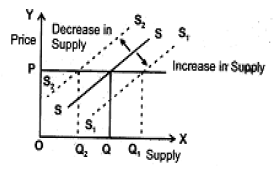
Use the following diagram to answer the next 11 questions. 
Question. If any Subsidies are by Government for producing this commodity, there will be a movement from —
(a) Movement from So to Si
(b) Movement from So to S2
(c) Movement on So itself
(d) No change at all
Answer: B
Question. Reduction in the price of Related Commodities will cause a movement from —
(a) Movement from So to Si
(b) Movement from So to S2
(c) Movement on So itself
(d) No change at all
Answer: B
Question. Movement from So to S2 is called —
(a) Contraction of Supply
(b) Expansion of Supply
(c) Decrease in Supply
(d) Increase in Supply
Answer: D
Question. Technology or fashion change, making the commodity outdated, will lead to —
(a) Movement from So to 51
(b) Movement from So to S2
(c) Movement on So itself
(d) No change at all
Answer: A
Question. Increase in the price of Related Commodities will cause a movement from —
(a) Movement from So to Si
(b) Movement from So to 52
(c) Movement on So itself
(d) No change at all
Answer: A
Question. Movement from So to Si is called —
(a) Contraction of Supply
(b) Expansion of Supply
(c) Decrease in Supply
(d) Increase in Supply
Answer: C
Question. Increase in Cost of Production of this Commodity will cause a movement from —
(a) Movement from So to Si
(b) Movement from So to S2
(c) Movement on So itself
(d) No change at all
Answer: A
Question. Movement from So to Si is caused by —
(a) Changes in Price of the product
(b) Changes in Factors other than price
(c) Both (a) and (b)
(d) Neither (a) nor (b)
Answer: B
Question. Inventions and Innovations on this commodity will cause a movement from —
(a) Movement from 50 to S1
(b) Movement from So to S2
(c) Movement on So itself
(d) No change at all
Answer: B
Question. Movement from So to Si is caused by —
(a) Changes in Price of the product
(b) Changes in Factors other than price
(c) Both (a) and (b)
(d) Neither (a) nor (b)
Answer: B
Question. Reduction in Cost of Production of this Commodity will cause a movement from —
(a) Movement from So to Si
(b) Movement from So to S2
(c) Movement on So itself
(d) No change at all
Answer: B
Question. In which of the following type of product, is the Elasticity of Supply lowest?
(a) Necessities
(b) Luxury Goods
(c) Perishable Goods
(d) Perfect Substitutes
Answer: C
Question. A Horizontal Supply Curve parallel to the quantity axis implies that the Elasticity of Supply is —
(a) Ze r o
(b) Inf ini te
(c) Equal to one
(d) Greater than zero but less than one.
Answer: B
Question. If the Elasticity of Supply is Infinity, then Supply Curve will be —
(a) Horizontal
(b) Downward Sloping
(c) Upward sloping to the right
(d) Vertical
Answer: A
Question. Elasticity of Supply is given by the formula —
(a) dp/Aq X q/p
(b) Ap/Aq X p/q
(c) 4 / 4 X q / p
(d) LS.q/Ap X p/q
Answer: D
Question. Elasticity of Supply can be measured using —
(a) Percentage Change or Proportional Method
(b) Point Elasticity Method
(c) Arc Elasticity Method
(d) All the above
Answer: D
Question. Price is fallen by 20% brings above 10% fall in quantity supplied then elasticity of supply is ________
(a) 2 . 0
(b) 0.5
(c) 1.0
(d) 1 . 5
Answer: B
Question. If Quantity Supplied increases by 60% for a 500/o increase in Price, Elasticity of Supply is —
(a) —1.2
(b) +1 .2
(c) —0.83
(d) +0.83
Answer: B
Question. Given the Market Demand, the burden of specific tax that will be borne by the Consumer (Buyer) depends on the
(a) Price Elasticity of Supply
(b) Price Elasticity of Demand
(c) Consumer's Ability
(d) Type of the Product
Answer: A
Question. If Price is 15, quantity supplied is 150 units. IfPrice is 25, quantity supplied is 300 units. Compute Price Elasticity of Supply using Arc Method.
(a) —1.09
(b) +1.09
(c) —0.98
(d) +0.98
Answer: B
Question. When Supply is perfectly inelastic, Elasticity of Supply is equal to —
(a) +1
(b) 0
(c) — 1
(d) Inf ini ty
Answer: B
Question. Elasticity of Supply refers to the degree of responsiveness of supply of a good to changes in its
(a) Demand
(b) Price
(c) Cost of Production
(d) State of Technology
Answer: B
Question. Elasticity of Supply is greater than one when
(a) Proportionate change in price is greater than proportionate change in supply
(b) Proportionate change in supply is greater than proportionate change in price
(c) Proportionate change in supply is equal to proportionate change in price.
(d) All of the above.
Answer: B
Question. If the Elasticity of Supply is Zero, then Supply Curve will be —
(a) Horizontal
(b) Downward Sloping
(c) Upward sloping to the right
(d) Vertical
Answer: D
Question. A Vertical Supply Curve parallel to Y axis implies that the Elasticity of Supply is —
(a) Zero
(b) Inf inity
(c) Equal to One
(d) Greater than Zero but less than infinity
Answer: A
Question. If Liq = Change in Quantity Supplied, Lip = Change in Price, when Supply is relatively elastic, it means —
(a) Liq = Zero
(b) Aq = Ap
(c) Aq<Ap
(d) Lip = Zero
Answer: B
Question. When Supply is perfectly elastic, Elasticity of Supply is equal to —
(a) + 1
(b) 0
(c) —1
(d) Infinity
Answer: D
Question. When change in the quanti ty suppl ied is proportionate to the change in the price, the product is said to have —
(a) Unitary Elastic Supply
(b) Perfectly Elastic Supply
(c) Relatively Elastic Supply
(d) Perfectly Inelastic Supply
Answer: A
Question. Which of the following has the lowest Price Elasticity of Supply?
(a) Luxury Items
(b) Necessities
(c) Perishable Goods
(d) Items that have the least budgetary allocation
Answer: C
Question. If the Elasticity of Supply is Infinity, then Supply Curve will be —
(a) Horizontal
(b) Downward Sloping
(c) 45 degrees Straight Line
(d) Vertical
Answer: C
Question. If Liq = Change in Quantity Supplied, Lip = Change in Price, when Supply is perfectly inelastic, it means
(a) Liq = Zero
(b) Aq>Ap
(c) Aq<Ap
(d) Lip = Zero
Answer: A
Question. If Liq = Change in Quantity Supplied, Lip = Change in Price, when Supply is perfectly elastic, it means —
(a) Aq = Zero
(b) Aq> Lip
(c) Aq<Ap
(d) Lip = Zero
Answer: D
Question. An Increase in the Supply of a product is caused by
(a) Inventions and Innovations on this commodity
(b) Reduction in Cost of Production of this Commodity
(c) Reduction in the price of Related Commodities
(d) All of these
Answer: D
Question. The Market Supply Curve is a lateral summation (totalling) of Individual Supply Curves of all Producing Firms.
This statement is —
(a) True
(b) False
(c) Partially True
(d) None of the above
Answer: A
Question. If Liq = Change in Quantity Supplied, Lip = Change in Price, when Supply is relatively elastic, it means —
(a) Liq = Zero
(b) Aq>Ap
(c) Aq<Ap
(d) Lip = Zero
Answer: B
Question. If Liq = Change in Quantity Supplied, Lip = Change in Price, when Supply is relatively inelastic, it means
(a) Liq = Zero
(b) Liq> Lip
(c) Liq< Lip
(d) Lip = Zero
Answer: C
Question. If as a result of a change in price, the quantity supplied of a product remains unchanged, we conclude that —
(a) Elasticity of Supply is perfectly inelastic
(b) Elasticity of Supply is relatively greater elastic
(c) Elasticity of Supply is inelastic
(d) Elasticity of Supply is relatively less elastic
Answer: A
Question. Which of the following method is not used for measuring elasticity of supply?
(a) Arc Method
(b) Percentage Method
(c) Total outlay Method
(d) Point Method
Answer: C
Short Questions
Question. Define supply.
Answer: Supply -It is that quantity of a commodity which a seller or producer is ready to sell in the market at a certain price within a given time period.
Question. Explain the law of supply.
Answer: Law of Supply -Other things being constant, there is a direct relation between price of a commodity and its quantity supplied i.e. higher the price more the supply and vice-versa.
Question. Explain briefly four factors which lead to an increase in supply of a commodity.
Answer:
1. Increase in number of firms.
2. Decrease in taxation.
3. Improved technology.
4. Decrease in cost of production.
Question. Explain briefly four factors which lead to decrease in supply of a commodity.
Answer:
1. Decrease in number of firms.
2. Increase in taxation.
3. Outdated technology.
4. Increase in cost of production.
Question. What will be the price elasticity of supply at any point on a straight line curve if:
(i) Supply curve intersects OX-axis.
(ii) Supply curve intersects OY-axis.
(iii) Supply curve passes through the origin.
(iv) Supply curve is vertical to OX-axis.
(v) Supply curve is Horizontal to OX-axis.
Answer:
1. es<1
2. es>1
3. es=1
4. es=0
5. es=∞
Question. Examine the effects of the following on the supply curve of a Good X.
(a) Fall in own price of Good X
(b) Rise in price of factor input producing Good X
Answer: Effect on supply curve of Good X when there is a :
(a) Fall in own price of Good X: When the price of a commodity falls, it leads to reduced profit margin of the producers, forcing them to sell lesser quantity. It is called as contraction in supply. There will be movement along the same supply curve towards the origin.
(b) Rise in price of factor input producing Good X: When price of factor input producing Good X rises, profit margin of the producers fall, forcing them to produce less quantity of Good X at the given price. Supply curve will shift leftwards.
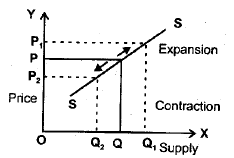
Contraction in supply -Supply decreases due to decrease in price.
a) Decrease in supply -when supply of a commodity falls due to factors other than price it is decrease in supply. In this case the entire supply curve shifts to the left (upward).
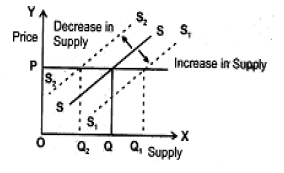
Question. Distinguish between extension of supply and increase in supply.
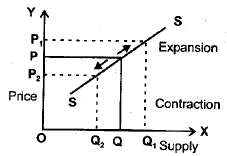
Answer: Expansion in supply –When supply of a commodity rises with rise in prices, other things remaining constant; it is called expansion of supply.
Free study material for Economics
Free CBSE Practice Worksheets: Class 12 Economics Supply
Daily Practice Questions for Class 12 Economics
Review targeted practice exercises for Class 12 Economics Supply. Curated to match official CBSE guidelines, these printable problem sets support daily revision and improve overall test readiness.
Detailed Answers for Class 12 Economics Supply
Designed around the official curriculum for Class 12 Economics, these practice sheets guarantee standard compliance. Reviewing step-by-step solutions after completion sharpens your accuracy and clarifies complex sub-topics within Supply.
Complete Your Chapter Revision
Follow up your worksheet practice by attempting the interactive online MCQ tests for Supply to evaluate your execution speed. All printable assignments and revision sheets on our platform are updated for the 2026 session and available free of charge.
FAQs
You can download the latest chapter-wise printable worksheets for Class 12 Economics Supply for free from StudiesToday.com. These have been made as per the latest CBSE curriculum for this academic year.
Yes, Class 12 Economics worksheets for Supply focus on activity-based learning and also competency-style questions. This helps students to apply theoretical knowledge to practical scenarios.
Yes, we have provided solved worksheets for Class 12 Economics Supply to help students verify their answers instantly.
Yes, our Class 12 Economics test sheets are mobile-friendly PDFs and can be printed by teachers for classroom.
For Supply, regular practice with our worksheets will improve question-handling speed and help students understand all technical terms and diagrams.