

Class 12 Economics Practice Sheet: CBSE Class 12 Economics Main Market Forms Worksheet
Explore structured practice materials through the CBSE Class 12 Economics Main Market Forms Worksheet. Tailored for Class 12 learners, utilizing these Economics worksheets ensures thorough preparation and strengthens problem-solving accuracy before final school evaluations.
Download Main Market Forms Worksheet PDF with Answers
Access the complete worksheet PDF for Class 12 Economics below. Regular practice with these targeted academic tasks builds familiarity with standard question patterns and helps secure higher marks in final school examinations.
Question. Monopolist can control only
(a) Price
(b) Demand
(c) Utility
(d) Both (a) & (b)
Answer: A
Question. If Marginal Revenue exceeds Marginal Cost, a Monopolist should —
(a) increase output.
(b) decrease output.
(c) keep output the same because profits are maximized when Marginal Revenue exceeds Marginal Cost.
(d) raise the price.
Answer: A
Question. Under Monopoly, in the short—run, the condition for shut—down is —
(a) AR < AC
(b) AR > AC
(c) AR > AVC
(d) AR < AVC
Answer: D
Question. A Market in which a Single Seller is required for efficient production is called —
(a) Regulated Industry
(b) Natural Monopoly
(c) Legal Monopoly
(d) Contestable Market
Answer: B
Question. Under Monopoly, Price Elasticity of Demand is
(a) Nil
(b) Less Elastic
(c) More Elastic
(d) Infinity
Answer: B
Question. In Monopoly, the relationship between Average and Marginal Revenue Curves is as follows:
(a) AR Curve lies above the MR Curve.
(b) AR Curve coincides with the MR Curve.
(c) AR Curve lies below the MR Curve.
(d) AR Curve is parallel to the MR Curve.
Answer: A
Question. Under Monopoly, a Firm can earn in the long-run.
(a) Normal Profits only
(b) Super Normal Profits
(c) Either (a) or (b)
(d) Losses
Answer: C
Question. Under Monopoly, the Firm can earn ____ in the short—run.
(a) Normal Profits only
(b) Super Normal Profits
(c) Losses
(d) All of the above.
Answer: D
Question. Which of these is not a feature of Monopoly?
(a) Single Seller
(b) Firm = Industry
(c) No substitutes
(d) Elasticity of Demand = 0
Answer: D
Question. In long-run a monopolist always earn profits
(a) Normal
(b) Abnormal
(c) Zero profit
(d) Loss
Answer: B
Question. The price discrimination under monopoly will be possible under which of the following conditions?
(a) The seller has no control over the supply of his product
(b) The market has the same conditions all over
(c) The price elasticity of demand is different in different markets
(d) The price elasticity of demand is uniform
Answer: C
Question. Abnormal profits exists in the long run only under
(a) Monopoly
(b) Perfect competition
(c) Monopolistic competition
(d) Oligopoly
Answer: A
Question. Under Monopoly, in the long—run, a Firm —
(a) will not have excess capacity.
(b) may have excess capacity
(c) has no capacity at all
(d) will leave the industry.
Answer: B
Question. If a Monopolist is operating at a production level where Marginal Cost is 10 and Marginal Revenue is 25, what action you would suggest to him?
(a) To reduce the price to 20
(b) To increase the costs by ' 4
(c) To increase output till Marginal Revenue would equal Marginal Cost
(d) To stop production
Answer: C
Question. Monopolies are allocatively inefficient because
(a) they restrict the output to keep the price higher than under Perfect Competition.
(b) they charge a price higher than the Marginal Cost.
(c) both (a) and (b) are correct.
(d) both (a) and (b) are incorrect.
Answer: C
Question. Which of these is a pre—requisite for Price Discrimination?
(a) Divisibility of Market into segments
(b) No scope of re—sale between segments
(c) Differing Elasticity in various market segments
(d) All of the above
Answer: D
Question. Which of the following is false regarding Monopoly?
(a) Firm is a price taker
(b) Unique product
(c) Single Seller
(d) None of the above
Answer: D
Question. If the Electricity Market is a Natural Monopoly, it is preferred to have a single producer rather than several small producers because —
(a) Marginal Cost is maximized
(b) Marginal Revenue is maximized
(c) Average Total Cost is minimized
(d) Profits are maximized
Answer: C
Question. Equilibrium Price of a Monopolist is —
(a) Less than Marginal Cost
(b) Equal to Marginal Cost
(c) Equal to Marginal Revenue
(d) More than Marginal Cost
Answer: D
Question. Under Monopoly, each Firm's control over price is —
(a) Nil
(b) Full and Absolute
(c) Subject to Competing Firms' Strategies
(d) None of the above.
Answer: B
Question. Under Monopoly, the Firm's Demand Curve is
(a) Horizontal Line, parallel to X Axis
(b) Vertical Line, parallel to Y Axis
(c) Negatively Sloped
(d) Kinked.
Answer: C
Question. Which of the following features is not associated with a Monopoly market structure?
(a) There is only one seller in the market
(b) There are no close substitutes for the product
(c) There are barriers to entry
(d) There are no close complements for the product
Answer: D
Question. All of the following are characteristics of a Monopoly except —
(a) There is a single Firm
(b) The Firm is a Price Taker
(c) The existence of some advertising
(d) The Firm produces a unique product
Answer: B
Question. Which of the following statements in not true about a discriminating Monopolist?
(a) He operates in more than one market
(b) He makes more profit because he discriminates
(c) He maximizes his profits in each market
(d) He charges different prices in each market
Answer: C
Question. Price Discrimination is possible —
(a) Only under Monopoly situation
(b) Under any market form
(c) Only under Oligopoly
(d) Only under Perfect Competition
Answer: A
Question. When different prices are charged by the Producer, from different customers, it is called
(a) Demand Supply Equilibrium
(b) Price Discrimination
(c) Optimum Price Search
(d) Profiteering
Answer: B
Question. Under Monopoly, in the long—run, a Firm —
(a) will always be a Optimal Firm.
(b) will never be an Optimal Firm.
(c) may or may not be an Optimal Firm.
(d) will leave the industry.
Answer: C
Question. A Monopoly will not be a Perfect Monopoly, if cross elasticity of demand of the related goods is
(a) High
(b) Low
(c) One
(d) Zero
Answer: B
Question. Economics of Scale allows the Monopolist to set a _______ price than any new entrant.
(a) Higher
(b) Lower
(c) Economics of scale does not influence the price
(d) At the existing market rate
Answer: A
Question. Under Monopoly, in the short—run, the Firm will never shut—down. This statement is —
(a) True
(b) False
(c) Partially True
(d) None of the above
Answer: B
Question. In the short run, the Monopolist —
(a) Earns Normal Profits
(b) Earns Super Normal Profits
(c) Incurs losses
(d) Any of these
Answer: D
Question. Objectives of price discrimination in international market is—
(a) To capture foreign markets
(b) To dispose of surplus stock
(c) To earn maximum profit
(d) All of the these
Answer: D
Question. The degree of Monopoly Power is measured in terms of difference between —
(a) Marginal Cost and Price
(b) Average Cost and Average Revenue
(c) Marginal Cost and Average Cost
(d) Marginal Revenue and Average Cost
Answer: A
Question. Price Discrimination in a Monopoly is described as —
(a) Same product selling at different prices since the costs of production are different
(b) Same product selling at different prices though the costs of production are same
(c) Different products having same price though costs of production are same
(d) Different products having different prices since costs of production are different
Answer: B
Question. The Demand Curve facing an industrial Firm under Monopoly is a/an —
(a) Horizontal Straight Line
(b) Indeterminate
(c) Downward Sloping
(d) Upward Sloping
Answer: C
Question. Under Monopoly, there is / are_______Seller(s).
(a) Many
(b) Only one
(c) A Few
(d) No
Answer: B
Question. Barriers to entry like_________allows the Monopolist to charge a price much below then the price of new entrant, thereby driving the new entrant out of business.
(a) Economics of Scale
(b) Product Differentiation
(c) Price Discrimination
(d) High Quality Product
Answer: A
Question. Under monopoly which of the following are correct—
(a) AR&MR both are downward sloping
(b) MR lies half way between AR & Y axis
(c) MR can be zero or negative
(d) all of the above
Answer: D
Question. A Monopoly Producer usually earns even in the long run.
(a) Super Normal Profits
(b) Only Normal Profits
(c) Losses
(d) None of the above
Answer: A
Question. In Monopoly Market, the product has —
(a) Perfect Substitutes
(b) No Close Substitutes
(c) the same feature as Giffen Goods
(d) None of the above
Answer: B
Question. Under Price Discrimination, the Producer Firm can charge higher prices from a market, if Price Elasticity (e) —
(a) e = 1
(b) e < 1
(c) e > 1
(d) e = 0
Answer: B
Question. In case of a profit maximizing Monopolist, what point determines the Selling Price?
(a) Point where marginal cost equals average revenue
(b) Point where average cost equals marginal revenue
(c) Point where average cost equals average revenue
(d) Point where marginal cost equals marginal revenue
Answer: D
Question. In Monopoly, entry of new Firms —
(a) is restricted at all times
(b) is possible only in short—run
(c) is possible only in long—run
(d) both (b) and (c)
Answer: A
Question. Price Discrimination is not possible if the market is an indivisible whole of Buyers. This statement is —
(a) True
(b) False
(c) Partially True
(d) None of the above
Answer: A
Question. Under Monopoly, in the short—run, the condition AR = MR = MC = AC, means that the Firm is earning —
(a) Normal Profits only
(b) Super Normal Profits
(c) Losses
(d) All of the above.
Answer: A
Question. Which of these does not apply to Monopoly?
(a) Single Seller
(b) Firm = Industry
(c) Free Entry and Exit of Firms
(d) No substitutes
Answer: C
Question. Under Monopoly, in the short—run, if AR > AC at the point when MC = MR, it means that the Firm —
(a) Normal Profits only
(b) Super Normal Profits
(c) Losses
(d) All of the above.
Answer: B
Question. By Imperfect Monopoly, we mean —
(a) It is possible to substitute the Monopolized product with another monopolized product
(b) Entry of new Firms is possible to produce the same product
(c) The amount of output produced is very small
(d) None of the above
Answer: A
Question. Under Price Discrimination, the Producer Firm may charge lower prices from a market, if Price Elasticity (e)
(a) e = 1
(b) e < 1
(c) e > 1
(d) e = 0
Answer: C
Question. Discriminating Monopolist divides the total production in two markets in a way that —
(a) MR earned in market with higher elasticity of demand is greater than the other with lower elasticity of demand
(b) MR earned in market with lower elasticity of demand is greater than the other
(c) MR earned in each market is the same (d) MR earned in each market is maximum
Answer: C
Question. In Monopoly Market, there is a —
(a) Single Seller
(b) Single Buyer
(c) Both (a) and (b)
(d) Neither(a) and (b)
Answer: A
Question. Which of the following best describes Monopoly?
(a) An indisputable market leader in an industry
(b) Only a single buyer in the market
(c) A single seller with large control over the price in the industry
(d) Only a single seller with complete control over the industry
Answer: D
Question. For price discrimination to be successful, the elasticity of demand for the commodity in the two markets, should be:
(a) Same
(b) different
(c) Constant
(d) Zero
Answer: A
Question. Under which of the followings forms of market structure does a firm has very considerable control over the price of its product?
(a) Monopoly
(b) Perfect competition
(c) Monopolistic competition
(d) Oligopoly
Answer: A
Question. Price discrimination will not be profitable if elasticity of demand is in different markets.
(a) Uniform
(b) Different
(c) Less
(d) Zero
Answer: A
Question. Under Monopoly, in the short—run, if AR < AC at the point when MC = MR, it means that the Firm —
(a) Normal Profits only
(b) Super Normal Profits
(c) Losses
(d) All of the above.
Answer: C
Question. Which of the following is false with reference to first—degree price discrimination?C
(a) The Monopolist will be able to extract entire Consumer's Surplus
(b) The price of each unit will be different
(c) By following first degree price discrimination, the Monopolist will earn higher profits than he would have earned by adopting a single price
(d) The price of the first unit will be less than that of the subsequent units
Answer: D
Question. Under Monopoly, in the short—run, the Firm can never make Losses. This statement is —
(a) True
(b) False
(c) Partially True
(d) None of the above
Answer: B
Question. Which of these is not a pre—requisite for Price Discrimination?
(a) Seller's Control over the supply of his product
(b) Market Segmentation
(c) Differing Elasticity in various market segments
(d) Different versions of the same product
Answer: D
Question. Under Monopoly, each Firm is a
(a) Price Maker
(b) Price Taker
(c) Price Maker for its own product.
(d) All of the above.
Answer: A
Question. Which of the following is not the characteristic of Monopoly?
(a) Many Buyers
(b) Heterogeneous Products
(c) Free Entry of new Firms
(d) Both b & c
Answer: C
Question. A Monopolist who is selling in two markets in which demand is not identical will be unable to maximize his profits unless he —
(a) Sells below Costs of Production in both markets.
(b) Practices Price Discrimination.
(c) Equates the volume of sales in both markets.
(d) Equates Marginal Costs with Marginal Revenue in one market only.
Answer: B
Question. A Monopolist is able to maximize his profits when —
(a) His output is maximum
(b) He charges a high price
(c) His average cost is minimum
(d) His Marginal Cost is equal to Marginal Revenue
Answer: D
Question. Which of the following is a condition which makes Price Discrimination possible?
(a) The market must be divided into sub markets with different price elasticities
(b) There has to be an effective separation of the submarkets
(c) Size of the submarkets should be very large
(d) Both a and b above
Answer: D
Question. In India, Monopoly exists in the following industry —
(a) Courier Services
(b) Internet Services providing industry
(c) Rail Transportation
(d) Toilet Soaps Industry
Answer: C
Question. Price Elasticity of Demand for Monopolist's Product is
(a) Infinity
(b) More than one
(c) Less than one.
(d) Zero
Answer: C
Question. A Monopolist who faces a negatively sloped demand curve operates in the region where the elasticity of demand is —
(a) Less than one
(b) Equal to one
(c) Greater than one
(d) Between zero and one
Answer: A
Question. Discriminating Monopoly implies that the Monopolist charges different prices for his commodity —
(a) From different groups of consumers
(b) For different uses
(c) At different places
(d) Any of the above
Answer: D
Question. For practicing Price Discrimination, the Seller should be able to divide his market into two or more sub—markets. The statement is —
(a) True
(b) False
(c) Partially True
(d) None of the above
Answer: A
Question. Which of these is not a feature of Monopoly? .
(a) Many Sellers
(b) Many Buyers
(c) No substitutes
(d) Firm = Industry
Answer: A
Question. Why is first degree price discrimination termed as the extreme form of price discrimination —
(a) All the Firms in the industry undertake price discrimination
(b) Firms in the industry discriminate in price for almost all the products they are producing
(c) Firms earn the least profit in this type of discrimination; they are just able to cover the cost
(d) In this type of discrimination Firms charge the consumers the maximum price
Answer: D
Question. Under Monopoly, the product is —
(a) Differentiated
(b) Homogeneous
(c) Necessity Goods
(d) Always Intangible
Answer: A
Question. Discriminating Monopoly is possible if two markets have
(a) Rising Cost Curves
(b) Rising and declining Cost Curves
(c) Different Elasticities of Demand
(d) Equal Elasticities of Demand
Answer: C
Questions 74 to 76 are based on the Figure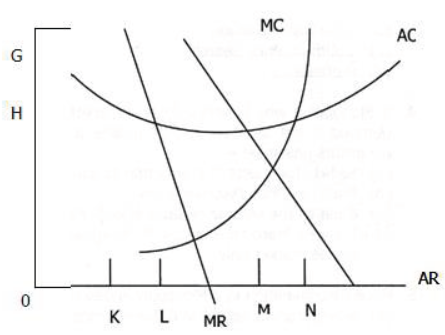
Question. In figure , the firm's marginal revenue curve is curve:
(a) E.
(b) A
(c) F
(d) B
Answer: C
Question. In figure , curve E is the firm's:
(a) Marginal cost curve
(b) Average cost curve
(c) Demand curve.
(d) Marginal revenue curve
Answer: C
Question. Figure represents a:
(a) Perfectly competitive firm.
(b) Perfectly competitive industry.
(c) Monopolist
(d) None of the above.
Answer: C
Question. In the case of Monopoly —
(a) MR Curve cannot be defined
(b) AR Curve cannot be defined
(c) Short Run Supply Curve cannot be defined
(d) None of the above
Answer: C
Free study material for Economics
CBSE Class 12 Economics Worksheets for Main Market Forms
Mastering Main Market Forms with Printable Worksheets
Access structured practice worksheets for Main Market Forms aligned with the 2026 CBSE curriculum. These downloadable exercises for Class 12 Economics help students build accuracy and reinforce core concepts for upcoming school tests.
Verified Solutions and NCERT Alignment
Built using official NCERT guidelines for Class 12 Economics, these practice sheets provide reliable academic support. Cross-reference your completed work with our detailed solutions to learn standard answer-writing formats for CBSE exams.
Additional Study Resources for Class 12 Economics
Follow up your worksheet practice by attempting the interactive online MCQ tests for Main Market Forms to evaluate your execution speed. All printable assignments and revision sheets on our platform are updated for the 2026 session and available free of charge.
FAQs
You can download the latest chapter-wise printable worksheets for Class 12 Economics Main Market Forms for free from StudiesToday.com. These have been made as per the latest CBSE curriculum for this academic year.
Yes, Class 12 Economics worksheets for Main Market Forms focus on activity-based learning and also competency-style questions. This helps students to apply theoretical knowledge to practical scenarios.
Yes, we have provided solved worksheets for Class 12 Economics Main Market Forms to help students verify their answers instantly.
Yes, our Class 12 Economics test sheets are mobile-friendly PDFs and can be printed by teachers for classroom.
For Main Market Forms, regular practice with our worksheets will improve question-handling speed and help students understand all technical terms and diagrams.