

Download Class 9 Science Worksheets for Chapter 04 Structure of the Atom
Review targeted practice sets for Class 9 Science Chapter 04 Structure of the Atom. Built according to official educational guidelines for the 2026-27 academic year, these downloadable worksheets support daily revision and core concept reinforcement.
Access Chapter 04 Structure of the Atom Questions and Exercises
View or download the dedicated Chapter 04 Structure of the Atom practice resource below. Engaging with these objective and subjective questions daily ensures continuous academic progress and mastery of the 2026-27 curriculum.
Question. Bromine is available in the form of two isotopes, Br – 79 (49.7 %) and Br – 81 (50.3 %), the average atomic mass of Bromine atom is
(a) 82.001 u
(b) 80.006 u
(c) 78.034 u
(d) 79.076 u
Answer: (b) 80.006 u
In simple words: Calculating the weighted average: \( (79 \times 0.497) + (81 \times 0.503) \approx 39.263 + 40.743 = 80.006 \) u.
Exam Tip: Average atomic mass is the sum of the masses of each isotope multiplied by their respective fractional abundance.
Question. Elements with valency 1 are
(a) Always metals
(b) Always metalloids
(c) Always nonmetals
(d) Either metals or non metals
Answer: (d) Either metals or non metals
In simple words: A valency of 1 can belong to a metal like Sodium (which loses 1 electron) or a non-metal like Chlorine (which gains 1 electron).
Exam Tip: Monovalent elements can be metals (Group 1) or non-metals (Group 17).
Question. The nucleons of an atom are
(a) Protons and electrons
(b) Neutrons and electrons
(c) Protons and neutrons
(d) None of these
Answer: (c) Protons and neutrons
In simple words: Nucleons are any subatomic particles located inside the nucleus, which include protons and neutrons.
Exam Tip: "Nucleons" refers specifically to the core particles: protons and neutrons together.
Question. The following two species have completely filled K and L shells
(a) Ne and Na
(b) Ne and Cl
(c) Ne and Na+
(d) He and Na+
Answer: (c) Ne and Na+
In simple words: Neon (10) and Sodium ion (originally 11, loses 1 electron to become 10) both have 10 electrons, which completely fills their K (2) and L (8) shells.
Exam Tip: Look for isoelectronic species with exactly 10 electrons to have filled K and L shells.
Question. According to Bohr’ s Model, an atom does not collapse due to ?
(a) The nuclear forces
(b) Motion of electrons in discrete energy levels
(c) The electron-electron repulsions
(d) All of these
Answer: (b) Motion of electrons in discrete energy levels
In simple words: Electrons do not lose energy when they remain in their allowed discrete energy levels, which keeps the atom stable.
Exam Tip: Bohr postulated that orbits are non-radiating states of fixed energy to prevent atomic collapse.
Question. In the alpha scattering experiment, very few alpha particles rebounded because
(a) Most of the space in the atom is empty.
(b) The atom is positively charged.
(c) The mass of the atom is concentrated in the shells.
(d) All the mass of the atom is concentrated in a small volume
Answer: (d) All the mass of the atom is concentrated in a small volume
In simple words: Because the positive charge and mass are concentrated in a tiny central nucleus, only the rare particles hitting it directly bounced straight back.
Exam Tip: Rebounding of alpha particles at 180 degrees showed that the nucleus is extremely dense and small.
Question. Which one of the following statements is true according to Rutherford’s nuclear model of an atom?
(a) There is a positively charged centre in an atom called the nucleus.
(b) All the mass of an atom resides in the nucleus.
(c) The electrons revolve around the nucleus in well-defined orbits.
(d) All of the above
Answer: (d) All of the above
In simple words: Rutherford's model showed that a positive nucleus holds almost all of the atomic mass, with electrons circling around it.
Exam Tip: Study all key points of Rutherford's nuclear model as they lay the foundation for modern atomic theories.
Question. Identify the set of divalent elements ( Valency = 2 )
(a) Mg , O , S
(b) He , Mg , S
(c) Mg , Li , Na
(d) O , S , Na
Answer: (a) Mg , O , S
In simple words: Magnesium has valency 2 (loses 2), while Oxygen and Sulphur also have valency 2 (gain 2 electrons).
Exam Tip: Divalent elements can achieve stability by losing or gaining exactly 2 electrons.
Question. Match column A with column B.
| Column A (Atomic number) | Column B (Valency) |
|---|---|
| (A) 12 | (i) 3 |
| (B) 17 | (ii) 0 |
| (C) 10 | (iii) 2 |
| (D) 15 | (iv) 1 |
(a) A → ii, B → iv, C → iii, D → i
(b) A → iii, B → iv, C → ii, D → i
(c) A → iii, B → iv, C → i, D → ii
(d) A → iii, B → ii, C → i, D → iv
Answer: (b) A → iii, B → iv, C → ii, D → i
In simple words: Atomic number 12 has valency 2, 17 has valency 1, 10 has valency 0, and 15 has valency 3.
Exam Tip: Find the valency by writing the electron configuration first to match the column pairs correctly.
Question. The relative atomic masses of many elements are not whole numbers because:
a) They cannot be determined accurately
b) The atoms ionize during determination of their masses
c) Existence of isotopes
d) Presence of impurities
Answer: (c) Existence of isotopes
In simple words: Elements have different isotopes with different mass numbers, so the average atomic mass is a decimal calculated from their natural abundance.
Exam Tip: Non-integer atomic masses are always due to the weighted average of naturally occurring isotopes.
ASSERTION - REASON TYPE QUESTIONS
Directions: Each of these questions contains two statements Assertion (A) and Reason (R). Select one of the codes (a), (b), (c) and (d) given below:
(a) Both A and R are true and R is the correct explanation of A.
(b) Both A and R are true, but R is not the correct explanation of A.
(c) A is true, but R is false.
(d) A is false, but R is true.
Question. Assertion: Mass number is defined as the sum of number of protons and neutrons present in the nucleus of an atom.
Reason: Protons and neutrons together called nucleons.
Answer: (b) Both A and R are true, but R is not the correct explanation of A.
In simple words: Mass number is the sum of protons and neutrons, which are also called nucleons, but naming them does not define what mass number is.
Exam Tip: Remember that mass number is a quantity, while "nucleons" is a term used for the particles themselves.
Question. Assertion: Isotopes have same atomic numbers but different mass numbers
Reason: They have the same number of protons but different numbers of neutrons.
Answer: (a) Both A and R are true and R is the correct explanation of A.
In simple words: Isotopes have the same atomic number because they have the same protons, but different mass numbers because their neutron counts differ.
Exam Tip: Since protons determine chemical identity and neutrons determine mass, isotopes share chemical but differ in physical properties.
Question. Assertion: \( _1^1\text{H}, _1^2\text{H}, _1^3\text{H} \) these are isotopes of H-atom
Reason: They have the same no. of neutrons
Answer: (c) A is true, but R is false.
In simple words: Protium, deuterium, and tritium are indeed hydrogen isotopes, but they have different numbers of neutrons (0, 1, and 2 respectively).
Exam Tip: Isotopes must have the same number of protons but different numbers of neutrons.
Question. Assertion: Isotopes have same chemical properties but different physical properties
Reason: They have the same number of valence electrons so the same chemical properties
Answer: (a) Both A and R are true and R is the correct explanation of A.
In simple words: Chemical behavior is determined by outer electrons, so having the same valence electrons means isotopes react in the same way.
Exam Tip: Identical electron configurations are the main reason why isotopes share identical chemical reactions.
Question. Assertion: Isobars are atoms of different elements with different atomic numbers but same mass numbers.
Reason: They have the same number of nucleons, but differ in the number of protons
Answer: (a) Both A and R are true and R is the correct explanation of A.
In simple words: Isobars have the same total number of core particles (nucleons), but different counts of protons, meaning they are different elements with the same weight.
Exam Tip: The total sum of protons and neutrons (nucleons) is equal in isobars, giving them identical mass numbers.
DESCRIPTIVE QUESTIONS (OPEN ENDED SHORT AND LONG ANSWER TYPE)
Question. Why are some elements inert?
Answer: These elements do not react because their valence shell contains a maximum number of electrons, which gives them a stable configuration.
In simple words: Their outer electron shells are completely full, so they do not need to share, gain, or lose electrons.
Exam Tip: Inert elements have 8 electrons in their outermost shell (or 2 for Helium), which is known as a stable octet/duplet.
Question. Why is atom electrically neutral?
Answer: An atom has no net charge because it contains an equal number of positive protons and negative electrons, which perfectly balance each other.
In simple words: Protons have positive charges and electrons have negative charges. Since an atom has the same number of both, they cancel out.
Exam Tip: Always state that the positive charge of protons is equal and opposite to the negative charge of electrons.
Question. What are valence electrons?
Answer: Valence electrons are the electrons located in the outermost shell of an atom.
In simple words: These are the electrons in the very outside layer of the atom, which take part in chemical bonding.
Exam Tip: The group number of main-group elements in the periodic table corresponds to the number of valence electrons.
Question. An atom has atomic number 12. What is its valency and name the element?
Answer: Since the atomic number is 12, the element has 12 electrons with the electronic configuration 2, 8, 2. It has 2 valence electrons, which it can lose to achieve stability, so its valency is 2. The name of the element is Magnesium.
In simple words: The element is magnesium. It has 2 extra electrons in its outer shell, which it can give away, so its valency is 2.
Exam Tip: Write the step-by-step electronic configuration: K=2, L=8, M=2, showing that the valency is 2 since it has 2 valence electrons.
Question. Where is the mass of an atom is concentrated ?
Answer: The total mass of an atom is concentrated within its central core, known as the nucleus.
In simple words: Almost all the weight of an atom is located in its tiny center called the nucleus.
Exam Tip: Protons and neutrons are massive compared to electrons, and because they reside in the nucleus, they account for nearly all of the atomic mass.
Question. Name two elements with same no of protons and neutrons ?
Answer: Carbon (which has 6 protons and 6 neutrons) and Oxygen (which has 8 protons and 8 neutrons) are two such elements.
In simple words: Carbon and Oxygen both have an equal number of protons and neutrons in their nuclei.
Exam Tip: Name Carbon (\(^{12}\text{C}\)) and Oxygen (\(^{16}\text{O}\)) as classic examples where \( Z = A - Z \).
Question. What are nucleons?
Answer: Nucleons are the collective term for the protons and neutrons situated in the nucleus of an atom.
In simple words: Nucleons is the word used to describe the protons and neutrons found inside the center of an atom.
Exam Tip: Always define nucleons as the sum of protons and neutrons located specifically inside the nucleus.
Question. Give the names of three atomic species of hydrogen?
Answer: The three isotopes of hydrogen are protium, deuterium, and tritium.
In simple words: The three forms of hydrogen are called protium, deuterium, and tritium.
Exam Tip: These isotopes differ only in their neutron counts: Protium has 0, Deuterium has 1, and Tritium has 2 neutrons.
Question. What is valency?
Answer: Valency refers to the combining capacity of an atom, which depends on the number of valence electrons.
In simple words: Valency is the power of an atom to bind or combine with other atoms.
Exam Tip: For elements with 1-4 valence electrons, valency is equal to valence electrons. For 5-8, it is \( 8 - \text{valence electrons} \).
Question. Which subatomic particle is absent in an ordinary hydrogen atom?
Answer: The neutron is absent in a standard hydrogen atom (protium).
In simple words: Ordinary hydrogen atoms do not have any neutrons in their nucleus.
Exam Tip: Protium (\( ^1\text{H} \)) is the only stable isotope of any element that contains no neutrons.
Question. J. Chadwick discovered a subatomic particle which has no charge and has mass nearly equal to that of a proton. Name the particle and give its location in the atom.
Answer: The particle discovered by J. Chadwick is the neutron, and it is located in the nucleus of the atom.
In simple words: The particle is the neutron, and it lives inside the nucleus of the atom alongside the protons.
Exam Tip: Remember that Chadwick discovered the neutron in 1932, and it is situated inside the nucleus.
Question. Is it possible for the atom of an element to have one electron, one proton and no neutron? If so, name the element.
Answer: Yes, it is possible for the protium isotope of hydrogen (\( ^1_1\text{H} \)), which has exactly one proton, one electron, and zero neutrons.
In simple words: Yes, the common form of hydrogen has 1 proton, 1 electron, and no neutrons at all.
Exam Tip: Use the notation \( ^1_1\text{H} \) to show that the mass number and atomic number are both 1, indicating 0 neutrons.
Question. What do you understand by ground state of an atom?
Answer: The ground state is the lowest energy state of an atom, where all of its electrons occupy the lowest available energy levels.
In simple words: The ground state is when all the electrons in an atom are in their lowest and most stable energy spots.
Exam Tip: Contrast the ground state with the excited state, where electrons have absorbed energy and jumped to higher shells.
Question. What is the maximum number of electrons which can be accommodated in ‘N’ shell?
Answer: The N shell (\( n = 4 \)) can accommodate a maximum of 32 electrons.
In simple words: The fourth shell of an atom can hold up to 32 electrons.
Exam Tip: Show the calculation using the Bohr-Bury formula: \( 2n^2 = 2 \times 4^2 = 32 \).
Question. What will be the valency of an atom if it contains 3 protons and 4 neutrons?
Answer: With 3 protons, the atom has 3 electrons. The electronic configuration is 2, 1, meaning it has 1 valence electron and thus a valency of 1.
In simple words: Since the atom has 3 electrons, it has 1 electron in its outer layer, making its valency 1.
Exam Tip: Identify that 3 protons corresponds to Lithium, which belongs to Group 1 and has a valency of 1.
Question. One electron is present in the outermost shell of the atom of an element X. What would be the nature and value of charge on the ion formed if this electron is removed from the outermost shell?
Answer: If the single outer electron is removed, a positively charged cation is formed. The value of the charge on this ion will be +1.
In simple words: Removing one negative electron leaves behind a positive ion with a charge of +1.
Exam Tip: Loss of electrons always forms a positive ion (cation), and the magnitude of the charge matches the number of electrons lost.
Question. In the atom of an element X, 6 electrons are present in the outermost shell. If it acquires noble gas configuration by accepting requisite number of electrons, then what would be the charge on the ion so formed?
Answer: To complete its octet, the atom needs to gain 2 electrons (\( 8 - 6 = 2 \)). Since it gains 2 negatively charged electrons, the resulting ion will have a charge of -2.
In simple words: The atom needs 2 more electrons to fill its outer shell. Gaining these 2 negative charges gives the ion a charge of -2.
Exam Tip: Gain of electrons forms a negative ion (anion), and the charge equals the number of electrons gained.
Question. Write two characteristics of the canal rays.
Answer: Two key features of canal rays are:
1. They consist of positively charged particles.
2. They are deflected by magnetic and electric fields in a direction opposite to that of cathode rays.
In simple words: Canal rays are streams of positive particles and they bend in electric and magnetic fields.
Exam Tip: Emphasize that their deflection behavior proves they carry positive charges.
Question. The electronic configuration of phosphorus atom is 2, 8, 5. Give the electronic configuration of P3- ion.
Answer: The phosphorus atom has the configuration 2, 8, 5. To form the \( \text{P}^{3-} \) ion, it gains 3 electrons, making the electronic configuration 2, 8, 8.
In simple words: A phosphorus atom adds 3 electrons to its outer shell, changing its configuration from 2, 8, 5 to a full 2, 8, 8.
Exam Tip: Show that adding 3 electrons to the valence shell of phosphorus (\( 5 + 3 = 8 \)) completes its octet.
Question. Why do helium, neon and argon have a zero valency ?
Answer: These elements have completely filled outer energy shells (Helium has 2, while Neon and Argon have 8). Because their valence shells are fully satisfied, they have no tendency to lose, gain, or share electrons, giving them a valency of zero.
In simple words: Their outer shells are already completely full, so they do not need to react with other elements.
Exam Tip: Mention that having a fully occupied outer shell is the reason why these elements are highly stable and unreactive.
Question. List any three distinguishing features between the models of an atom proposed by J.J. Thomson and Ernest Rutherford.
Answer:
| J. J. Thomson Model of Atom | Rutherford’s Model |
|---|---|
| 1. Positive charge is spread out as a sphere (kernel). | 1. Nucleus (positive charge) is concentrated in the center. |
| 2. Electrons are embedded throughout the positive sphere. | 2. Electrons revolve around the nucleus in circular orbits. |
| 3. There is no empty space inside the atom. | 3. Most of the space inside the atom is completely empty. |
In simple words: Thomson thought the atom was solid with positive charge everywhere, while Rutherford proved it is mostly empty space with a positive center.
Exam Tip: Be sure to mention the concept of the nucleus in Rutherford's model as the major distinguishing factor.
Question. Complete the table on the basis of information available in the symbols given below: (a) \( _{17}^{35}\text{Cl} \), (b) \( _{6}^{12}\text{C} \), (c) \( _{35}^{81}\text{Br} \)
Answer:
| Element | Number of Protons (\( n_p \)) | Number of Neutrons (\( n_n \)) |
|---|---|---|
| Cl | 17 | 18 |
| C | 6 | 6 |
| Br | 35 | 46 |
In simple words: The atomic number (bottom) is the number of protons, and subtracting this from the mass number (top) gives the number of neutrons.
Exam Tip: Use the formulas \( n_p = Z \) and \( n_n = A - Z \) to fill in tables of this kind.
Question. Complete the following gaps in the given table:
Answer:
| Elements | Protons | Electrons | Neutrons | Atomic Number | Mass Number |
|---|---|---|---|---|---|
| A | 8 | 8 | 10 | 8 | 18 |
| B | 15 | 15 | 16 | 15 | 31 |
| C | 1 | 1 | 2 | 1 | 3 |
| D | 11 | 11 | 12 | 11 | 23 |
In simple words: In neutral atoms, protons, electrons, and atomic numbers are all equal. Adding neutrons to protons gives the mass number.
Exam Tip: Remember that for neutral atoms, \( \text{Protons} = \text{Electrons} = \text{Atomic Number} \), and \( \text{Mass Number} = \text{Protons} + \text{Neutrons} \).
LONG ANSWER QUESTIONS & ANSWERS
Question. The given figure depicts the atomic structure of an atom of an element ‘X’. Write the following information about the element ‘X’. (a) Atomic number of ‘X’ (b) Atomic mass of ‘X’ (c) Valence electrons (d) Valency of ‘X’ (e) ‘X’ should be metal or non-metal.
Answer:
(a) Atomic number = Number of protons = 8
(b) Atomic mass = Number of protons + Number of neutrons = 8 + 10 = 18 u
(c) Valence electrons = 6 (as seen in the outer L-shell containing 6 electrons)
(d) Valency of ‘X’ = 8 - 6 = 2
(e) ‘X’ is a non-metal because it has 6 valence electrons and needs to gain 2 more to complete its outermost octet.
In simple words: The element has 8 protons, making it oxygen. Its mass is 18 due to 10 neutrons. It needs 2 electrons to fill its outer shell, so it behaves as a non-metal with a valency of 2.
Exam Tip: A valence electron count greater than 4 usually indicates a non-metal that gains electrons to show a negative valency.
Question. What is the gold foil experiment? Name the scientist who performed this experiment. Write the conclusions and shortcomings of Rutherford’s model of atom.
Answer: In 1911, Ernest Rutherford performed the gold foil experiment. He bombarded a stream of fast-moving, positively charged alpha-particles on a very thin gold foil (about 0.00006 cm thick) in an evacuated chamber.
Observations and Conclusions:
1. Most alpha-particles passed straight through the foil without any deflection, concluding that most of the space inside an atom is empty.
2. A few alpha-particles were deflected through small and large angles. This occurred because of a concentrated positive charge inside the atom, which repelled the positive alpha-particles. This positively charged center was named the nucleus.
3. A very small fraction of particles rebounded back, concluding that the entire mass and positive charge are concentrated in an extremely small volume within the atom.
Shortcomings of Rutherford's Model:
1. It could not explain the stability of the atom: according to classical electromagnetic theory, an accelerating charged electron orbiting a nucleus should continuously lose energy as radiation and ultimately collapse into the nucleus.
2. It did not specify the distribution of electrons in different orbits.
In simple words: Rutherford shot positive alpha particles at gold foil. Most went straight through, but a few bounced back, showing there is a heavy positive center (nucleus). However, he couldn't explain why the moving electrons don't lose energy and crash into the nucleus.
Exam Tip: Focus on the three main observations and their corresponding conclusions, as this is a standard 5-mark question.
Question. What are the postulates of Bohr’s model of an atom?
Answer: The postulates put forth by Niels Bohr about the model of an atom are:
1. Only certain special orbits known as discrete orbits of electrons are allowed inside the atom.
2. While revolving in these discrete orbits, the electrons do not radiate energy. These orbits are called energy levels or energy shells.
3. These orbits or shells are represented by the letters K, L, M, N... or the numbers \( n = 1, 2, 3, 4 \)...
In simple words: Niels Bohr suggested that electrons can only travel in special orbits without losing energy, and these orbits are labeled K, L, M, N.
Exam Tip: Memorize the shell letters (K, L, M, N) and their corresponding principal quantum numbers (n = 1, 2, 3, 4).
Question. Show diagrammatically the electron distribution in a sodium atom and a sodium ion and also give their atomic number.
Answer: The atomic number of both sodium atom and sodium ion is 11, which means both contain 11 protons in their nucleus. A neutral sodium atom has 11 electrons, distributed as 2, 8, 1. When it loses its outermost valence electron, it forms a positively charged sodium ion (\( \text{Na}^+ \)) with 10 electrons, distributed as 2, 8.
In simple words: A sodium atom has 11 electrons (2, 8, 1). To become stable, it loses the 1 outer electron to become a sodium ion with 10 electrons (2, 8).
Exam Tip: When drawing these structures, ensure that the outer valence shell of the ion is shown as completely empty or show only the two filled shells (2,8) to represent \( \text{Na}^+ \).
Question. How many electrons will weigh 1 g?
Answer:
Mass of an electron = \( 9.11 \times 10^{-31} \) kg = \( 9.11 \times 10^{-28} \) g
Therefore, the number of electrons in 1 g is:
\( \text{Number of electrons} = \frac{1}{9.11 \times 10^{-28}} \approx 1.098 \times 10^{27} \) electrons.
In simple words: Since an electron is incredibly light, it takes about \( 1.098 \times 10^{27} \) of them to weigh just one gram.
Exam Tip: Be careful to convert the electron's mass from kilograms (\( 10^{-31} \) kg) to grams (\( 10^{-28} \) g) before calculating.
Question. List the main differences between an atom and an ion.
Answer:
| Atom | Ion |
|---|---|
| 1. It is electrically neutral. | 1. It carries a net positive or negative charge. |
| 2. The valence shell may or may not have 8 electrons. | 2. The valence shell always has a complete octet (except for stable duplets). |
| 3. It is chemically reactive and less stable. | 3. It is chemically stable. |
| 4. It cannot generally exist freely in solutions. | 4. It can exist stably in solutions. |
In simple words: Atoms are neutral and reactive, whereas ions are charged particles that have gained or lost electrons to become stable.
Exam Tip: Use a clear table format to contrast charge, stability, valence electron count, and existence in solution.
Question. Atom A has a mass number 238 and atomic number 92 and atom B has mass number 235 and atomic number 92.
(i) How many protons, atoms A and B have?
(ii) How many neutrons, atoms A and B have?
(iii) Are atoms A and B isotopes of the same element? How?
Answer:
(i) Both atoms A and B have 92 protons, as their atomic number is 92.
(ii) Number of neutrons in Atom A = 238 - 92 = 146.
Number of neutrons in Atom B = 235 - 92 = 143.
(iii) Yes, A and B are isotopes because they have the exact same atomic number (92) but different mass numbers (238 and 235).
In simple words: Both atoms are forms of Uranium because they have 92 protons. They are isotopes since they differ only in their neutron counts.
Exam Tip: Clearly show the subtraction step for calculating neutrons: \( \text{Neutrons} = \text{Mass Number} - \text{Atomic Number} \).
Question. An atom of an element has three electrons in the third shell which is the outermost shell. Write
(a) the electronic configuration
(b) the atomic number
(c) number of protons
(d) valency
(e) the name of the element
(f) its nature whether metal or non-metal.
Answer:
(a) Since the third shell is the outermost and contains 3 electrons, the inner K and L shells must be completely filled. Thus, the electronic configuration is 2, 8, 3.
(b) Atomic number = Total electrons = 2 + 8 + 3 = 13.
(c) Number of protons = Atomic number = 13.
(d) Valency = 3 (since it has 3 valence electrons which it can easily lose).
(e) Name of the element is Aluminium (Al).
(f) It is metallic in nature.
In simple words: The element has 13 electrons arranged as 2, 8, 3. This is aluminium, which is a metal with a valency of 3.
Exam Tip: Elements with 1, 2, or 3 valence electrons are typically metals that exhibit metallic behavior and positive valencies.
Question. Answer the following in one line or two:
(a) What is the maximum number of electrons that can be accommodated in the outermost energy shell in an atom?
(b) On the basis of Thomson’s model of an atom, explain how an atom is neutral as a whole.
(c) How many neutrons are present in hydrogen atom?
(d) Do isobars belong to the same element?
(e) An element has five electrons in the M shell which is the outermost shell. Write its electronic configuration.
Answer:
(a) The outermost shell can hold a maximum of 8 electrons.
(b) In Thomson's model, the total negative charge of the embedded electrons is equal to the total positive charge of the surrounding sphere, making the atom electrically neutral.
(c) An ordinary hydrogen atom (protium) contains zero neutrons.
(d) No, isobars belong to different elements because they have different atomic numbers.
(e) Since the M shell is the outermost with 5 electrons, K and L must be full. The electronic configuration is 2, 8, 5.
In simple words: The maximum outer electrons is 8. Thomson's positive sphere balances negative electrons. Hydrogen has no neutrons. Isobars are different elements. An outer shell of 5 means a configuration of 2, 8, 5.
Exam Tip: For part (e), ensure K and L shells are shown as fully filled (2, 8) before placing 5 in the M shell.
Question. (a) What are isobars?
(b) Atomic number of an element Y is 17.
(i) Write its electronic configuration.
(ii) What is the number of valence electron in Y?
(iii) How many electrons are needed to complete the octet of Y?
(iv) Is it a metal or non-metal?
(c) The valency of Na is 1 and not 7. Give reason.
Answer:
(a) Isobars are atoms of different elements that share the same mass number but have different atomic numbers.
(b) (i) Electronic configuration of Y (Z=17) is 2, 8, 7.
(ii) Number of valence electrons is 7.
(iii) It needs \( 8 - 7 = 1 \) electron to complete its octet.
(iv) It is a non-metal.
(c) Sodium has a configuration of 2, 8, 1. It is much easier for sodium to lose 1 electron to achieve stability than to gain 7 electrons, which requires a huge amount of energy. Thus, its valency is 1.
In simple words: Isobars are elements with different atomic numbers but equal weights. Element Y is chlorine (2, 8, 7) which is a non-metal needing 1 electron. Sodium loses 1 electron instead of gaining 7 because it is energetically much easier.
Exam Tip: When explaining sodium's valency, always emphasize the energetic ease of losing one electron compared to the high energy requirement of gaining seven.
Question. What information do you get from the figure given below about the atomic number, mass number and valency of atoms X, Y and Z? Give your answer in a tabular form.
Answer:
| Atom | Atomic No. (Protons) | Mass No. (Protons + Neutrons) | Electronic Configuration | Valency |
|---|---|---|---|---|
| X | 5 | 11 | 2, 3 | 3 |
| Y | 8 | 18 | 2, 6 | 2 (8 - 6) |
| Z | 15 | 31 | 2, 8, 5 | 3 (8 - 5) |
In simple words: We can find atomic number from protons, mass number by adding protons and neutrons, and valency from the electronic configuration of the atom.
Exam Tip: Present the data in a clear, labeled table to score maximum marks.
Question. An ion Y3- contains 18 electrons and 16 neutrons. Calculate the atomic number and mass number of the element Y. Name the element Y.
Answer:
The ion \( \text{Y}^{3-} \) has a charge of -3, which means it has gained 3 electrons.
Number of electrons in a neutral Y atom = 18 - 3 = 15.
Since atomic number is equal to the number of electrons in a neutral atom, Atomic number of Y = 15.
Mass number = Number of protons (15) + Number of neutrons (16) = 31.
The element with atomic number 15 is Phosphorus.
In simple words: The ion has 18 electrons because it gained 3 extra. The neutral atom has 15 electrons and protons, which is phosphorus. Its mass is 31.
Exam Tip: For negative ions, subtract the charge magnitude from the ion's electron count to find the neutral proton number.
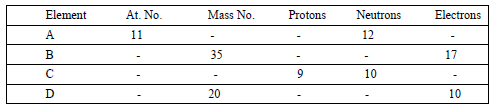
Question. Following data represent the distribution of electrons, protons and neutrons in atoms of four elements A, B, C, D.
(a) Give the electronic distribution of element B.
(b) The valency of element A.
(c) The atomic number of element B.
(d) The mass number of element D.
Answer:
(a) Element B has 16 electrons, so its electronic configuration is 2, 8, 6.
(b) Element A has 9 electrons (configuration 2, 7), so its valency is \( 8 - 7 = 1 \).
(c) Atomic number of B = Number of protons = 16.
(d) Mass number of D = Protons (17) + Neutrons (22) = 39.
In simple words: Element B is sulphur (2, 8, 6), element A is fluorine (valency 1), the atomic number of B is 16, and the mass number of D is 39.
Exam Tip: Work out the electronic configuration of each element first to easily answer these structured sub-questions.
Question. Give a reason to explain why:
(a) isotopes of an element show identical chemical properties?
(b) the atomic masses of elements are in fractions?
(c) atoms combine with other atoms?
Answer:
(a) Isotopes have the same atomic number, meaning they have the identical number of electrons and valence electron configuration. Since chemical properties are determined by valence electrons, they behave identically in reactions.
(b) Many elements exist naturally as a mixture of different isotopes, each with a different mass. The fractional atomic mass is the weighted average of these isotopic masses based on their natural abundance.
(c) Atoms combine with other atoms to achieve a stable octet configuration (completely filled outer shell) like the nearest noble gas, which lowers their overall energy.
In simple words: Isotopes have the same outer electrons so they react the same way. Atomic masses are decimals because they are averages of different isotopes. Atoms combine to get a full outer shell and become stable.
Exam Tip: For part (b), use the key phrase "weighted average of naturally occurring isotopes" to secure full marks.
Question. (a) Describe the main features of Bohr’s model of an atom. Draw a neat and labelled diagram of energy levels.
(b) Which of the following pairs are isotopes and which are isobars?
(i) \( _{26}^{58}\text{A}, _{28}^{58}\text{B} \)
(ii) \( _{35}^{79}\text{X}, _{35}^{80}\text{Y} \)
Give reasons for your choice.
(c) Elements A and B have atomic numbers 18 and 16 respectively. Which of these two would be more reactive and why?
Answer:
(a) Features of Bohr's model:
1. Electrons orbit the nucleus only in certain permitted, non-radiating circular paths called discrete energy levels.
2. These levels are designated as K, L, M, N... or \( n = 1, 2, 3, 4 \)...
3. Electrons do not lose energy while they remain in a particular energy level.
4. Energy is absorbed or released only when an electron jumps from one energy level to another.
(b) (i) \( _{26}^{58}\text{A} \) and \( _{28}^{58}\text{B} \) are **isobars** because they have different atomic numbers (26 and 28) but the same mass number (58).
(b) (ii) \( _{35}^{79}\text{X} \) and \( _{35}^{80}\text{Y} \) are **isotopes** because they have the same atomic number (35) but different mass numbers (79 and 80).
(c) Element B (Z=16, configuration 2, 8, 6) is more reactive because it needs only 2 electrons to complete its octet. Element A (Z=18, configuration 2, 8, 8) is a noble gas (Argon) with a completely filled valence shell, making it highly stable and unreactive.
In simple words: Bohr's model states electrons stay in fixed orbits without losing energy. Isobars have the same mass but different atomic numbers, while isotopes have the same atomic number but different masses. Element B is reactive because it wants to fill its outer shell, while A is already full and inert.
Exam Tip: When labeling Bohr's diagram, make sure the energy levels are labeled clearly from the center outward as n = 1 (K), n = 2 (L), n = 3 (M).
Question. Choose the noble gases from the elements shown in the table below:
| Element | A | B | C | D |
|---|---|---|---|---|
| Mass number | 4 | 40 | 27 | 20 |
| No. of neutrons | 2 | 22 | 13 | 10 |
Answer:
To identify noble gases, we calculate the number of protons (which equals the number of electrons in a neutral atom): \( \text{Protons} = \text{Mass number} - \text{Number of neutrons} \).
- For A: Protons = 4 - 2 = 2. Electronic configuration = 2 (filled K shell - duplet complete). Thus, A is Helium (Noble gas).
- For B: Protons = 40 - 22 = 18. Electronic configuration = 2, 8, 8 (filled outer shell - octet complete). Thus, B is Argon (Noble gas).
- For C: Protons = 27 - 13 = 14. Electronic configuration = 2, 8, 4 (incomplete outer shell).
- For D: Protons = 20 - 10 = 10. Electronic configuration = 2, 8 (filled outer shell - octet complete). Thus, D is Neon (Noble gas).
Therefore, A, B and D are noble gases.
In simple words: Noble gases have full outer shells. Elements A (Helium), B (Argon), and D (Neon) all have completely filled valence shells, making them noble gases.
Exam Tip: Always show the calculation for finding the proton count before writing down the electronic configuration to justify your selection.
Question. The mass number and electronic configuration of five elements A, B, C, D and E are as follows:
(a) Name the elements which has 22 neutrons in nucleus.
(b) What is atomic number of C?
(c) Name the elements which will form most stable ionic bond.
(d) Give the formation of the compound between B and D.
(e) Name the elements which will not take part in chemical combination.
Answer:
(a) Element E has atomic number 18 (2+8+8). Neutrons = Mass number - Protons = 40 - 18 = 22. So, the element is E.
(b) The atomic number of C (configuration 2, 8, 1) is 11.
(c) Element B (needs 1 electron) and Element C (loses 1 electron) will form the most stable ionic bond (compound CB, which is Sodium Fluoride).
(d) Element B has valency 1, and Element D has valency 4. They form a compound with the formula \( \text{DB}_4 \).
(e) Element E has a completely filled outer shell (2, 8, 8) and will not take part in chemical combination.
In simple words: Element E has 22 neutrons. C has an atomic number of 11. B and C form the most stable ionic bond. B and D form a compound with formula \( \text{DB}_4 \). Element E is a noble gas and does not react.
Exam Tip: For part (c), ionic bonds are formed between highly electropositive metals (like C) and highly electronegative non-metals (like B).
Question. The mass number and the electronic configurations of the following elements and write the number of valence electrons present in it.
(a) \( _7\text{N}^{14} \)
(b) \( _{14}\text{Si}^{28} \)
(c) \( _{20}\text{Ca}^{40} \)
(d) \( _{18}\text{Ar}^{40} \)
(e) \( _4\text{Be}^9 \)
Answer:
| Element | Electronic Configuration | Valence Electrons | |||
|---|---|---|---|---|---|
| K | L | M | N | ||
| (a) Nitrogen (N) | 2 | 5 | - | - | 5 |
| (b) Silicon (Si) | 2 | 8 | 4 | - | 4 |
| (c) Calcium (Ca) | 2 | 8 | 8 | 2 | 2 |
| (d) Argon (Ar) | 2 | 8 | 8 | - | 8 |
| (e) Beryllium (Be) | 2 | 2 | - | - | 2 |
In simple words: The valence electrons are simply the count of electrons located in the very last shell of each element's electronic configuration.
Exam Tip: Keep your electronic configurations organized by K, L, M, N shells to ensure you do not miscount the valence electrons.
Question. Complete the following table.
| Particle | Atomic No. (Z) | Mass no. (A) | No. of electrons (e) | No. of protons (p) | No. of neutrons (n) |
|---|---|---|---|---|---|
| F | 9 | .... | .... | .... | 10 |
| \( \text{Mg}^{2+} \) | .... | 24 | .... | 12 | .... |
| S | .... | 32 | .... | 16 | .... |
| \( \text{P}^{3-} \) | .... | .... | 18 | .... | 16 |
Answer:
| Particle | Atomic No. (Z) | Mass no. (A) | No. of electrons (e) | No. of protons (p) | No. of neutrons (n) |
|---|---|---|---|---|---|
| F | 9 | 19 | 9 | 9 | 10 |
| \( \text{Mg}^{2+} \) | 12 | 24 | 10 | 12 | 12 |
| S | 16 | 32 | 16 | 16 | 16 |
| \( \text{P}^{3-} \) | 15 | 31 | 18 | 15 | 16 |
In simple words: Protons equal the atomic number. Mass number is protons plus neutrons. Electron count changes when an atom becomes a charged ion by losing or gaining electrons.
Exam Tip: Be extremely careful with ions: a positive charge means fewer electrons, while a negative charge means more electrons than the proton number.
Question. Summarize the rules for the writing of the distribution of electrons in various shells for the first eighteen elements.
Answer: The Bohr-Bury rules for distributing electrons in different shells are:
1. Maximum Capacity Rule: The maximum number of electrons that can be held in any shell is given by the formula \( 2n^2 \), where \( n \) is the shell number. Thus, K-shell (\( n=1 \)) holds 2, L-shell (\( n=2 \)) holds 8, and M-shell (\( n=3 \)) holds 18 electrons.
2. Outermost Shell Limit: The outermost shell of an atom cannot hold more than 8 electrons, regardless of its maximum capacity.
3. Stepwise Filling Rule: Electrons are filled in a stepwise manner from the innermost shell outward. A outer shell is not filled until the inner shells are completely occupied.
In simple words: The first shell holds 2 electrons, and the outer shells hold up to 8. Electrons must fill the inside shells completely before they can start filling the outer ones.
Exam Tip: State all three rules clearly: the \( 2n^2 \) formula, the maximum of 8 in the valence shell, and the sequential filling order.
Question. The description of atomic particles of two elements X and Y is given below:
| Element | Protons | Neutrons | Electrons |
|---|---|---|---|
| X | 8 | 8 | 8 |
| Y | 8 | 9 | 8 |
(i) What is the atomic number of Y?
(ii) What is the mass number of X?
(iii) What is the relation between X and Y?
(iv) Which element/elements do they represent?
(v) Write the electronic configuration of X?
(vi) Write the cation/anion formed by the element
Answer:
(i) The atomic number of Y is 8 (since it has 8 protons).
(ii) The mass number of X is 16 (8 protons + 8 neutrons).
(iii) X and Y are isotopes because they have the same atomic number (8) but different mass numbers (16 and 17).
(iv) They represent the element Oxygen.
(v) The electronic configuration of X is 2, 6.
(vi) Since Oxygen has 6 valence electrons, it gains 2 electrons to complete its octet and forms an anion \( \text{O}^{2-} \).
In simple words: Both are isotopes of oxygen. X has a mass of 16 and Y has a mass of 17. They have a configuration of 2, 6 and form a negative oxide ion (\( \text{O}^{2-} \)).
Exam Tip: Showing that both have the same proton count is the key to identifying them as isotopes of the same element (Oxygen).
Question. Which of the following are isotopes and which are isobars?
Argon, Protium, Calcium, Deuterium. Explain why the isotopes have similar chemical properties but they differ in physical properties?
Answer:
- Isotopes: Protium and Deuterium (both are isotopes of Hydrogen).
- Isobars: Argon and Calcium (both have a mass number of 40).
- Chemical properties: Isotopes have the same atomic number, meaning they have the identical number of electrons and valence electronic configuration. Since chemical properties depend on valence electrons, they show similar chemical behavior.
- Physical properties: Physical properties depend on the mass of the atom. Since isotopes have different mass numbers (due to different neutron counts), they have different physical properties like density, boiling point, and melting point.
In simple words: Protium and Deuterium are isotopes of hydrogen. Argon and Calcium are isobars. Isotopes have the same outer electrons, so they react the same way chemically, but they have different weights, which changes their physical properties.
Exam Tip: Distinguish clearly between chemical properties (electron-dependent) and physical properties (mass-dependent) in your explanation.
Question. Both helium (He) and beryllium (Be) have two valence electrons. Whereas He represents a noble gas element, Be does not. Assign reason.
Answer: Helium (\( Z = 2 \)) has only one energy shell, the K-shell, which has a maximum capacity of exactly 2 electrons. Since this sole shell is completely filled, Helium is extremely stable and acts as a noble gas.
Beryllium (\( Z = 4 \)) has the configuration 2, 2. Its outer shell is the L-shell, which has a maximum capacity of 8 electrons. Since the L-shell is not completely filled, Beryllium is reactive and behaves as a metal, not a noble gas.
In simple words: Helium's only shell is completely full with 2 electrons. Beryllium has 2 electrons in its outer shell, but that shell can hold up to 8, so it is not stable and reacts with other elements.
Exam Tip: Emphasize that the first shell (K) is fully satisfied with 2 electrons (duplet rule), while the second shell (L) requires 8 electrons (octet rule) for noble gas stability.
Question. Which of the two will be chemically more reactive ; element X with atomic number 17 or element Y with atomic number 16 ?
Answer: The electronic configurations of the two elements are:
- Element X (\( Z = 17 \)): 2, 8, 7
- Element Y (\( Z = 16 \)): 2, 8, 6
Element X needs only 1 electron to complete its stable octet, while Element Y needs 2 electrons. Because Element X requires only one electron, it has a stronger tendency to gain an electron, making it chemically more reactive than Element Y.
In simple words: Element X is chlorine (2, 8, 7) and Element Y is sulphur (2, 8, 6). Chlorine is more reactive because it only needs to grab 1 electron to fill its outer shell.
Exam Tip: Reactivity of non-metals increases as the number of electrons required to complete their outer octet decreases.
Question. An atom of an element has three electrons in the third shell which is the outermost shell. Write
1. the electronic configuration
2. the atomic number
3. number of protons
4. valency
5. the name of the element
Answer: 1. Electronic configuration: Since the third shell (M-shell) has 3 electrons, the K and L shells must be fully filled. This gives a configuration of 2, 8, 3.
2. Atomic number: \( 2 + 8 + 3 = 13 \).
3. Number of protons: 13.
4. Valency: 3 (since it can easily lose its 3 valence electrons to achieve stability).
5. Name of the element: Aluminium (Al).
In simple words: The element is aluminium, which has 13 protons and electrons, an arrangement of 2, 8, 3, and a valency of 3.
Exam Tip: Show the step-by-step logic to deduce the filled inner shells from the given outer shell electrons.
Question. (i) State the method of determining the valency of an element if its atomic number is given.
(ii) determine the valency of the following elements, the atomic numbers of which are given parenthesis. Chlorine (17), sulphur (16), Aluminium (13)
Answer: (i) Method to determine valency:
- Write the electronic configuration of the element using its atomic number.
- Identify the number of valence electrons (\( v \)) in the outermost shell.
- If \( v \le 4 \), then Valency = \( v \).
- If \( v > 4 \), then Valency = \( 8 - v \).
(ii) Valencies of the given elements:
- Chlorine (17): Configuration is 2, 8, 7. Since \( v = 7 > 4 \), Valency = \( 8 - 7 = 1 \).
- Sulphur (16): Configuration is 2, 8, 6. Since \( v = 6 > 4 \), Valency = \( 8 - 6 = 2 \).
- Aluminium (13): Configuration is 2, 8, 3. Since \( v = 3 \le 4 \), Valency = 3.
In simple words: To find valency, look at the outer electrons. If it has 1 to 4, that's its valency. If it has more, subtract the number from 8. Chlorine's is 1, Sulphur's is 2, and Aluminium's is 3.
Exam Tip: Always state the mathematical formula used for elements with more than 4 valence electrons (\( 8 - \text{valence electrons} \)).
Question. Find out the valency of the atoms represented by the Figs. (a) and (b)
Answer:- Atom (a): Has 8 electrons in its outermost shell (completely filled octet). Therefore, its combining capacity is zero, and its valency is 0.
- Atom (b): Has 7 electrons in its outermost shell. It needs 1 electron to complete its octet (\( 8 - 7 = 1 \)). Therefore, its valency is 1.
In simple words: Atom (a) has a full outer shell of 8, so its valency is 0. Atom (b) has 7 outer electrons, so it needs 1 more, making its valency 1.
Exam Tip: Count the electrons in the outermost ring carefully to determine whether you should use the valence electron count or subtract it from 8.
Please click on below link to download CBSE Class 9 Science Structure of The Atom Worksheet Set D
Free study material for Science
Download CBSE Practice Material: Class 9 Science Chapter 04 Structure of the Atom
Download Practice Sheet: Chapter 04 Structure of the Atom (Class 9 Science)
Access structured practice worksheets for Chapter 04 Structure of the Atom designed in alignment with the latest CBSE curriculum for Class 9 Science. These printable problem sets help students build accuracy and prepare effectively for school tests.
Concept Clarification for Chapter 04 Structure of the Atom
Each worksheet is structured around standard CBSE textbooks, allowing students to check their working steps and correct mistakes early in their revision.
Additional Study Resources for Class 9 Science
Wrap up your chapter revision by testing your knowledge against standard question formats. Everything on our platform is provided free of charge.
FAQs
You can download the teacher-verified PDF for CBSE Class 9 Science Structure of The Atom Worksheet Set 04 from StudiesToday.com. These practice sheets for Class 9 Science are designed as per the latest CBSE academic session.
Yes, our CBSE Class 9 Science Structure of The Atom Worksheet Set 04 includes a variety of questions like Case-based studies, Assertion-Reasoning, and MCQs as per the 50% competency-based weightage in the latest curriculum for Class 9.
Yes, we have provided detailed solutions for CBSE Class 9 Science Structure of The Atom Worksheet Set 04 to help Class 9 and follow the official CBSE marking scheme.
Daily practice with these Science worksheets helps in identifying understanding gaps. It also improves question solving speed and ensures that Class 9 students get more marks in CBSE exams.
All our Class 9 Science practice test papers and worksheets are available for free download in mobile-friendly PDF format. You can access CBSE Class 9 Science Structure of The Atom Worksheet Set 04 without any registration.