DIFFERENT CHEMICAL CHANGES
Reaction of iron with copper sulphate
(a) Iron with copper sulphate solution
Objectives: To study the reaction of iron with copper sulphate
Requirements: Iron nails, thread, test tubes, copper sulphate, distilled water, spatula, TT stand, sand paper, etc.
Points to remember:
1. Colour of pure iron is greyish
2. Colour of pure copper is brownish.
3. Aqueous solution of copper sulphate is blue due to the presence of Cu2+ ions and ferrous sulphate is light green due to the presence of Fe2+ ions.
4. Fe is more reactive than Cu. Due to their difference in reactivity, copper get deposited on iron when iron is kept in a solution of copper sulphate and metallic iron dissolves in water to form iron sulphate.
5. This is an example of a single displacement reaction.
Procedure:
1. Take 10 ml each of copper sulphate solution in two test tubes and keep on a TT stand.
2. Take two iron nails and clean them using a sand paper to remove any rust.
3. Put one iron nail in one of the test tubes.
4. After 15 minutes, take out the iron nail keep it on a filter paper next to the clean iron nail and compare them. Compare also the solutions in both the test tubes.
5. Record your observation in the following table.

Conclusions:
Fe displaces Cu from CuSO4 and forms FeSO4 in the solution hence the colour of the solution changes from light blue to pale green. The displaced copper gets deposited on iron nail. It appears as brown coating on iron nail
Precautions:
1. Iron nail should be clean; otherwise impurity such as rust will cause interference to the expected reaction.
2. During the experiment the test tube should not be disturbed. (The deposit of copper might fall off)
3. More the time taken better will be the result
(b) Burning of Magnesium in air
Objectives: To study the burning of Mg in air
Requirements: A strip of Mg ribbon, a pair of tongs, china dish, Bunsen burner, litmus paper, match box etc.
Points to remember:
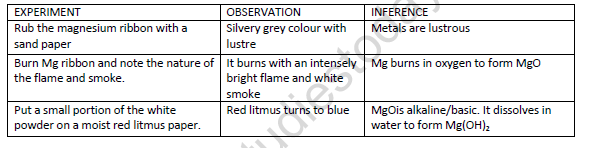
1. Mg is an active metal.It combines with oxygen to form magnesium oxide.
2. The reaction is an example of direct combination reaction.
3. MgO on dissolving (It is only partially soluble) in water gives a base magnesium hydroxide.
4. Both MgO and Mg(OH)2 turn red litmus blue.
Procedure:
1. Take a clean strip of Mg ribbon and burn it by showing to a Bunsen flame with the help of a pair of tongs.
2. Collect the white powder that is formed during burning in a china dish
Conclusions:
1. When Mg burns in air, it combines with oxygen (of air) to form a white powder of magnesium oxide. & MgO is basic in nature.
Precautions:
1. Mg ribbon should be clean
2. Avoid looking directly at the flame when the Mg ribbon burns as the intensity of the flame may damage your eye sight.
3. A pair of tongs should be used to hold the Mg ribbon while burning.
4. The white powder formed should not come in contact with your body partsReaction of Zinc with sulphuric acid
(c) Zinc with Dil.Sulphuric acid
Objectives: To study the chemical reaction between Zn and dil H2SO4 acid.
Points to remember:
1. Zn is an active metal. It has two valance electrons.
2. H2 is less reactive than Zn, so the following reaction takes place when Zn comes in contact with acid.
3. This reaction is an example of a single displacement.

Precautions:
1. Sulphuric acid should be handled carefully.
2. Use clean Zn granules.
Conclusion:
Zn is more reactive than hydrogen.
(d)Heating of Copper sulphate
Objective : To study the chemical reaction when hydrated copper sulphate is heated.
Apparatus: Test tubes ,bunsen burner ,hydrated copper sulphate,tongs ,spatula etc
Theory : The hydrated copper sulphate loses its water of crystallisation on heating
CuSO4.5H2O → CuSO4 + 5H2O
blue white
• It is a reversible chemical reaction
Procedure:
• Use safety goggle while heating..
• Be careful when you handle hot objects.
(e) Reaction between Sodium sulphate &Barium chloride
Objectives: To study the chemical reaction between Sodium sulphate and Barium Chloride.
Requirements: Solutions of Na2SO4 & BaCl2, test tubes etc.
Points to remember:
1. Sodium sulphate contains 2 sodium ions and one sulphate ion.
2. On mixing the solutions a double displacement reactions takes place.

Questions:
1. What is meant by displacement reaction? (Ans: A stronger element displaces a weaker element from its compound)
2. Which is more reactive? Copper or iron and why? (Ans: Fe is more reactive as it displaces Cu from its compounds)
3. Which is more reactive? Copper or iron and why? (Ans: Fe is more reactive as it displaces Cu from its compounds)
4. Which is more reactive? Copper or iron and why? (Ans: Fe is more reactive as it displaces Cu from its compounds)
5. What is the colour of copper sulphate solution before the experiment? (Blue/Peacock blue)
6. Which out of the following get coated on iron nail? What is its colour? (Copper oxide, copper sulphate, copper sulphide, copper metal) [Reddish brown ]
7. Why it is not advised not to look directly at the flame of a burning Mg piece? (Ans: intense dazzling flame may damage retina)
8. What is the colour of barium chloride solution? What is the colour of barium sulphate precipitate?
Please click on below link to download CBSE Class 9 Science Lab Worksheet Different Chemical Changes


