CBSE Class 9 Science Lab Worksheet law of Conservation of Mass

Access the latest CBSE Class 9 Science Lab Worksheet law of Conservation of Mass. We have provided free printable Class 9 Science worksheets in PDF format, specifically designed for Conservation of Mass. These practice sets are prepared by expert teachers following the 2025-26 syllabus and exam patterns issued by CBSE, NCERT, and KVS.

Conservation of Mass Science Practice Worksheet for Class 9

Students should use these Class 9 Science chapter-wise worksheets for daily practice to improve their conceptual understanding. This detailed test papers include important questions and solutions for Conservation of Mass, to help you prepare for school tests and final examination. Regular practice of these Class 9 Science questions will help improve your problem-solving speed and exam accuracy for the 2026 session.

Download Class 9 Science Conservation of Mass Worksheet PDF

 
LAB SHEET

LAW OF CONSERVATION OF MASS
 
 
Objective: To prove the law of conservation of mass in a chemical reaction.
 
Requirements: Conical flask ,test tubes ,barium chloride, sodium sulphate , cork , spring balance

Theory :
 
• According to law of conservation of mass, mass can neither be created nor destroyed in a chemical reaction.
 
• Total mass of reactants = Total mass of the products

Procedure:
 
• Prepare 5% solutions of barium chloride and sodium sulphate.
 
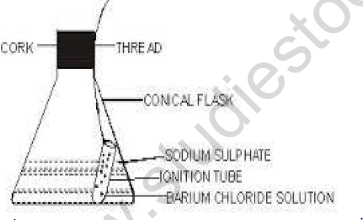
• Take 2ml of barium chloride solution in the conical flask and 2ml of sodium sulphate solution in the test tube.
 
• Suspend the test tube with sodium sulphate in the flask with the thread and cork as shown in the figure
CBSE Class 9 Science Lab Worksheet law of Conservation of Mass 1
 
• Weigh the complete system.
 
• Now loosen the cork so that the solution in the test tube mixes with the solution in the conical flask.
 
• Again weigh the complete system.
 
• Find the difference between the initial and final masses of the system.

Observation:
 
• A white precipitate of barium sulphate is formed on mixing barium chloride and sodium sulphate which shows the formation of the product.
 
• The mass of the reaction flask is found to remain unchanged, ie, mass remains same before and after the reaction.
 
Conclusions:
 
The above activity shows that in any chemical reaction, the total mass of the reactants is equal to the total mass of the products i.e; mass can neither be created nor be destroyed in a chemical reaction which proves the law of conservation of mass.
 
Precautions
 
1. The spring balance should be held vertical while in use.
 
2. Before making use of the spring balance it must be ensured that its pointer is at zero mark
 
3. The reading of the balance should be noted only when its pointer comes to rest.
 
4. Solutions should not get mixed before initial weighing

MULTIPLE CHOICE TYPE QUESTIONS
 
1. To identify the law of conservation of mass, a student added 10 mL of 5% barium chloride solution into 10 mL of 5% sodium sulphate solution. Which one of the following is the correct observation?
 
a) A clear solution is obtained
 
b) The solution turns to red colour
 
c) A yellow precipitate is formed
 
d) A white precipitate is formed
 
2. While veryfying the law of conservation of mass Smith added 3.5 g of magnesium metal into 13.7 g of hydrochloric acid. If the mass of magnesium chloride formed is 13.8 g , what is the mass of eliminated hydrogen gas if the law of conservation of mass of mass is correct.
 
a) 3.2 g     b) 3.4 g     c) 4.3 g      d) 5 g
 
3. In a chemical reaction one molecule of nitrogen reacts with three molecules of hydrogen to form ammonia. If the law of conservation of mass is correct what will be the number of atoms of nitrogen and hydrogen at the end of the reaction?
 
a) N = 2 , H = 6
 
b) N = 1 , H = 3
 
c) N = 6 , H = 2
 
d) N = 3 , H = 3
 
4. While verifying the law of conservation of mass, a student added 5 g of sodium bicarbonate to a test tube containing 14.5 g of acetic acid. The total mass of the reactant is 19.5 g but the mass of the product after the reaction is only 16.2 g. The reduction in the mass of the product is due to
 
a) Elimination of CO2 gas
 
b) Elimination of O2 gas
 
c) Liberation of heat
 
d) Elimination of CO gas
 
5. Which one of the following reactions is not suitable in the laboratory to verify the law of conservation of mass?
 
a) Mixing HCl and NaOH solution
 
b) Thermal decomposition of ferrous sulphate
 
c) Mixing copper sulphate and barium chloride solutions
 
d) Mixing lead nitrate and potassium iodide solutions
 
6. Lime stone(CaCO3) upon strong heating undergoes thermal decomposition to form lime(CaO) and CO2 gas. The mass of CaO and mass of CO2 formed by the decomposition of 25 g of CaCO3 are (RAM of Ca = 40, C = 12 , O = 16)
 
a) CaO= 28 , CO2 = 22
 
b) CaO= 14 , CO2 = 11
 
c) CaO= 22 , CO2 = 28
 
d) CaO= 11 , CO2 = 14
 
7. To verify the law of conservation of mass, which one of the following combinations can a student select to prove the law.
 
a) Copper sulphate and sodium sulphate
 
b) Sodium sulphate and sodium chloride
 
c) Copper sulphate and sodium carbonate
 
d) Sodium sulphate and sodium carbonate
 
8. For the verification of law of conservation of mass in a chemical reaction four students, A , B, C and D performed the following reactions:
 
A - Added calcium oxide to water
 
B - Heated ferrous sulphate crystals in a test tube.
 
C - Dipped iron nails in copper sulphate solution.
 
D - Added silver nitrate to calcium chloride.
 
The student who is likely to get the best result is,
 
a) A      b) B      c) C     d) D


Please click on below link to download CBSE Class 9 Science Lab Worksheet law of Conservation of Mass

Conservation of Mass CBSE Class 9 Science Worksheet

Students can use the Conservation of Mass practice sheet provided above to prepare for their upcoming school tests. This solved questions and answers follow the latest CBSE syllabus for Class 9 Science. You can easily download the PDF format and solve these questions every day to improve your marks. Our expert teachers have made these from the most important topics that are always asked in your exams to help you get more marks in exams.

NCERT Based Questions and Solutions for Conservation of Mass

Our expert team has used the official NCERT book for Class 9 Science to create this practice material for students. After solving the questions our teachers have also suggested to study the NCERT solutions  which will help you to understand the best way to solve problems in Science. You can get all this study material for free on studiestoday.com.

Extra Practice for Science

To get the best results in Class 9, students should try the Science MCQ Test for this chapter. We have also provided printable assignments for Class 9 Science on our website. Regular practice will help you feel more confident and get higher marks in CBSE examinations.

Where can I download latest CBSE Practice worksheets for Class 9 Science Conservation of Mass

You can download the CBSE Practice worksheets for Class 9 Science Conservation of Mass for the latest session from StudiesToday.com

Are the Class 9 Science Conservation of Mass Practice worksheets available for the latest session

Yes, the Practice worksheets issued for Conservation of Mass Class 9 Science have been made available here for the latest academic session

Is there any charge for the Practice worksheets for Class 9 Science Conservation of Mass

There is no charge for the Practice worksheets for Class 9 CBSE Science Conservation of Mass you can download everything free

How can I improve my scores by solving questions given in Practice worksheets in Conservation of Mass Class 9 Science

Regular revision of practice worksheets given on studiestoday for Class 9 subject Science Conservation of Mass can help you to score better marks in exams

Are there any websites that offer free Practice test papers for Class 9 Science Conservation of Mass

Yes, studiestoday.com provides all the latest Class 9 Science Conservation of Mass test practice sheets with answers based on the latest books for the current academic session