CBSE Class 9 Science Structure of The Atom Worksheet Set C

Access the latest CBSE Class 9 Science Structure of The Atom Worksheet Set C. We have provided free printable Class 9 Science worksheets in PDF format, specifically designed for Chapter 4 Structure of the Atom. These practice sets are prepared by expert teachers following the 2025-26 syllabus and exam patterns issued by CBSE, NCERT, and KVS.

Chapter 4 Structure of the Atom Science Practice Worksheet for Class 9

Students should use these Class 9 Science chapter-wise worksheets for daily practice to improve their conceptual understanding. This detailed test papers include important questions and solutions for Chapter 4 Structure of the Atom, to help you prepare for school tests and final examination. Regular practice of these Class 9 Science questions will help improve your problem-solving speed and exam accuracy for the 2026 session.

Download Class 9 Science Chapter 4 Structure of the Atom Worksheet PDF

 
STRUCTURE OF ATOM

WORKSHEET- IV
 
1 Mark Questions:
 
1.On the basis of Thomson’s model of an atom, explain how the atom is neutral as a whole?
 
2.Where are electrons found in the atom?
 
3. What are canal rays?
 
4.Why is the nucleus of an atom positively charged?
 
5.Why did Rutherford select a gold foil in his α-ray scattering experiment?
 
6. If Mg2+ has 12 protons and 12 neutrons, what is its atomic number and mass number?
 
7.What is the defect of Rutherford's atom model?
 
8.Define valency & give one example of a monovalent element.
 
9.An atom of an element has 7 electrons in its L-shell,name the element and write it's atomic number?
 
10.Why Mg atom gets 2+ charge when it loses two electrons ?
 
11.Name the particles which determine the mass of an atom.
 
12.Which of the following are isotopes and which are isobars? Argon, Protium, Calcium, Deuterium.
 
2 Mark Questions:
 
1.What observations in a scattering experiment led Rutherford to make the following conclusions:
 
i) Most of the space in an atom is empty.
 
ii) Nucleus is positively charged.
 
iii)Whole mass of an atom is concentrated in its centre.
 
2.What are alpha particles? How are they related to Helium gas?
 
3. State the characteristics of nucleus of an atom.
 
4. Describe Bohr’s model of the atom?
 
5.The atomic number of chlorine is 17 and mass number is 35.
 
a. What would be the electronic configuration of a negatively charged chloride ion, Cl- ?
 
b. What would be the atomic number and mass number of Cl- ?
 
6.What is electronic configuration and how is the valency of an atom related to it ?
 
7.Which of the two would be chemically more reactive element, X of atomic number 18 or Y of atomic number 17 &why?
 
8.What are isotopes? Why do isotopes show similar chemical properties but they differ in physical properties?
 
9.Write isotopes of uranium and its uses.
 
10.Write one pair of Isobars. Why the chemical properties of isobars are not similar?
 
3 Mark Questions:
 
1. Explain Rutherford's gold foil experiment with diagram
 
2.Write three points of difference between isotopes and isobars.
 
3.The average atomic mass of a sample of an element ‘X’ is 16.2u. What is the percentage of each isotope 16X and 18X in the sample?
 
4.Define valency of an element. Find the valency of chlorine and magnesium.
 
5.i)What is the similarity in the electronic structure of the following set of atoms?
 
Lithium, Sodium & Potassium.
 
ii) Which of the above element is most reactive and why?

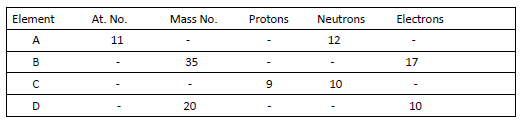
6.Complete the following table.


CBSE Class 9 Science Structure of The Atom Worksheet Set C


7.Give reason for the following
 
a) An atom is electrically neutral
 
b) Noble gases show least reactivity
 
c) Nucleus of an atom is heavy and positively charged.
 
d) Ions are more stable than atoms.
 
8. An element has an atomic number 12 and mass number 26.Draw a diagram showing the distribution of electrons in the orbits and the nuclear composition of the neutral atom. If this element X combines with another element Y whose electronic configuration is 2,8,7, what will be the formula of the compound thus formed?
 
9. Name the Scientists who have contributed the following towards the understanding of the atomic structure.
 
i) Discovery of electrons
 
ii) Canal rays
 
iii) Concept of nucleus
 
iv) Stationary orbits
 
v) Indivisibility of atoms
 
vi) Neutron
 
Value Based Question :
 
1.In Kaiga nuclear Power Corporation building, drinking water was found to be contaminated with tritium . It is highly radioactive.
 
a) What is tritium? Write its atomic number and mass number.
 
b) It is an isotope of which element?
 
c) Name the other two isotopes of the same element.
 
d) What precautions do you suggest so that this type of incident does not occur again?
 
e) What is meant by radioactive?
 
2. Most of the children burst crackers during Diwali. It creates a lot of noise pollution and air pollution. Asthma patients have tough time during Diwali. Many children get hurt due to mishandling of fire crackers. Poisonous gases like sulphur dioxide ,phosphorous pentoxide are formed.
 
a) Name two elements present in gun powder used in crackers.
 
b) Government has banned bursting of fire crackers after 10pm.Do you agree? Give reason.
 
c) Why should we not wear synthetic clothes while bursting crackers?


Please click on below link to download CBSE Class 9 Science Structure of The Atom Worksheet Set C

Chapter 4 Structure of the Atom CBSE Class 9 Science Worksheet

Students can use the Chapter 4 Structure of the Atom practice sheet provided above to prepare for their upcoming school tests. This solved questions and answers follow the latest CBSE syllabus for Class 9 Science. You can easily download the PDF format and solve these questions every day to improve your marks. Our expert teachers have made these from the most important topics that are always asked in your exams to help you get more marks in exams.

NCERT Based Questions and Solutions for Chapter 4 Structure of the Atom

Our expert team has used the official NCERT book for Class 9 Science to create this practice material for students. After solving the questions our teachers have also suggested to study the NCERT solutions  which will help you to understand the best way to solve problems in Science. You can get all this study material for free on studiestoday.com.

Extra Practice for Science

To get the best results in Class 9, students should try the Science MCQ Test for this chapter. We have also provided printable assignments for Class 9 Science on our website. Regular practice will help you feel more confident and get higher marks in CBSE examinations.

Where can I download the latest PDF for CBSE Class 9 Science Structure of The Atom Worksheet Set C?

You can download the teacher-verified PDF for CBSE Class 9 Science Structure of The Atom Worksheet Set C from StudiesToday.com. These practice sheets for Class 9 Science are designed as per the latest CBSE academic session.

Are these Science Class 9 worksheets based on the 2026 competency-based pattern?

Yes, our CBSE Class 9 Science Structure of The Atom Worksheet Set C includes a variety of questions like Case-based studies, Assertion-Reasoning, and MCQs as per the 50% competency-based weightage in the latest curriculum for Class 9.

Do you provide solved answers for CBSE Class 9 Science Structure of The Atom Worksheet Set C?

Yes, we have provided detailed solutions for CBSE Class 9 Science Structure of The Atom Worksheet Set C to help Class 9 and follow the official CBSE marking scheme.

How does solving CBSE Class 9 Science Structure of The Atom Worksheet Set C help in exam preparation?

Daily practice with these Science worksheets helps in identifying understanding gaps. It also improves question solving speed and ensures that Class 9 students get more marks in CBSE exams.

Is there any charge for the Class 9 Science practice test papers?

All our Class 9 Science practice test papers and worksheets are available for free download in mobile-friendly PDF format. You can access CBSE Class 9 Science Structure of The Atom Worksheet Set C without any registration.