Exercises
Question : Look at the activities listed below. Reason out whether or not work is done in the light of your understanding of the term ‘work’.
• Suma is swimming in a pond.
• A donkey is carrying a load on its back.
• A wind-mill is lifting water from a well.
• A green plant is carrying out photosynthesis.
• An engine is pulling a train.
• Food grains are getting dried in the sun.
• A sailboat is moving due to wind energy.
Answer :
• Suma is swimming in a pond.
Suma is doing work as she is able to move herself by applying force with the movement of her arms and legs in the water.
• A donkey is carrying a load on its back.
Donkey is not doing any work (in the sense of physics) as the weight he is carrying (the direction of force) and displacement are perpendicular to each other.
• A wind-mill is lifting water from a well.
Wind mill is lifting water from a well and doing work against the gravity.
• A green plant is carrying out photosynthesis.
No force and displacement are present here, so work done is zero.
• An engine is pulling a train.
During the pulling a train, engine does the work against the friction, present between the railway track and wheels.
• Food grains are getting dried in the sun.
During the drying the grains, there is no force as well as displacement is present. So, no work is done.
• A sailboat is moving due to wind energy.
Work is done by the wind as it moves the sailboat towards the direction of the force (force of blowing air).
Question : An object thrown at a certain angle to the ground moves in a curved path and falls back to the ground. The initial and the final points of the path of the object lie on the same horizontal line. What is the work done by the force of gravity on the object?
Answer : When the object moves upwards, the work done by gravity is negative (as the direction of gravitational force is towards the Earth’s center) and when the object come downwards, there is a positive work done. So, the total work down is zero in throughout the motion.
Question : A battery lights a bulb. Describe the energy changes involved in the process.
Answer : Battery converts chemical energy into electrical energy. This electrical energy is further converted into light and heat energy.
Question : A mass of 10 kg is at a point A on a table. It is moved to a point B. If the line joining A and B is horizontal, What is the work done on the object by the gravitational force? Explain your answer.
Answer : Zero. Because here angle between force of gravity and displacement is 90 degree (90°).
Now Work = W = F S Cosθ = FS Cos90° = 0 ( because Cos90°= 0)
Question : The potential energy of a freely falling object decreases progressively. Does this violate the law of conservation of energy? Why?
Answer : As the potential energy of the freely falling object decreases, its kinetic energy increases. The sum
total of the potential energy and the kinetic energy of the object during its free fall remains the same. Thus, the
law of conservation of energy is not violated.
Question : What are the various energy transformations that occur when you are riding a bicycle?
Answer : During riding a bicycle, the muscular energy of the rider is transformed into heat and mechanical energy. Kinetic energy provides motion to the bicycle and warmth energy heats our body.
Muscular energy → mechanical energy + heat
Question : Does the transfer of energy take place when you push a huge rock with all your might and fail to move it? Where is the energy you spend going?
Answer : No transfer of energy takes place when we push a huge rock unsuccessfully. The energy is spent for
the physical activity of muscles.
Question : Certain force acting on a 20 kg mass changes its velocity from 5 m s–1 to 2 m s–1. Calculate the work done by the force.
Answer :
Mass of the body = 20 kg
Initial velocity = 5 m/s
Final velocity = 2 m/s
We know that,
Work done = change in kinetic energy
= 1/2 mu2 −1/2mv2
= 1/2 m(u2 −mv2)
= 1/2 (20)(52 − 22)
= 10(25 − 4)
= 210 J
Question : A certain household has consumed 250 units of energy during a month. How much energy is this in joules?
Answer : We know that
1 unit = 3,600,000 J
So,
250 units = 250 × 3,600,000 J
= 900,000,000 J
= 9 × 10⁸ J
Hence, the energy consumed = 9 × 10⁸ J
Question : An object of mass 40 kg is raised to a height of 5 m above the ground. What is its potential energy? If the object is allowed to fall, find its kinetic energy when it is half-way down.
Answer : We know that, potential energy = mgh
Where, m = 40 kg
g = 9.8 m/s2
h = 5 m
So, the potential energy = 40 × 9.8 × 5 J = 1960 J
According to law of conservation of energy, the total mechanical energy (Kinetic and potential energy) of an object remains constant.
Therefore, when the object is half-way down, its potential energy become half the original energy and remaining half converted into kinetic energy.
Hence, the kinetic energy = ½ (1960) J = 980 J
Question : What is the work done by the force of gravity on a satellite moving round the Earth? Justify your answer.
Answer : When a satellite moves around the Earth, the displacement in short interval is along the tangential direction and the force (gravitational force) is towards the centre of the Earth. Since, the force and displacement are perpendicular to each other, the work done by gravitational force is zero.
Question : Can there be displacement of an object in the absence of any force acting on it?
Think. Discuss this question with your friends and teacher.
Answer : Yes, it is true. There may be displacement in the absence of force.
We know that, F = ma,
In the absence of force, F = 0, then ma = 0
⇒ a = 0 [as m ≠ 0]
If a = 0, the object is either at rest or in a state of uniform motion in a straight line. In case the object is moving in a straight line, there must be displacement.
So, in the absence of force, there may be displacement in the object.
Question : A person holds a bundle of hay over his head for 30 minutes and gets tired. Has he done some work or not? Justify your answer.
Answer : The person holding a bundle of hay get tired because his muscular energy is converting into thermal energy. There is no displacement at all, so he had no work.
As Work done = Force × displacement.
Question : An electric heater is rated 1500 W. How much energy does it use in 10 hours?
Answer : We know that, Energy = Power × time
Here, Power = 1500 W
Time = 10 hours = 10 × 60 × 60 seconds = 36000 seconds
Therefore,
The energy used by heater = Power × time
= 1500 × 36000 J
= 54000000 J
= 5.4 × 10⁷ J
Question : Illustrate the law of conservation of energy by discussing the energy changes which occur when we draw a pendulum bob to one side and allow it to oscillate. Why does the bob eventually come to rest? What happens to its energy eventually? Is it a violation of the law of conservation of energy?
Answer : In the given pendulum, there are three cases of points to be discussed.
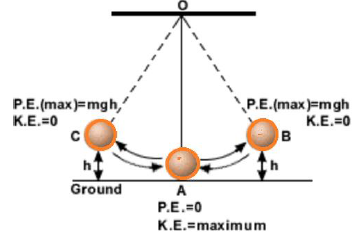
At the points B and C, the pendulum bob is at its maximum height, so its potential energy is maximum and kinetic energy is zero. In this way the total mechanical energy remains constant. At the point A, the pendulum bob is at its lowest point, total potential energy is converted into kinetic energy. Now the kinetic energy is maximum and potential energy is zero. Once again the total mechanical energy
remains constant.
Question : An object of mass, m is moving with a constant velocity, v. How much work should be done on the object in order to bring the object to rest?
Answer : The object is in motion, so its energy = kinetic energy = 1/2 mv2
The kinetic energy of the object, when it comes to rest = 0.
Work done on object = change in kinetic energy
=1/2 mv2 – 0
=1/2 mv2
Question : Calculate the work required to be done to stop a car of 1500 kg moving at a velocity of 60 km/h?
Answer : Mass of the car m = 1500 kg
Velocity of the car v = 60 km/h
= 60×1000 / 60×60
= 50/3 m/s
The car is in motion, so its energy = kinetic energy = 1/2 mv2
= 1/2 (1500) (50/3)2 J
= 1/2 × (1500) × 2500/9 J
= 208333.3 J
The kinetic energy of the car, when it comes to rest = 0 J
Work done on object = change in kinetic energy
= 208333.3 − 0 J
= 208333.3 J
Hence, the work required to stop the car is 208333.3 J.
Question : In each of the following a force, F is acting on an object of mass, m. The direction of displacement is from west to east shown by the longer arrow. Observe the diagrams carefully and state whether the work done by the force is negative,
positive or zero.

Answer : In the first case, the force and displacement are perpendicular to each other, so work done is zero.
In the second case, the force and displacement are in the same direction, so the work done is positive.
In the third case, the force and displacement are in the opposite direction, so the work done is negative.
Question : Soni says that the acceleration in an object could be zero even when several forces are acting on it. Do you agree with her? Why?
Answer : If the resultant force acting on a body in different directions is zero, then the acceleration will be zero.
We know that, F = ma,
In the net force is zero, F = 0, then ma = 0
⇒ a = 0 [as m ≠ 0]
Question : Find the energy in kW h consumed in 10 hours by four devices of power 500 W each.
Answer : The power of four devices = 4 × 500 W = 2000 W
Time = 10 hours
Therefore, the energy consumed = power × time
= 2000 × 10 Wh
= 20000 Wh
= 20 kWh
= 20 units [1 unit = 1 kWh]
Question : A freely falling object eventually stops on reaching the ground. What happens to its kinetic energy?
Answer : When a freely falling body eventually stops on reaching the ground, its kinetic energy gets converted into heat energy (as the body and ground become warm due to collision), sound energy and into potential energy (due to change of shape or deformation).
Question : What is work?
Answer : Work is defined as force acting upon an object to cause a displacement.
Question : Define constant force?
Answer : A constant force is any force acting on an object at an unchanging rate.
Question : What happens when the force acts opposite to the direction of displacement?
Answer : Work done is negative when the force acts opposite to the direction of displacement.
Question : Define 1J work?
Answer : 1 Joule is defined as the amount of work done by force of 1 N when displacement is 1 m.
Question : What is the unit of work?
Answer : Joule is the unit of work.
Click below to download practice worksheet for CBSE Class 9 Science Work and Energy Worksheet Set A

