

Official Class 9 Science Worksheets: Chapter 08 Force and Laws of Motion
Review targeted practice sets for Class 9 Science Chapter 08 Force and Laws of Motion. Built according to official educational guidelines for the 2026-27 academic year, these downloadable worksheets support daily revision and core concept reinforcement.
Chapter-wise Practice Material: Chapter 08 Force and Laws of Motion
Navigate directly to the printable exercises for Chapter 08 Force and Laws of Motion using the digital viewer below. Each practice set allows students to isolate specific topics for thorough review and uninterrupted practice alongside standard textbooks.
Short Answer
Question. An object has moved through a distance. Can it have zero displacement? If yes, support your answer with an example.
Answer : Yes,an object can have zero displacement even when it has moved through a distance.This happens when final position of the object coincides with its initial position. For example,if a person moves around park and stands on place from where he started then here displacement will be zero.
Question. Which of the following is true for displacement?
(a) It cannot be zero.
(b) Its magnitude is greater than the distance travelled by the object.
Answer : None of the statement is true for displacement First statement is false because displacement can be zero. Second statement is also false because displacement is less than or equal to the distance travelled by the object.
Question. Under what condition(s) is the magnitude of average velocity of an object equal to its average speed?
Answer : The magnitude of average velocity of an object is equal to its average speed, only when an object is moving in a straight line.
Question. What does the path of an object look like when it is in uniform motion?
Answer : An object having uniform motion has a straight line path.
Question. When will you say a body is in (i) uniform acceleration? (ii) nonuniform acceleration?
Answer :
(i) A body is said to be in uniform acceleration if it travels in a straight line and its velocity increases or decreases by equal amounts in equal intervals of time.
(ii) A body is said to be in nonuniform acceleration if the rate of change of its velocity is not constant.
Question. A train starting from a railway station and moving with uniform acceleration attains a speed 40 km h−1 in 10 minutes. Find its acceleration.
Answer :
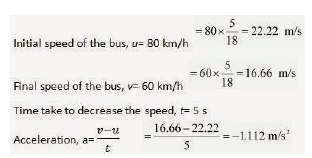
Question. What is the nature of the distance - 'time graphs for uniform and nonuniform motion of an object?
Answer : When the motion is uniform,the distance time graph is a straight line with a slope.
When the motion is non uniform, the distance time graph is not a straight line.It can be any curve.
Question. What can you say about the motion of an object if its speed - 'time graph is a straight line parallel to the time axis?
Answer : If speed time graph is a straight line parallel to the time axis, the object is moving uniformly.
Question. A ball is gently dropped from a height of 20 m. If its velocity increases uniformly at the rate of 10 m s−2, with what velocity will it strike the ground? After what time will it strike the ground?
Answer : Let us assume, the final velocity with which ball will strike the ground be 'v' and time it takes to strike the ground be 't'
Initial Velocity of ball, u =0
Distance or height of fall, s =20 m
Downward acceleration, a =10 m s-2
As we know, 2as =v2-u2
v2 = 2as+ u2
= 2 x 10 x 20 + 0
= 400
∴ Final velocity of ball, v = 20 ms-1
t = (v-u)/a
∴Time taken by the ball to strike = (20-0)/10
= 20/10
= 2 seconds
Free study material for Science
Exam Preparation Worksheet for Class 9 Science Chapter 08 Force and Laws of Motion
Chapter Practice Questions for Class 9 Science
Access structured practice worksheets for Chapter 08 Force and Laws of Motion designed in alignment with the latest CBSE curriculum for Class 9 Science. These printable problem sets help students build accuracy and prepare effectively for school tests.
Expert Practice Material for Class 9 Science
Cross-reference your completed exercises with comprehensive NCERT solutions for Class 9 Science to ensure absolute clarity across all sub-topics in this chapter.
Complete Your Chapter Revision
Wrap up your chapter revision by testing your knowledge against standard question formats. Everything on our platform is provided free of charge.
FAQs
You can download the teacher-verified PDF for CBSE Class 9 Science Force and Laws of Motion Worksheet Set 02 from StudiesToday.com. These practice sheets for Class 9 Science are designed as per the latest CBSE academic session.
Yes, our CBSE Class 9 Science Force and Laws of Motion Worksheet Set 02 includes a variety of questions like Case-based studies, Assertion-Reasoning, and MCQs as per the 50% competency-based weightage in the latest curriculum for Class 9.
Yes, we have provided detailed solutions for CBSE Class 9 Science Force and Laws of Motion Worksheet Set 02 to help Class 9 and follow the official CBSE marking scheme.
Daily practice with these Science worksheets helps in identifying understanding gaps. It also improves question solving speed and ensures that Class 9 students get more marks in CBSE exams.
All our Class 9 Science practice test papers and worksheets are available for free download in mobile-friendly PDF format. You can access CBSE Class 9 Science Force and Laws of Motion Worksheet Set 02 without any registration.