
CBSE Class 12 Accountancy Fundamentals Worksheet Set 02

Class 12 Accountancy Practice Set: Part 1 Chapter 01 Accounting for Partnership Basic Concepts

Explore reliable practice materials for Part 1 Chapter 01 Accounting for Partnership Basic Concepts tailored for Class 12 learners. Utilizing these Accountancy worksheets ensures thorough preparation and strengthens problem-solving speed for upcoming school assessments.

Download Part 1 Chapter 01 Accounting for Partnership Basic Concepts Worksheet PDF

Access the complete worksheet PDF for Part 1 Chapter 01 Accounting for Partnership Basic Concepts below. Regular practice with these targeted questions builds familiarity with standard exam patterns and helps secure higher marks in final Accountancy evaluations.

Interest on Drawings
 
1 Mr. A withdrew Rs 1, 20,000 p.a. @10% p.a. Calculate interest on drawing of Mr. A at the end of the financial year
(Ans Rs 6,000)
 
2 Mr. B withdrew Rs 1, 20,000 p.a. @10% Calculate the interest on drawings of Mr. B at the end of the financial year (Ans Rs 12,000)
 
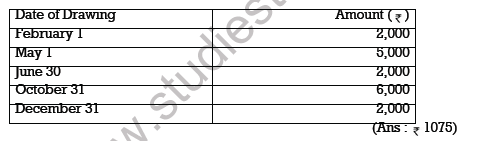
3 In a partnership, partners are charged interest on drawings @15% p.a. During the year ended 31st December, 2013 a partner drew as follows Calculate interest on drawing

CBSE Class 12 Accountancy Fundamentals Worksheet Set B 1

4 Calculate interest on drawings of Rajesh @10% p.a. for the year ended 31st December, 2014 in each of the below mentioned cases
 
(a) If he withdrew Rs 2,000 per month in the beginning of every month
(Ans : Rs 1,300)
 
(b) If he withdrew Rs 2,000 per month in the end of every month
(Ans :Rs  1,100)
 
(c) If he withdrew Rs 2,000 per month in the middle of every month
(Ans : Rs 1,200)
 
5 Calculate interest on drawings of Shiv @10% p.a. for the year ended 31st December, 2014 in each of the below mentioned cases
 
(a) If he withdrew Rs  2,000 per quarter in the beginning of every quarter
(Ans : Rs 500)
 
(b) If he withdrew Rs 2,000 per quarter in the end of every quarter
(Ans : Rs 300)
 
(c) If he withdrew Rs 2,000 per quarter in the middle of every quarter
(Ans :Rs  400)
 
6 Mr. X and Mr. Y started business on 1st April, 2013 with capitals of 5, 00,000 and 3,00,000 respectively Calculate interest on drawings of Mr. X @10% p.a. for the year ended 31st December 2015 in each of the following alternative cases :
(a) If he withdrew Rs 2,000 per month in the beginning of every month
(Ans : Rs 750)
 
(b) If he withdrew Rs 2,000 per month in the end of every month
(Ans :Rs 600)
 
(c) If he withdrew Rs 2,000 per month in the middle of every month
(Ans :Rs Rs 675)
 
(d) If he withdrew Rs  6,000 in the beginning of every quarter
(Ans : Rs 900)
 
(e) If he withdrew Rs 6,000 in the end of every quarter
(Ans : Rs 450)
 
(f) If he withdrew Rs 6,000 in per quarter
(Ans : Rs 675)
 
Interest on Capital
 
7 L and M started business on 1st April, 2013 with capitals of Rs 3, 00,000 and Rs 1, 80,000 respectively There is no withdrawal or addition of capital during the year Calculate the interest on capital @ 12% p.a. for the year (a) 31st March, 2014 and (b) on 31st December, 2013
 
(Ans (a) L 36, 000; M 21,600 (b) L 27,000; M 16,200)
 
8 X and Y started business on 1st April, 2015 with capitals of Rs 3, 00,000 and 1, 80,000 respectively On 1st May 2015 he introduced an additional capital of Rs 60, 000 and Y withdrew 30, 000 from his capital On 1st October 2015, X withdrew Rs 1, 20,000 from his capital and Y introduced 1, 50,000 Interest on capital is allowed @6% p.a. Calculate the interest on capital for the year ending 31st March, 2016
 
(Ans: IOC of X Rs 17,700 and IOC of Y Rs 13,650)
 
9 On 31st March 2013 after the close of A/c, the capital accounts of Mr. X and Mr. Y stood in the books of the firm at Rs 2, 40,000 and Rs 3, 00,000 respectively On 1st May, 2012, Mr. X introduced an additional capital of Rs 60,000 and Mr. Y withdrew Rs 30,000 from his capital On 1st October, 2012, Mr. X withdrew Rs 1, 20,000 from his capital and Y introduced Rs 1, 50,000 Interest on capital is allowed @6% p.a. Calculate the interest on capital for the year ending 31st March, 2013
 
(Ans : Total IOC of Mr. X Rs 17,700 and Mr. Y Rs 13, 650)
 
10 Leena and Kavita are partners sharing the profits and losses in the ratio of 2:3 with capitals of Rs 20,000 and Rs 10,000 respectively Show the distribution of profit/loss for the year 2015 by preparing the relevant account in each of the following in the below cases
 
(a) If the partnership deed is silent as to the interest on capital and the trading profits for the year are Rs 1,600
(Ans : Divisible Profit Leena Rs 640; Kavita Rs 960)
 
(b) If the partnership deed provides for interest on capital @6% and the trading losses for the year are Rs 1,600
(Ans : Divisible Loss Leena Rs 640; Kavita Rs 960)
 
(c) If the partnership deed provides for interest on capital @6% and the trading profits for the year are Rs 2,200
(Ans : Divisible Profit Leena Rs 160; Kavita Rs 240)
 
(d) If the partnership deed provides for interest on capital @6% and the trading profits for the year are Rs 1,650
(Ans : Divisible Profit Leena Rs 1,100; Kavita Rs 550)
 
(e) If the partnership deed provides for interest on capital @6% even if it involves


Please click on below link to download CBSE Class 12 Accountancy Fundamentals Worksheet Set B

Download CBSE Practice Material: Class 12 Accountancy Part 1 Chapter 01 Accounting for Partnership Basic Concepts

CBSE Practice Material: Class 12 Accountancy Part 1 Chapter 01 Accounting for Partnership Basic Concepts

Explore reliable practice questions for Part 1 Chapter 01 Accounting for Partnership Basic Concepts tailored for Class 12 Accountancy learners. Use these structured worksheets to evaluate preparedness and strengthen problem-solving skills.

NCERT-Aligned Questions and Solutions

Built using the official NCERT book for Class 12 Accountancy, these practice materials provide reliable academic guidance. Pair your practice with our recommended NCERT solutions to master optimal problem-solving approaches.

Next Steps in Your Exam Preparation

Explore our broader library of printable assignments, chapter notes, and mock tests designed to support continuous revision and secure higher marks in CBSE assessments.

FAQs

Where can I download the latest PDF for CBSE Class 12 Accountancy Fundamentals Worksheet Set 02?

You can download the teacher-verified PDF for CBSE Class 12 Accountancy Fundamentals Worksheet Set 02 from StudiesToday.com. These practice sheets for Class 12 Accountancy are designed as per the latest CBSE academic session.

Are these Accountancy Class 12 worksheets based on the 2026-27 competency-based pattern?

Yes, our CBSE Class 12 Accountancy Fundamentals Worksheet Set 02 includes a variety of questions like Case-based studies, Assertion-Reasoning, and MCQs as per the 50% competency-based weightage in the latest curriculum for Class 12.

Do you provide solved answers for CBSE Class 12 Accountancy Fundamentals Worksheet Set 02?

Yes, we have provided detailed solutions for CBSE Class 12 Accountancy Fundamentals Worksheet Set 02 to help Class 12 and follow the official CBSE marking scheme.

How does solving CBSE Class 12 Accountancy Fundamentals Worksheet Set 02 help in exam preparation?

Daily practice with these Accountancy worksheets helps in identifying understanding gaps. It also improves question solving speed and ensures that Class 12 students get more marks in CBSE exams.

Is there any charge for the Class 12 Accountancy practice test papers?

All our Class 12 Accountancy practice test papers and worksheets are available for free download in mobile-friendly PDF format. You can access CBSE Class 12 Accountancy Fundamentals Worksheet Set 02 without any registration.