CBSE Class 12 Accountancy Dissoultion of Partnership Firm Worksheet Set C

Access the latest CBSE Class 12 Accountancy Dissoultion of Partnership Firm Worksheet Set C. We have provided free printable Class 12 Accountancy worksheets in PDF format, specifically designed for Part 1 Chapter 4 Dissolution of Partnership Firm. These practice sets are prepared by expert teachers following the 2025-26 syllabus and exam patterns issued by CBSE, NCERT, and KVS.

Part 1 Chapter 4 Dissolution of Partnership Firm Accountancy Practice Worksheet for Class 12

Students should use these Class 12 Accountancy chapter-wise worksheets for daily practice to improve their conceptual understanding. This detailed test papers include important questions and solutions for Part 1 Chapter 4 Dissolution of Partnership Firm, to help you prepare for school tests and final examination. Regular practice of these Class 12 Accountancy questions will help improve your problem-solving speed and exam accuracy for the 2026 session.

Download Class 12 Accountancy Part 1 Chapter 4 Dissolution of Partnership Firm Worksheet PDF

Dissolution of Partnership Firm
 

Question. Unrecorded assets when realised is credit to
(a) Partners capital A/c
(b) Realisation A/c
(c) Current Account
(d) None of the options

Answer: B

Question. At the time of dissolution of a firm, Debtors were Rs. 17,000 out of which Rs. 500 became bad and the rest realised 60%. Which account will be debited and by how much amount?
(a) Realisation Account by Rs. 16,500.
(b) Profit and Loss Account by Rs. 500.
(c) Cash Account by Rs. 9,900.
(d) Debtors Account by Rs. 7,100.

Answer: C

Question. Deceased partners share of profit is to be transferred to his account by:
(a) P/L Suspense A/c
(b) P/L Adjustment A/c
(c) P/L Appropriation A/c
(d) Revaluation Account

Answer: A

Question. Which is the main right of a partner?
(a) Stop other partners for drawings
(b) Share the old profits of the firm
(c) Share the Profits of the firm.
(d) All of the options

Answer: C

Question. Section ____ of the Indian Partnership Act provides that a new partner shall not be inducted into a firm without the consent of all existing partners
(a) 31
(b) 35
(c) 40
(d) 45

Answer: A

Question. Revaluation Account is also known as ________
(a) Asset Account
(b) Profit and Loss Account
(c) Profit and Loss Adjustment Account
(d) None of the options

Answer: C

Question. Except outgoing partner, which other partner can be credited at the time of settlement of goodwill amount?
(a) Sacrificing partner
(b) Gaining partner
(c) All the partners
(d) None of the options

Answer: A

Question. At the time of dissolution of firm, at which stage the balance of partner’s capital accounts is paid?
(a) After making the payment to third party’s loans
(b) Before making the payment of partners in respect of their loans
(c) After making the payment to third party for their loans as well as partners loans
(d) None of the above.

Answer: C

Question. On taking responsibility of payment of realisation expenses by a partner, the account credited will be :
(a) Realisation Account
(b) Cash Account
(c) Capital Account of the Partnei
(d) None of the Above

Answer: C

Question. On payment of expenses of dissolution, account will be debited :
(a) Realisation Account
(b) Cash Account
(c) Profit & Loss Account
(d) None of the Above

Answer: A

Question. On dissolution of a firm, partners’ capital accounts balance was Rs.63,000; creditors balance was Rs. 12,000 and profit & loss account debit balance was Rs.6,000. Profit on realisation of assets was Rs.7,800. Total amount realised from assets was:
(a) Rs.81,000
(b) Rs.76,800
(c) Rs.70,800
(d) None

Answer: B

Question. On dissolution, Goodwill Account is transferred to
(a) In the Capital Accounts of Partners.
(b) On the Credit of Cash Account.
(c) On the Debit of Realisation Account
(d) On the Credit of Realisation Account.

Answer: C

Question. On dissolution, if a partner undertakes to make payment of a liability of the firm, the account to be debited is:
(a) profit & Loss Account
(b) Realisation Account
(c) Partner’s Capital Account
(d) Cash Account

Answer: B

Question. Unrecorded liabilities when paid are shown in :
(a) Debit side of Realisation Account
(b) Debit side of Bank Account
(c) Credit side of Realisation Account
(d) Credit side of Bank Account

Answer: A

Question. The modes by which a firm may be dissolved are
(a) By Mutual agreement
(b) Compulsory Dissolution
(c) By Notice
(d) All of the options

Answer: D

Question. At the time of dissolution of the firm , if goodwill appears in the balance sheet , it is transferred to
(a) Realisation A/c
(b) Revaluation A/c
(c) Capital A/c
(d) Current Account

Answer: A

Question. Reason for preparing Profit and Loss suspense Account is to
(a) Adjust the profit of deceased partner
(b) Adjust the Revaluation profit
(c) Adjust the capital of deceased partner
(d) Adjust the Revaluation loss

Answer: A

Question. On dissolution of the firm , all assets are transferred to realisation account at
(a) Market Value
(b) Cost value
(c) Book Value
(d) None of the options

Answer: C

Question. Give circumstances under which the fixed capitals of partners may change
(a) Both
(b) When fresh capital is introduced by the partner
(c) When a part of capital is withdrawn by the partner
(d) None of the options

Answer: A

Question. ............ is prepared at the time of dissolution :
(a) Revaluation Account
(b) Profit & Loss Account
(c) Profit and Loss Appropriation Account
(d) Realisation Account

Answer: D
 
ALL questions are Compulsory.
 
I. Following QUESTIONS are of 3 Marks.
 
Question. A,B and C are partners in a firm sharing profits and losses in the ratio 2:2:1. The firm was dissolved on 31 Jan.2016. On that date the profit and loss account showed a debit balance of Rs 10000, and General Reserve a balance of Rs 15,000. Pass necessary journal entries.
 
Question. A and B were partners sharing profits and losses in the Capital ratio, which was 3:2. They agreed to dissolve the firm on 31st March 2012. Following information were available; Creditors Rs 18,000; Sundry Assets Rs 77,000; Cash Rs 13,000 ; B’s Loan Rs 12,000. Find the value of Capital of A and B.
 
Question. All the partners want to dissolve the firm. Y, a partner wants that his loan of Rs 20,000 must be paid off before the payment of capitals to the partners. But X another partner wants that capitals must be paid before the payment of Y’s loan .State who is correct?
 
Question. O and P were partners in a firm sharing profits and losses equally. Their firm was dissolved on 15th March , 2012, which resulted in a loss of Rs 50,000 .On that date the capital account of O showed a credit balance of Rs 40,000 and capital account of P showed a credit balance of Rs 50,000 .There was a cash balance of Rs 40,000 on the date of dissolution.
 
You are required to pass the necessary journal entries for the (i) transfer of loss to the capital accounts of the partners and (ii) making final payment to the partners.
 
Question. A and B were partners from 1.1.20X1 with capitals of Rs 60,000 and Rs 40,000 respectively. They shared profits in the ratio of 3:2. They carried on business for two years . In the first year ending on 31.12.20X1, they made a profit of Rs 50,000 but in the second year ending on 31.12.20X2. a loss of `20,000 was incurred. As the business was no longer profitable, they dissolved the firm on 31.12.20X2. Creditors on that date were Rs 20,000 .Each partner withdrew for personal use ,Rs 8,000 per year . The expenses of realization were Rs 3,000. The assets realized Rs 1,00,000 . Prepare Realization Account, Partners Capital Accounts and Cash Account.
 
Question. A and B were partners sharing profits as 3:2. They dissolved their firm on December 31,2003. On that date their capitals were `1,50,000 and `2,00,000 respectively. Creditors were 50,000. General reserve of Rs 30,000 and cash at bank Rs 80,000. All the assets realized Rs 2,20,000. The expenses of realization came to be Rs 500. Close the books of the firm.
 
II. Following QUESTIONS are of 6 Marks.
 
Q.7. What journal entries would be passed for the following transactions on the dissolution of a firm, after various assets (other than cash) and third party liabilities have been transferred to Realization account.
 
(i) Bank loan Rs 12,000 is paid.
 
(ii) Stock worth Rs 6,000 is taken over by partner B
 
(iii) Expenses on dissolution amounted to Rs 1,500 and were paid by partner A.
 
(iv) A typewriter completely written off in the books of accounts was sold for `200.
 
(v) Loss on realisation Rs 14,000 was to be distributed between A and B in the ratio 5:2.
 
(vi) An unrecorded asset taken over by Partner A worth Rs 4,000.
 
(vii) Dissolution expenses amount to Rs 700.
 
(viii) Creditors of `30,000 are discharged by paying Rs 27,000.
 
(ix) Profit on realisation amounting Rs 6,000 is to be distributed between the partners A and B In the ratio 7:5.
 
(x) There was a joint life policy for Rs 60,000. The policy was surrendered for Rs 15,000.
 
(xi) Total creditors in the books Rs 40,000. Office equipment was accepted by a creditor for Rs 7,000 in full settlement and remaining creditors were paid in full by cheque.
 
(xii) During the course of realisation a liability under action for damages was settled at Rs 12,000 against Rs 10,000 included in creditors. Total Creditors Rs 20,000.
 
(xiii) Investment worth Rs 10,000 taken over by partner A against his loan in full settlement.
 
(xiv) Partner B had taken a loan from insurers for Rs 5,000 on the security of the joint life policy. The policy was surrendered and insurers paid a sum of `6,200 after deducting Rs 5000 for B’s loan and Rs 300 interest thereon.
 
(xv) Partner A promised to pay off Mrs. A’s loan of Rs 9,000.
 
(xvi) Partner B agreed to bear all realisation expenses. For this service B is paid Rs 1,100. Actual expenses amounted to Rs 1,800.
 
(xvii) Out of the total Creditors Rs 40,000, one of the creditors agreed to accept Debtors amounting Rs 20,000 at Rs 17,900 and balance paid in cheque.
 
(xviii) Partner A’s loan Rs 3,000 paid in cash.
 
(xix) Mrs. A’ s loan Rs 5,000 paid in cheque.
 
(xx) Furniture worth Rs 15,000 taken over by Creditors.
 
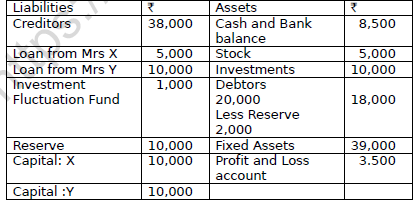
Q.8. The following is the Balance sheet of X and Y on 30th June 2011.

CBSE Class 12 Accountancy Dissoultion of Partnership Firm Worksheet Set C 1

The firm was dissolved on 30th June 2011 and the following arrangement was decided upon:
(a)X agreed to pay off his Brother’s loan. (b) Debtors of Rs 5,000 proved bad.
(c) Other assets realized as follows: Plant 20% less, Building 100% more, Goodwill 60% (d) Sundry creditors were settled at 5% discount. (e) Y accepted stock at Rs 8,000 and all investments at Rs12,000 and X took over Bills Receivable at 20% discount. (f) Realization Expenses amounted to Rs 2,000. Prepare necessary ledger accounts.
 
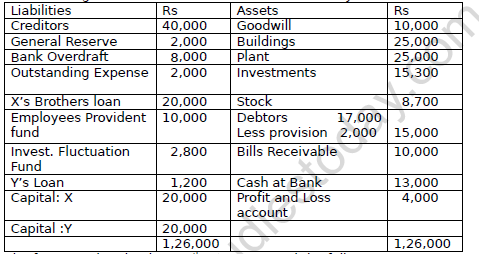
Q.9. The following is the Balance sheet of X and Y on 31st Dec. 2011.

CBSE Class 12 Accountancy Dissoultion of Partnership Firm Worksheet Set C 2

CBSE Class 12 Accountancy Dissoultion of Partnership Firm Worksheet Set C 3

The firm was dissolved on 31st December2011 and following was found:
 
(a)X promised to pay off Mrs. X’s loan and took away the stock at 20% discount.
 
(b)Y took away half the investments at 10% discount.
 
(c)Debtors falling due on 1st Nov 2012 were realized at a discount of 6% p.a.
 
(d)Creditors falling due on 31st January, 2012 were paid at@ 6% discount p.a.
 
(e)Fixed assets realized at Rs 71,000 and remaining investments realized at Rs 4,500.
 
(f) There was old furniture which has been written off completely from the books. Y agreed to take away the same at the price of Rs 300. (g) Realization expenses were Rs 1,000. Prepare necessary ledger A/cs.
 
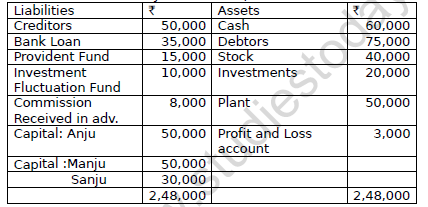
Q.10. Anju, Manju and Sanju were partners in affirm sharing profits in the ratio of 2:2:1. On 31st May 2012 their B/S was as follows

CBSE Class 12 Accountancy Dissoultion of Partnership Firm Worksheet Set C 4

On this date the firm was dissolved. Anju was appointed to realize the assets. Anju was to receive 5% commission on the sale of assets( except cash) and was to bear all expenses of realization. Anju realized the assets as follows:-
 
Debtors Rs 60,000, Stock Rs 35,500. Investments Rs 16,000, Plant 90% of the book value. Expenses of realization amounted to Rs 7,500. Commission received in advance was returned to the customers after deducting Rs 3,000. Firm had to pay Rs 8,500 for outstanding salary not provided for earlier. Compensation paid to employees amounted to Rs 17,000, This liability was not provided in the balance sheet Rs 20,000 had to be paid for provident fund. Prepare Realization Account, Capital Accounts and Cash account.


Please click on below link to download CBSE Class 12 Accountancy Dissoultion of Partnership Firm Worksheet Set C

Part 2 Chapter 03 Financial Statements of a Company
CBSE Class 12 Accountancy Financial Statements of A Company Worksheet

Part 1 Chapter 4 Dissolution of Partnership Firm CBSE Class 12 Accountancy Worksheet

Students can use the Part 1 Chapter 4 Dissolution of Partnership Firm practice sheet provided above to prepare for their upcoming school tests. This solved questions and answers follow the latest CBSE syllabus for Class 12 Accountancy. You can easily download the PDF format and solve these questions every day to improve your marks. Our expert teachers have made these from the most important topics that are always asked in your exams to help you get more marks in exams.

NCERT Based Questions and Solutions for Part 1 Chapter 4 Dissolution of Partnership Firm

Our expert team has used the official NCERT book for Class 12 Accountancy to create this practice material for students. After solving the questions our teachers have also suggested to study the NCERT solutions  which will help you to understand the best way to solve problems in Accountancy. You can get all this study material for free on studiestoday.com.

Extra Practice for Accountancy

To get the best results in Class 12, students should try the Accountancy MCQ Test for this chapter. We have also provided printable assignments for Class 12 Accountancy on our website. Regular practice will help you feel more confident and get higher marks in CBSE examinations.

Where can I download the latest PDF for CBSE Class 12 Accountancy Dissoultion of Partnership Firm Worksheet Set C?

You can download the teacher-verified PDF for CBSE Class 12 Accountancy Dissoultion of Partnership Firm Worksheet Set C from StudiesToday.com. These practice sheets for Class 12 Accountancy are designed as per the latest CBSE academic session.

Are these Accountancy Class 12 worksheets based on the 2026 competency-based pattern?

Yes, our CBSE Class 12 Accountancy Dissoultion of Partnership Firm Worksheet Set C includes a variety of questions like Case-based studies, Assertion-Reasoning, and MCQs as per the 50% competency-based weightage in the latest curriculum for Class 12.

Do you provide solved answers for CBSE Class 12 Accountancy Dissoultion of Partnership Firm Worksheet Set C?

Yes, we have provided detailed solutions for CBSE Class 12 Accountancy Dissoultion of Partnership Firm Worksheet Set C to help Class 12 and follow the official CBSE marking scheme.

How does solving CBSE Class 12 Accountancy Dissoultion of Partnership Firm Worksheet Set C help in exam preparation?

Daily practice with these Accountancy worksheets helps in identifying understanding gaps. It also improves question solving speed and ensures that Class 12 students get more marks in CBSE exams.

Is there any charge for the Class 12 Accountancy practice test papers?

All our Class 12 Accountancy practice test papers and worksheets are available for free download in mobile-friendly PDF format. You can access CBSE Class 12 Accountancy Dissoultion of Partnership Firm Worksheet Set C without any registration.