

Physics Objective Questions and Answers: Case Study
Review structured MCQ sets for Class 12 Physics Case Study. Built according to official CBSE guidelines, these downloadable questions support daily revision and core concept reinforcement.
Download Case Study MCQs with Answers
Navigate directly to the 50 objective questions for Case Study using the digital viewer below. Each practice set includes verified answer keys, allowing students to instantly cross-check their work and identify areas requiring further revision.
Question. Read the source given below and answer any four out of the following questions:
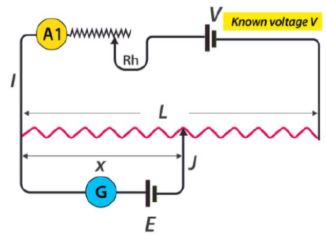
The potentiometer consists of a long resistive wire(L) and a battery of known EMF, ‘V’ whose voltage is known as driver cell voltage. Assume a primary circuit arrangement by connecting the two ends of L to the battery terminals. One end of the primary circuit is connected to the cell whose EMF ‘E’ is to be measured and the other end is connected to galvanometer G. This circuit is assumed to be a secondary circuit.
Question. How can we increase the sensitivity of a potentiometer?
(a) Increasing the potential gradient
(b) Decreasing the potential gradient
(c) Decreasing the length of potentiometer wire
(d) Increasing resistance put in parallel
Answer: B
Question. If l1 and l2 are the balancing lengths of the potentiometer wire for the cells of EMFs ε1ε1 and ε2ε2, then
(a) ε1ε1+ ε2ε2 = l1 + l2
(b) ε1ε2=l1l2ε1ε2=l1l2
(c) ε1ε1ε2ε2 = l1l2
(d) None of the options
Answer: B
Question. An example of a potentiometer is
(a) Mobile
(b) Modem
(c) Joystick
(d) All of these
Answer: C
Question. The emf of a cell is always greater than its terminal voltage. Why?
(a) Because there is some potential drop across the cell due to its small internal resistance
(b) Because there is some potential drop across the cell due to its large internal resistance
(c) Because there is some potential drop across the cell due to its low current
(d) Because there is some potential drop across the cell due to its high current
Answer: A
Question. Why is a ten-wire potentiometer more sensitive than a four-wire one?
(a) Small potential gradient
(b) Large potential gradient
(c) Large length
(d) None of the options
Answer: A
Question Read the source given below and answer any four out of the following questions:
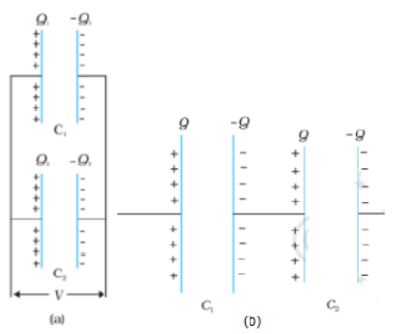
If two or more capacitors are connected in series, the overall effect is that of a single (equivalent) capacitor having the sum total of the plate spacing of the individual capacitors. If two or more capacitors are connected in parallel, the overall effect is that of a single equivalent capacitor having the sum total of the plate areas of the individual capacitors. ( figure (a) shows parallel combination and (b) shows series combination)
Question. Capacity can be increased by connecting capacitors in:
(a) parallel
(b) series
(c) both a and b
(d) none of the options
Answer: A
Question. Three capacitors having a capacitance equal to 2F, 4F and 6F are connected in parallel. Calculate the effective parallel capacitance:
(a) 10 F
(b) 11 F
(c) 12 F
(d) 13 F
Answer: C
Question. When capacitors are connected in the series ________ remains the same.
(a) voltage
(b) capacitance
(c) charge
(d) resistance
Answer: C
4. The plates of a parallel plate capacitor are 10 cm apart and have an area equal to 2m2. If the charge on each plate is 8.85×10⁻¹⁰C8.85×10−10C , the electric field at a point:
(a) between the plates will be zero
(b) outside the plates will be zero
(c) between the plates will change from point to point
(d) between the plates will be 25NC−125NC−1
Answer: B
Question. Four 10 F capacitors are connected in series, calculate the equivalent capacitance.
(a) 1.5 F
(b) 2.5 F
(c) 3.5 F
(d) 4.5 F
Answer: B
Question Read the source given below and answer any four out of the following questions:
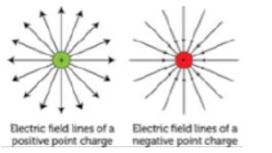
A charge is a property associated with the matter due to which it experiences and produces an electric and magnetic field. Charges are scalar in nature and they add up like real numbers. Also, the total charge of an isolated system is always conserved. When the objects rub against each other charges acquired by them must be equal and opposite.
Question. The cause of charging is:
(a) the actual transfer of protons
(b) the actual transfer of electrons
(c) the actual transfer of neutrons
(d) none of the options
Answer: B
Question. Pick the correct statement.
(a) The glass rod gives protons to silk when they are rubbed against each other.
(b) The glass rod gives electrons to silk when they are rubbed against each other.
(c) The glass rod gains protons from silk when they are rubbed against each other.
(d) The glass rod gains electrons when they are rubbed against each other.
Answer: B
Question. If two electrons are each 1.5×10⁻¹⁰m1.5×10−10m from a proton, the magnitude of the net electric force they will exert on the proton is
(a) 1.97×10⁻⁸ N
(b) 2.73×10⁻⁸ N
(c) 3.83×10⁻⁸ N
(d) 4.63×10⁻⁸ N
Answer: A
Question. A charge is a property associated with the matter due to which it produces and experiences :
(a) electric effects only
(b) magnetic effects only
(c) both electric and magnetic effects
(d) none of these
Answer: C
Question. The cause of quantization of electric charges is:
(a) transfer of an integral number of neutrons
(b) transfer of an integral number of protons
(c) transfer of an integral number of electrons
(d) none of the options
Answer: C
Free study material for Physics
Multiple Choice Questions (MCQs) for Class 12 Physics Case Study
Download Multiple Choice Questions: Case Study (Class 12 Physics)
Explore reliable practice questions for Case Study tailored for Class 12 Physics learners. Use these multiple-choice formats to evaluate preparedness and strengthen problem-solving skills.
Concept Clarification for Case Study
Cross-reference your completed choices with comprehensive NCERT solutions for Class 12 Physics to ensure absolute clarity across all sub-topics in this chapter.
Additional Study Resources for Class 12 Physics
Wrap up your chapter revision by testing your knowledge against standard question formats. Everything on our platform is provided free of charge.
FAQs
You can get most exhaustive CBSE Class 12 Physics Case Study MCQs for free on StudiesToday.com. These MCQs for Class 12 Physics are updated for the 2026-27 academic session as per CBSE examination standards.
Yes, our CBSE Class 12 Physics Case Study MCQs include the latest type of questions, such as Assertion-Reasoning and Case-based MCQs. 50% of the CBSE paper is now competency-based.
By solving our CBSE Class 12 Physics Case Study MCQs, Class 12 students can improve their accuracy and speed which is important as objective questions provide a chance to secure 100% marks in the Physics.
Yes, Physics MCQs for Class 12 have answer key and brief explanations to help students understand logic behind the correct option as its important for 2026 competency-focused CBSE exams.
Yes, you can also access online interactive tests for CBSE Class 12 Physics Case Study MCQs on StudiesToday.com as they provide instant answers and score to help you track your progress in Physics.