

Multiple Choice Questions (MCQs) for Class 12 Physics: Chapter 01 Electric Charges and Fields
Review structured MCQ sets for Class 12 Physics Chapter 01 Electric Charges and Fields. Built according to official CBSE guidelines, these downloadable questions support daily revision and core concept reinforcement.
Practice Chapter 01 Electric Charges and Fields MCQs for Class 12 Physics
Access the complete set of multiple-choice questions for Chapter 01 Electric Charges and Fields below. This focused format allows students to isolate specific topics for thorough review and uninterrupted practice alongside official CBSE textbooks.
Read the para given below and answer the questions that follow:
Potentiometer. A potentiometer is a device used to measure/compare unknown voltages. The device shown has a 4 metre long wire and draws current from a source of emf ‘E’.
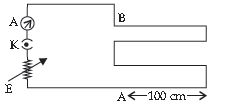
Question. The potentiometer can compare emf E1 and E2 of two sources.
(a) If both E1 and E2 exceed E.
(b) If both E1 and E2 are less than E.
(c) If either E1 and E2 exceed E.
(d) For all values of E1 and E2.
Answer: B
Question. The sensitivity of potentiometer
(a) is independent of the length of the wire used.
(b) increases if the wire is longer.
(c) decreases if the wire is longer.
(d) increases with rise in temperature of the wire.
Answer: B
Question. The Potentiometer wire should have;
(a) uniform area of cross section.
(b) very large cross section.
(c) gradually increasing area of cross section from A to B.
(d) gradually decreasing area of cross section from A to B.
Answer: A
Question. Which of the following is not essential in a potentiometer?
(a) The wire should have uniform area of cross section.
(b) The wire should be made of copper.
(c) The current through the wire should be steady.
(d) The strips used to connect the parallel one metre long wire should be thick.
Answer: B
Question. In order to use the above potentiometer to find the internal resistance of cell.
(a) The positive terminal of the cell should be connected to A.
(b) The negative terminal of the cell should be connected to A.
(c) The cell should have an emf exceeding E
(d) Either of the two terminals positive or negative can be connected to A.
Answer: A
Read the para given below and answer the questions that follow:
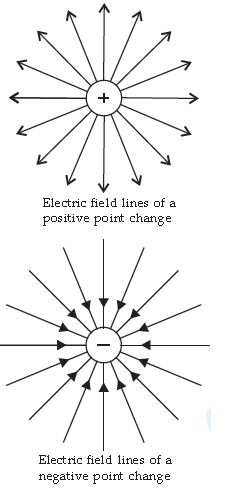
A charge is a property associated with the matter due to which it experiences and produces an electric and magnetic field. Charges are scalar in nature and they add up like real number. Also, the total charge of an isolated system is always conserved. When the objects rub against each other charges acquired by them must be equal and opposite.
Question. The cause of a charing is:
(a) the actual transfer of protons.
(b) the actual transfer of electrons.
(c) the actual transfer of neutrons.
(d) none the above
Answer: D
Question. Pick the correct statement.
(a) The glass rod gives protons to silk when they are rubbed against each other.
(b) The glass rod gives electrons to silk when they are rubbed against each other.
(c) The glass rod gains protons from silk when they are rubbed against each other.
(d) The glass rod gains electrons when they are rubbed against each other.
Answer: B
Question. If two electrons are each 1.5 × 10⁻¹⁰ m from a proton, the magnitude of the net electric force they will exert on the proton is
(a) 1.97 × 10⁻⁸ N
(b) 2.73 × 10⁻⁸ N
(c) 3.83 × 10⁻⁸ N
(d) 4.63 × 10⁻⁸ N
Answer: A
Question. A charge is a property associated with the matter due to which it produces and experiences:
(a) electric effects only
(b) magnetic effects only
(c) both electric and magnetic effects
(d) none of these.
Answer: C
Question. The cause of quantization of electric charges is:
(a) Transfer of an integral number of neutrons.
(b) Transfer of an integral number of protons.
(c) Transfer of an integral number of electrons.
(d) None of the above.
Answer: C
Read the para given below and answer the questions that follow:
Surface Charge Density . Surface charge density is defined as the charge per unit surface area the surface (Arial) charge symmetric distribution and follow Gauss law of electro statics mathematical term of surface charge density σ = ΔQ/ΔS
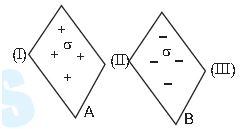
Two large thin metal plates are parallel and close to each other. On their inner faces, the plates have surface charge densities of opposite sign (± s). Having magnitude 8.8 × 10⁻¹² cm–2 as shown here. The intensity of electrified at a point is E = σ/∈0 and flux is Φ = E→ Δ S→, where ΔS = 1 m2 (unit arial plate)
Question. E in the outer region (I) of the first (A) plate is
(a) 1.7 × 10⁻²² N/C
(b) 1.1 × 10⁻¹² V/m
(c) Zero
(d) Insufficient data
Answer: C
Question. E in the outer region (III) of the second plate (B) is
(a) 1 N/C
(b) 0.1 V/m
(c) 0.5 N/C
(d) zero
Answer: D
Question. E between (II) the plate is
(a) 1 N/C
(b) 0.1 V/m
(c) 0.5 N/C
(d) None of these
Answer: D
Question. The ratio of E from left side of plate A at distance 1 cm and 2 m respectively is
(a) 1 : √2
(b) 10 : √2
(c) 1 : 1
(d) √20 : 1
Answer: C
Question. In order to estimate the electric field due to a thin finite plane metal plate the Gaussian surface considered is
(a) Spherical
(b) Linear
(c) Cylindrical
(d) Cybic
Answer: C
Read the para given below and answer the questions that follow:
Work is done in moving a unit positive charge. From infinity to a point in an electric field, against the direction of electric field, is called electric potential. It is a scalar quantity and is measured in volts. Electric intensity at a point is equal to the negative of the potential gradient i.e, E = − dV/dr Electric potential due to a single charge is given by V = kq/r. Electric potential due to an electric dipole is given by:
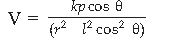
Electric potential energy is given by:
U = electric potential × Change = kq1 q2/r
Question. Two concentric spheres r1 and r2 carry charges q1 and q2 respectively. If the surface charge density σ is the same for both spheres, the electric potential at the common centre will be:
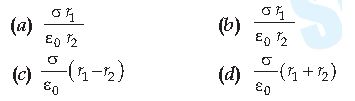
Answer: D
Question. Dimensions of electrostatic potential are:
(a) [M1 L–2 T–3 A–1]
(b) [M1 L2 T2]
(c) [M–1 L–2 T–3 A–2]
(d) [M1 L2 T–3 A–1]
Answer: D
Question. Two metallic spheres of radii 1 cm and 3 cm are given charges of –1 × 10⁻² C and 5 × 10⁻² C respectively. If these are connected by a conducting wire, the final charge on the bigger sphere is:
(a) 2 × 10⁻² C
(b) 3 × 10⁻² C
(c) 4 × 10⁻² C
(d) 1 × 10⁻² C
Answer: B
Question. Changes are placed on the vertices of a square as shown in figure. Let E be the electric field and V be the potential at the centre. If the charges on A and B are interchanged with those on D and C respectively then,
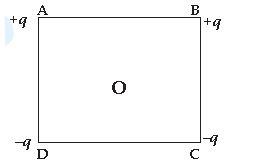
(a) E Changes, V remains constant.
(b) E remains unchanged, V changes.
(c) Both E and V Changes.
(d) E and V remains unchanged.
Answer: A
Question. The electric potential difference V at any point (x,y,z) in space is given by V = 3x2 where x, y and z are all in meters. The electric field at the point (1 m, 0, 2 m) is:
(a) 6V/m along positive x–axis.
(b) 6V/m along negative x–axis.
(c) 12V/m along negative x–axis.
(d) 12V/m along positive x–axis.
Answer: B
Read the para given below and answer the questions that follow:
Gauss Theorem: The total flux through a closed surface, enclosing a volume, in vacuum is 1/∈0 time the net change, enclosed by the surface
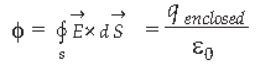
Gaussian Surface: Any closed surface imagined around the charge distribution, so that Gauss theorem can be conveniently applied to find electric field due to the give charge distribution. Electric field due to infinitely long straight charged wire of linear charge density λ ;
E = λ/2π∈0r, where r is the perpendicular distance of the observation point from the wire. Electric field due to an infinite plane sheet of charge of surface charge density σ. E = σ/2∈0
Question. S.I unit of electric flux is ……………….. .
(a) N2 m C
(b) Nm C–2
(c) Nm2 C–1
(d) Nm–2 C
Answer: C
Question. Electric flux is a …………………. .
(a) Constant quantity
(b) Vector quantity
(c) Scalar quantity
(d) None of these
Answer: C
Question. Two charges of magnitude –2Q and +Q are located at points (a, 0) and (4a, 0) respectively. What is the electric flux due to these charges through a sphere of radius ‘3a’ with its centre at origin?
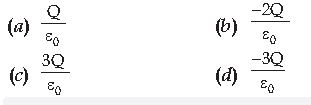
Answer: B
Question. A charge q is placed at the centre of a cube of side l. What is the electric flux passing through each face to the cube?
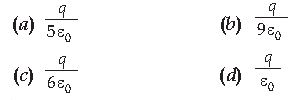
Answer: C
Question. The figure shows three charges +2q , –q and +3q. Two charges + 2q and –q are enclosed with in a surface ‘S’. What is the electric flux due to this configuration through the surface ‘S’ ?
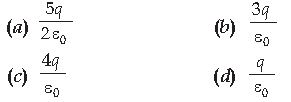
Answer: D
Free study material for Physics
Multiple Choice Questions (MCQs) for Class 12 Physics Chapter 01 Electric Charges and Fields
Chapter MCQs with Answers for Class 12 Physics
Explore reliable practice questions for Chapter 01 Electric Charges and Fields tailored for Class 12 Physics learners. Use these multiple-choice formats to evaluate preparedness and strengthen problem-solving skills.
Expert Practice Material for Class 12 Physics
Each question includes structured solution keys mapped directly to standard CBSE textbooks, helping students evaluate their reasoning and correct mistakes early in their revision.
Complete Your Chapter Revision
Explore our broader library of printable assignments, chapter notes, and mock tests designed to support continuous revision and secure higher marks in CBSE assessments.
FAQs
You can get most exhaustive CBSE Class 12 Physics Electric Charges and Fields MCQs Set 03 for free on StudiesToday.com. These MCQs for Class 12 Physics are updated for the 2026-27 academic session as per CBSE examination standards.
Yes, our CBSE Class 12 Physics Electric Charges and Fields MCQs Set 03 include the latest type of questions, such as Assertion-Reasoning and Case-based MCQs. 50% of the CBSE paper is now competency-based.
By solving our CBSE Class 12 Physics Electric Charges and Fields MCQs Set 03, Class 12 students can improve their accuracy and speed which is important as objective questions provide a chance to secure 100% marks in the Physics.
Yes, Physics MCQs for Class 12 have answer key and brief explanations to help students understand logic behind the correct option as its important for 2026 competency-focused CBSE exams.
Yes, you can also access online interactive tests for CBSE Class 12 Physics Electric Charges and Fields MCQs Set 03 on StudiesToday.com as they provide instant answers and score to help you track your progress in Physics.