

Here is CBSE Class 12 Chemistry HOTs Haloalkanes And Haloarenes for your advanced practice. Find detailed High Order Thinking Skills (HOTS) questions and solutions for Class 12 Chemistry Unit 6 Haloalkanes and Haloarenes. Built for the 2026-27 exam session, these expert-tested questions sharpen your problem-solving skills according to standard CBSE, NCERT, and KVS rules.
Analytical Questions: Unit 6 Haloalkanes and Haloarenes (Class 12 Chemistry)
Want to boost your grades in Chemistry? Solving Class 12 Chemistry HOTS Questions is a great way to build strong logic. Review the step-by-step answers below to increase your speed and feel fully ready for your Class 12 exams.
HOTS Questions and Answers for Class 12 Chemistry Unit 6 Haloalkanes and Haloarenes
Case Based Questions :
Free radical chlorination or bromination of alkanes usually gives a complex mixture of isometric mono and poly- haloalkane which is difficult to separate into pure compounds . For example , chlorination of propane yield 1-Chloropropane and 2 -Chloropropane in addition to polychlorinated products .Therefore ,haloalkanes are generally not prepared in laboratory by halogenation of alkanes .However, in certain cases Where formation of isometric products is not possible or where there is large difference in the reactivity of halogen attached to different carbon atoms ,this method can be used for the preparation of haloalkanes
Question. How many isometric monochloinated products are possible for iso-pentane?
(a) 3.
(b) 4.
(c) 5.
(d) 6
Answer: B
Question. Which of the following halide cannot be prepared in good yield by free radical halogenatom of corresponding hydrocarbon?
(a) Benzyl chloride.
(b) Allyl chloride.
(c) neo-Pentyl chloride.
(d) iso- Pentyl chloride
Answer: D
Question. Chlorination of methane in the presence of light yield a mixture of CH3Cl ,CH2Cl2,CHCl3 and CCl4 The most polar compound among these is .
(a) CH3Cl.
(b) CH2Cl2.
(c) CCl4
(d) CHCl3
Answer: B
Question. Which of the following lighter than water?
(a) CCl4.
(b) CH2Cl2.
(c) CH3Cl.
(d) CHCl3
Answer: C
Short type Question And Answers
Question. Why haloalkanes are more reactive than haloarenes?
Answer: In haloarenes, there is partial double bond character b/w carbon and halogen due to resonance effect which makes him less reactive.
(ii) In benzene, carbon being sp2 hybridised which is smaller in size than sp3 present in haloalkanes. So C–Cl bond in aryl halides is shorter and stronger.
Question. Why do haloalkenes under go nucleophillic substitution whereas haloarenes under go electophillic substitution?
Answer: Due to more electro negative nature of halide atom in haloalkanes carbon atom
becomes slightly positive and is easily attacked by nucleophillic reagents. While in haloarenes due to resonance, carbon atom becomes slightly negative and attacked by electrophillic reagents.
Question. The treatment of alkyl chlorides with aqueous KOH lead to the formation of alcohols but in presence of alcoholic KOH alkenes are major products. Explain?
Answer: In aqueous KOH,OH– is nucleophile which replaces another nucleophile.
R-X + KOH → R-OH + KX
Where as in alcoholic KOH, C2H5O– ion is produced which is a strong base hence b-elimination took place to form alkane
C2H5OH + KOH → C2H5O- + K+
CH3CH2-Cl + alcoholic KOH → CH2 = CH2 + C2H5OH
Question. Explain why vinyl chloride is unreactive in nucleophillic substitution reaction?
Answer: Vinyl chloride is unreactive in nucleophillic substitution reaction because of double bond character between C–Cl bond which is difficult to break.
Question. Arrange the following compounds according to reactivity towards nucleophillic substitution reaction with reagents mentioned :-
(i) 4-nitrochlorobenzene> 2,4 dinitrochlorobemzene > 2,4,6, trinitrochlorobenzene with CH3ONa
Answer: ,4,6, trinitrochlorobenzene > 2,4 dinitrochlorobemzene > 4- nitrochlorobenzene
Question. Why Grignard reagent should be prepared under an hydrous conditions?
Answer: Grignard reagent react with H2O to form alkanes, therefore they are prepared under anhydrous condition.
Question. Why is Sulphuric acid not used during the reaction of alcohols wiht KI?
Answer: It is because HI formed will get oxidized to I2 by concentrated Sulphuric acid which is an oxidizing agent.
Question. p-dichlorobenzene has highest m.p. than those of ortho and m-isomers?
Answer: p-dichlorobenzene is symmetrical, fits into crystal lattice more readily and has higher melting point.
Question. Give reasons:
(i) C–Cl bond length in chlorobenzene is shorter than C–Cl bond in CH3Cl.
(ii) The dipole moment of chlorobenzene is lower than that of cyclohexyl chloride.
(iii) SN1 reactions are accompained by racemization in optically active alkyl halides.
Answer: (i) In chlorobenzene, each carbon atom is sp2 hybridised/ resonating structures / partial donable bond character.
(ii) Due to + R effect in chlorobenzene / difference in hybridization i.e., sp2 and sp3 respectively.
(iii) Due to formation of planer carbocation.
More Questions..
1 Iodoform gives the precipitate with AgNO3 on heating while chloroform does not. Give reasons
2 The following reaction give 2 products. Write their structures .
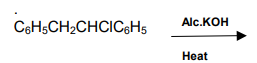
3 Predict the products of the following reactions:
a. HCl with CH3CCl=CH2
b. HBr with CH3CH=C(CH3)2
4 Monochlorination of ethane to ethyl chloride is more practical than chlorination of npentane. Give reasons
5 An optically active compound having molecular formula C7H15Br reacts with aq. KOH to give racemic mixture of products. Write the mechanism involved in the reaction. [hint: a carbocation being planar, allows attack of nucleophile from either direction.]
6 a. Which of the following 2 compounds would react faster by SN2 pathway:- 1- bromobutane or 2-bromobutane and why?
b. Allyl chloride is more reactive than n-propyl chloride towards nucleophilic substitution reaction. Explain why?
c. Haloalkanes react with KCN to give alkyl cyanides as main product while with AgCN, they form isocyanide as the main product. Give reasons.
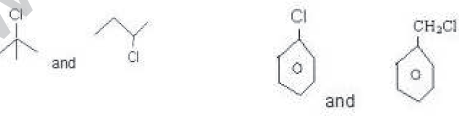
7 In each of the following pairs of organic compounds, identify the compound which will undergo SN1reaction faster. Also give reason with related structures.
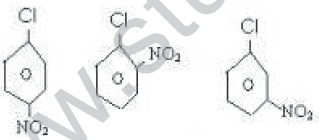
8 p-nitrobenzene undergoes nucleophilic substitution faster than chlorobenzene. Explain giving the resonating structures as well.


Free study material for Chemistry
Download Class 12 Chemistry Unit 6 Haloalkanes and Haloarenes HOTS Practice Questions
Class 12 Chemistry Chapter Unit 6 Haloalkanes and Haloarenes Advanced Problem Sets
Strengthen your preparation for Class 12 Chemistry examinations with specialized Unit 6 Haloalkanes and Haloarenes HOTS worksheets. These structured problems are curated to match official CBSE guidelines and help tackle difficult board-level questions.
NCERT-Aligned Solutions and Explanations
Each question in this set is mapped directly to the official NCERT book for Class 12. Review the detailed answer keys provided below each problem to verify your solution steps and correct mistakes early.
Next Steps for Class 12 Chemistry Preparation
Wrap up your chapter revision by testing your speed with our interactive Chemistry quizzes. Access all curriculum-aligned study resources online without any restrictions.
FAQs
You can download the teacher-verified PDF for CBSE Class 12 Chemistry HOTs Haloalkanes And Haloarenes from StudiesToday.com. These questions have been prepared for Class 12 Chemistry to help students learn high-level application and analytical skills required for the 2026-27 exams.
In the 2026 pattern, 50% of the marks are for competency-based questions. Our CBSE Class 12 Chemistry HOTs Haloalkanes And Haloarenes are to apply basic theory to real-world to help Class 12 students to solve case studies and assertion-reasoning questions in Chemistry.
Unlike direct questions that test memory, CBSE Class 12 Chemistry HOTs Haloalkanes And Haloarenes require out-of-the-box thinking as Class 12 Chemistry HOTS questions focus on understanding data and identifying logical errors.
After reading all conceots in Chemistry, practice CBSE Class 12 Chemistry HOTs Haloalkanes And Haloarenes by breaking down the problem into smaller logical steps.
Yes, we provide detailed, step-by-step solutions for CBSE Class 12 Chemistry HOTs Haloalkanes And Haloarenes. These solutions highlight the analytical reasoning and logical steps to help students prepare as per CBSE marking scheme.