

Check out CBSE Class 12 Chemistry HOTs Answers to HOTs Question Database right here. Get complete High Order Thinking Skills (HOTS) questions and answers for Class 12 Chemistry All Chapters. Created for the 2026-27 exam session, these analytical practice problems help learners master core ideas while following guidelines from CBSE, NCERT, and KVS.
High Order Thinking Skills: Class 12 Chemistry All Chapters
Every Class 12 Chemistry student should practice these HOTS Questions to tackle difficult exam problems. Use the provided solutions to improve your critical thinking and boost your overall performance in Class 12.
HOTS Questions and Answers for Class 12 Chemistry All Chapters
HINTS: CHAPTER:1
1. 4
15. 123.8pm
16. 438pm
17. 2.786 ×10⁻²³c.c
25. .268.8 pm
26. 346.4pm
27. fcc,141.4 pm
28. i) 1.5463 g cm-3 ii) 1.5448 g cm-3
HINTS: CHAPTER:2
9. 9.22 mol kg-1
10. 38.7 g
12. 256.5 g mol-1
13. 270.21 K
14. 75 %
16. 83 %
17. 243.92
HINTS: CHAPTER:3
10. mass of Zn rod = 23.725 g, molarity of SO4
2- remains same
12. % of Cu, Fe, Ag are 98.88, 0.831, 0.289 respectively
12. – 0.79 V
14. 1.9966
15. 95 %
HINTS: CHAPTER:4
1. When the initial conc. become ¼, half life becomes 4 times. Order of reaction is 2.
2: 2:1
3: Molecules of reactants collide simultaneously and go to products. The probability of colliding 4 or 5 species simultaneously is very rare.
4.The half life is independent of conc. of B. This means the reaction is of first order w.r.t. B and w.r.t. A also it is first order and overall order is second.
5: t1/2 ∝(conc.)1-n n=2
t1/2 ∝(conc.)-1 or
t1/2 ∝1/(conc.)
6. Energy of activation (Ea)
7. t1/2 = 1/k .1/[Ao]
log t1/2 = -log K – log [Ao]
Intercept = t1/2
8. B =76.8% C= 23.2%
Percentage of formation of B = K1/K1+K2 X 100
9. log K2 /K1 = ΔH/ 2.303R (1/T1 –1/T2)
log 6 /2 = ΔH/ 2.303R (1.5 X10⁻³ –2.0 X10⁻³)
DH comes negative. Hence exothermic
10. Rate = K [NOBr2 ][NO]
But [NOBr2]/[NO][Br2] = K
Or [NOBr2] =K[NO][Br2]
Substituting values of [NOBr2] in rate law
Rate = K’[NO]2[Br2]
11.Earlier rate R = K[A]n[B]m
Now rate R1 = K[2A]n[B/2]m
R1/R = 2n-m
12. SO2Cl2(g) → SO2(g) +Cl2(g)
T =100s 0.5 -x x x
0.5 –x +x+x = 0.60
x=0.10
K= 2.303/100 log 0.5/0.4 = 2.23 X 10⁻³ s-1
Similarly k can be calculated when
0.5 –x +x+x = 0.65
13. In heterogenous catalysis molecules of NH3 are absorbed on surface. Under lower conc. the surface of catalyst is not completely occupied . When pressure is high the
surface is completely occupied and further increase in pressure (conc.) does not
affect the rate.
14. Rate of reaction = -1/2 d[NO2]/dt
= K1 [NO2]2 –K2 [N2O4]
therefore rate of disapperance of NO2
= - d[NO2]/dt = 2K1 [NO2]2 –2 K2 [N2O4]
15 Log K =log A-Ea/2.303RT
Log K’ =log A-Ea’/2.303RT
Log K =log A-Ea/2.303RT
Log K’/K = Ea-Ea’/2.303 RT = 9.8037
Or K’/K = 6.36 X 10⁹
UR catalysted /UR uncatalysed =K’/K = 6.4X 10 9
16. K=0.693/t1/2
(a-x)∝ (0.40 –P)atm.
K= 2.303/12 log 0.40/0.40 –P
P calculated = 0.1745 atm
Total pressure = 0.4 –P+P+P+P =0.749 atm
17. K=Ae-Ea/RT
Ea ,absence of catalyst = x KJ/mol
Ea, presence of catalyst = (x-20)KJ/mol
At 500K
K=Ae-x/R.500 (1)
At 400
K=Ae-(x-20)/R.400 (2)
Divide 1 by 2, we get
X=100KJ/mol
Ea = 100KJ/mol
18. 40 min=2 half lives
Amount present after 40 min =a/4
Amount added = a/2
Total amount after 40 min =a/4 + a/2 = 3a/4
After 60 min from start , amount left = 3a/8
Total amount taken = a+ a/2 = 3a/2
Hence % = 3a/8 ÷ 3a/2 X 100 =25%
19. Fraction of molecules having energy equal to or greater than activation energy
X = n/N =e –Ea/RT
Ln X = - Ea/RT
Log X = -Ea/2.303RT
= 209.5X10³/2.303 X 8.314 X 581
=-18.8323
X= 1.471 X 10⁻¹⁹
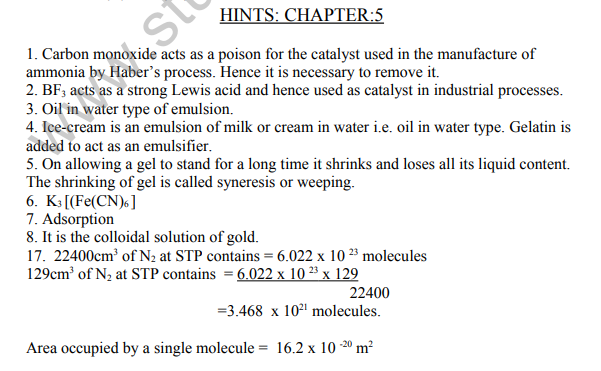
Area occupied by 3.468 x 10²¹ molecules of N2
=(16.2 x 10-20) x (3.468 x 1021) m2
=561.8m2
Therefore surface area per gram of gel =561.8m2
HINTS: CHAPTER: 11
1. Isobutylene (2-Methyl propane)
2. Due to electron-withdrawing effect of the benzene ring, the C — O bond in phenol is less polar but in case of methanol due to electron-donating effect of — CH3 group, C — O bond is more polar.
4. Grignard reagents from co-ordination complexes with ether but not benzene since the former has lone pair of electrons but the later does not.
6. Since tert-butyl bromide being 3°-alkyl halide prefers to undergo elimination rather than substitution ether.
8. The oxygen atom of the hydroxyl group has two lone pairs of electrons. Therefore alcohols accept a proton from strong mineral acid to form oxonium ions.
Hence act as weak bases.
9. m- cresol
10. Phenol is a weaker acid than carbonic acid (H2CO3) and does not liberate CO2 from Na HCO3 .
11. Secondary aliphatic alcohol
12. 3
13. H2O < CH3OH < OH - < CH3O-(Since stronger base displaces a weaker base from its compound,CH3O- is stronger base.)
14. Diethyl ether ( Ethoxy ethane ).
15. Phenol and methyl iodide .
16. Diethyl ether does not contain an active hydrogen attached to oxygen like in alcohols and phenol.
17. The b. pt. of butanol is higher than that of butanal because butanol has strong intermolecular H-bonding while butanal has weak dipole-dipole interaction
18. Cresol are less acidic than phenol.Electron releasing groups such as alkyl groups
in General donot favour the formation of phenoxide ion resulting in decrease in acid Strength.
19. (a) The alkyl group in cyclohexanol is more compact than the alkyl group in
Hexanol-1.The -OH group of cyclohexanol is more exposed and is more available for Hydrogen bonding with water. Hence, Cyclohexanol is more soluble in water than hexanol-1. (b) In Propane1,3-diol, there are two - OH groups present which increase the no. of H bonds between water and the diol. Hence Propane 1,3-diol is more soluble in water than propan-1-ol. . 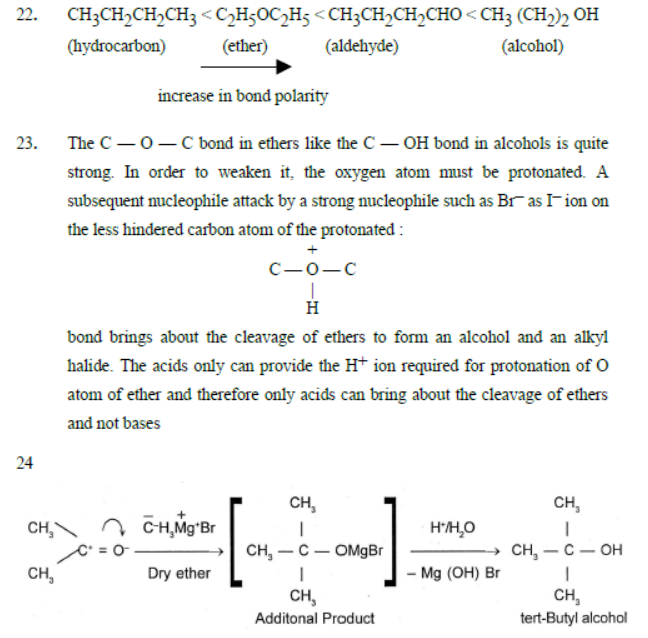
25.(a)This is because pcc is a mild oxidising agent and can oxide methanol to methanal only while KMnO4 being strong oxidising agent oxidises it to methanoic acid.
25.(b)Because esterification rxn is reversible and presence of base (pyridine) neutralises HCl produced during reaction thus promoting forward reaction
26. (I) First convert phenol to benzene by heating with Zn dust.
(II) Nitration of benzene with conc. nitric acid in presence of conc.
sulphuric acid. 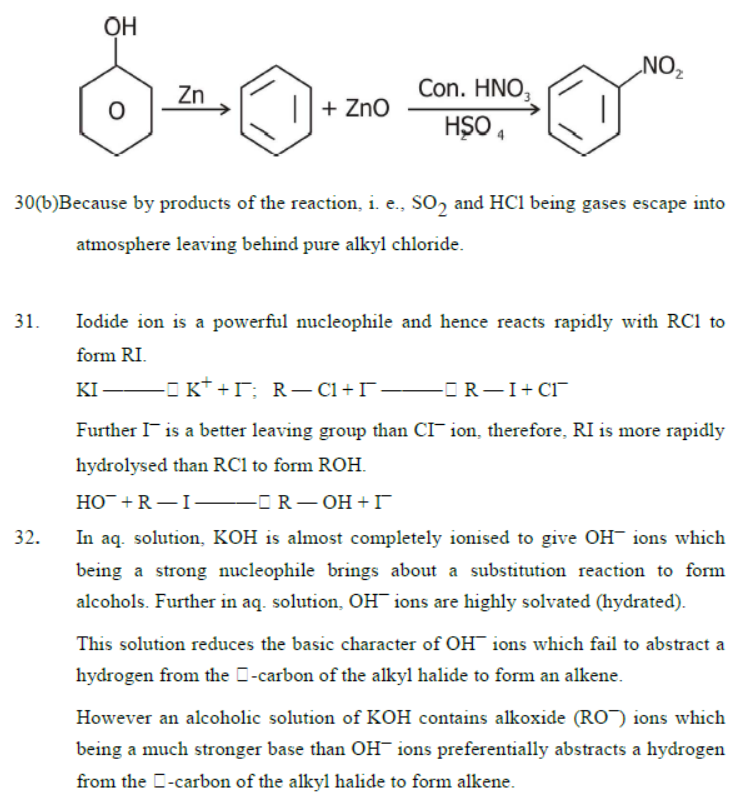
HINTS: CHAPTER:12
1. Formalin is 40% aqueous solution of methanal whereas trioxane is trimer of methanal
2. Benzaldehyde does not give Fehling soln. test.
(Aromatic aldehydes do not give this test.)
3. Greater resonance stabilization of acetate ion over phenoxide ion
4. CH3COOH contains α hydrogens and hence give HVZ reaction but HCOOH does not contain α -hydrogen and hence does not give HVZ reaction.
5. This is because pcc is a mild oxidising agent and can oxide methanol to methanal only.While KMnO4 being strong oxidising agent oxidises it to methanoic acid.
6. C-atom of carbonyl group of benzaldehyde is less electrophilic than C-atom of carbonyl group in propanal. Polarity of carbonyl group is in benzaldehyde reduced due to resonance making it less reactive in nucleophilic addition reactions. 
There is no such resonance effect in propanal and so the polarity of carboxyl group in it is more than in benzaldehyde. This makes propanal more reactive than benzaldehyde.
Free study material for Chemistry
Advanced HOTS Questions with Solutions: Class 12 Chemistry All Chapters
Challenging Questions for Class 12 Chemistry All Chapters
Strengthen your preparation for Class 12 Chemistry examinations with specialized All Chapters HOTS worksheets. These structured problems are curated to match official CBSE guidelines and help tackle difficult board-level questions.
Step-by-Step Answers for All Chapters
Pair these practice sets with our comprehensive NCERT solutions for Class 12 Chemistry to clear up doubts. Checking your working against our detailed explanations guarantees absolute mastery over this chapter.
Complete Your Chapter Revision
Wrap up your chapter revision by testing your speed with our interactive Chemistry quizzes. Access all curriculum-aligned study resources online without any restrictions.
FAQs
You can download the teacher-verified PDF for CBSE Class 12 Chemistry HOTs Answers to HOTs Question Database from StudiesToday.com. These questions have been prepared for Class 12 Chemistry to help students learn high-level application and analytical skills required for the 2026-27 exams.
In the 2026 pattern, 50% of the marks are for competency-based questions. Our CBSE Class 12 Chemistry HOTs Answers to HOTs Question Database are to apply basic theory to real-world to help Class 12 students to solve case studies and assertion-reasoning questions in Chemistry.
Unlike direct questions that test memory, CBSE Class 12 Chemistry HOTs Answers to HOTs Question Database require out-of-the-box thinking as Class 12 Chemistry HOTS questions focus on understanding data and identifying logical errors.
After reading all conceots in Chemistry, practice CBSE Class 12 Chemistry HOTs Answers to HOTs Question Database by breaking down the problem into smaller logical steps.
Yes, we provide detailed, step-by-step solutions for CBSE Class 12 Chemistry HOTs Answers to HOTs Question Database. These solutions highlight the analytical reasoning and logical steps to help students prepare as per CBSE marking scheme.