

Find CBSE Class 12 Chemistry HOTs Polymers right below. We offer complete High Order Thinking Skills (HOTS) questions and answers for Class 12 Chemistry Unit 15 Polymers. Designed to support your 2026-27 exam session goals, these expert questions match standard curriculum patterns from CBSE, NCERT, and KVS.
Download Class 12 Chemistry Unit 15 Polymers HOTS Practice
Working through Class 12 Chemistry HOTS Questions helps you master complex topics in Chemistry. Rely on the clear explanations given below to sharpen your analytical skills and prepare well for your Class 12 evaluations.
Download HOTS: Unit 15 Polymers (Class 12 Chemistry)
Answer. The polymer formed by the polymerization of single/same monomeric species is known as homopolymerisation. E.g., Polythene/PVC/Polypropene.
Question. Give an example of elastomer.
Answer. Natural rubber or Buna-S or Buna-N or Neoprene.
Question. Why is bakelite a thermosetting polymer ?
Answer. Because bakelite have three dimensional network of covalent bonds with crosslinking between chains.
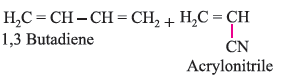
Question. Write the monomers of Buna-N.
Answer.
Question. Is [H2CCH(C6H5)]n a homopolymer or copolymer ? Why ?
Answer. Homopolymer, because it is formed by polymerization of one kind of monomer species.
Question. Write the structure and one use of urea formaldehyde resin.
Answer. [HNCONHCH2 ]n
It is used in unbreakable crockery.
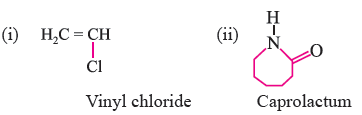
(i) PVC (ii) Nylon-6
Answer.
Question. What is the repeating unit in the condensation polymer obtained by combining HOOCCH2CH2COOH (succinic acid) and H2NCH2CH2NH2 (ethylene diamine) ?
Answer.

Question. Draw the structure of monomers of the following polymers :
(i) Teflon (ii) Polythene
Answer. (i) F2C = CF2 Tetrafluoroethene
(ii) H2C = CH2 Ethene
Question. Name the two groups into which polymers are classified on the basis of magnitude of intermolecular forces.
Answer. (i) Elastomers
(ii) Fibres
(iii) Thermoplastic polymers
(iv) Thermosetting polymers
Question. Mention two important uses of each of the following :
(i) Bakelite (ii) Nylon-6
Answer. (i) Bakelite : For making combs, electrical switches, handles of utensils, computer disc etc.
(ii) Nylon-6 : For making tyre cords, fabrics, ropes etc.
Question. Distinguish between homopolymers and copolymers with an example of each.
Answer. Homopolymers : Polymers whose repeating structural units are derived from only one type of monomer units are called homopolymers. For example, Polythene.
Copolymers : Polymers whose repeating structural units are derived from two or more types of monomer units are called copolymers. For example, Nylon-6, 6.
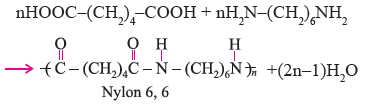
Question. What is step growth polymerisation ? Explain with an example.
Answer. Step growth polymerisation involves condensation between monomers having multifunctional groups. It is also known as condensation polymerisation. E.g.,
Question. What is the difference between elastomers and fibres ? Give one example of each.
Answer. Elastomers : Polymers in which the intermolecular forces of attraction between the polymer chains are weakest are called elastomers. E.g., Natural rubber.
Fibres : Polymers in which intermolecular forces of attraction are the strongest are called fibres. E.g., Nylon-6, 6.
Question. Mention the important uses of each :
(i) Nylon-6, 6 (ii) PVC
Answer. (i) Uses of Nylon-6, 6 :
(a) It is used in making carpets, textile fibres etc.
(b) It is used for making elastic hosiery.
(a) It is used for making raincoats, hand bags etc.
(b) It is used in making water pipes.
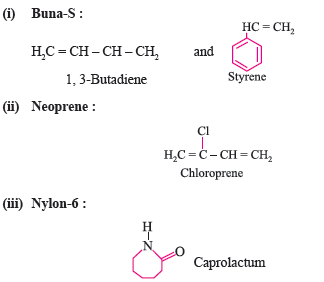
Question. Write the names and structure of the monomers of the following polymers :
(i) Buna-S (ii) Neoprene (iii) Nylon-6
Answer.
Question. Write names and structure of monomers of following polymers :
(i) Bakelite (ii) Nylon-6 (iii) Polythene
Answer. (i) Phenol and formaldehyde
C6H5OH + HCHO
(ii) Caprolactum

H2C = CH2
Question. Write names and structure of monomers of following polymers :
(i) Polystyrene (ii) Dacron (iii) Teflon

(ii) Ethylene glycol + Terephthalic acid

F2C = CF2
Question. (i) What is the role of t-butyl peroxide in the polymerisation of ethane ?
(ii) Identify the monomers in the following polymer :
[ HN(CH2 ) NHCO(CH2 )4 CO ]
(iii) Arrange the following polymers in the increasing order of their intermolecular forces :
Polystyrene, Terylene, Buna-S
Answer. (i) Catalyst/initiator of free radical
(ii) Hexamethylenediamine and adipic acid
(iii) Buna-S < Polystyrene < Terylene
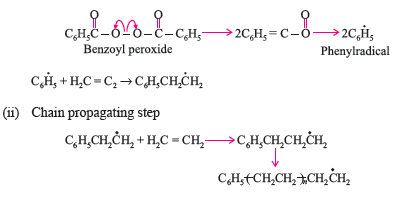
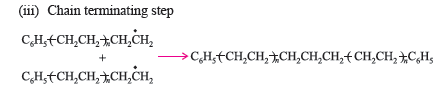
Question. Write the mechanism of free radical polymerisation of ethane.
Answer. (i) Chain initiation step
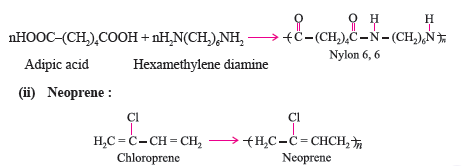
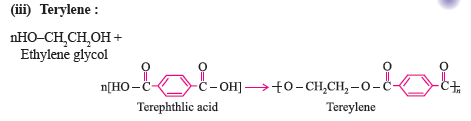
Question. Write chemical equation for the synthesis of :
(i) Nylon-6, 6 (ii) Neoprene (iii) Terylene
Answer. (i) Nylon-6, 6 :
Question. Write the monomers which are used for the synthesis of following polymers :
(i) Terylene (ii) Polythene (iii) Bakelite
Indicate the type of polymerisation for each which forms polymers.
Answer. Monomers Type of polymerisation
(i) Ethylene glycol + Terephthalic acid Condensation
(ii) Ethene Addition
(iii) Phenol + Formaldehyde Condensation
Question.
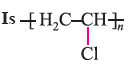
a homopolymer or a copolymer ?
Answer. Homopolymer.
Question. Which of the following is natural polymer ?
Buna-S, Proteins, PVC
Answer. Proteins.
Question. Based on molecular forces what type of polymer is neoprene ?
Answer. Elastomer.
Question. Which of the following is a fibre ?
Nylon, Neoprene, PVC
Answer. Nylon
SHORT ANSWER-I TYPE QUESTIONS
Question.Arrange the following polymers in the order of increasing intermolecular forces :
(i) Nylon-6, Buna-S, Polythene
(ii) Nylon-6, Neoprene, Polyvinyl chloride
Answer. (i) Buna-S < Polythene < Nylon-6
(ii) Neoprene < Polyvinyl chloride < Nylon-6
Question.Define thermoplastic and thermosetting polymers. Give one example of each.
Answer. Thermoplastics : Polymers in which the intermolecular forces of attraction are in between those of elastomers and fibres are called thermoplastics. E.g., Nylon-6, PVC, etc.
Thermosetting polymers : These are semi-fluid substances with low molecular
masses which when heated in a mould undergo a permanent change in chemical composition to give hard, infusible and insoluble mass. E.g., Bakelite.
Question.What is biodegradable polymer ? Give an example of a biodegradable polymer.
Answer. Biodegradable polymers are those which are decomposed by micro organisms.
E.g., PHBV (Poly-B-hydroxybutyrate – Co – B – hydroxyl valerate).
Question.How does vulcanization change the character of natural rubber ?
Answer. It introduce sulphur bridge or cross-link between polymer chain.
Question.Name a polymer each for the following applications :
(i) Insulation of electrical switches
(ii) Making laminated sheets
Answer. (i) Bakelite (ii) Urea formaldehyde resin
Question.How does the presence of double bonds in rubber influence their structure and reactivity ?
Answer. Natural rubber is a cis-polyisoprene. These cis- double bonds do not allow to polymer unit to come close for effective interaction. Hence rubber show elasticity.
SHORT ANSWER-II TYPE QUESTIONS
Question. How are polymers classified on the basis of mode of polymerisation ? Explain with examples.
Answer. Addition polymers : Are formed by repeated addition of a large number of same or different monomers possessing double or triple bonds. E.g., Polythene.


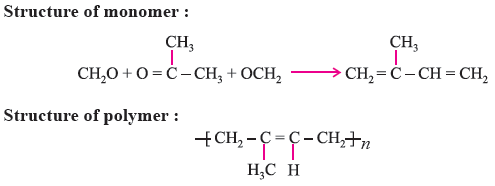
Question.A monomer of a polymer on ozonolysis gives two moles of CH2O and one mol of
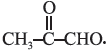
Write the structure of monomer and polymer and each step of reaction.
Answer. Structure of monomer :
Question.Can a copolymer be formed in both addition and condensation polymerisation ? Explain with examples.
Answer. Yes. Buna-S, Buna-N : Addition polymer
Nylon-6, 6, terylene : Condensation
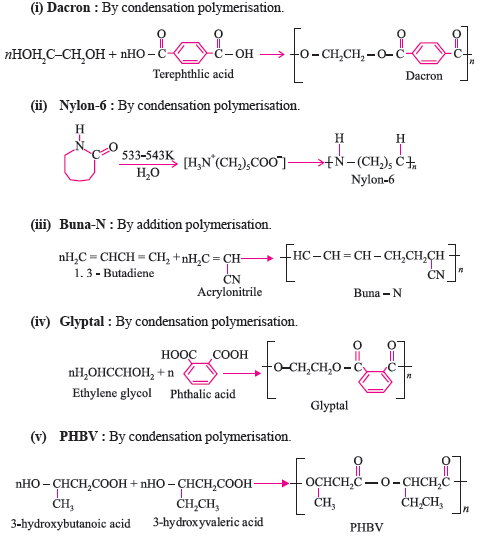
(i) Dacron (ii) Nylon-6 (iii) Buna-N
(iv) Glyptal (v) PHBV
Free study material for Chemistry
Download Class 12 Chemistry Unit 15 Polymers HOTS Practice Questions
High Order Thinking Skills: Unit 15 Polymers Overview
Download high-level analytical questions for Unit 15 Polymers. Designed in alignment with the latest CBSE syllabus for Class 12 Chemistry, these problem sets test deep conceptual understanding and prepare students for complex exam questions.
NCERT-Aligned Solutions and Explanations
Each question in this set is mapped directly to the official NCERT book for Class 12. Review the detailed answer keys provided below each problem to verify your solution steps and correct mistakes early.
Next Steps for Class 12 Chemistry Preparation
Looking for more practice? Explore our complete library of Class 12 Chemistry worksheets, chapter notes, and online mock tests. Everything is provided free of charge to support your academic goals.
FAQs
You can download the teacher-verified PDF for CBSE Class 12 Chemistry HOTs Polymers from StudiesToday.com. These questions have been prepared for Class 12 Chemistry to help students learn high-level application and analytical skills required for the 2026-27 exams.
In the 2026 pattern, 50% of the marks are for competency-based questions. Our CBSE Class 12 Chemistry HOTs Polymers are to apply basic theory to real-world to help Class 12 students to solve case studies and assertion-reasoning questions in Chemistry.
Unlike direct questions that test memory, CBSE Class 12 Chemistry HOTs Polymers require out-of-the-box thinking as Class 12 Chemistry HOTS questions focus on understanding data and identifying logical errors.
After reading all conceots in Chemistry, practice CBSE Class 12 Chemistry HOTs Polymers by breaking down the problem into smaller logical steps.
Yes, we provide detailed, step-by-step solutions for CBSE Class 12 Chemistry HOTs Polymers. These solutions highlight the analytical reasoning and logical steps to help students prepare as per CBSE marking scheme.