

Download Class 8 Science Concept Summaries: CBSE Class 8 Science Pollution of Air and Water Notes
Review targeted revision notes for Class 8 Science with the CBSE Class 8 Science Pollution of Air and Water Notes. Built according to official educational guidelines for the 2026-27 academic year, these downloadable summaries for Chapter 18 Pollution of Air and Water support daily study and last-minute exam readiness.
Access Chapter 18 Pollution of Air and Water Notes and Study Material
Access the complete concept summary PDF for Chapter 18 Pollution of Air and Water below. Regular review of these targeted notes builds familiarity with complex Class 8 Science themes and helps secure higher marks in final school evaluations.
CBSE Class 8 Science Pollution Chapter Notes. Learning the important concepts is very important for every student to get better marks in examinations. The concepts should be clear which will help in faster learning. The attached concepts made as per NCERT and CBSE pattern will help the student to understand the chapter and score better marks in the examinations.
POLLUTION
Human beings are dependent on the living and non-living components of environment for their survival. But, with the increase in population, human activities have led to deterioration of the quality of environment. For
e.g. :
• With increase in population, our living places have become congested and we face the problem of housing.
• More food is needed to feed the increasing population. So we cut forests to make space for the fields to grow crops.
• More and more industries, to manufacture useful products, are developed. These industries release harmful gases in the atmosphere and liquid wastes in water.
All these activities have led to the contamination of our physical environment, namely air, water and soil. As a result, (i) quality of air, water & soil has drastically gone down, and (ii) a large number of plant and animal species have disappeared. The contamination of our physical environment (air, water and soil) is called pollution, which is a serious problem these days.
Pollution :– Is an undesirable change in physical chemical or biological characteristic of air, water and land which is harmful to man directly or indirectly.
Pollutant :– Is a substance present in the environment in such a concentration that is harmful to the environment and living organisms.
Types of Pollutants
(i) Gaseous Pollutants : All pollutants which are in the gaseous state under normal conditions are called gaseous pollutants. e.g., Carbon monoxide, carbon dioxide, Oxides of Sulphur and Nitrogen, Chlorine gas etc.
(ii) Particulate Pollutants : Very small particles of solids and liquids suspended in the air are called particulates. Most particulates have particle size ranging from 0.1 micrometer to 10 micrometer. These particles create haziness in the atmosphere and cause air pollution. The inhalation of small particulates over longer periods may cause 'scarring' or 'fibrosis' of the lung lining leading to a disease called pneumoconiosis. Some common particulates present in the atmosphere (or air) are Dust, smoke, fumes, mist, fly ash, pesticides, insecticides, cement dust, asbestos dust, lead dust, pollen grains, bacteria, fungi, etc. Although the metallic particles are present in very low concentrations, some of them are very harmful to the living organisms.
The two metals which are extremely harmful to the human beings are lead and mercury.
(iii) Non-biodegradable Pollutants : The pollutants which are not broken down to simpler and harmless substances by the action of water, soil and/ or enzymes are called non-biodegradable pollutants. These are very serious pollutants. Substances such as metallic oxides : Particulates of mercury, lead, arsenic etc., insecticides, pesticides, DDT etc. are non-biodegradable pollutants.
(iv) Biodegradable Pollutants : These include the pollutants that can be rapidly decomposed by natural or by some artificial systems. Decomposition is naturally caused by micro-organisms. Examples of biodegradable pollutants are paper, cloth, wood, domestic sewage, faecal matter and agricultural residues.
How does a pollutant differ from a contaminant?
A contaminant is a substance which does not occur in nature, but is introduced in significant amounts into the environment by human activities. It may or may not be harmful to the living organisms and the environment. A contaminant which is harmful falls under the category of pollutant. One well-known example of a contaminant is that of Pyrosulphuric acid (H2S4O7) that had leaked from a defective tank in Delhi, leading to the death of many persons and causing skin and breathing problems to many others. As pyrosulphuric acid does not occur in the atmosphere, it is a contaminant. Further, as it
had dangerous effects, it is also a pollutant.
Threshold Limit Value (TLV) : The permissible limit of a pollutant in the atmosphere to which if a healthy worker is exposed for eight hours a day or 40 hours a week throughout his life and there is no adverse effect on him is called Threshold Limit Value (TLV). For example, TLV of carbon monoxide is 40 p.pm, while that of carbon dioxide is 5000 p.pm. On the other hand, for a poisonous gas like phosgene, TLC is 0.1 p.pm.
AIR POLLUTION
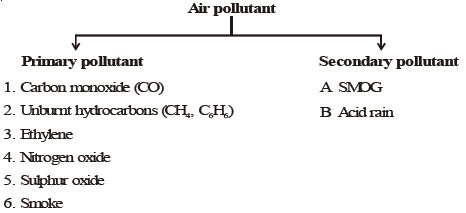
Degradation of air quality and natural atmospheric conditions constitutes air pollution. Air pollutants can be classified into two categories.
Check your grasp
1. Define air pollution.
2. Name any two secondary pollutants.
3. Differentiate between pure air and polluted air.
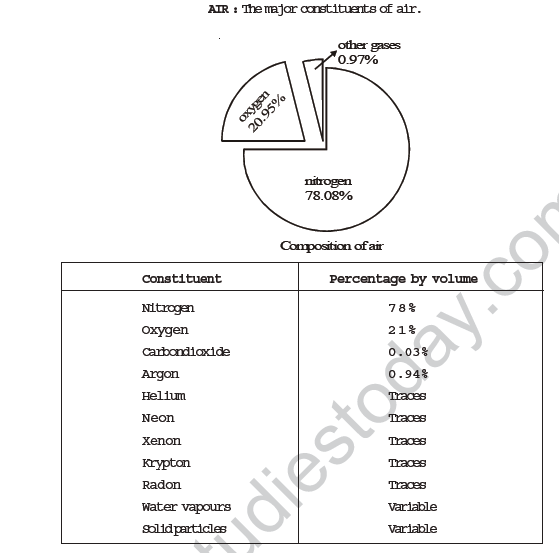
4. What are major constituents of air?
Acid rain : This word was given by Robert Augus, NO2 and SO2 (Nitrogen dioxide and Sulphur dioxide) released from different sources in form of smoke dissolved in atmospheric water vapour to form sulphuric acid and nitric acid (H2SO4, HNO3). These acids came down on earth with rain water called acid rain.
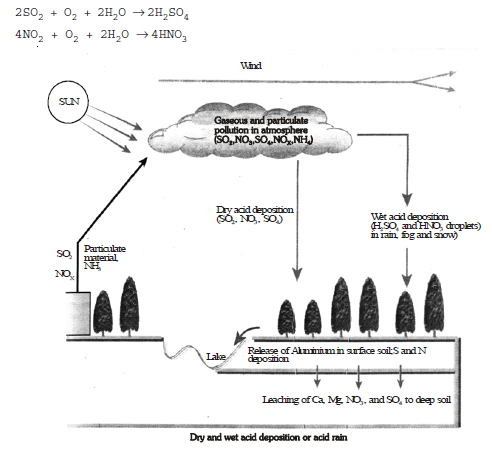
Effects of acid rain :–
1. Due to acid rain acidity of soil increases and fertility of soil decreases.
2. Acid rain corrodes metals, marble, painted surface, leather, fabrics etc.
3. Spots and corrosion of marble due to acid rain is known as stone leprosy.
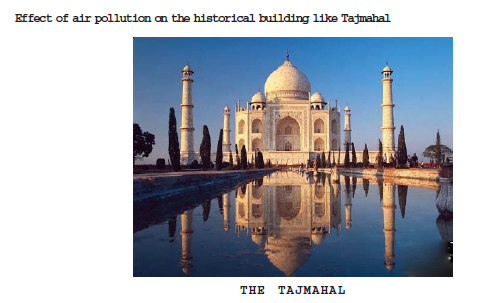
The industries located in and around Agra like rubber processing automobiles, chemical and especially Mathura Oil Refinery have been responsible for producing pollutants like sulphur dioxide and nitrogen dioxide. These gases react with water vapour in the atmosphere to form sulphuric acid and nitric acid. The acid drop down with rain making the rain acidic.
Acid rain corrodes the marble of monument, this process is known as Marble Cancer. Suspended particulate matter such as soot particles emitted from Mathura Oil Refinery has contributed towards the yellowing of marble.
• Supreme court has ordered industries to switch to cleaner fuel like CNG and LPG.
• CNG – Compressed natural gas.
• LPG – Liquefied petroleum gas.
• Use of unleaded petrol vehicle or battery operated vehicle in Taj zone.
Q. What kind of danger does the Tajmahal face from pollution?
GREEN HOUSE EFFECT
Green house effect was predicted by Fourier (1827) and term was coined by Arrhenius
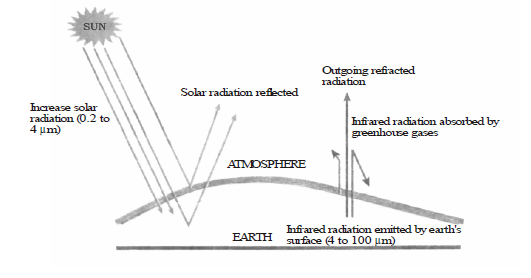
Usually carbon dioxide is not considered as pollutant but its higher concentration forms thick layer above the earth's surface. Checks the radiation of heat from the earth surface because of this temperature of earth surface increases, this is called Green house effect or Global Warming.
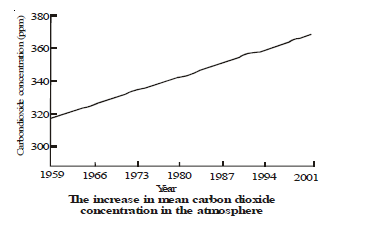
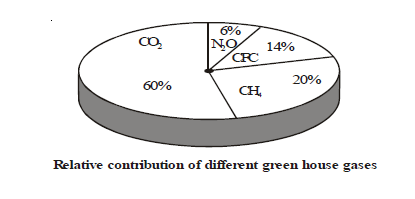
Main green house gases are CO2, CH4, CFC, N2O released from various industries and agriculture units which are responsible for green house effect.
In this phenomenon cover of CO2 layer around the earth allow the short wave length incoming solar radiation to come in but does not allow the long wave length of out going heat radiation from warm surface of earth and keep the earth warm.
The consequent increase in global mean temperature is referred as Global warming.
Approaches to deal with Global warming
Reducing the green house gas emissions by limiting the use of fossil fuel and by developing alternative renewable sources of energy. Like : Wind energy, solar energy.
• Increasing the vegetation cover particularly the forest for photosynthetic utilization of CO2
• Minimizing the use of nitrogen fertilizers in agriculture for reducing N2O emissions.
• Developing substitutes for chlorofluorocarbons.
Please click the link below to download pdf file for CBSE Class 8 Science Pollution Chapter Notes.
Free study material for Science
Chapter 18 Pollution of Air and Water Concepts and Summary for Class 8 Science
Key Concepts and Summary for Class 8 Science Chapter 18 Pollution of Air and Water
Explore reliable chapter overviews for Chapter 18 Pollution of Air and Water tailored for Class 8 learners. Use these structured points to grasp difficult themes and ensure solid preparation for upcoming assessments.
NCERT-Aligned Chapter Summary and Notes
Built using the official NCERT book for Class 8 Science, these notes provide reliable academic guidance. Pair your summary review with our recommended NCERT solutions to master optimal problem-solving approaches.
Next Steps in Your Exam Preparation
Explore our broader library of printable assignments, chapter notes, and mock tests designed to support continuous revision and secure higher marks in CBSE assessments.
FAQs
You can download the teacher prepared revision notes for CBSE Class 8 Science Pollution of Air and Water Notes from StudiesToday.com. These notes are designed as per 2026-27 academic session to help Class 8 students get the best study material for Science.
Yes, our CBSE Class 8 Science Pollution of Air and Water Notes include 50% competency-based questions with focus on core logic, keyword definitions, and the practical application of Science principles which is important for getting more marks in 2026 CBSE exams.
Yes, our CBSE Class 8 Science Pollution of Air and Water Notes provide a detailed, topic wise breakdown of the chapter. Fundamental definitions, complex numerical formulas and all topics of CBSE syllabus in Class 8 is covered.
These notes for Science are organized into bullet points and easy-to-read charts. By using CBSE Class 8 Science Pollution of Air and Water Notes, Class 8 students fast revise formulas, key definitions before the exams.
No, all study resources on StudiesToday, including CBSE Class 8 Science Pollution of Air and Water Notes, are available for immediate free download. Class 8 Science study material is available in PDF and can be downloaded on mobile.