

Download Class 8 Science Concept Summaries: CBSE Class 8 Science Coal And Petroleum Notes
Review targeted revision notes for Class 8 Science with the CBSE Class 8 Science Coal And Petroleum Notes. Built according to official educational guidelines for the 2026-27 academic year, these downloadable summaries for Chapter 05 Coal and Petroleum support daily study and last-minute exam readiness.
Access Chapter 05 Coal and Petroleum Notes and Study Material
Access the complete concept summary PDF for Chapter 05 Coal and Petroleum below. Regular review of these targeted notes builds familiarity with complex Class 8 Science themes and helps secure higher marks in final school evaluations.
CBSE Class 8 Science Coal and Petroleum Chapter Notes. Learning the important concepts is very important for every student to get better marks in examinations. The concepts should be clear which will help in faster learning. The attached concepts made as per NCERT and CBSE pattern will help the student to understand the chapter and score better marks in the examinations.
COAL & PETROLEUM
INTRODUCTION
We use various materials for our basic needs. Some of them are found in nature and some have been made by human efforts. The variety of substances that man gets from earth and nature to meet his basic needs are called natural resources.
Types of Natural Resources :
These are two types namely renewable and non-renewable.

Fossil fuels : Exhaustible natural resources like coal , petroleum or natural gas were formed from the dead remains of living organism (fossils). So , these are called fossil fuels. Coal and petroleum are very important natural resources and play a vital role in modern society. They are found in the earth's crust.
Coal : Coal is a complex mixture of carbon, hydrogen and oxygen compounds. Some nitrogen, sulphur and phosphorus compounds are also present in it. It is found in coal mines deep under the surface of earth.
Occurence of coal : Russia, China, UK. Germany, Africa and Australia have rich deposits of coal. In India, big coal mines are found at Jharia and Bokaro in Jharkhand and Raniganj in West Bengal.
Types of coal :
The different varieties of coal with varying carbon content are given below in table

Formation : It is believed that millions of years ago, the ground below the forests was split open by natural forces such as earthquakes and volcanoes. The forests were buried in the chasms. Thus, the plants had no contact with oxygen. Successive layers of sediments sealed the buried plants. Over millions of years these deposits were subjected to tremendous pressure and heat which finally transformed them into coal.
Carbonisation : The chemical process involved in the transformation of plant matter into coal is called the carbonisation of plant matter.

Destructive distillation of coal : The process of heating coal in the absence of air is called the destructive distillation of coal. Coal contain a number of elements such as carbon, hydrogen, oxygen, nitrogen and sulphur. When coal is heated in the absence of air, a number of products are obtained.
The main products obtained by the destructive distillation of coal are as follows :
(i) Coke (ii) Coal tar (iii) Ammoniacal liquor (iv) Coal gas
(i) Coke : Coke contains 98% carbon. It is porous , tough black and the purest form of coal. Like charcoal, it is a good fuel and burns without smoke. But it is seldom employed as a fuel because it can be put to more valuable use. It is largely employed as a reducing agent in the extraction of metals from their ores, It is also used in making fuel gases like water gas and producer gas.
DO YOU KNOW?
Water gas is an equimolar mixture of carbon monoxide and hydrogen. (CO + H2) Producer gas is a mixture of carbon monoxide and nitrogen. (CO + N2)
(ii) Coal tar : Coal tar is a mixture of different carbon compounds. It is a thick, black liquid with unpleasant smell. The fractional distillation of coal tar gives many chemical substances which are used in the preparation of dyes, explosives, paints, synthetics fibres, drugs, and pesticides. Some of these chemical substances are benzene, toluene, phenol and aniline. Naphthalene balls used to repel moth and other insects are also obtained from coal tar. Bitumen is used in place of coal tar for metalling the roads.
(iii) Ammoniacal liquor : The ammonia produced as a result of destructive distillation of coal is absorbed in water. The aqueous solution of ammonia, i.e. ammonium hydroxide solution , is called ammoniacal liquor. It is used in the preparation of fertilizers such as ammonium sulphate and ammonium superphosphate.
(iv) Coal gas : Coal gas is mainly a mixture of hydrogen, methane and carbon monoxide. The gases present in coal gas are combustible, and hence it is an excellent fuel. It has high calorific value. It was used for lighting houses, factories and streets in Mumbai until 1950. It was also used for cooking until recently.
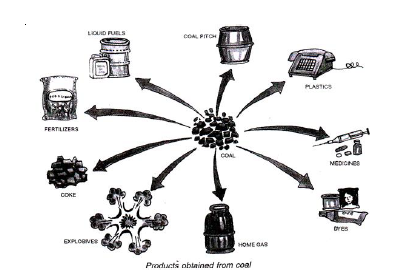
Coal gas was used for street lighting for the first time in London in 1810 and New York around 1820. Now it is used as a source of heat rather than light.
Uses of Coal
• It is used as a domestic and industrial fuel.
• It is used in the manufacturing of fuel gases like coal gas and water gas.
• It is used in the manufacturing of synthetic petrol.
• It is used to make coke which acts as a reducing agent in metallurgy.
• It is used as a source of organic compounds like benzene, toluene, phenol, aniline and anthracene.
Ques. Describe how coal is formed from dead vegetation. What is this process called ?
Ques. Explain why fossil fuels are exhaustible natural resources.
Ques. Describe characteristics and uses of coke.
Ques. Name the petroleum product used for surfacing of roads.
Ques. Write the uses of coaltar.
Petroleum : In the present day world, petroleum is the life line of modern civilization. In fact, the economy of a nation depends to a great extent on its petroleum wealth. That is why petroleum is called the black gold. It is dark coloured, viscous, strong smelling liquid. The name petroleum is derived from petra meaning rocks and oleum meaning oil. It is a natural product which is also obtained from oil wells. The crude oil (petroleum) is a complex mixture of solid, liquid and gaseous hydrocarbons mixed with water, salt and other particles. Thus, the crude petroleum oil is not a single chemical compound, but a mixture of compounds.
Origin of petroleum : It is fossil fuel formed in nature by the decomposition of animal and plant matter which were buried under the earth, millions of years ago.
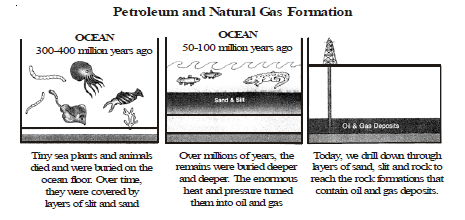
Occurrence of petroleum : Petroleum occurs deep down under the earth between layers of impervious rocks (non-porous rocks). Oil deposits are usually found mixed with water, salt and earth particles. Natural gas occurs above the petroleum oil, under the rock. This is shown in fig.

Refining : Petroleum is a mixture of several hydrocarbons. It is a foul-smelling brown black liquid. It also contain water, salt and rocky materials. It cannot be used in this crude form either as a fuel or as a basic material to produce other useful components. Before being put to use, it has to be purified or refined. The process of separating the various components of petroleum from one another is known as the refining of petroleum. This is done by a process called fractional distillation which is based on the fact that the different components of petroleum have distinctly different boiling points.
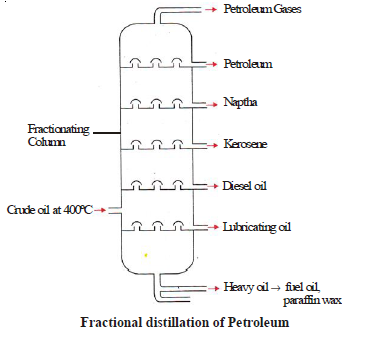
The first oil well was found in Pennsylvania in USA in 1859. In India, first oil well was found in 1867 in Maukam, Assam.
Petroleum Refining in India : There are about a dozen oil refineries in our country. The oil refineries in India are located at Mumbai, Chennai, Mathura, Barauni, Digboi, Guwahati, Haldia, Kochi, Kyyali and Vishakhapatanam. The oldest oil refinery in India is at Digboi in Assam which was established in 1901.
Most of the refining of petroleum and marketing of petroleum products are being done by a government organisation like Indian Oil Corporation Ltd. (IOC). Oil and Natural Gas Commission. (ONGC) is also engaged in exploring new sources of petroleum.
Petrochemicals : The chemicals which are prepared from the fractions of petroleum are called petrochemicals. Some of the important petrochemicals are methyl alcohol, ethyl alcohol , ethylene, benzene, toluene, acetone, D.D.T. and B.H.C.
Use of Petroleum :
• Petroleum products are used as fuels.
• Lubricating oils, and vaseline are used as lubricants.
• Paraffin wax, products of petroleum, is used for manufacturing candles, polishes, waxed paper, water proofing, etc.
• Some of the by-products of petroleum after purification are used in the preparation of medicines, ointments, face creams and cosmetics.
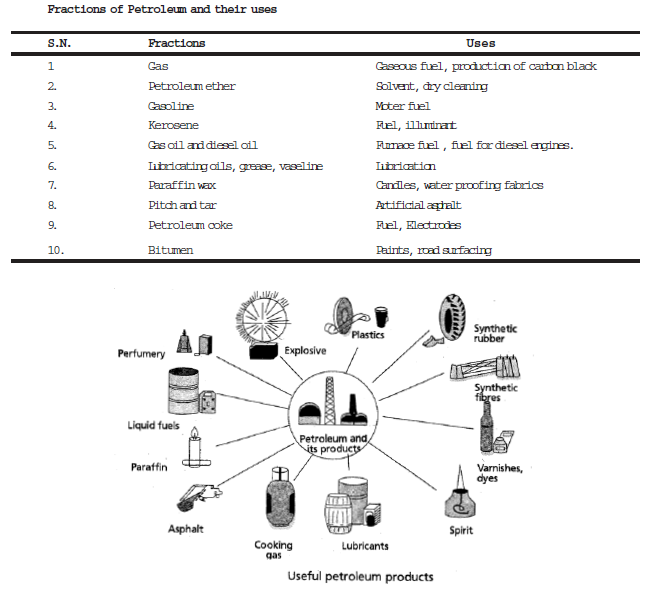
Petroleum gas : It is a mixture of ethane, propane and butane. Its main constituent is butane which burns by giving off a lot of heat. Butane is easily liquefied under high pressure. In the liquid form it is supplied in cylinders and is commonly known as liquefied petroleum gas (LPG). It is a colourless , odourless and inflammable gas. A strong smelling substance called ethyl mercaptan (C2H5SH) is added to LPG to detect the leakage of gas from the cylinder. On being lighted it burns with blue flame. One gram of LPG produces about 50 kJ of heat.
Please click the link below to download pdf file for CBSE Class 8 Science Coal and Petroleum Chapter Notes.
Free study material for Science
Study Material and Revision Notes for Class 8 Science Chapter 05 Coal and Petroleum
Quick Revision Notes: Chapter 05 Coal and Petroleum (CBSE)
Access structured revision notes for Chapter 05 Coal and Petroleum designed in alignment with the latest CBSE curriculum for Class 8 Science. These summaries help clarify core themes and support effective daily study.
Expert Study Material for Class 8 Science
Each chapter summary is structured around standard CBSE textbooks, allowing students to check their understanding and clarify complex ideas early in their revision.
Complete Your Chapter Revision
Follow up your revision by attempting the interactive online Science MCQ test and practice worksheets for this chapter to verify your mastery. All platform resources are free to access.
FAQs
You can download the teacher prepared revision notes for CBSE Class 8 Science Coal And Petroleum Notes from StudiesToday.com. These notes are designed as per 2026-27 academic session to help Class 8 students get the best study material for Science.
Yes, our CBSE Class 8 Science Coal And Petroleum Notes include 50% competency-based questions with focus on core logic, keyword definitions, and the practical application of Science principles which is important for getting more marks in 2026 CBSE exams.
Yes, our CBSE Class 8 Science Coal And Petroleum Notes provide a detailed, topic wise breakdown of the chapter. Fundamental definitions, complex numerical formulas and all topics of CBSE syllabus in Class 8 is covered.
These notes for Science are organized into bullet points and easy-to-read charts. By using CBSE Class 8 Science Coal And Petroleum Notes, Class 8 students fast revise formulas, key definitions before the exams.
No, all study resources on StudiesToday, including CBSE Class 8 Science Coal And Petroleum Notes, are available for immediate free download. Class 8 Science study material is available in PDF and can be downloaded on mobile.