

Official Class 11 Accountancy Revision Material: CBSE Class 11 Accountancy Rectification Of Error Notes
Review targeted revision notes for Class 11 Accountancy with the CBSE Class 11 Accountancy Rectification Of Error Notes. Built according to official educational guidelines for the 2026-27 academic year, these downloadable summaries for Chapter 06 Trial Balance and Rectification of Errors support daily study and last-minute exam readiness.
Chapter-wise Concept Summaries: Chapter 06 Trial Balance and Rectification of Errors
Navigate directly to the revision notes for Chapter 06 Trial Balance and Rectification of Errors using the digital viewer below. Each summary is structured to highlight high-weightage sections, allowing students to instantly access critical definitions and focus on core exam topics.
Introduction
Correcting the errors of accounting by passing journal entry is known as rectification of error.
Error affecting or disclosed by trial balance
1. Errors of additions and subtractions :- wrong totaling and balancing of ledger, totaling of trial wrong totaling of trial balance.
2.Posting at the wrong side of an account :- Instead of debiting amounts by mistake are written in credit.
3. Entering incorrect amount:- Incorrect copying ,Transposing figure( Writing 56 in place of 65), sliding figure (8000 in place of 800), doubling the wrong figure and duplicate posting.
4. Errors of omission:- Not posted in subsidiary accounts, accounts are not opened in the ledger.
5. Wrong posting in the trial balance:- Instead of writing debit side accounts has posted in credit side.
Errors not affecting by trail balance
1. Errors of omission:- Transactions not recorded in books. For example:- goods return to supplier not recorded.
2.Errors of principle:-Disobey of accounting principles, (salary paid to manager) manager‟s accounts are debited.
3.Compensating errors: - Sales of goods to Rani for Rs.100 debited to Rain's account with Rs.10 and Rs.100 cash received for Ajay was credited to Ajay with Rs.10.
4. Incorrect account in the original book: - Insteadof B . Babu‟s accountN.babu‟s account affected by writer.
5. Posting to wrong account: - Instead of writing in purchases book , sales book are opened.
CLERICAL ERRORS
1. Errors of omission: - Forget to write the transaction in books.
Example:
1. Goods worth Rs.5,000 returned by a customer was not recorded in the books.
2. Goods worth Rs.3,000 sold to Anil was not recorded in the books.
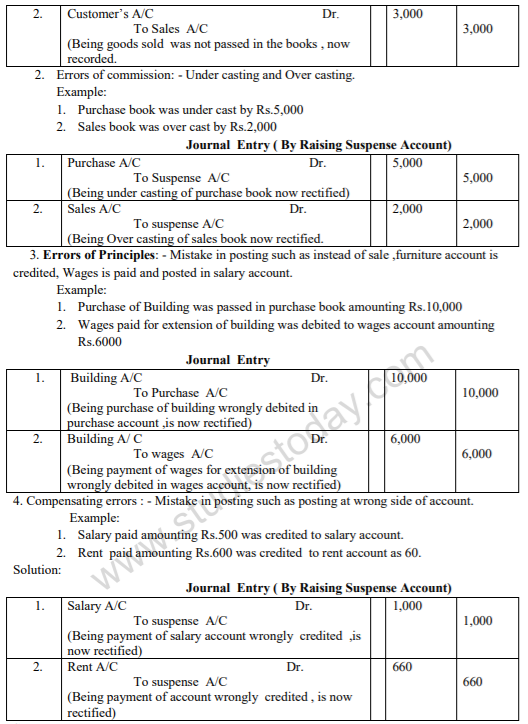
Suspense account
When Trial balance does not agree, the difference of amount will be transferred into suspense account.
Treatment of Suspense account:-When mistakes are detected and rectified, Suspense account will be closed. Balance of suspense account will be transferred in to Balance sheet.
Point to be remembered: (Debit balance of suspense account will be at assets side. Credit balance will be at liabilities side of balance sheet)
Questions:
1. Explain the types of errors.
2. What do you mean by Suspense account?
Illustration:
Pass journal entry for following cases assuming the use of suspense account
1. Under casting in sales day book by Rs.5,000
2. Goods returned By Amit costing Rs.2,000 was not recorded in the books
3. Salary paid Rs.1500 was debited in wages account.
4. Interest due on investment Rs.2, 500 was not recorded in the books.
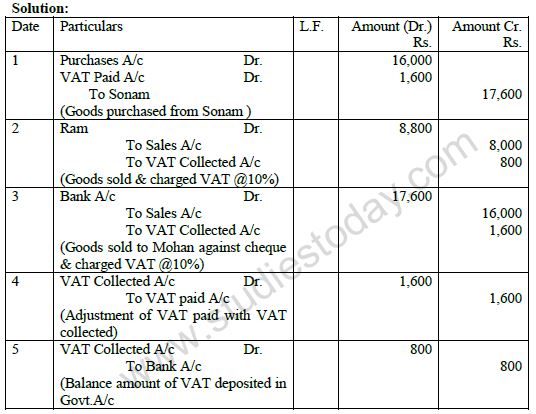
Generally students commit these mistakes, please avoid:
1. Wrong selection in nature of error.
2. Focus on use of suspense account.
3. Do not write single amount in case of fundamental error.
Numerical questions:
Q.1 Pass journal entry for following cases
1. Purchase of Furniture was passed in purchase book amounting Rs.25,000
2. Wages paid for installation of machine posted to wages account amounting Rs.7000
3. Goods worth Rs.15,000 returned to supplier was not recorded in the books.
4. Goods worth Rs.23,000 sold to Anil was not recorded in the books.
5. Commission received from z Rs.2,500 not recorded in books.
Q.2 Pass journal entries for following cases assuming the use of suspense account
1. Under casting in purchase day book by Rs.3,,000
2. Goods returned to Prakash costing Rs.12,000 was not recorded in the books
3. Repair paid Rs.2,500 was debited in Rent account.
4. Interest due on investment Rs.4, 500 was not recorded in the books.
Q.3 Pass journal entries for following cases:
1. Interest paid amounting Rs.600 was credited to interest account as Rs. 60.
2. Salary paid to employee Rs.5,000 was debited to his personal account.
3. Goods purchased from AB limited costing Rs.8,000 not recorded in books.
4. Machinery sold for Rs.6,000 was wrongly credited in Furniture account
A trial balance serves as a statement that compiles the debit and credit balances of every ledger account, including real, personal, and nominal accounts. This ledger summary contains two main columns, namely debit and credit. Assuming all transactions are systematically recorded using double-entry bookkeeping rules and posted accurately, the sum of both columns must match.
Essentially, it acts as a working schedule reflecting the closing credit and debit balances of all accounts. Accountants use this summary sheet to construct the final financial statements of an enterprise. It verifies whether the books are arithmetically accurate. While it confirms mathematical correctness, it does not guarantee that the financial records are completely free of errors.
Objectives of Preparing the Trial Balance
1. Verifying Ledger Balance Accuracy: Preparing a trial balance allows businesses to check if ledger accounts are balanced properly. A matching total indicates that all debit and credit postings have been recorded correctly.
2. Facilitating the Correction of Mistakes: If the debit and credit columns do not equal each other, it signals that an error has occurred somewhere during the accounting cycle. Typical discrepancies include:
- Subsidiary book totals
- Journal postings to ledger accounts
- Incorrect balance calculations
- Wrong transfers of balances to the trial balance
- Errors in summing the trial balance itself
3. Assisting in Preparing Financial Statements: A compiled trial balance acts as the starting point for final accounts. Items of nominal nature (expenses and gains) go to the Trading and Profit and Loss Account, while real and personal accounts (assets, liabilities, and equity) are transferred to the Balance Sheet.
Preparation of Trial Balance
There are three common methods used to prepare a trial balance:
1. Total Method: This technique involves recording the gross totals of both debits and credits for every ledger account into separate columns. Under the double-entry system, the sum of all debit totals must equal the sum of all credit totals.
2. Balances Method: As the most common approach, this method lists only the net closing balance (either debit or credit) of each ledger account. The sum of all net debit balances must equal the sum of all net credit balances.
3. Total-cum-Balance Method: Combining the features of both previous systems, this format uses four distinct amount columns. Two columns are dedicated to gross debit and credit totals, while the remaining two show the respective net balances.
Types of Errors
In the context of financial accounting, errors made while maintaining books can be broadly classified into four main categories. Let us examine each type in detail:
- Errors of Omission: These occur when an entire transaction or a part of a transaction is left unrecorded. Omissions are categorized as either partial (forgetting to post one side of a double entry) or complete (forgetting to record the transaction altogether).
- Errors of Principle: This type of mistake happens when transactions are recorded in violation of standard accounting principles, such as confusing capital expenditure with revenue expenditure. These errors do not disrupt the trial balance's matching totals.
- Errors of Commission: These are clerical errors that involve incorrect calculations, wrong amounts, wrong ledger postings, incorrect balancing, or mistakes in carrying forward totals. These can either cause the trial balance to disagree or remain balanced depending on the nature of the error.
- Compensating Errors: These are multiple independent errors that cancel each other out. Because one mistake counterbalances another, they do not affect the agreement of the trial balance.
Steps to Identify Errors in the Trial Balance
- Verify the addition of both the debit and credit columns.
- Cross-check that cash, bank balances, and discounts (allowed and received) are copied accurately.
- Determine the exact difference between the totals to look for potential omissions.
- Confirm the accuracy of ledger balances and verify their extraction to the trial balance.
- Scan subsidiary books for any mistakes made during carry-forward processes.
- If there is a large discrepancy, compare the current year's figures with those of the previous year.
- Ensure that correct amounts are written on the correct debit or credit sides of accounts.
- If errors cannot be located immediately, transfer the difference to a Suspense Account to keep the books moving. One-sided errors can later be rectified using this account.
Limitations of a Trial Balance
- It fails to discover complete omissions where transactions are never entered into the journal.
- It cannot reveal errors of principle where capital items are treated as revenue, or vice versa.
- It does not identify mistakes where an entry is posted to the wrong personal or nominal account altogether.
- It remains unaffected by compensating errors, since one mistake counterbalances another.
- It fails to highlight situations where the correct value is placed on the proper side but under an incorrect account name, or if the wrong figure is posted symmetrically on both sides.
Format of Trial Balance
| Account Title | L.F. | Debit Balance (Rs.) | Credit Balance (Rs.) |
|---|---|---|---|
| Capital | - | - | |
| Buildings and Land | - | - | |
| Machinery and Plant | - | - | |
| Equipment | - | - | |
| Fixtures and Furniture | - | - | |
| Cash in Hand | - | - | |
| Cash at Bank | - | - | |
| Debtors | - | - | |
| Receivable Bills | - | - | |
| Raw Materials Stocks | - | - | |
| Finished Goods Stocks | - | - | |
| Purchases | - | - | |
| Carriage Inwards | - | - | |
| Carriage Outwards | - | - | |
| Sales | - | - | |
| Sales Return | - | - | |
| Purchases Return | - | - | |
| Interest Paid | - | - | |
| Commission / Discount Received | - | - | |
| Salaries | - | - | |
| Long Term Loan | - | - | |
| Bills Payable | - | - | |
| Creditors | - | - | |
| Advances from Customers | - | - | |
| Drawings | - | - | |
| Total | - | - |
Please click the link below to download pdf file for CBSE Class 11 Accountancy Rectification Of Error Notes.
Free study material for Accountancy
Chapter 06 Trial Balance and Rectification of Errors Concepts and Summary for Class 11 Accountancy
Quick Revision Notes: Chapter 06 Trial Balance and Rectification of Errors (CBSE)
Review targeted chapter notes for Class 11 Accountancy Chapter 06 Trial Balance and Rectification of Errors. Built according to official CBSE guidelines, these summaries highlight high-yield topics frequently tested in school evaluations.
Expert Study Material for Class 11 Accountancy
Built using the official NCERT book for Class 11 Accountancy, these notes provide reliable academic guidance. Pair your summary review with our recommended NCERT solutions to master optimal problem-solving approaches.
Complete Your Chapter Revision
Explore our broader library of printable assignments, chapter notes, and mock tests designed to support continuous revision and secure higher marks in CBSE assessments.
FAQs
You can download the teacher prepared revision notes for CBSE Class 11 Accountancy Rectification Of Error Notes from StudiesToday.com. These notes are designed as per 2026-27 academic session to help Class 11 students get the best study material for Accountancy.
Yes, our CBSE Class 11 Accountancy Rectification Of Error Notes include 50% competency-based questions with focus on core logic, keyword definitions, and the practical application of Accountancy principles which is important for getting more marks in 2026 CBSE exams.
Yes, our CBSE Class 11 Accountancy Rectification Of Error Notes provide a detailed, topic wise breakdown of the chapter. Fundamental definitions, complex numerical formulas and all topics of CBSE syllabus in Class 11 is covered.
These notes for Accountancy are organized into bullet points and easy-to-read charts. By using CBSE Class 11 Accountancy Rectification Of Error Notes, Class 11 students fast revise formulas, key definitions before the exams.
No, all study resources on StudiesToday, including CBSE Class 11 Accountancy Rectification Of Error Notes, are available for immediate free download. Class 11 Accountancy study material is available in PDF and can be downloaded on mobile.