

Official Class 11 Accountancy Revision Material: CBSE Class 11 Accountancy Financial Statements Concepts And Illustrations
Access comprehensive revision notes for Chapter 08 Financial Statements - I using the CBSE Class 11 Accountancy Financial Statements Concepts And Illustrations. Designed to align with the 2026-27 academic syllabus for Class 11 Accountancy, these concept summaries help students streamline their exam preparation and review complex topics efficiently.
Chapter-wise Concept Summaries: Chapter 08 Financial Statements - I
Navigate directly to the revision notes for Chapter 08 Financial Statements - I using the digital viewer below. Each summary is structured to highlight high-weightage sections, allowing students to instantly access critical definitions and focus on core exam topics.
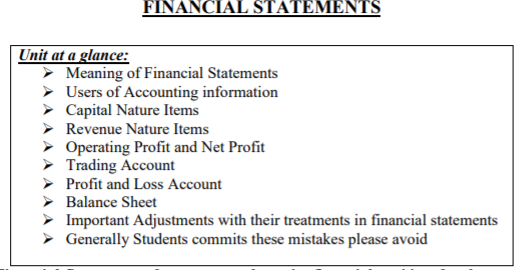
“Financial Statements of a company shows its financial position for the current year”
Meaning : The financial statement provide a summary of the accounts of a business enterprise. Financial statement include two statements include two statements :
i) „Trading and Profit and Loss Account‟ or Income Statement‟ (To Know Profit or loss)
ii) Balance Sheet (To know value of assets and liabilities on the closing date of an accounting period)
Users of Accounting Information :
Internal Users : Management, Employees, Current owners
External Users : Potential Investors Government, Banks/Lenders, Stock Exchange, Suppliers and Trade Creditors, Public.
Capital Nature Items:
Capital Expenditure : Those expenditures which are incurred in acquiring and increasing the value of fixed assets. Ex. 1. Purchase of fixed assets or bringing into existence of fixed assets
2. Expenditure incurred on erection of a fixed asset
3. Payment of goodwill
4. Decrease in long term debts.
5. Capital Receipts : Any receipt from the sale of fixed assets is known as capital receipt.
Revenue Nature items :
Revenue Receipts : Receipts in the business of recuirring nature are called as Revenue receipts ex: rent received, discount received, commission received Revenue Expenditures : Recurring nature of expenditure done in the business which are done in order to earn profit are known as revenue expenditure ex.:
1. Purchase of goods during the year
2. Money spent in acquiring or manufacturing goods like freight, carriage, wages etc. Any expenses for meeting day to day business like wages, salaries, postage etc.
OPERATING PROFIT AND NET PROFIT
After getting Gross Profit from the business. Profit may be divided into two parts :
1 Operating Profit,
2 Net Profit Operating Profit : Operating profit is that profit which is earned through the normal activities of the business. It can be ascertained by deducting aqll operating expenses from the gross profit.
2. Net Profit : Net profit is that profit which is earned after deducting all operating as well as non operating expenses from the Gross Profit.
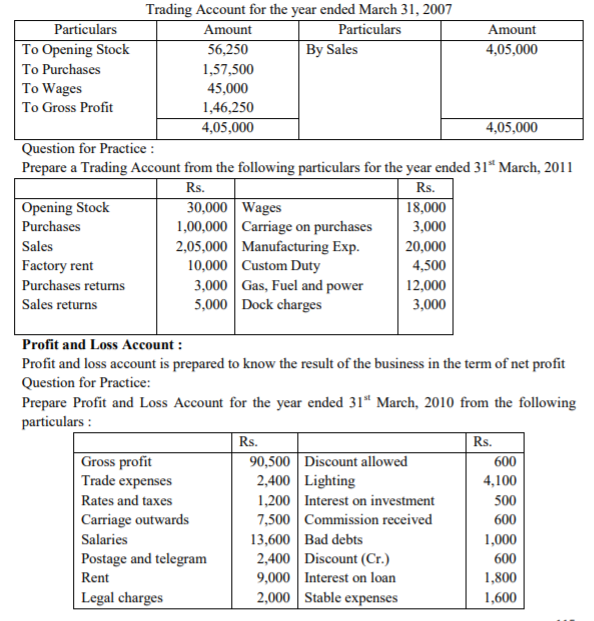
Trading Account : Trading account is prepared to know the result of manufacturing and trading activities : Ex: Prepare A Trading Account from the following particulars for the year ender March 31, 2007.
Opening Stock 56,250
Purchases 157500
Sales 405000
Wages 45000
Please click the link below to download pdf file for CBSE Class 11 Accountancy Financial Statements Concepts And Illustrations.
Financial Statements of Sole Proprietorship: From Complete and Incomplete Records
Meaning
Financial statements are structured reports generated to provide a regular overview of the administrative progress of an enterprise. They outline the current state of business investments and highlight the operational outcomes over a specific time frame.
Users of Financial Statements and Parties Interested in Financial Analysis
Internal Users
- 1. Proprietors: The business owners require clear insights into the firm's profitability and overall financial health. Since they supply the risk capital, analyzing these statements helps them assess operational outcomes, evaluate the final financial status, and gauge future growth potential.
- Proprietors are primarily concerned with:
- Profitability
- Stability
- Solvency
- Earning Capacity
- Financial Position
- Future Outlook of the Business
- Proprietors are primarily concerned with:
- 2. Management: Corporate managers utilize financial evaluations to plan operations and exercise control. This analysis guides critical decision-making, helping to boost efficiency and optimize the enterprise's earnings.
- Management focuses on:
- Profitability
- Liabilities
- Solvency (both short-term and long-term)
- Earning Capacity
- Financial Position
- Future Outlook of the Business
- Management focuses on:
- 3. Employees: Workers show a deep interest in financial evaluations to understand how profitable the firm is. Favorable business outcomes boost job security and satisfaction, as their livelihoods depend directly on these results. Furthermore, in enterprises with profit-sharing incentives, staff members closely monitor how net income is determined.
- Employees are interested in:
- Profitability
- Financial Position
- Future Outlook of the Business
- Employees are interested in:
External Users
- 1. Creditors: Trade creditors and lenders seek information on the company's profitability and solvency. Since they have supplied funds or goods on credit, their outstanding receivables rely heavily on the firm's financial viability. A strong financial standing encourages them to extend further credit.
- Creditors are interested in:
- Profitability
- Financial Position
- Stability
- Creditors are interested in:
- 2. Investors: Prospective and current investors rely on detailed profitability insights before committing capital to a business. Financial statements provide the essential quantitative data they need to make investment decisions.
- Investors are interested in:
- Profitability
- Financial Position
- Stability
- Future prospects of the business
- Growth
- Long-term solvency
- Investors are interested in:
- 3. Government: Public authorities monitor profitability and financial metrics to ensure correct tax assessments.
- Government is interested in:
- Profitability
- Financial Position
- Estimation of National Income
- Growth
- Long-term solvency
- Government is interested in:
- 4. Researchers: Scholars and analysts utilize financial records to conduct economic studies and industry analyses.
- Researchers are interested in:
- Profitability
- Financial Position
- Future prospects of the business
- Growth
- Solvency
- Researchers are interested in:
- 5. Competitors: Rival firms examine these reports to benchmark performance and understand market dynamics.
- 6. Taxation Authorities: Tax departments rely on accounting disclosures to verify statutory tax liabilities.
Limitations of Accounting
- (a) Excludes critical qualitative or non-monetary data.
- (b) Vulnerable to window dressing (manipulation of accounts).
- (c) Ignores changes in price levels (inflation).
- (d) Lacks absolute consistency across different accounting methods.
- (e) Relies on subjective estimates and personal judgments.
- (f) Influenced by a conservative bias (prudence concept).
- (g) Represents a historical "post-mortem" analysis of transactions.
Capital and Revenue Expenditure
Any financial outlay that leads to the acquisition of a fixed asset, enhances an existing asset, or improves the long-term revenue-generating capacity of a business is classified as a Capital Expense. Conversely, revenue expenditure refers to routine operational costs incurred to run the business day-to-day.
Deferred Revenue Expenditure
This term describes an exceptionally large, non-recurring revenue expense whose economic benefits extend beyond the single accounting year in which it is incurred. Rather than debiting the entire amount at once, a proportional share is charged to the Profit and Loss Account each year. The unamortized portion carried forward to future balance sheets is called deferred revenue expenditure.
Trading Account
A Trading Account is designed to show the direct outcome of purchasing and selling commodities. When constructing this statement, general administrative overheads are excluded, focusing solely on direct transactions relating to inventory.
Profit and Loss Account
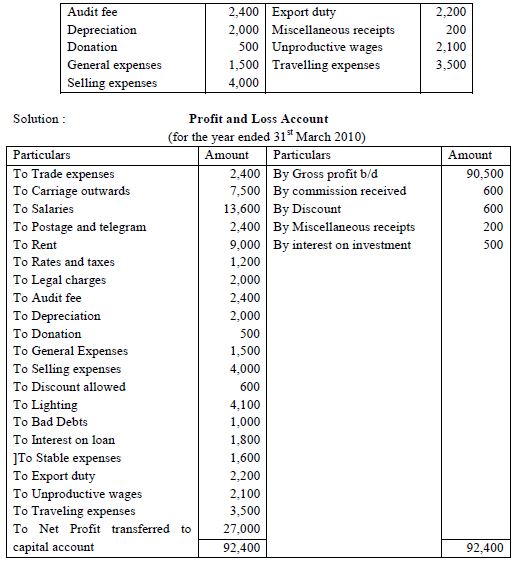
This account compiles all indirect revenues, gains, operating expenses, and losses to determine if the enterprise achieved a net profit or suffered a net loss during the financial period.
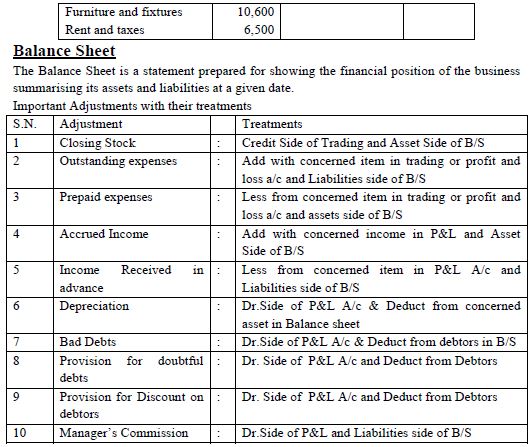
Balance Sheet
A Balance Sheet is a financial statement that summarizes the assets, liabilities, and capital of a business at a specific date. It serves as a snapshot of the firm's financial position. Even though it is derived from ledger balances, its columns are headed as Liabilities (on the left, representing credit balances) and Assets (on the right, representing debit balances).
Closing Entries
At the close of the financial year, nominal accounts representing expenditures and revenues must be closed. This is achieved by transferring their balances to either the Trading Account or the Profit and Loss Account through closing journal entries. For instance, balances of opening stock, gross purchases, sales returns, and direct manufacturing costs (such as carriage inward, freight, octroi, and factory expenses) are transferred to the debit side of the Trading Account.
Trading A/c .............................. Dr.
To Opening Stock A/c
To Purchases A/c
To Sales Return A/c
To Carriage A/c
To Freight A/c
To Factory Expenses A/c
(Being the various nominal accounts transferred to trading account)
To close accounts carrying credit balances - such as sales, purchase returns, and closing stock - we debit these accounts and credit the Trading Account:
Sales A/c .............................. Dr.
Purchase Return A/c .................... Dr.
Closing Stock A/c ...................... Dr.
To Trading A/c
(Being credit balance accounts transferred to trading account)
A resulting gross profit is transferred by debiting the Trading Account and crediting the Profit and Loss Account:
Trading A/c .............................. Dr.
To Profit and Loss A/c
(Being gross profit transferred to profit and loss account)
Conversely, in the event of a gross loss, this journal entry is reversed.
Accrual Concept
Under the accrual basis of accounting, revenues and expenses are recognized when they occur rather than when cash changes hands. Consequently, certain unpaid expenses and uncollected revenues must be incorporated into the ledger at year-end. Making these adjustments is essential to present an accurate and realistic view of the business's finances.
Need and Importance of Adjustments
- To determine the true net profit or loss of the enterprise.
- To ascertain the actual financial standing of the business.
- To reflect the true value of liabilities and assets.
- To incorporate any unrecorded assets and liabilities into the books.
- To account for outstanding expenses and accrued incomes.
- To correct any accounting errors.
- To make appropriate provisions for doubtful debts, depreciation, and tax liabilities.
Adjustments
Ensuring that every financial transaction is properly adjusted is vital for calculating precise profits and evaluating the firm's true financial standing. Outstanding or prepaid expenditures, alongside accrued or unearned incomes, must be adjusted when drafting the final accounts.
Single Entry System
Meaning of Single Entry System
As a non-systematic method of bookkeeping, the single entry system does not record both the debit and credit aspects of every transaction. Typically, only personal accounts of customers (debtors) and suppliers (creditors) are maintained, while real and nominal accounts are generally ignored.
"It is a system of book keeping in which, as a rule, only records of cash and of personal accounts are maintained, it is always incomplete double entry system, varying with circumstances." - Kohler
Features or Characteristics of Single Entry System
- Maintenance of personal accounts only.
- Maintenance of a cash book.
- High reliance on original source vouchers.
- Incomplete and unsystematic records.
- Limited suitability and application.
- Lack of standardized recording rules.
- Determination of estimated rather than absolute true profit.
- Difficulty in preparing standard final accounts.
Advantages of Single Entry System
- Straightforward and simple to operate.
- Highly economical.
- Saves significant bookkeeping time.
- Simplifies the calculation of net profit or loss.
- Often exploited by small businesses to minimize tax liabilities.
- Flexible and adaptable.
- Highly suitable for small-scale proprietors.
Disadvantages of Single Entry System
- Unscientific and incomplete bookkeeping.
- Inability to prepare a trial balance to check arithmetical accuracy.
- Difficult to ascertain the exact value of assets and liabilities.
- Limits year-on-year performance comparisons.
- Generally rejected by tax and regulatory authorities.
- Absence of a reliable internal check system.
- Fails to provide an accurate view of the actual financial position.
- Raises difficulties when applying for bank loans.
Calculations Under Net Worth Method
Formula of Opening Capital
Capital at the end of the year
(+) Add: Drawings made during the year
(-) Less: Additional capital introduced during the year
(-) Less: Net profit achieved during the year
(=) Opening Capital
Formula of Profit
Capital at the end of the year
(+) Add: Drawings made during the year
(-) Less: Capital at the start of the year
(-) Less: Additional capital introduced during the year
(=) Net Profit of the year
Alternatively, this can be written as a direct equation:
\[ \text{Profit} = \text{Closing Capital} + \text{Drawings} - \text{Additional Capital} - \text{Opening Capital} \]
Free study material for Accountancy
Download CBSE Revision Notes: Class 11 Accountancy Chapter 08 Financial Statements - I
Key Concepts and Summary for Class 11 Accountancy Chapter 08 Financial Statements - I
Access structured revision notes for Chapter 08 Financial Statements - I designed in alignment with the latest CBSE curriculum for Class 11 Accountancy. These summaries help clarify core themes and support effective daily study.
NCERT-Aligned Chapter Summary and Notes
Cross-reference your comprehension with comprehensive NCERT solutions for Class 11 to ensure absolute clarity across all sub-topics in this chapter.
Next Steps in Your Exam Preparation
Explore our broader library of printable assignments, chapter notes, and mock tests designed to support continuous revision and secure higher marks in CBSE assessments.
FAQs
You can download the teacher prepared revision notes for CBSE Class 11 Accountancy Financial Statements Concepts And Illustrations from StudiesToday.com. These notes are designed as per 2026-27 academic session to help Class 11 students get the best study material for Accountancy.
Yes, our CBSE Class 11 Accountancy Financial Statements Concepts And Illustrations include 50% competency-based questions with focus on core logic, keyword definitions, and the practical application of Accountancy principles which is important for getting more marks in 2026 CBSE exams.
Yes, our CBSE Class 11 Accountancy Financial Statements Concepts And Illustrations provide a detailed, topic wise breakdown of the chapter. Fundamental definitions, complex numerical formulas and all topics of CBSE syllabus in Class 11 is covered.
These notes for Accountancy are organized into bullet points and easy-to-read charts. By using CBSE Class 11 Accountancy Financial Statements Concepts And Illustrations, Class 11 students fast revise formulas, key definitions before the exams.
No, all study resources on StudiesToday, including CBSE Class 11 Accountancy Financial Statements Concepts And Illustrations, are available for immediate free download. Class 11 Accountancy study material is available in PDF and can be downloaded on mobile.